Making the Case for a Linebacker as the New York Giants' 1st-Round Draft Pick
With the 10th overall pick in the 2016 NFL draft, the New York Giants select…
Let’s be honest: Is your head spinning yet with the countless possibilities for the Giants at No. 10 in this year’s draft?
Mine is, and not a day seems to go by where just when I’m convinced who will be there for the Giants at No. 10, I end up reconsidering.


Creating a mock draft is hard work, and I tip my hat to those who take that task on for a living. With that all said, I tend to look at the draft in terms of best available at a need rather than best available overall.
So in having already looked at the cases for and against taking an offensive tackle and a cornerback in the first round of the draft, let’s now take a look at another position that appears to have a glaring need: linebacker.
Why It Should Be a Linebacker
Let’s start off with some numbers. The following table breaks down how each of the Giants linebackers (those who played in at least 200 snaps on defense) were used.
| Jonathan Casillas | WSL | 230 | 67 | 391 |
| J.T. Thomas | WSL | 215 | 29 | 161 |
| Devon Kennard | SLB | 218 | 80 | 197 |
| Jasper Brinkley | MLB | 211 | 18 | 199 |
| Uani ‘Unga | MLB | 138 | 42 | 261 |
This data tells us a couple of things. First, the Giants' most frequently used pass-rushers last year were Jonathan Casillas and Devon Kennard.
Per Pro Football Focus, Kennard finished with a pass-rush productivity of 8.5 percent, Casillas with a 7.7. The two combined for one sack (credited to Casillas) and just 15 pressures—a contributing factor behind the Giants’ struggling pass rush last year.
Now, let’s look at pass coverage. If you are really a true-blue Giants fan—and I know you are—you probably have nightmares to this day of tight ends enjoying career days against the Giants defense.
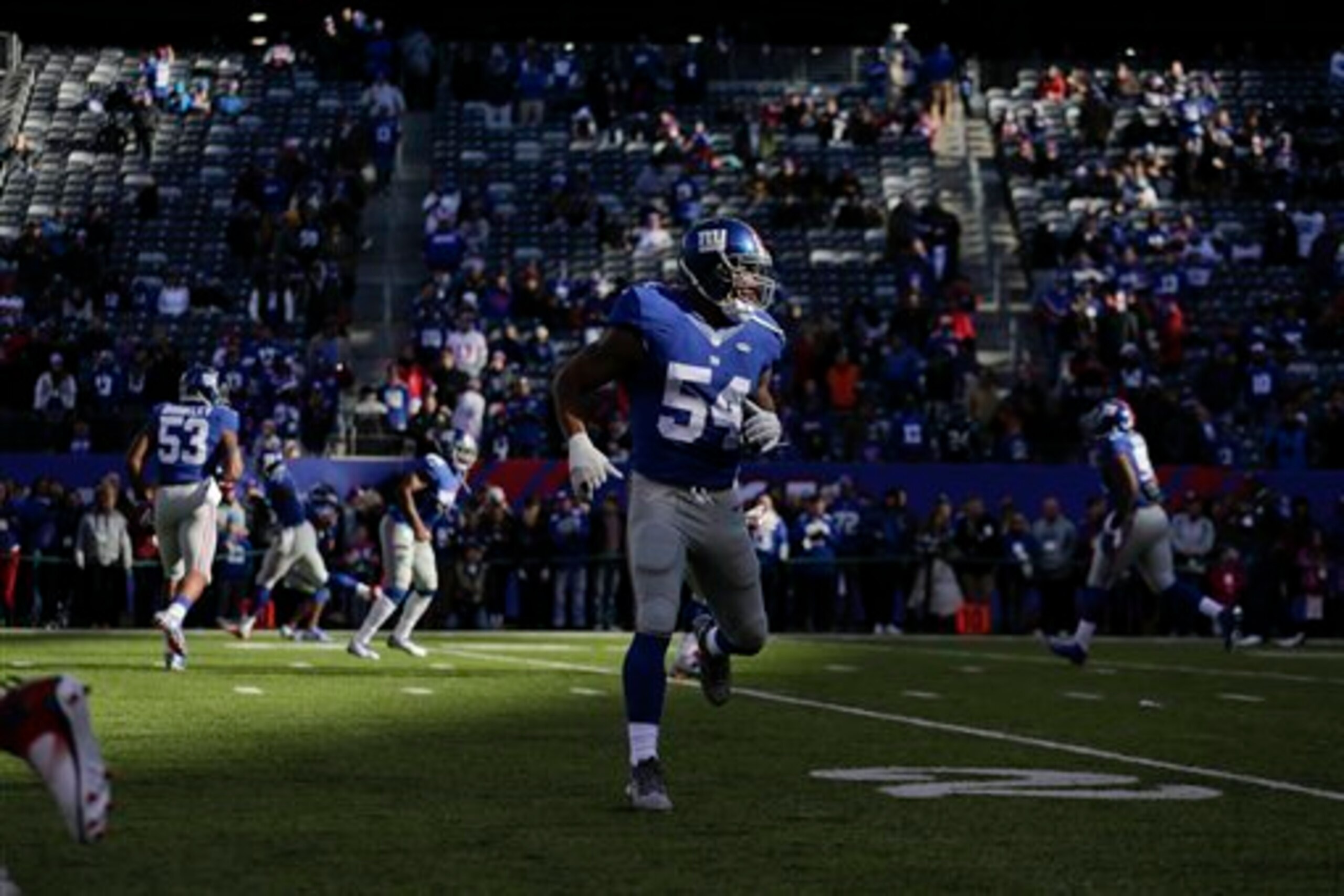
How bad was it? Per Football Outsiders, the Giants defense ranked 27th in the league against opposing tight ends. Tight ends averaged 80.8 yards per game against New York—tops in the league and well over the 55.1 league average. (By contrast, the Carolina Panthers and Denver Broncos ranked first and eighth, respectively, against opposing tight ends.)
The problem? Only two of the Giants linebackers, J.T. Thomas and Casillas, finished the 2015 season with NFL Ratings under 100. (Per Pro Football Focus, Thomas led the Giants linebackers with a 95.0 NFL Rating followed by Casillas’ 98.4 rating.)
Wondering how those ratings stack up against some of the league’s best? Per PFF, K.J. Wright (Seattle) finished with an 82.1 rating in coverage, Thomas Davis (Carolina) with a 86.6, Von Miller (Denver) with a 71.6 rating and Luke Kuechly (Carolina) with a 48.7 rating.
Against opposing running backs who were used as receivers out of the backfield, the Giants weren’t that much better, finishing 21st (48.7 receiving yards per game, which topped the league average of 44 yards per game).
With the league having evolved more toward the passing game, having linebackers who can rush the passer and cover are key. Since 2007, the first year Jerry Reese became the general manager, the Giants pass defense has ranked in the top 15 of the league just four times: in 2007 (11th, 207.3 passing yards per game), in 2008 (eighth, 196.2 yards per game), in 2009 (15th, 214.1 yards per game) and in 2014 (15th, 240.6 yards per game).
While coaches will tell you that stopping the run is key to a defense’s success, that all starts with a solid defensive front, which the Giants appear to have assembled this offseason.
The short and intermediate passes over the middle need to be better defended, and that can start with better play from the linebackers.
There is one other factor worth looking at in the argument as to why it might be a linebacker in the first round: the contract status of the players currently on the roster.
Both of the Giants’ inside linebackers, Jasper Brinkley and Keenan Robinson, are signed to one-year deals. Backup and special teamer Mark Herzlich is entering the final year of his contract.
J.T. Thomas, Uani ‘Unga, Casillas and Kennard are all due to have their respective contracts end after the 2017 season; hence the Giants currently do not have a linebacker under contract past 2017.
If the draft is used to build for the future, it’s high-time that the Giants show a little more love to the linebacker position, rather than leaving it to chance in free agency or Day 3 projects whose chances of working out are 50-50.
Draft a stud, lock him up for four years (five if it’s a first-round pick) and look to build the unit around that player.
Why It Won’t Be a Linebacker
For whatever the reason—maybe it’s the talent, maybe it’s the way they use linebackers in the defense or maybe it’s just a coincidence—the Giants, at least under Reese, haven't had many situations in the first three rounds to where a linebacker still on the board is their “best available” player.
Sure, there was the exception made in 2009 when the team rolled the dice on Clint Sintim, drafted in the second round, from a 3-4 defensive end into an outside linebacker.

Between injuries and Sintim’s struggles to get comfortable in the new role, the experiment was a colossal bust. In retrospect, it was a foolish gamble that would eventually become a pattern of Giants drafts until 2013, when the team stopped trying to outsmart the league by going for projects with potential.
Part of the problem can also be tied into the various personnel groupings that we see on defense, groupings that often lead to either one of the three starting linebackers in the base defense being taken off the field in favor of an extra defensive back or the swapping of personnel, e.g. replacing the middle linebacker with Casillas in coverage situations.
Regardless of the reason, a defense consists of 11 players, at least one of which is going to be a linebacker. To continually cut corners or slap bandages on a position that has proved that it can be vital to the success of a defense is being short-sighted.
What’s more, right now the Giants don’t really have that one guy they can build the unit around, and as the historical stats have shown, it’s hurt the defense.
The X-Factor: Devon Kennard
I mentioned that the Giants don’t really have that one guy they can build the linebacker unit around. I’d be remiss if I didn’t discuss Devon Kennard, who they drafted to potentially be that guy,
Kennard, the starting strong-side linebacker, has yet to make it through a 16-game season. His short NFL career, in fact, has seen him deal with a hamstring (twice) and of course the foot injury that ended his season early last year.
When a player has that kind of injury history to where he can’t be counted on, chances are the front office and coaching staff are going to be a little squeamish about building around that player.
A recent example of that is cornerback Prince Amukamara, a solid cornerback and first-round draft pick whose struggles with staying on the field sent the Giants in another direction.
For this reason, and the ones previously mentioned about the depth and their contract statuses, it might behoove the Giants to make an investment in a player who can become the centerpiece of this unit.
And the Pick Is…
While the need appears to be greater at inside linebacker given the one-year contracts of Brinkley and Robinson, it would be surprising if the Giants are even thinking about taking an inside linebacker, such as Reggie Ragland, early in this draft.
The inside linebacker is the one that usually comes off the field for the Giants, who prefer that their inside guy is more of a thumper against the run.
If New York is looking for the best value at outside linebacker and if Myles Jack won’t be there at No. 10—which he probably won’t, according to the mock drafts posted by NFLDraftScout.com analysts (h/t CBSSports.com)—the choice at linebacker would have to be Darron Lee (6’2”, 228 pounds) of Ohio State. NFLDraftScouts.com (h/t CBSSports.com) rates Lee as the 12th-best overall prospect and the second-best outside linebacker behind Jack.
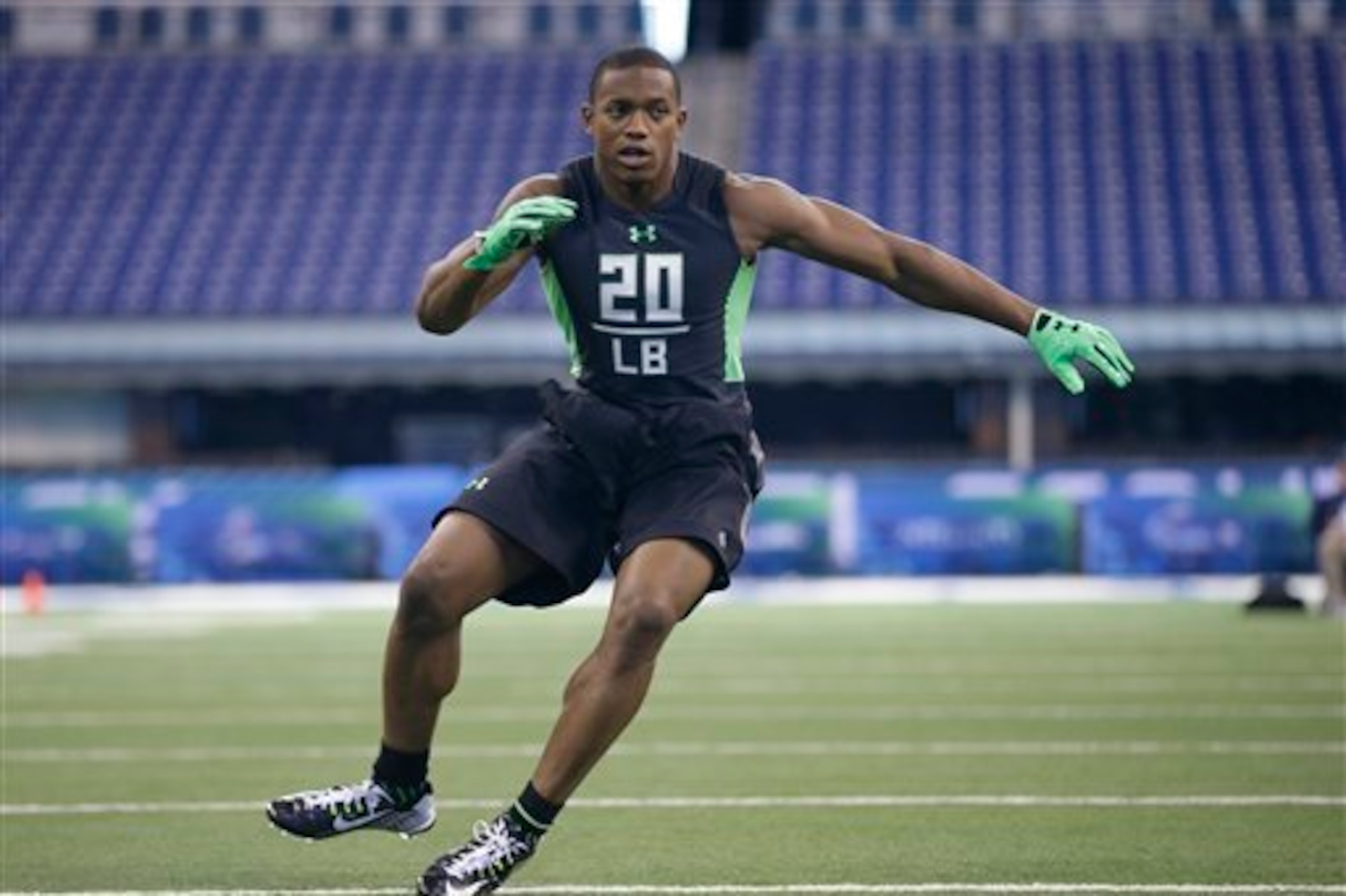
Besides coming from a 4-3 defense, Lee is a converted safety who, per his college bio, posted 147 tackles (90 solo), 27.5 tackles for a loss, 12 sacks and three interceptions in the last two seasons.
As Dane Brugler of NFLDraftScout.com (h/t CBSSports.com) notes, Lee played the “walkout” linebacker role for the Buckeyes, a role that the Giants have attempted to fill with players such as Damontre Moore and, more recently, with Kennard, both of whom came from a 3-4 system in college.
It’s time for the Giants to stop cutting corners at this position, and it’s also time to stop investing in long-term projects, especially in the first three rounds.
While Lee is still relatively new to the outside linebacker position and could probably stand to add some bulk to his frame, he seems to have a solid skill set that the coaching staff can further develop into a potential cornerstone at the position.
Patricia Traina covers the Giants for Inside Football, the Journal Inquirer and Sports Xchange. All quotes and information were obtained firsthand unless otherwise sourced. Advanced stats courtesy of Pro Football Focus.
Follow me on Twitter @Patricia_Traina.
.jpg?w=2560 "LA Premiere of \"Chad Powers\"")