10 Most Difficult College Football Players to Replace in 2016 Season
Out with the old, in with the new. If only it were that easy.
The 2015 college football season is complete, and the NFL early-entry deadline has come and gone, leaving teams with a true sense of what they've lost and what they have to work with. Barring an unexpected transfer or a freak injury, the holes have been identified and the task is set for trying to replace those lost stars.
A plan should have already been in place as to how to address these losses, though some players aren't so easily replaceable. Their performance in 2015 (and possibly earlier) made it so just plugging in a backup or a newcomer isn't going to do the trick.
Here's a look at 10 of the toughest players to replace for the 2016 season, along with some insight into how their former teams plan to deal with their absence.
Roberto Aguayo, K, Florida State
1 of 10
You don't truly realize how important a kicker is until he makes a mistake. Or until he turns pro following three of the most productive seasons ever at that position.
Roberto Aguayo was so consistent and reliable during his Florida State career that he almost made fans forget about the school's horrible luck when it came to late-game field goals. The school that was often referred to as "Wide Right U" because of several missed clutch kicks in big games now had a player who in his freshman year (2013) almost personally outscored the Seminoles' opponents.
That earned Aguayo the Lou Groza Award as the nation's best kicker. His 69 field goals (on 78 attempts) and 405 points are both second in school history, only because career leader Dustin Hopkins (88 field goals, 466 points) kicked at FSU for four seasons.
FSU now will turn to Ricky Aguayo, Roberto's younger brother, a freshman early enrollee.
Tyler Boyd, WR, Pittsburgh
2 of 10
Pittsburgh has produced some mighty good NFL-caliber receivers over the past 15 years, including Antonio Bryant and Larry Fitzgerald. But neither of those standouts was as integral to his team's offense as Tyler Boyd was in 2015.
The 6'2", 200-pound junior hauled in 91 catches for 926 yards and six touchdowns last season. Pitt's next five most targeted players combined for 89 receptions.
He was also the Panthers' second-leading rusher, with 349 yards on 40 carries, as they tried to get the ball in his hands as often as possible.
With Boyd turning pro early, Pitt must hope Dontez Ford (who averaged 19.4 yards on 26 catches as a junior) can go from just a deep threat to one who can handle every route.
Trevone Boykin, QB, TCU
3 of 10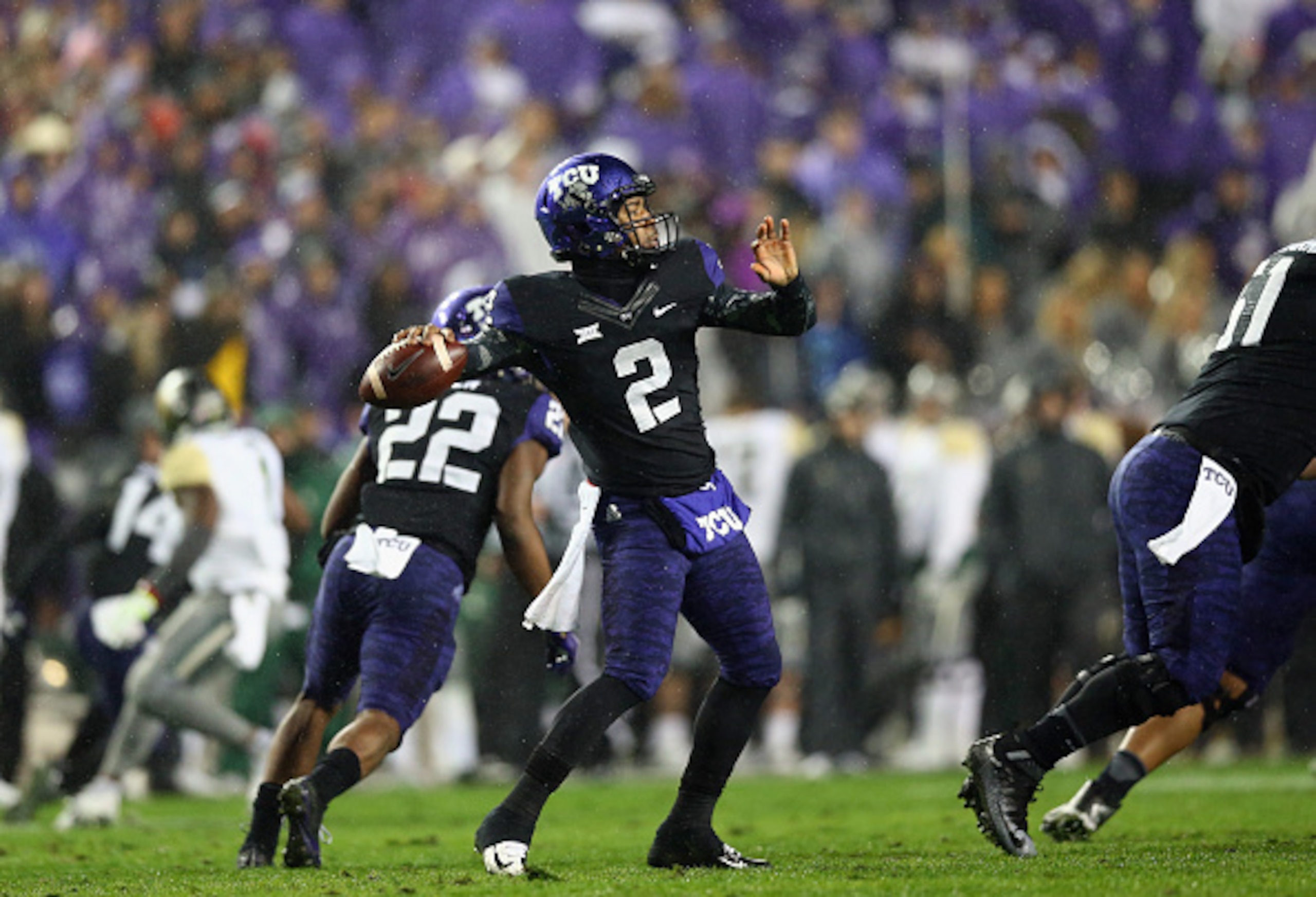
The TCU offense was in need of a major kick in the pants heading into 2014, which prompted coach Gary Patterson to bring in a few fresh faces in co-coordinators Sonny Cumbie and Doug Meacham. But the real key to the Horned Frogs becoming an offensive juggernaut was getting Trevone Boykin to harness his many talents into one position.
Boykin responded with two amazing seasons at quarterback, with nearly 8,800 yards of total offense and 82 total touchdowns in 2014 and '15. It wasn't just his numbers that made him so essential to TCU's rise as it was his overall presence—the confidence he exuded after seeming unsure of himself during his first two years.
This manifested itself in a calm and cool demeanor no matter what situation TCU was in, including several times in 2015 when the Frogs' injury-ravaged defense had put the team in an early hole on the scoreboard.
And now the Frogs are basically starting over at that position, with Boykin graduating along with backup Bram Kohlhausen. Foster Sawyer did not impress in his time on the field, but TCU will have former Texas A&M quarterback Kenny Hill available after he sat out the 2015 season.


Ezekiel Elliott, RB, Ohio State
4 of 10
Ohio State loses more top talent than any other team in the country because of the combination of graduation and nine underclassmen declaring for the draft. The Buckeyes' depth is such that they're well-prepared to fill in most of their holes, with one glaring exception.
Ezekiel Elliott was far and away OSU's most productive offensive player last season, so much so that his lack of use in some games became a bigger story than how he did when given the ball. He ran for 1,821 yards and 23 touchdowns in 2015, giving him back-to-back 1,800-yard seasons, yet there were games when he'd hardly have his name called.
OSU gave Elliott only 12 carries in its lone loss, at home to Michigan State—a game plan that Elliott ripped afterward while also announcing his intention to turn pro. Not surprisingly, he had 30 carries the following week and ran for 214 yards and two TDs against Michigan. He then wrapped up his junior season with 27 rushes for 149 yards and four scores in the Fiesta Bowl.
Elliott's departure was expected, but OSU didn't exactly get a replacement set up with key experience during the season. The top returning rusher, not including quarterback J.T. Barrett, is Curtis Samuel, who had 17 carries as a sophomore.
"Replacing the talents of a star running back such as Ezekiel Elliott might take more than one player for Ohio State," Bleacher Report's Justin Ferguson wrote.
Jared Goff, QB, California
5 of 10
Where would California be without Jared Goff? We might find out in 2016.
The likely first quarterback taken in the upcoming NFL draft, Goff is almost single-handedly responsible for the Golden Bears' jump from 1-11 in his freshman year to 8-5 in 2015. As a junior, he threw for 4,719 yards and 43 touchdowns, both of which are Pac-12 Conference records, and he finishes his career ranked 26th in FBS history with 12,195 passing yards.
Goff's play helped make up for an underperforming run game as well as a defense that—though much improved from the year before—still ranked 109th in the country.
Cal coach Sonny Dykes regularly kept Goff in games even when the outcome wasn't in doubt, resulting in only three appearances and 18 total passes (17 of which game in one game) for possible successor Chase Forrest.
Tom Hackett, P, Utah
6 of 10
If you don't think punters can be irreplaceable, you didn't watch Tom Hackett during his time at Utah. Otherwise, you'd have seen how this Australian wizard managed to pinpoint kicks so well that he became a rockstar.
He's also a legend, of sorts, as the Pac-12 named him to its All-Century Team while he was still playing.
Hackett became just the second player in FBS history to win the Ray Guy Award twice in his career, doing so in both 2014 and 2015. He was a unanimous All-American as a senior, averaging 47.95 yards on 61 punts while placing 24 of those inside the 20-yard line and 11 inside the 10.
Utah led the nation in net punting, using that control of field position to get to 10 wins for the first time since joining the Pac-12 in 2011. But with Hackett graduating, the only punter left on the roster is Jake Kane, a walk-on who has only participated on the scout team.
Hunter Henry, TE, Arkansas
7 of 10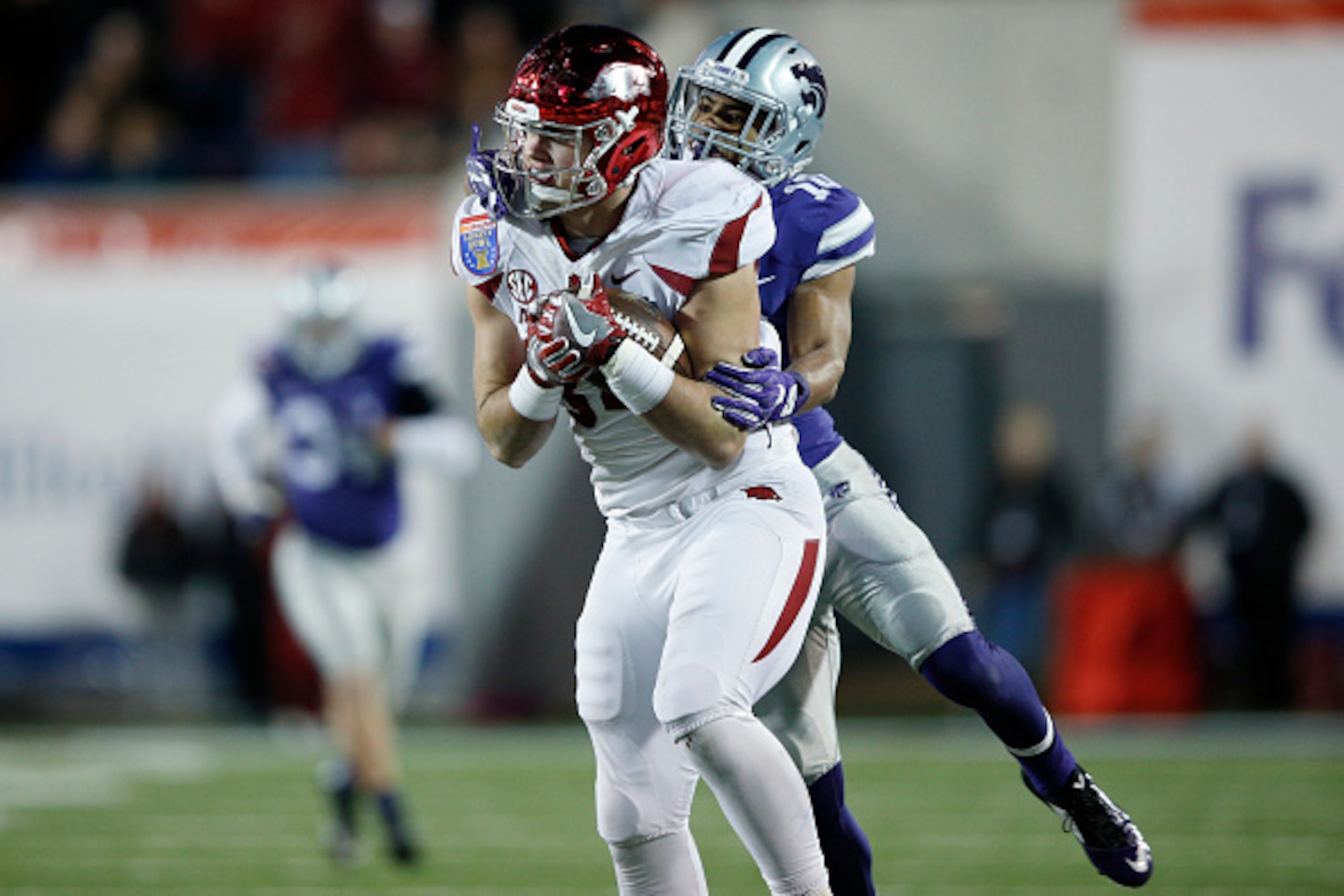
The NFL loves its tight ends who can impact both the run game and passing attack, though it will take what it gets from the college ranks, where most players at that position focus on one or the other. That is, unless they come from Arkansas, where Bret Bielema has built a cottage industry out of do-it-all tight ends.
Even with that history, though, Hunter Henry isn't the kind of player who's easily replaced.
The consensus All-American (who might have been unanimous had the FWAA picked a tight end) had 51 catches for 739 yards during his junior year, giving him 116 for his career. That came from a 6'5", 253-pounder who has run a 4.68-second 40-yard dash, per NFL Draft Scout.
Guys that big shouldn't be able to move that fast. And even if they do, they shouldn't also be so adept at run blocking, which Henry showed throughout his career, as Arkansas had four 1,000-yard rushers over the last three seasons.
Now the task of being an all-purpose tight end falls to 6'6", 255-pound Jeremy Sprinkle, who had 27 catches and six touchdowns as a junior.
Jalen Ramsey, CB, Florida State
8 of 10
It felt like Jalen Ramsey played every position in the secondary at some point in his career, sometimes more than one in the same game. But no matter where the Seminoles put him, he got the job done.
Ramsey started as a freshman in 2013 both at cornerback and free safety. In 2014, he shifted to the "Star" position. He was moved back to corner this past fall, making a seamless transition from a rover/hitter to a blanket cover man.
He finished his career with 181 tackles, 23 pass breakups and three interceptions.
Long pegged as one of the top defensive back prospects in the 2016 draft, Ramsey's early departure was in the making for a long time. But that doesn't make the task of replacing someone who did so much any easier.
FSU will likely turn to Tarvarus McFadden, Ramsey's backup at the boundary corner in 2015, though McFadden isn't expected to be able to bounce around to other positions as easily.
A'Shawn Robinson, DE, Alabama
9 of 10
Alabama's perpetual dominance on the recruiting trail has made it so there's no shortage of top-tier prospects waiting in the wings to replace departing stars. The Crimson Tide were shuffling out former 5-star players with their third string during the national championship game, so don't worry about their ability to reload.
Finding someone to fill A'Shawn Robinson's spot on the defensive line isn't an issue. Having that person be as physically imposing, however, will take some work.
The 6'4" Robinson played defensive end at 312 pounds as a junior, which is bigger than most NFL interior defensive linemen, yet he had the swiftness and agility of a true edge-rusher. He also looked well beyond his years—not like someone who has yet to turn 21.
"You can’t convince me that A'Shawn Robinson isn’t a 45-year-old superhero," Bleacher Report's Adam Kramer tweeted during the lead-up to the Cotton Bowl.
Based on what Alabama's depth chart says, leading sack man Jonathan Allen is Robinson's replacement at end, but Allen is 283 pounds. There isn't anyone on the Tide's roster with the same size and physical skills as Robinson.
Scooby Wright, LB, Arizona
10 of 10
Scooby Wright didn't make the Arizona defense great; he kept it from being really bad. That is what it became when the winner of three national Defensive Player of the Year awards from 2014 limped off the field during the first quarter of the Wildcats' 2015 season opener.
Arizona ranked 115th in total defense and 106th in scoring defense this past season, a direct result of only having Wright for one full game and brief pieces of two others in his junior year. Minor knee surgery kept him out two games. Then a foot injury suffered in his return sidelined Wright until the Wildcats' bowl game.
Healthy for the first time all year, Wright had 15 tackles, two sacks and 3.5 tackles for loss. He then declared pro almost immediately after the New Mexico Bowl, leaving Arizona in the same situation it was for most of 2015.
Wright's most likely replacement is Cody Ippolito, who would have stepped in when Wright was injured had he not tore an ACL just before the season opener.
Follow Brian J. Pedersen on Twitter at @realBJP.
_0.png?w=2560)


.jpg?w=2560 "Injury-stricken Seahawks signing veteran RB")
.jpg?w=2560 "2 NFL Officials Suspended")
.jpg?w=2560 "Viral Rams Coach Vid 🖕")



.jpg?w=2560 "Mahomes' Wife Trolls Kubiak 💀")