

Teams look to rebuild for the future. They scour the Association for win-now talent in hopes of vaulting into the championship discussion. Contract situations get messy. Players underachieve. They overachieve. Developing prospects make certain teammates expendable. Feelings get hurt.
Chatter has yet to reach its apex with the Feb. 18 deadline still weeks away, but there are plenty of recurring rumors that figure to shape how this year's cutoff date unfolds.
We will let this batch of scuttlebutt dictate how we determine the league's biggest trade chips. Players or teams must in some way be linked to specific reports or sourced teardowns. We will not be haphazardly plucking out the NBA's best players and citing them as valuable trade assets. That wouldn't be fun.
Stock statuses are determined by looking at a player's performance in 2015-16 only and are also based on how much he can get his team in return relative to his previous value.
Honorable Mentions
1 of 8
Brooklyn's Not-So-Big Three
After dismissing head coach Lionel Hollins and reassigning general manager Billy King, the Brooklyn Nets are prime candidates to sell off talent in search of picks, prospects and some general framework for the future—so long as you don't interpret owner Mikhail Prokhorov's public vision as gospel.
Prokhorov explained his outlook to reporters, per ESPN.com's Mike Mazzeo. "Our approach helped us reach the playoffs three seasons in a row, but we have failed [to win a title], and it's important for us to go [further]," Prokhorov said. "That's why we need a small reset for this year, and I hope we will be back as a playoff team and as a championship contender. It's my only goal."
Assuming that Prokhorov is just trolling us, Brooklyn's three most prominent assets should be ripe for acquiring. The states of their stocks are as follows:
- Joe Johnson (Stock: ↓): Even as an expiring contract, Joe Johnson is basically immovable. No team has the financial clout to absorb his $24.9 million salary, and Brooklyn, while interested in moving Johnson, per ESPN.com's Zach Lowe, should balk at any proposal that has it taking back long-term deals.
- Brook Lopez (Stock: ↑): Hollins did not berate the fun out of Brook Lopez. His rebounding percentages slightly improved under Hollins' watch, and he joins Anthony Davis as the only two players averaging 20 points, nine rebounds and two blocks per 36 minutes. Lopez is in the first season of a three-year deal that will pay him more than $63 million, making him difficult to unload. But he a rising 27-year-old and an All-Star at his position. There will be interest if the Nets start fielding calls.
- Thaddeus Young (Stock: ↑): If Thaddeus Young could shoot threes, he and Paul Millsap would be best friends. Still, owed just $36.2 million through 2017-18, with a player option worth $13.8 million for 2018-19, Young is a blockbuster-level acquisition. This is the fourth consecutive season that he has averaged 15 points, six rebounds and 1.5 steals per 36 minutes, a streak matched only by DeMarcus Cousins, LeBron James and Millsap.
DeMarcus Cousins, Sacramento Kings (Stock: ↓)
Speaking of Cousins...this is a "his stock is so high, the Kings aren't going to trade him, so don't bother asking" honorable mention.
You're welcome for the heads up, eager general managers.
The Kings are just two games off the Western Conference's No. 8 seed and haven't been to the playoffs since 2006. There is no way they engage in talks for their best player and lone All-Star now.
If they did, they would ask for the following: the world.
As yours truly previously noted, Cousins is clearing 25 points, 10 rebounds and 2.5 assists per 36 minutes for the third time and isn't even 26 years old. Kareem Abdul-Jabbar is the only other player to do the same.
So, yeah, the world.
Ryan Anderson, New Orleans Pelicans
2 of 8
Stock: ↑
New Orleans Pelicans head coach Alvin Gentry is going out of his way to ward off the vultures that are circling Ryan Anderson.
As Gentry told USA Today's Sam Amick of the Anderson rumors, "We like Ryan on our team. He and AD really complement each other. ... And as I said, we have not made one [trade] call about him, but we've got a ton of calls that have come in about him."
Anderson and Anthony Davis most definitely complement each other. The Pelicans are outscored by 0.5 points per 100 possessions when they share the floor, but that ranks as one of the team's best pairings among two-man combinations to see at least 100 minutes of court time, and it's nearly 10 times better than New Orleans' overall net rating of minus-4.8.
It's also more than nine times better than the Pelicans fare with Davis and Omer Asik, the latter of whom is on a cap-clogging five-year deal that all but ensures Anderson prices himself out of New Orleans' range.
Yes, Anderson's player efficiency rating has been higher. And sure, he's shot better from three-point range in the past. There is even a certain level of danger that comes with trading for him; his $8.5 million salary is incredibly reasonable, but he could command twice as much annually in free agency.
He is shooting better than 39 percent on spot-up triples and joins Kevin Durant, Kawhi Leonard and Dirk Nowitzki as the only Western Conference forwards averaging 18 points and seven rebounds per 36 minutes with a three-point success rate north of 36 percent.
Just 27 years old, Anderson has a game that will adequately age. He doesn't finish at the rim particularly well but can collapse defenses off the dribble, and his outside acumen is ideal for offenses with a post-up big and/or ball-dominant point guard.
Incumbent teams must craft defensive schemes around his slow-to-react half-court gaffes, but neither that nor his impending free agency should be enough to scare off suitors. Acquiring Anderson's Bird rights poses value in itself, and he instantly raises the offensive bar for any contender.
Tyson Chandler, Phoenix Suns
3 of 8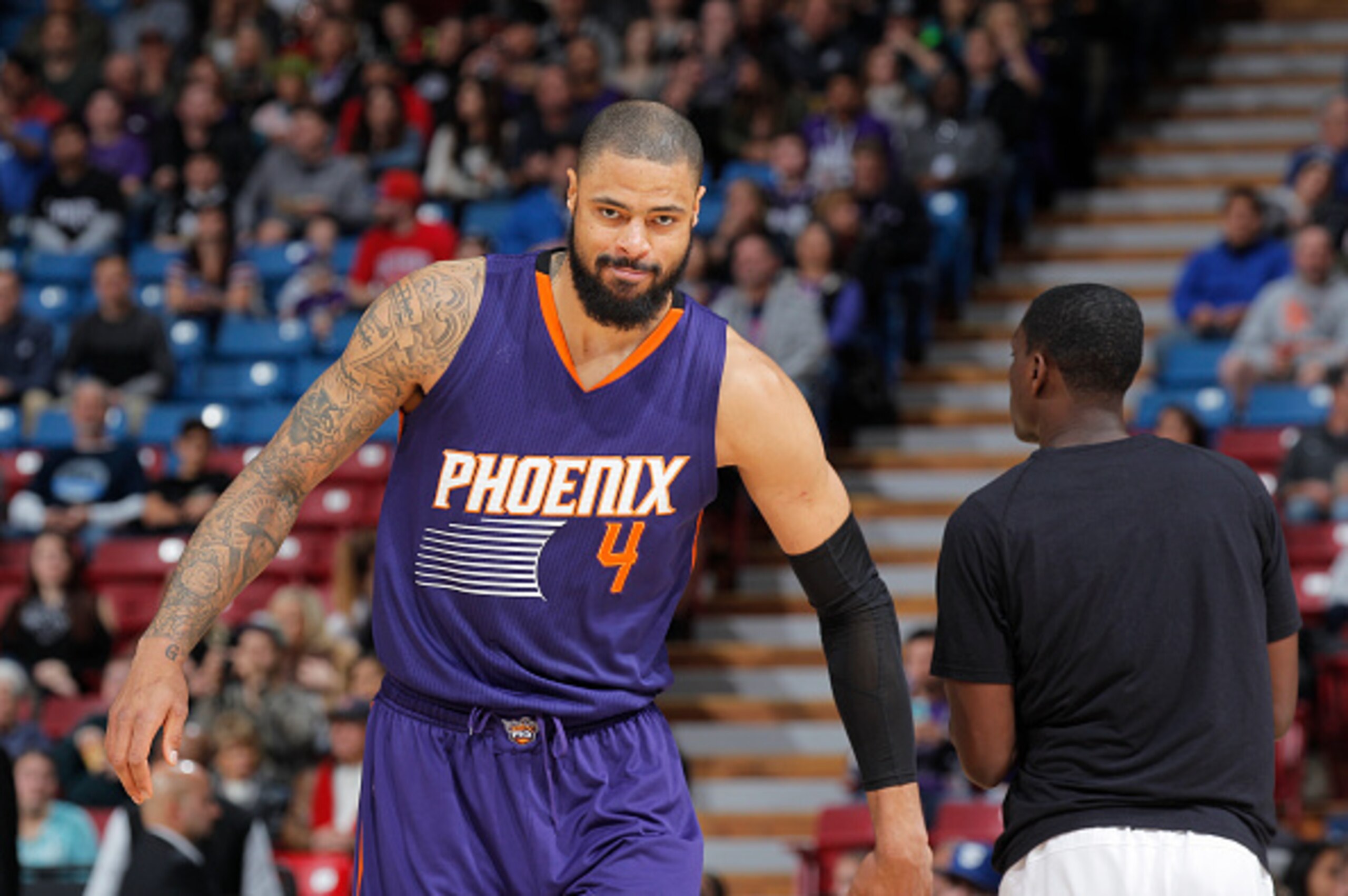
Stock: ↓
Tyson Chandler isn't lighting the rumor mill on fire in the same way that a certain disgruntled teammate is, but the Phoenix Suns' swift, mostly predictable implosion thrusts him into the "Common Sense Trade Chips" category.
"We are looking at a number of things between now and the trade deadline," general manager Ryan McDonough told Arizona Sports 98.7 FM's Burns and Gambo show (via Bright Side of the Sun's Dave King). "We obviously need to make some changes."
Phoenix had little reason in the first place to sign a 33-year-old Chandler to a four-year, $52 million contract. He has never been more expendable this side of Eric Bledsoe's season-ending surgery and the team's defunct playoff hopes.
The issue for the Suns is actually moving him.
Suitors won't be chomping at the bit to pay Chandler an average of $13 million through his 36th birthday. He is far from durable, losing minutes to Alex Len and Jon Leuer, shooting under 55 percent for the first time since 2004-05 and registering the second-lowest PER of his career.
Chandler's decline is only going to get more pronounced as he ages. He is already unable to function at a high level within a fast-paced offense, and the Suns, a bottom-10 defensive unit overall, are much worse with him jumping center.
Moving him less than a full season into his new deal, without accepting a horrid contract in return, might prove impossible.



Brandon Jennings, Detroit Pistons
4 of 8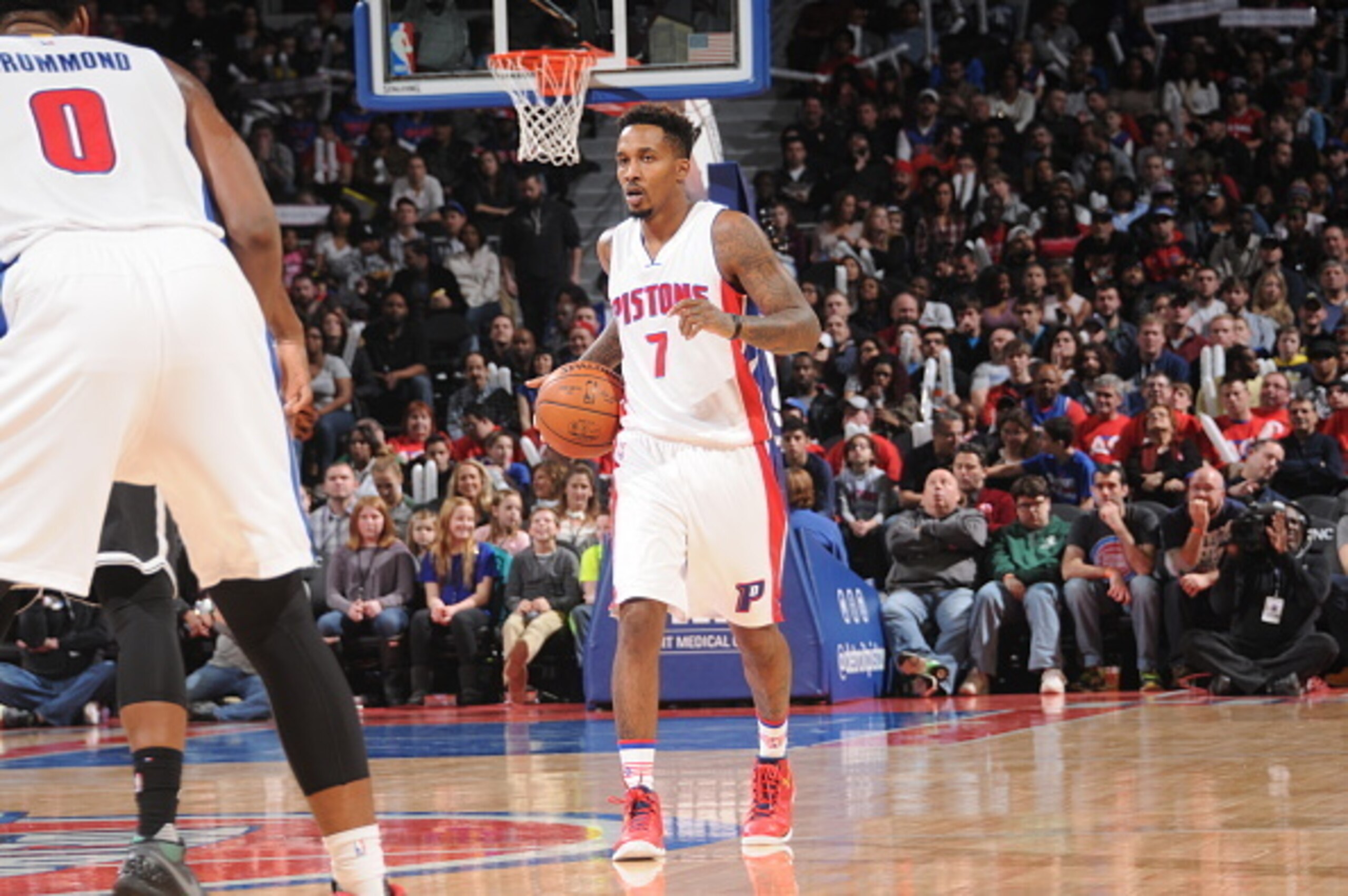
Stock: ↑
Brandon Jennings may be available.
Counterpoint: Brandon Jennings may not be available.
Stan Van Gundy, head coach and president of the Detroit Pistons, doesn't really know.
"Our plan right now is that Brandon can help us make a playoff push," he said, per Pistons.com's Keith Langlois. "That's our plan right now. If something changes in the next five weeks, then we'll look at it. But right how he's a very good player who can help us. And that's the only way we’re looking at it."
Jennings is less than 10 games into his return from an Achilles injury and on pace to notch the second-worst effective field-goal percentage—the combined measurement of two- and three-point accuracy—of his career. But his cap-friendly expiring contract works for teams pining after a short-term punch that doesn't jeopardize long-term flexibility.
Though he's shooting under 30 percent on catch-and-shoot threes this season, Jennings buried 41.7 percent of his standstill deep balls in 2014-15—a stark improvement over his 31.3 percent clip in those situations for 2013-14. His shot selection remains far from refined, but he is already a ridiculous offensive plus in Detroit and no longer needs to be the primary ball-handler.
Acquiring Jennings is by no means a move that shifts fortunes in an entirely different direction. But as far as rumor-mill fixtures go, his value as a secondary floor general is on the rise.
Terrence Jones, Houston Rockets
5 of 8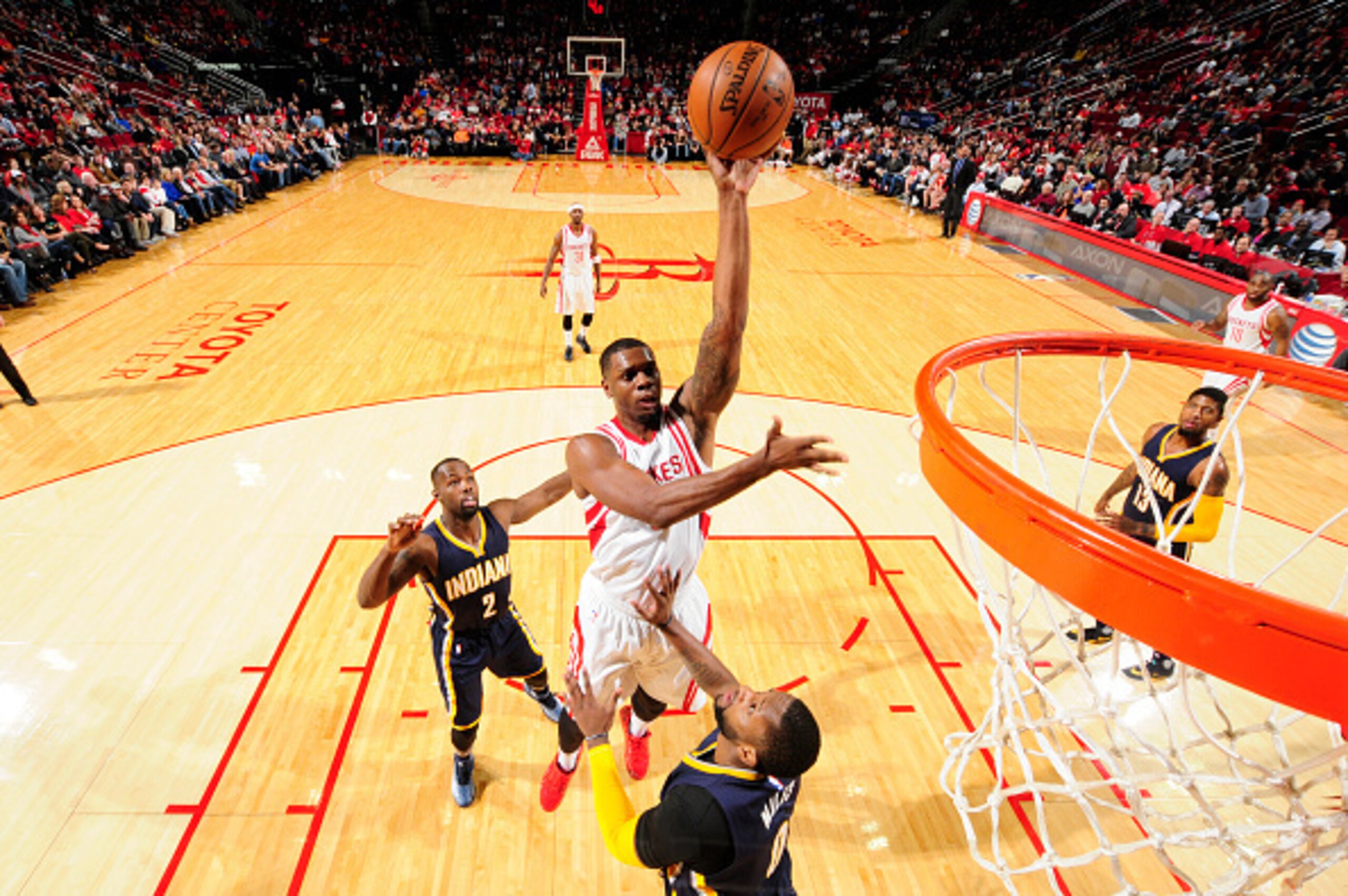
Stock: ↑
Someone should tell Houston Rockets general manager Daryl Morey to think bigger.
According to Marc Stein of ESPN.com, the Rockets are expected to seriously consider, if not inevitably pull the trigger on a deal that sends Corey Brewer and Terrence Jones to Phoenix in exchange for Markieff Morris. It's a move that feels wrong for a number of reasons—mostly because Jones offers more big-picture possibilities than Morris.
Jones' rim protection numbers are down, and his PER is a personal worst. The Rockets are getting destroyed when he's on the hardwood to boot. The offense is plummeting in efficiency, and opponents are outscoring them by more than 8.5 points per 100 possessions.
But Houston isn't exploiting Jones' frontcourt versatility as well as it did last season. Clint Capela's emergence and Dwight Howard's good health have limited his opportunities at center, and the Rockets are pinning him to a badly built second unit that, per HoopsStats.com, ranks in the bottom five of offensive and defensive efficiency.
Many of Jones' best performances come within lineups that run him as an undersized 5. This isn't to say he cannot function as a 4; he has to at 6'9". He's just at a disadvantage when doing so alongside space-crippling centers.
There is enough intrigue in Jones' individual numbers to trump the wonky ways Houston uses him. Among players to record at least 700 minutes and attempt five three-pointers, he is one of four averaging 15 points, seven rebounds and one block per 36 minutes while shooting 36 percent from long range. Kevin Durant, Draymond Green and Kelly Olynyk are the other three.
Only Jones' $2.5 million salary truly threatens to warp his market value. Impact players seldom make so little, and that limits what the Rockets can get in return—as does Jones' eventual foray into restricted free agency, which demands his next team almost immediately be prepared to shell out more than $10 million annually for his services.
Still, stretch "bigs" with shot-blocking potential are the future. And even now, amid a topsy-turvy Rockets season, Jones looks like he'll be a prominent part of that future.
Ty Lawson, Houston Rockets
6 of 8
Stock: ↓
Do not confuse Ty Lawson's risk-free stock as a booming entity.
Taking on his contract has never been the issue. He is making $12.4 million this season, but his $13.2 million salary for 2016-17 is non-guaranteed. He is on a glorified expiring deal in that sense, and his next home can dump him rather easily if he doesn't live up to his pay grade.
But Lawson has never seemed less likely to bust out of his present rut, and there's a reason the apparent trade request from him and his agents, per CBS Sports' Ken Berger, hasn't been pacified. He is shooting under 38 percent from the field, isn't guaranteed even 20 minutes of burn per game and has yet to prove he can thrive in a secondary role.
Some of his fringe All-Star value should be recouped with a change of scenery. Lawson has at least shown he can operate off the catch, drilling more than 38 percent of his spot-up three-pointers. But like most point guards, he needs touches to maximize his impact, and Houston has slashed his usage rate, cut his driving opportunities and asked him to spend nearly two-thirds of his minutes playing off James Harden.
Another team promising more playing time and possessions would be good for Lawson—assuming, of course, that team exists.
Starting point guards aren't in short supply. The list of current floor generals that Lawson would jump in a different rotation is short. The Nets need someone to replace the injured Jarrett Jack; the Chicago Bulls, if given the chance, should explore a cheaper alternative to Derrick Rose; and the Milwaukee Bucks need someone not named Michael Carter-Williams directing their offense.
Would the New York Knicks even be willing to play Lawson over Jose Calderon? Do the Utah Jazz see him as an upgrade over Raul Neto?
And should this theoretical situation exist, how is Houston getting Lawson there? His pay scale, while devoid of downside, is typically reserved for plus players, and he's declined into a net minus.
Maybe the Rockets will be able to send him elsewhere ahead of Feb. 18. But it won't be for much, and worse, his new digs won't have any idea what to expect from him.
Kevin Martin, Minnesota Timberwolves
7 of 8
Stock: ↓
Since signing with the Minnesota Timberwolves in 2013, Kevin Martin has gone from a bargain scorer to a spot-up specialist to an unnecessarily used veteran on a rebuilding contingent to his current role as seldom-used reserve with bedrock efficiency.
The Timberwolves have been unsuccessfully trying to flip Martin for Courtney Lee of the Memphis Grizzlies, according to USA Today's Sam Amick, and their failure isn't surprising. Martin is earning less than $7.1 million this season, with a player option worth under $7.4 million for 2016-17, but his shooting percentages have taken a nosedive as he's vacillated in and out of the rotation.
Interim Timberwolves head coach Sam Mitchell didn't use him at all for seven straight contests, and the 32-year-old wing hasn't seen more than 17 minutes of playing time in a single game since re-entering the fold.
When Martin has played, the offense and defense have been statistically worse. He is shooting a respectable 38-plus percent on catch-and-shoot treys, and that bodes well for him should he end up within an offense that does a better job of implementing and passing out of pick-and-rolls.
In theory, getting him to that team shouldn't be a problem. His reputation as an outside marksman is well worth the modest cap hit. But where the Timberwolves would have assuredly grabbed an expiring contract for him last season, they must now come to terms with potentially attaching a pot sweetener to his deal.
Well, that, or they must hope Martin agrees to decline his player option in exchange for a different home, further diminishing the financial commitment for his new squad.
Markieff Morris, Phoenix Suns
8 of 8
Stock: ↓
Surprise!
But not really.
Markieff Morris hasn't just spent time in the Association's rumor mill. He has owned it.
Incidentally, Morris' trade value has reached an all-time low. His contract has become the primary selling point. He is under lock and key through 2018-19 and won't ever earn more than $8.6 million in a single season.
That type of deal won't exist once the salary cap erupts ahead of 2016-17. It's part, if not all, of why Houston, per Stein, is apparently willing to fork over Terrence Jones as compensation for the 26-year-old forward.
And if this was last season, the Suns wouldn't have any issue extracting assets out of possible takers. Morris was one of 10 players to average at least 17.5 points, seven rebounds and 2.5 assists per 36 minutes. Seven of the other nine were All-Stars; one of the remaining two was Kawhi Leonard.
One offseason makes all the difference, though. The Suns traded Morris' brother, Marcus, to Detroit, and Markieff is posting career-low shooting percentages across the board, along with a personal-worst PER. He statistically hurts Phoenix's offense, and his effective field-goal percentage is the fifth-worst among players who have attempted at least 250 shots.
"It's a tire fire in Phoenix," Berger wrote, "where the Suns fell for the elixir of an unexpected 48-win season in 2013-14, went for it with a series of moves that deviated from their original rebuilding plan and now find themselves in a state of chaos."
Drumming up Morris' value in time for the Feb. 18 deadline is out of the question at this point. He has appeared in just seven of Phoenix's last 20 tilts, and the team is bogged down by a self-created absence of leverage.
All that's left for the Suns to do is settle for what's out there—even if what's out there doesn't come close to replacing the player they thought they had in Morris.
Stats courtesy of Basketball-Reference.com and NBA.com unless otherwise cited and are accurate leading into games on Jan. 12.
Dan Favale covers the NBA for Bleacher Report. Follow him on Twitter, @danfavale.

.jpg?w=2560 "Raiders Could Start Mendoza")

.jpg?w=2560 "Rodgers Iced Out on Plane 💎")
.jpg?w=2560 "Packers Safety Slams Refs 🤬")
.jpg?w=2560 "🚨 Week 8 AP Top 25 Poll")