

D'Angelo Russell, Julius Randle Making Do in Byron Scott's 'Big Boys League'
In their first 20 games this season, the Los Angeles Lakers had only three wins, and none of their five top five-man units had a positive net rating, per NBA.com. For an organization so publicly inflexible about its commitment to winning, this made for a historically grotesque opening month.
Then on December 7, head coach Byron Scott mercifully pulled the plug on a starting lineup that was getting outscored by 13.9 points per 100 possessions. His most noteworthy scapegoats? D'Angelo Russell and Julius Randle, who were benched for Lou Williams and Larry Nance Jr.
The decision sent shock waves throughout Lakers Nation. With a playoff berth already looking less likely than Kobe Bryant's bagging his third scoring title, why do anything but intensify the evolution of two potential franchise cornerstones by playing them as often as possible? Relegation seemed a tad counterproductive.
TOP NEWS

LeBron's Special Helicopter Deal

MJ Makes Record-Setting Donation 🙌
Shams: KAT, Hart Could Be Trade Names

But what if Scott was right? We're dealing with a microscopic two-game sample size, but since their demotions, Russell and Randle have responded with the best basketball of their young careers.
The Lakers behave like they think it's possible to constructively balance player development while experimenting with radical lineup changes. Based on Wednesday's overtime loss to the Minnesota Timberwolves, maybe it's a realistic possibility after all.
Here's what general manager Mitch Kupchak had to say about Scott's recent decisions, per the Los Angeles Times' Mike Bresnahan:
"I think Byron has got to continue to mess with combinations and search. That's really all you can do. What we're doing right now has not resulted in the kind of record that we like, so my guess is he's going to try and continue to move things around and try to find something that does. That's what a coach does.
"
A direct benefit both players get off the bench is the chance to battle less formidable opposition. Never was this more evident than Monday night against the Toronto Raptors, when Randle obliterated smaller backups—lineups that didn't feature starting center Bismack Biyombo.
On his way to a 15-point, 11-rebound night (in under 21 minutes), last year's seventh overall pick gobbled up his own misses, relentlessly attacked the paint and destroyed an opposing frontcourt that wasn't long enough to slow him down.
Scott deployed the same strategy Wednesday night, unleashing Randle against Gorgui Dieng and Nemanja Bjelica. In 33 minutes, Randle scored 20 points and grabbed 12 rebounds. He didn't settle for ugly isolation jump shots and instead manufactured his own opportunities by crashing the glass, drawing fouls and driving straight into his defender's chest.
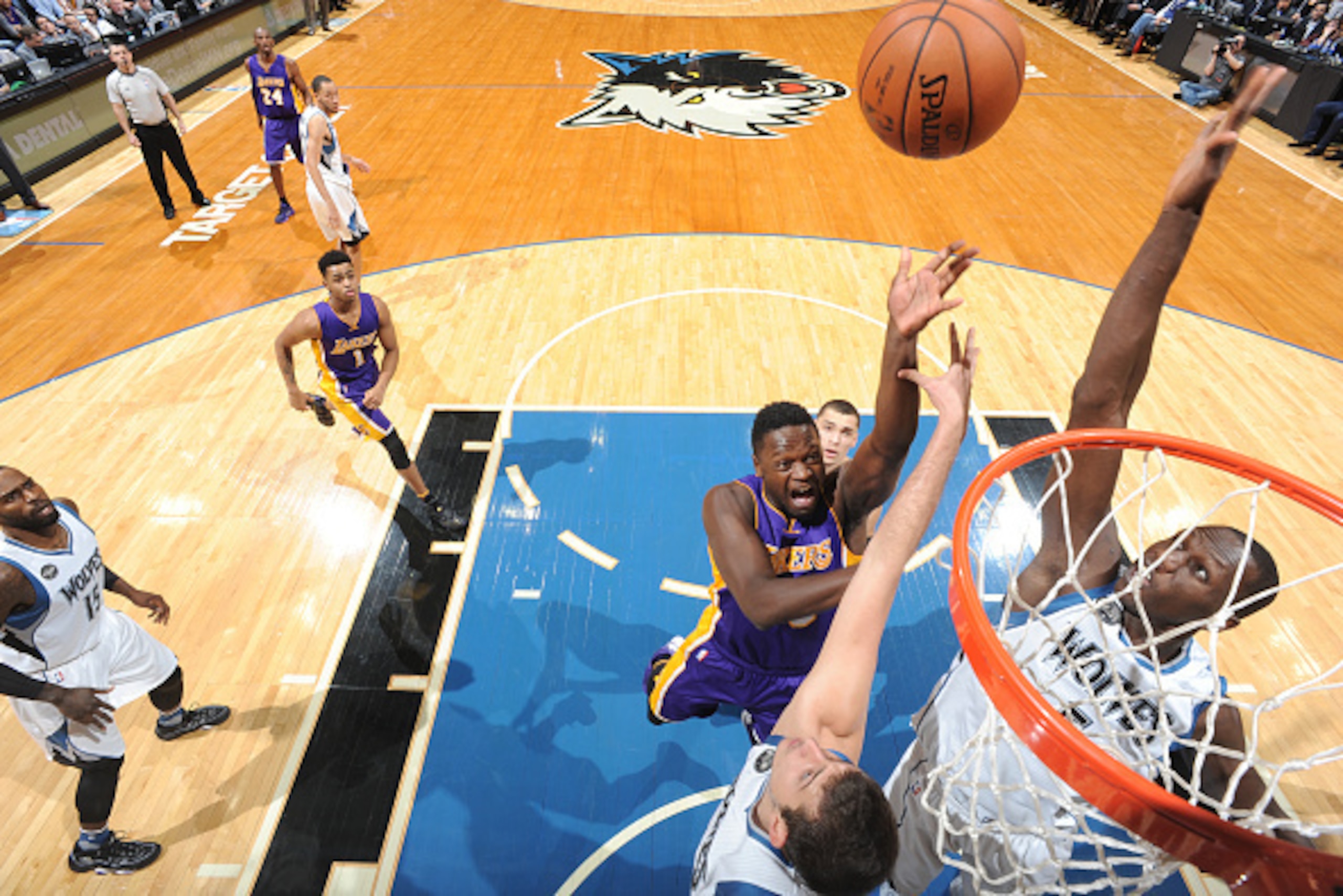
These were only two matchups, but Randle also didn't have to worry (as much) about defending the opposing team's starting power forward, a position with endless talent that's repeatedly eviscerated the 21-year-old by inducing him into foul trouble all year long. (As a bonus: Playing a majority of his minutes without Roy Hibbert on the court, Randle's had a little more room to operate in the paint too.)
Russell—who scored a career-high 23 points Wednesday night—also enjoys facing opposing second units, but he's aided more by the opportunity to commandeer Los Angeles' offense with a supporting cast that enhances his talent.
This mostly means "no Kobe!"—a very real byproduct Russell acknowledged after the loss in Toronto:
When asked how he thought Randle and Russell performed without Bryant on the floor, Scott reluctantly admitted there was a positive effect, per Lakers.com:
"I don't think it did really anything to their game. The one thing it did do—I'll take that back—is they didn't defer as much. When KB's out there, they seem to defer a little bit more to him. I thought tonight they played a little bit more free. They still made mistakes, but they're going to make mistakes. They're young. But I want them to continue to play as hard as they played tonight.
"
Never is this more clear than when Russell runs a pick-and-roll. In the clip below, ignore Minnesota's miscommunication and instead focus on the weak-side corner. It's Nick Young (fresh out of Scott's doghouse), Los Angeles' most potent spot-up threat, spacing the floor, persuading his man, Zach LaVine, to stay put.

The result is a wide-open lane for Robert Sacre to roll through for the easy basket.
Russell has looked like a different player over the past two games, consistently attacking the basket for the first time all season and not settling for pull-up elbow jumpers. It's real-time development, and it supports the idea that whether he and Randle start games shouldn't be something people obsess over.
Not when there are so many other variables to study. Which teammates are by their side? Who are they facing? Are their defensive mistakes shrinking? Are they in position to find a rhythm? Is their confidence growing—i.e., are they trying new things?
Big picture, that's what matters, and Scott is hunting for a best-of-both-worlds scenario where he can help L.A.'s two most critical long-term assets while making the Lakers competitive in the present day. It sounds impossible, but smart lineup choices won't hurt.
That means limiting Bryant's second-half minutes, erasing Metta World Peace's playing time altogether, getting more out of Young, giving Nance a long leash and not pigeonholing Brandon Bass as a backup center.
Wednesday's loss was a definite step in the right direction—a win for common sense and a confidence boost for the team's growing talent. What was initially viewed as a disaster may end up being the exact opposite.

.jpg?w=2560 "Grading WWE Raw 🔠")

.jpg?w=2560 "Viral Rams Coach Vid 🖕")

