

It's Time for Eagles, Chip Kelly to Consider Changing Direction of the Franchise
On Sunday, the Philadelphia Eagles lost in convincing 45-17 fashion to the Tampa Bay Buccaneers. It was Philadelphia's second straight loss and its third loss in the past four games. It was the third time this year that the Eagles have lost by at least 10 points.
At 4-6, the Eagles now find themselves in third place in the NFC East. The team isn't out of the woeful division race—not by a long shot—but this latest loss still hurts. It hurts a lot.
The loss to the Buccaneers has so much sting to it because this is an Eagles team that was supposed to be a legitimate Super Bowl contender. It's a team that went 10-6 a year ago and was blowing opponents out in the preseason.
TOP NEWS

New NFL Power Rankings 📊

The Robinsons POUND the Rock 🪨

Takeaways from Falcons' dominant MNF win
Through the first three weeks of the preseason—the games in which starters actually make an appearance—Philadelphia won by an average of 20.7 points. The Eagles averaged 33.3 points per game in the preseason and were rated seventh in overall offense and eighth in overall defense by Pro Football Focus.
Since the regular season began, though, the Eagles have fallen hard, fast and spectacularly. The team is still rated a respectable 14th in overall offense by Pro Football Focus and an even better fourth in overall defense. However, the team is now scoring and allowing an equal 22.9 points per game.
Can the Eagles still be a playoff team in 2015? Possibly, but it's hard to envision Philadelphia really competing for the NFC Super Bowl spot against teams like the Carolina Panthers and Arizona Cardinals.
This is obviously a problem, because the goal for any NFL franchise is (or at least should be) to win a championship. Under head coach Chip Kelly, the Eagles have been intriguing, exciting and at least competitive. However, Kelly's Eagles don't seem to be improving or moving closer to a Super Bowl. Instead, the team is pulling against itself as Kelly tries to match the players he wants with the offense he wants to run in order to win his way.
If Kelly's way isn't going to create a title contender, then perhaps he—and the Philadelphia braintrust in general—should consider switching up the strategy.
Otherwise, the Eagles may have already seen their pinnacle under Kelly and could continue the their current decline.

At no point has Philadelphia's fall been more clear than during Sunday's blowout loss at home to a Buccaneers team that was the absolute worst in the league just one year ago. If you want to be even more specific, the low point in the season may have come in the fourth quarter when Tampa Bay capped its scoring with an interception return for a touchdown.
The interception came when Eagles quarterback Mark Sanchez, filling in for a concussed Sam Bradford, tried to find running back Darren Sproles on a screen pass. Unfortunately, however, Sanchez instead found Buccaneers linebacker Lavonte David, who returned the pass the other way for six.
Immediately after the play, Sanchez and Sproles appeared to get into a fairly heated discussion about who should bear the blame for the interception.
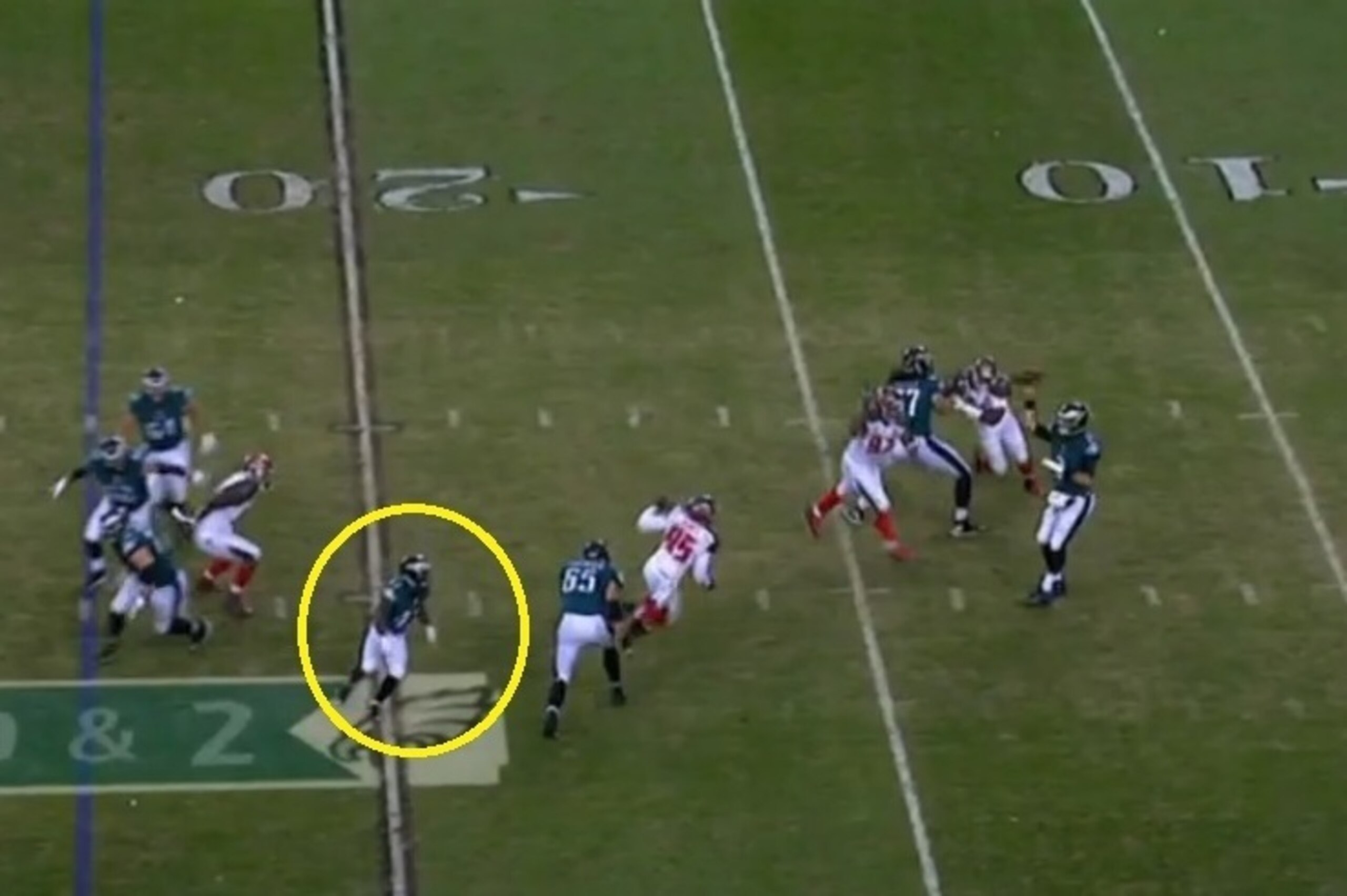
As you can see from the screenshot below, Sproles stops and waits for the ball, possibly short of where his route was supposed to take him.
Instead of throwing directly to Sproles, Sanchez then zips the ball past him, potentially where he thought the running back was supposed to be.
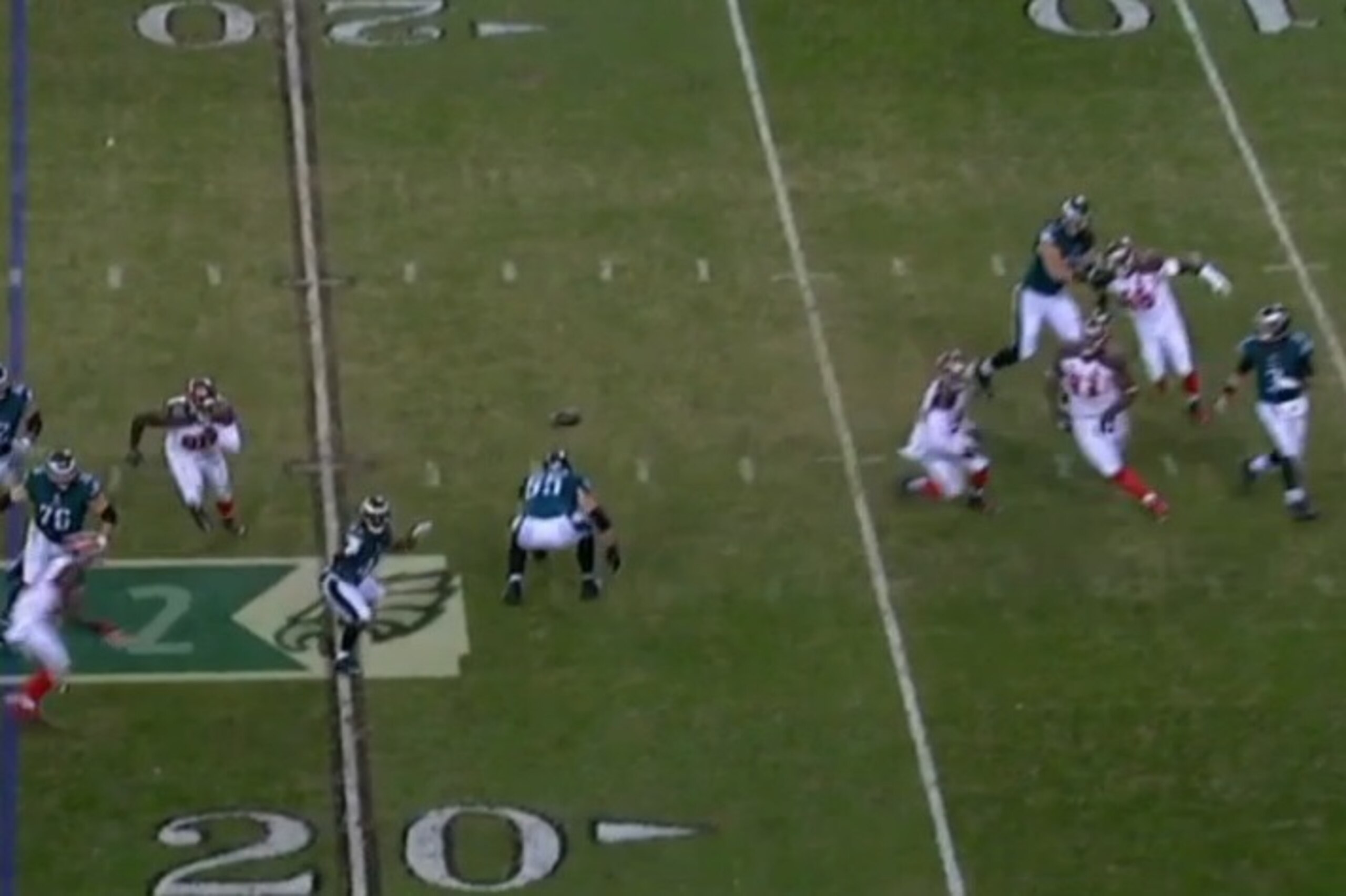
"[I]t looks like he’s on the run so I am trying to lead him on the run,” Sanchez said of the play, per Mike Florio of Pro Football Talk. “And so he stopped so I had already let the ball go and when he stopped that’s why I was upset."
Though Sanchez admitted that he was upset, he also tried to dismiss the spat as nothing important.
"So the mature part is that we talked about it again." He said, per Florio. "If we would have left it there and just said, ‘You screwed up’... ‘No, you screwed up’ then move on, well, then now we don’t get to the bottom of it."
"We’re OK," is all Sproles added when asked about the confrontation.
So the good news is that there doesn't seem to be utter turmoil within the roster, and Sanchez probably won't be on the receiving end of the type of hateful stare Bradford got from running back DeMarco Murray earlier this season. What is troubling, though, is the fact that Sanchez and Sproles clearly were on completely different pages on the interception.
The fact that Sproles and Sanchez aren't on the same page and are upset about it is concerning, because this is the second year that both players have been in head coach Kelly's system.
If Sproles and Sanchez are going to struggle executing a simple screen pass after playing on the same team together for a year and a half, how are new additions supposed to fare in Kelly's uptempo, matchup-oriented offensive system.
The short answer is "not great."
Bradford has struggled enough at quarterback (rated 26th overall at the position by Pro Football Focus), that there was talk coming into Sunday's game that Sanchez might be able to keep the job with a strong performance.
"The future for Bradford in Philadelphia is murky," NFL Media Insider Ian Rapoport, speaking on NFL Network's GameDay First, said before the game. "First of all, in the short term, Mark Sanchez is expected to start again on Thursday, so he's going to get at least a two-game audition potentially for the starting job."
Sanchez threw three interceptions on Sunday and another to seal last week's loss to the Miami Dolphins. If he's the answer over Bradford, then the Eagles might want to just stop asking questions.
How about Murray, the 2014 NFL rushing leader? He's barely topped 500 yards through 10 games and is averaging just 3.7 yards per carry. Kelly's radical game-changing offense? It's producing middle-of-the-pack results, ranked 15th in the league.
The fast pace of Kelly's offense is also creating problems for an Eagles defense that is playing far better than most expected. On average, Philadelphia is losing the time-of-possession battle by nearly seven minutes per game (26:45 vs. 33:38).
Even worse is that Kelly's offense might be getting, gasp, predictable.
"It was just play recognition," David said of Sunday's pick-six, per Matt Lombardo of NJ Advance Media. "I knew exactly what they wanted to do. It's the same thing they were doing all game. I knew that on the drive before they were hitting us a lot with screen passes. So, knowing that, all I needed to do was read and react."
This isn't the first time someone has hinted that Kelly's play-calling is easy to read, as 97.5 The Fanatic's Tim McManus noted:
So if Kelly's play-calling is predictable, his offensive tempo is possibly hurting the defense and players aren't executing in a successful manner, then it should be clear that it is time to change strategies on one of two fronts.
Either Kelly needs to change the way he approaches the Eagles offense, or the Eagles need to change how they go about acquiring the personnel to run it. Right now, the players and the system just aren't meshing.
Whether the Eagles personnel or Kelly's scheming is to blame for this year's struggles, both fall on Kelly, who has control of the roster. Taking away this privilege might be the key to the Eagles getting the right people in place for Kelly to succeed—his handpicked players have almost universally disappointed this year.
Bradford, whom Kelly brought in for two draft picks and quarterback Nick Foles, has been below-average. The duo of Murray and Ryan Mathews—whose contracts total $51 million—are leading an offense that is good (ranked 11th at 119.2 yards per game) but certainly isn't elite.
If Kelly can't recognize the right talent for his own system, then the Eagles have every right to be skeptical about his team-building acumen. If Philadelphia finds itself making the potentially franchise-altering decision to draft a new quarterback in the offseason, the team might want to put that decision into more capable hands.
This, of course, is where things could get dicey. Having final say on the roster was a condition Kelly required when he signed his contract with the Eagles back in 2013. That contract, by the way, is good through 2017.
Would Kelly be willing to compromise in the roster department, or would he back the Eagles into an all-or-nothing scenario? If Kelly would be willing to focus on coaching while letting someone else handle player acquisition, this might set the team up best for success.
Of course, if Kelly gives up some creative freedom, he would also have to alter his precious offense to fit his players.
Something has to give here.
Philadelphia has gone 10-6 in each of Kelly's two seasons and might be back in the playoffs this year. However, the Eagles seem to be stuck in the stasis in which good-but-not-great teams often find themselves.
A good example here might be the Cincinnati Bengals, who have gone to the playoffs and lost in the opening round for four consecutive seasons. The difference is that Cincinnati has steadily improved its talent level and depth through smart free-agent moves and opportunistic drafting. Kelly's moves usually seem to be lateral at best, and the proverbial wheels in Philadelphia are just spinning in place.
The other difference is that the 8-2 Bengals feel like a team that could realistically compete for a Super Bowl berth. The 4-6 Eagles feel like a team that might be able to steal the pitiful NFC East, but one that probably isn't going any further.
If Kelly, vice president Howie Roseman and owner Jeffrey Lurie don't seriously consider altering their approach to franchise-building, then being a postseason footnote may be all the Eagles have to hope for.

.jpg?w=2560 "Rams Eagles Football")
.jpg?w=2560 "Grading WWE Raw 🔠")


.jpg?w=2560 "Injury-stricken Seahawks signing veteran RB")
