

What Packers Must Do in Week 9 to Avoid Another Disappointing Loss
There's no question that while the Green Bay Packers' Week 8 loss to the Denver Broncos was an ugly mark on their otherwise perfect season, it was, in many ways, a necessary evil.
The film of that game and the myriad ways Denver's defense was able to shut down Green Bay's offense do not have to serve as a blueprint that the Carolina Panthers can use to beat the Packers in Week 9.
In fact, there are a few key adjustments that the Packers can make to their game plan and their in-game coaching decisions that should improve player execution and, ultimately, lead to a more favorable result against Carolina.

.jpg?w=2560 "Falcons Saints Football")
.jpg?w=2560 "Rams Eagles Football")
Let's break down three specific improvements Green Bay must make in Week 9 to improve to 7-1 on the season and maintain its lead in the NFC North.
Run More Man-Beater Routes
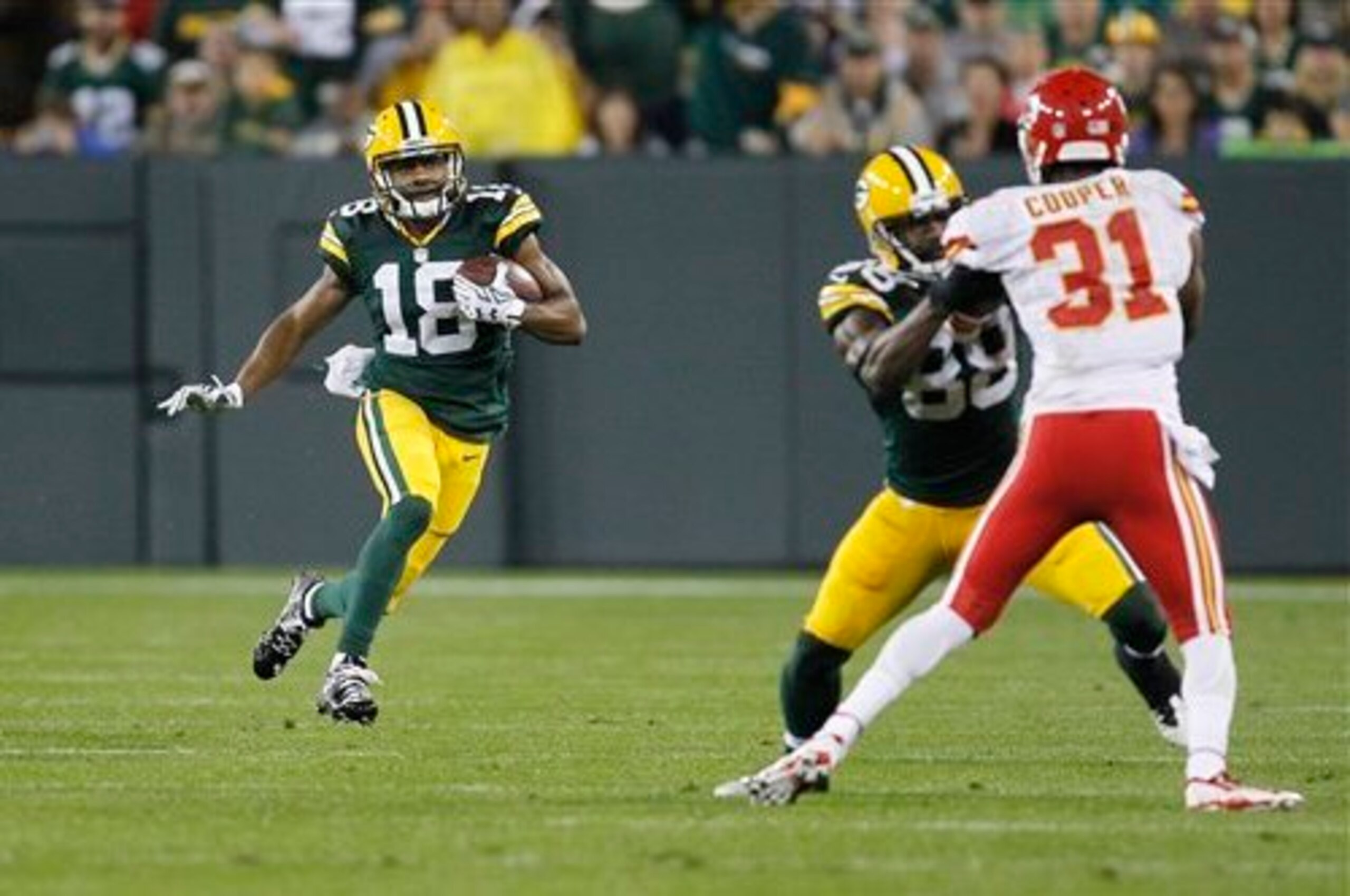
The Packers run a spread formation. They have for years, and it's kept them at the forefront of the league in total offense.
Until this season.
Theirs is a formation that agrees with and highlights quarterback Aaron Rodgers' many strengths, and talented receivers over the years in Donald Driver, James Jones, Jordy Nelson and Randall Cobb have found great success running the isolation routes built into the scheme.
But in 2015, it's a different story. Isolation routes put immense pressure on the wide receivers to beat man coverage and get open, especially Rodgers' first read. Nelson and Cobb, when on the field together, are especially skilled at this.
It also helps that Rodgers has profound trust in both receivers and that he can throw to Nelson even when he's completely covered, because Rodgers can fit the ball into impossible windows and Nelson is a receiver who can, in turn, catch it.
This season, however, Nelson is on injured reserve, and Cobb is facing consistent double coverage. At least half the team's receivers on the field at any given time are inexperienced—rookie Ty Montgomery and second-year player Jeff Janis. Plus, injuries to Davante Adams, Montgomery and tight end Andrew Quarless have also limited the potency of the passing offense.
So the Packers continue to run their spread offense, but now it's questionable whether the receivers on the field are good enough or trusted enough by Rodgers to succeed on those routes.
Bleacher Report's Chris Simms cautioned that the Packers' simple offense and lack of a legitimate outside threat could be their undoing down the road:
Sure, this scheme might prove successful against opponents such as Kansas City, which features the 23rd-ranked secondary in the league. But against Denver, the league's top passing defense? Not so much.
The answer to this problem begins from on high. Head coach Mike McCarthy, associate head coach Tom Clements and offensive coordinator Edgar Bennett must introduce more man-beater routes into Green Bay's offensive plan.
Putting receivers into motion before the snap, bunch formations and stacking receivers can help the offense move down the field more easily against Carolina's secondary—which, incidentally, is No. 5 in the NFL.
These formations can exploit defenders' ability to diagnose patterns and force them to play farther off the pass-catchers in order to avoid crashing into one another on the field when covering crossing targets. It will also help top target Cobb elude defenders more easily and allow Rodgers to go to him more often.
Establish the Run
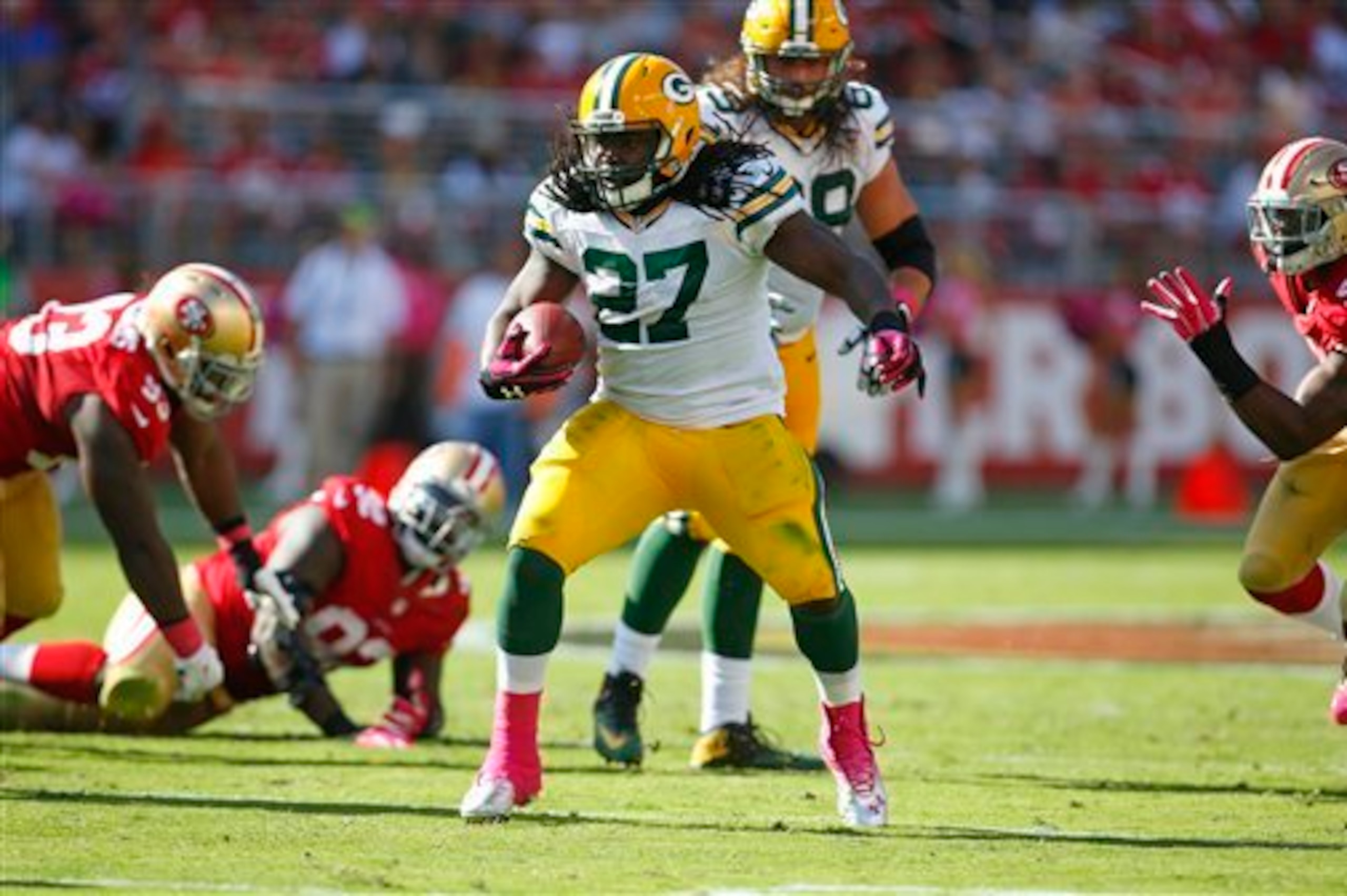
It's such a simple concept, yet it can change the flow of an entire game.
McCarthy is smarter and better at game-planning and management than any football analyst. The idea here isn't to play armchair coach and pretend to plan a better game than McCarthy can.
Obviously, he did not head into Denver in Week 8 planning to run the ball 21 total times or give Eddie Lacy just 11 carries.
He also did not, for that matter, likely plan to run only 46 offensive plays during the game, the lowest among any NFL team in Week 8, per TeamRankings.com.
| 58.1 | 29.1 | 27 |
Eight of Lacy's 11 carries came in the first half against Denver. But in the second half, with the team trailing by 14 points, McCarthy eventually had to dial up the heat on the passing game in the hopes of making a comeback.
For instance, in the middle of the third quarter against the Broncos, with Denver leading by two touchdowns, the Packers had a six-play, 18-yard drive that ended in a punt.
The play calls and results on that drive? Pass, pass, pass (negated by a penalty), pass, rush, pass (sack), pass.
Denver's front knew exactly what to expect on that drive and kept the pressure on Rodgers, eventually sacking him on 2nd-and-9 at Green Bay's 46-yard line to force a punt.
But the Packers were never closer than seven yards to a first down on that drive. Passing is obvious in that situation, right?
Only if you want to help the opponent succeed in defending it.
Pressure, Pressure, Pressure
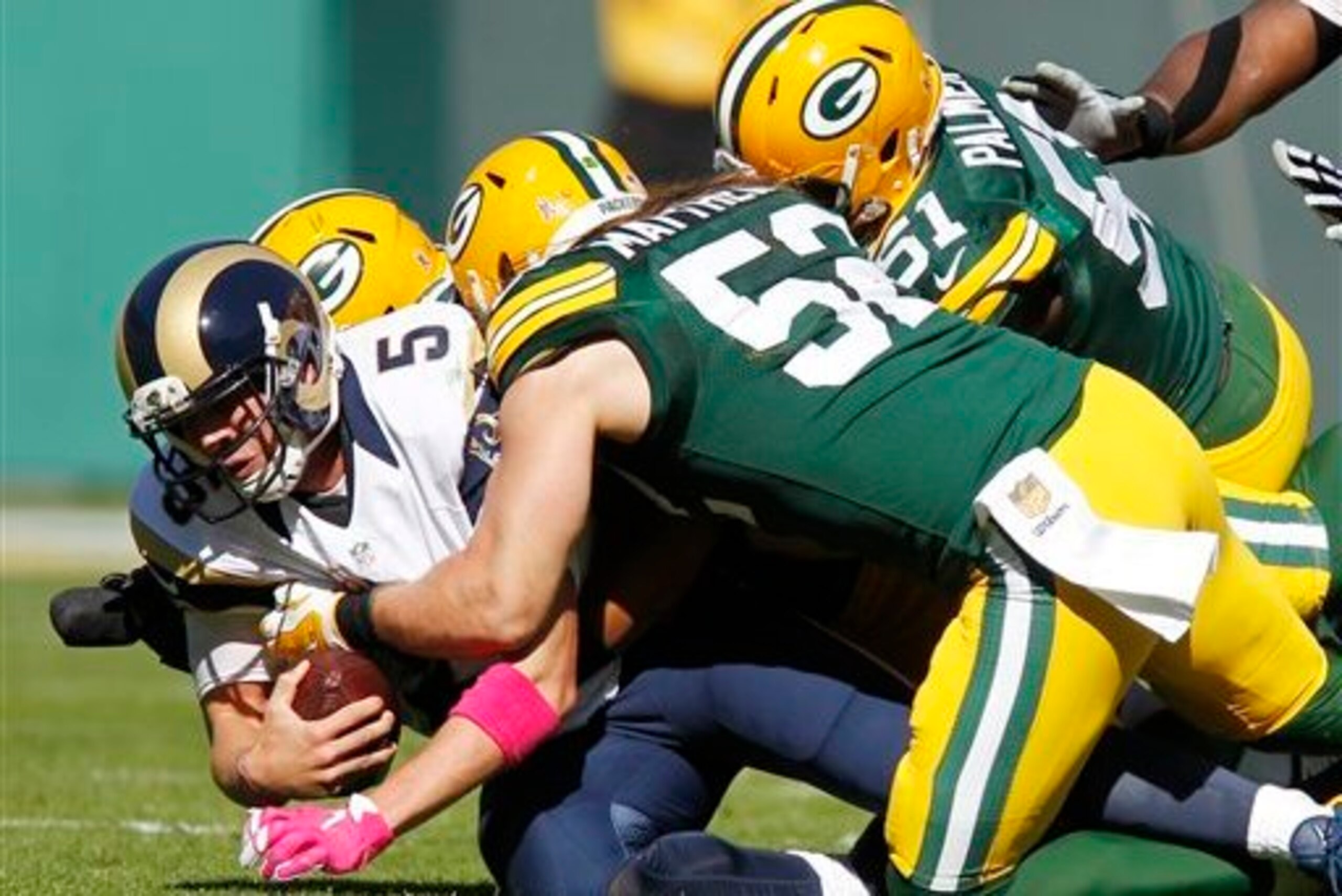
The Packers have one of their most talented pass-rushing corps in recent memory.
The team's 23 sacks, good for third-most in the league, are spread out among multiple players, including linebackers and linemen: Julius Peppers (5.5), Clay Matthews (4.5), Nick Perry (3.5), Mike Daniels (3), Jayrone Elliott (2), Mike Neal (2), Joe Thomas (1), Datone Jones (1) and B.J. Raji (0.5).
Those players also have countless more quarterback hits and hurries.
The unit was so productive, in fact, that until Week 8 against Denver it held the NFL's longest streak of consecutive games with a sack.
That's right; this group of players couldn't bring Peyton Manning down once and only hit him three times. Two of those came from Matthews, who missed part of the game with an ankle injury.
It's not that Denver's offensive line was so stout that the Packers couldn't penetrate it. Rather, Denver's offensive game plan was designed to neutralize Green Bay's pass rush.
The Broncos got the run game going early and stuck with it, totaling 160 yards on the ground. Manning also made sure to get the ball out fast on slants and quick strikes, taking just 2.32 seconds to throw on average in the matchup, per Pro Football Focus.
That was the fourth-quickest release among starting quarterbacks in Week 8. Incidentally, Philip Rivers did the same thing against the Packers in Week 6, and he was the quarterback with the quickest arm overall in Week 8.
Offensive coordinators know that it's nearly impossible for even the league's best defenders to break into the backfield in two seconds. In the two-and-a-half or three seconds it takes, the ball is already gone.
Watching the film on Green Bay's past two matchups with Denver and San Diego, Carolina would no doubt like to try the same thing. Luckily for the Packers, however, Newton doesn't have one of the quicker releases this season.
The Carolina signal-caller is averaging 2.85 seconds to throw, the seventh-slowest release in the league, per Pro Football Focus.
If the Packers can keep the pressure turned up against Newton, they can potentially succeed in preventing him from connecting with his go-to target, Greg Olsen, and keeping Carolina out of the end zone.
.jpg?w=2560 "Texans-Mixon Released Football")

.jpg?w=2560 "Grading WWE Raw 🔠")


.jpg?w=2560 "2 NFL Officials Suspended")
