Oakland Raiders quarterback Derek Carr’s pick-six thrown to Denver Broncos cornerback Chris Harris stands out, but there’s a bigger issue going unnoticed.
No, this isn’t a reference to the Blue Angels theory reported by Bleacher Report’s Kyle Newport. According to Vic Tafur of the San Francisco Chronicle, head coach Jack Del Rio actually assigned fault to both the quarterback and wide receiver involved in the play:
TOP NEWS
.jpg?w=2560 "Colts Football")
Jonathan Taylor Landing Spots
.jpg?w=2560 "NFL Paris Football")
NFL House in Paris Closes for Protests (AP)
.jpg?w=2560 "Seahawks Chiefs Football")
Trevon Diggs Cut by Seahawks
Let’s backtrack a bit.
The Raiders averaged 24 points per game heading into Week 5 and struggled to score 10 points on Sunday.
The Broncos have the fifth-ranked pass defense in the league, allowing 192.8 yards per contest, but Carr surpassed that threshold with 249 passing yards.
He moved the ball steadily. Five passing plays extended for 20 yards or more down the field. The offense entered Broncos territory five times and came away with only one touchdown:
| No. of Plays | Time of Possession | Field Position | Result |
| 12 | 6:54 | Denver's 20-yard line | Missed FG |
| 8 | 4:42 | Denver's 3-yard line | Touchdown |
| 6 | 2:52 | Denver's 22-yard line | Missed FG |
| 9 | 4:05 | Denver's 31-yard line | Interception |
| 1 | 0:12 | Denver's 32-yard line | FG |
Raiders Lack Red-Zone Threat
The Raiders don’t have a finisher or, in NFL terms, a viable red-zone threat to score in critical moments. In cramped situations closer to the goal line, teams often use a tight end or a dominant wide receiver capable of executing on fade routes to cap off an offensive drive.
Wide receiver Amari Cooper shows impressive quickness and awareness. However, he hasn't developed a go-to route that defenses find difficult to defend in the clutch. The same goes for wideout Michael Crabtree.
The Raiders have two tight ends capable of posting up defenders as large targets in traffic, but they’re seldom used in or near the red zone.
In the last two weeks, tight end production shows an inadequacy in getting the ball to Mychal Rivera and Clive Walford.
| Player | Snaps | Targets | Receptions | Yards | Touchdowns |
| Lee Smith | 79 | 2 | 2 | 14 | 0 |
| Mychal Rivera | 47 | 6 | 5 | 45 | 0 |
| Clive Walford | 45 | 2 | 1 | 33 | 0 |
A large target serves as the best option for a quarterback throwing in traffic. Thus far, offensive coordinator Bill Musgrave hasn’t used the two tight ends to Carr’s advantage. As a result, the Raiders' scoring drives often stall as the play-calling goes into conservative mode.
Is Marcel Reece the Answer?
The former fullback now classified as an H-back crept out of the backfield for a touchdown in the second quarter against the Broncos:
The Raiders' commitment to establishing the ground attack helped execute the three-yard play-action pass to Reece. Should the Raiders consider him a red-zone threat?
Realistically, Musgrave would have to show creativity when utilizing Reece as a target near the end zone. Play-action designs fall into the "deception" category that forces defenders to take their eyes off short-distance receivers.
In confined one-on-one situations, Reece becomes less effective. He does most of his damage in space, where he can pick up yards after the catch:
| Snaps | Targets | Receptions | Yards | Yards After Catch | Touchdowns |
| 33 | 10 | 9 | 65 | 56 | 1 |
In the last two weeks when the Raiders needed a closer, Reece picked up 56 of his 65 receiving yards after the catch. Goal-line opportunities don’t allow the space for him to pose a threat unless there’s a misdirection or form of trickery to open clear passing lanes.
Who’s the Consistent Slot Receiver?
The disparity in production between Oakland’s starting receivers and reserves limits Carr’s options inside the opposition's 20-yard line:
| Player | Snaps | Targets | Receptions | Yards | Touchdowns |
| Michael Crabtree | 123 | 15 | 9 | 134 | 0 |
| Amari Cooper | 81 | 13 | 8 | 96 | 1 |
| Seth Roberts | 59 | 4 | 0 | 0 | 0 |
| Andre Holmes | 35 | 2 | 0 | 0 | 0 |
Seth Roberts and Andre Holmes have failed to record a catch in the last two games. Opposing defenses are rolling coverage over to Cooper and Crabtree, making it difficult for either receiver to maintain rhythm in the second half or find openings in the end zone.
Recent opponents have likely game-planned to double-team Cooper or Crabtree knowing the No. 3 and No. 4 wide receivers lack consistency in production.
Musgrave should design plays for Holmes in the absence of a tight end in the red zone.
In 2014, the 6’4”, 210-pound wideout led the Raiders in receiving yards. However, he took a major step back with the influx of talent at the position. The Raiders could still use Holmes’ size as a useful component in short-yardage situations and on fade routes.
Roberts flashed during the preseason as a speed receiver capable of catching the deep ball. He scored two touchdowns earlier in the season but vanished in his last two outings.
Musgrave could help him develop into a prominent red-zone threat by using his speed and quickness on slants, similarly to the crossing pattern that resulted in a pick-six on Sunday. Of course, Carr and Roberts would need to work on communication, but that develops over time between two second-year players.
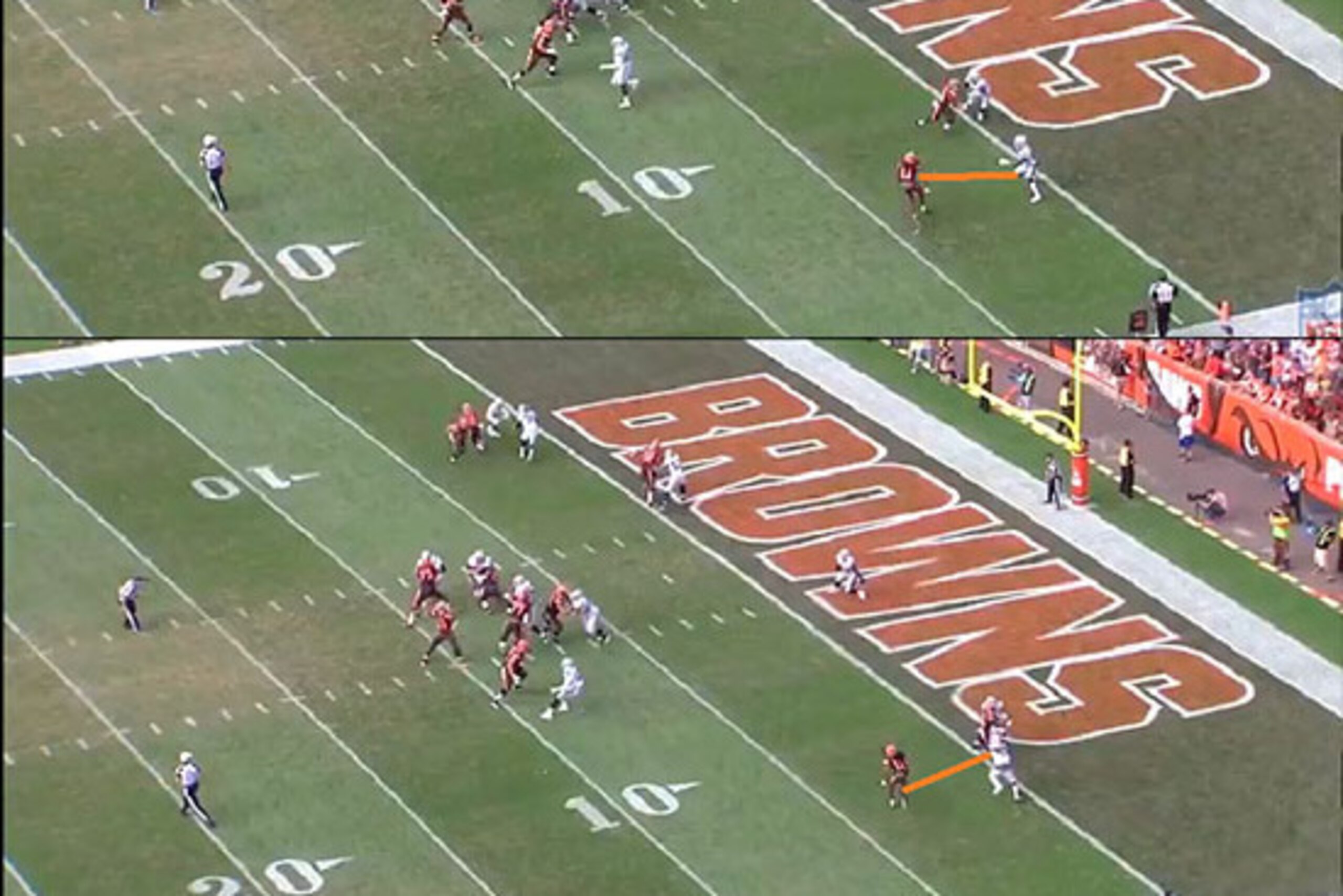
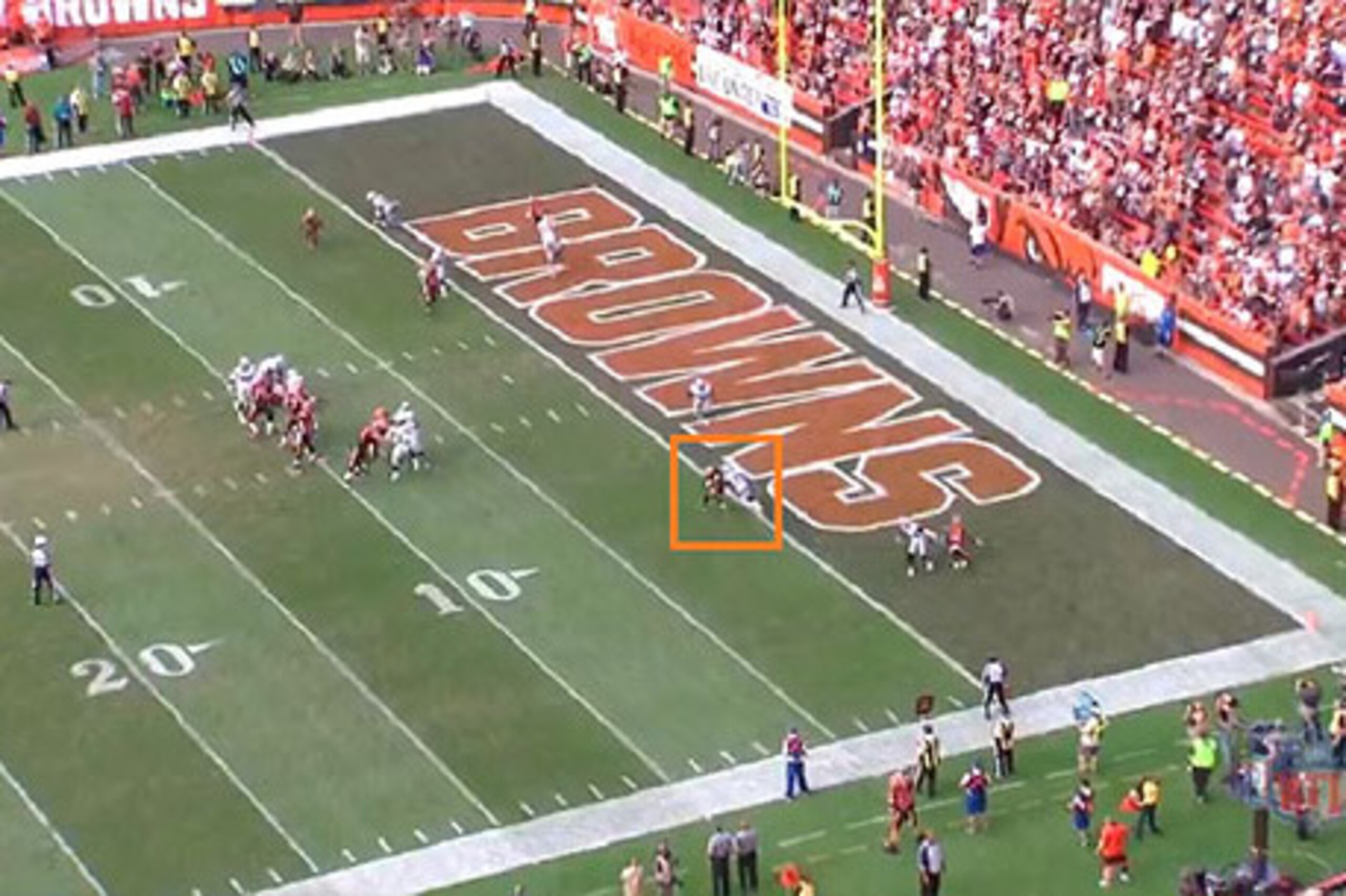
The film example above shows an ideal go-to slant pattern for Roberts in the red zone. The Cleveland Browns used the pattern and wide receiver Travis Benjamin’s quickness to score an easy six points with solid execution.
Carr needs more than two reliable weapons to win games as opponents game-plan for the Raiders' primary playmakers. Reece and the running backs attack the flat effectively as high-percentage targets in short distance, but the Raiders need receivers capable of stretching the field a bit.
They can diversify their game plan with either a big target or a wide receiver's speed to attack in the red zone and finish off drives.
Follow Maurice Moton on Twitter for news, updates and intriguing discussion about the Oakland Raiders.
All statistics are provided by Pro-Football-Reference.com and Pro Football Focus unless otherwise noted.
Week 5 statistics and play-by-play analysis provided by NFL.com.
.jpg?w=2560)