How Top College Football Teams Have Dealt with Major Injuries in 2015
It's too early in the college football season to call 2015 the "year of the injury," not to mention that's an unfortunate part of the game that happens every year. But it certainly feels like this season has been especially bad on the injury front—and for high-profile, playoff-caliber teams, too.
Consider the following short list: Michigan State linebacker Ed Davis—done for the year with a knee injury in August. Offensive lineman Jack Conklin is also out for an unspecified period with a knee injury.
Notre Dame quarterback Malik Zaire: out for the rest of the season with a fractured ankle. He joins defensive tackle Jarron Jones, running back Tarean Folston, tight end Durham Smythe, defensive backs Shaun Crawford and Drue Tranquill on the Irish's injury list.

.jpg?w=2560)
UCLA linebacker Myles Jack, defensive tackle Eddie Vanderdoes and cornerback Fabian Moreau: done, done and done.
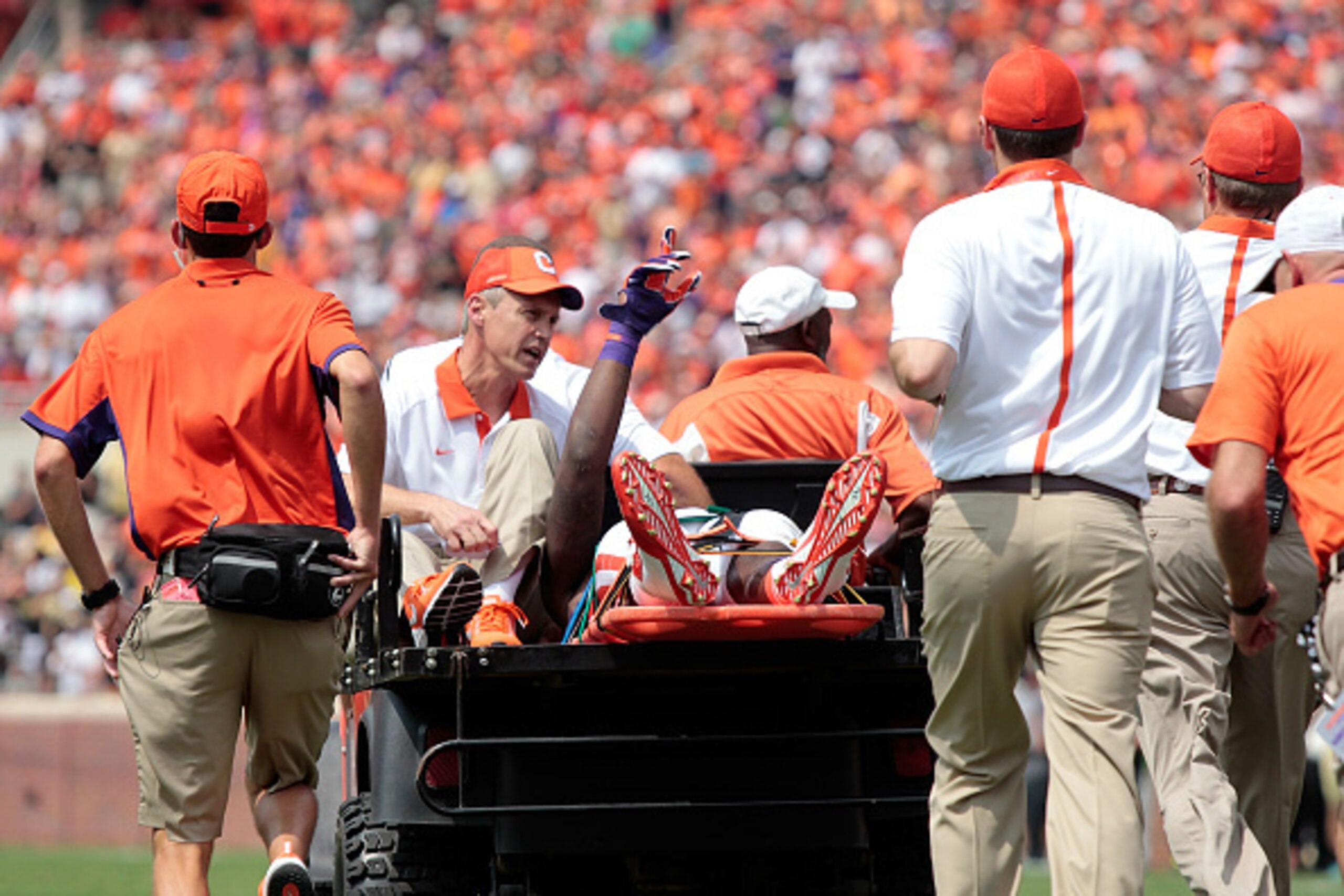
Clemson wide receiver Mike Williams: out indefinitely with a neck fracture.
TCU: The laundry list includes safety Kenny Iloka, defensive tackle James McFarland and receiver Ty Slanina.
Even non-playoff teams have been hit hard by crucial injuries. Virginia Tech cornerback Kendall Fuller is done for the year with a knee injury. Similarly, Oregon wide receiver Byron Marshall is likely out for the same period with a leg injury.
Unreal.
This is when depth charts are truly tested. Depth isn't simply defined by the sheer number of available players, either. Depth is also a matter of skill. Are your No. 2s and No. 3s capable of playing at a high level for an extended period of time? That's what some of these teams are going to find out in earnest.
The Hardest Hit
For some teams, we've already seen the effects injuries have had, for better and worse. The two most snakebitten teams without a doubt have been Notre Dame and TCU.
Perhaps no team has shown more resiliency early on than the Irish. DeShone Kizer has filled in admirably at quarterback for Zaire, though his toughest test yet comes in Week 5 at Clemson. As Keith Arnold of InsidetheIrish.com writes, the trip to Death Valley is the biggest moment is Kizer's young career:
"For some, the moment could become too large. But Notre Dame’s head coach believes his second-year quarterback will be ready.
“He has a presence about him, a commanding presence that, when he goes out there with the other ten players, you don’t feel like you’re putting a freshman quarterback out there,” [Brian] Kelly said.
“I see that every day he goes out there, he takes control of that offensive unit. It’s not meek. It’s not weak. It’s a presence that he brings when he goes out there, and I think that that’s what he’s brought.”
"
Kizer isn't the only Notre Dame backup who's played well in relief of others. Running back C.J. Prosise has become one of the pleasant surprises of the season, averaging 150 yards per game. Defensive tackle Jerry Tillery has performed above and beyond expectations for a freshman working in rotation as a replacement for Jones.
TCU is another team that's been dealing with numerous injuries and general attrition since the early stages in the season. However, it's already clear the impact on the depth chart has translated to the field. In the past two weeks, the Frogs have given up an average of 44.5 points to SMU and Texas Tech. Granted, the Mustangs and Red Raiders can score in bunches, but having to win games in the 40s and 50s might not be a sustainable model for eight more regular-season games.
It nearly backfired against Tech. The fortuitous Frogs needed a tipped-ball touchdown and the most amazing end-of-game finish that never happened to come out of Lubbock with a win.
Head coach Gary Patterson can only do so much with the players available. Per Chuck Carlton of the Dallas Morning News:
""Some years, you kind of shake your head," Patterson said. "We have to keep plugging them in, and they have to keep getting better."
Case in point: linebackers Montrel Wilson and Travin Howard, each thrust into starting roles that neither expected. Wilson is a freshman; Howard is a sophomore and a converted safety. Each had their moments in a 55-52 win over Texas Tech and each struggled at times, Patterson said.
"
Can Notre Dame and TCU sustain their success throughout the season with several backups thrust into starting roles? The Irish have a number of key games remaining on the schedule, and the Frogs are already in Big 12 conference play.
The Fewer, But Major Injuries
For teams like Clemson, Michigan State and UCLA, the pure number of major season-ending injuries has been smaller than the likes of Notre Dame and TCU. But that doesn't mean they haven't had to work around them.
Davis' injury was the biggest in college football at the time. The Spartans were replacing their longtime defensive coordinator Pat Narduzzi along with key members of the secondary. Losing Davis was just another blow to a defense that suddenly looked more and more like a question mark.
However, the combination of Jon Reschke and Chris Frey has proved to work better than perhaps many expected. No one can replace what Davis brings to the defense—experience and smarts, to start—but Reschke has upped his production and is a versatile option at a couple of spots along the linebacker corp. The sophomore is third on the team in tackles, 11 of which came against Oregon. He's shown flashes of being a capable full-time starter down the road:
Michigan State may need to win a few games with offense this year, but the defensive replacements have been good enough to make plays when needed.
The same thing can be said for UCLA, though for how long remains to be seen. Linebacker Jayon Brown has been productive in Jack's absence, but he left the Arizona game with a back injury. His status for Arizona State is questionable, per Chris Foster of the Los Angeles Times:
How many more injuries on defense can the Bruins take? The early theme for UCLA as been that the team goes as freshman quarterback Josh Rosen goes. Moving forward, however, Rosen and his learning curve might not be UCLA's biggest issue.
There is no doubt, however, that Williams' injury has been Clemson's biggest problem through three games. Against Louisville, there was little to no deep threat in the passing game. The Cardinals have an excellent defense and were able to get pressure on Deshaun Watson, which made matters worse, but it's clear the Tigers miss the big-bodied Williams down the field. This is a pass-catcher, after all, ranked as the top wide receiver heading into the 2016 NFL draft, per B/R's Matt Miller:
Receiver Artavis Scott is an outstanding weapon in the short-to-intermediate passing game, but he's not going to win many jump balls down the field. The lack of a vertical passing game hurt Clemson's offense against Louisville. Will it be a problem versus Notre Dame as well? There's simply no replicating what Williams brings to the Tigers offense unless someone emerges out of nowhere to become the new downfield threat.
Who Can Recover?
If Notre Dame and/or TCU goes undefeated this year, you might as well make Kelly and Patterson the 1A and 1B choices for every coach of the year award out there. On that note, give them extensions and raises, stat. Otherwise, there's a good chance the number of injuries each team has already experienced will catch up to them at some point.
However, just because a team has fewer injuries doesn't mean it's immune to deficiencies. Williams' absence could completely change the look of Clemson's offense. It already has in one game. Long-term, Conklin's injury could disrupt the chemistry of Michigan State's offense, even though the Davis injury has received more attention.
Ultimately, the question is how will these injury-riddled teams do in big games? Can UCLA's shorthanded defense stop, say, USC or Utah? Will TCU be able to win another four to six shootouts?
Making a playoff and/or national championship run requires many things, one of which is a little bit of luck. Staying healthy, at least relatively speaking, falls under that category. Every single one of the aforementioned playoff contenders can still achieve their goals despite being down key players. But some—like TCU—have already shown what struggles lie ahead.
Ben Kercheval is a lead writer for college football. All quotes cited unless obtained firsthand. All stats courtesy of cfbstats.com.


.jpg?w=2560 "Jonathan Taylor Landing Spots")
.jpg?w=2560 "NFL House in Paris Closes for Protests (AP)")


.jpg?w=2560 "Trevon Diggs Cut by Seahawks")