
Seattle Seahawks: Why Michael Bennett Should Hold Out
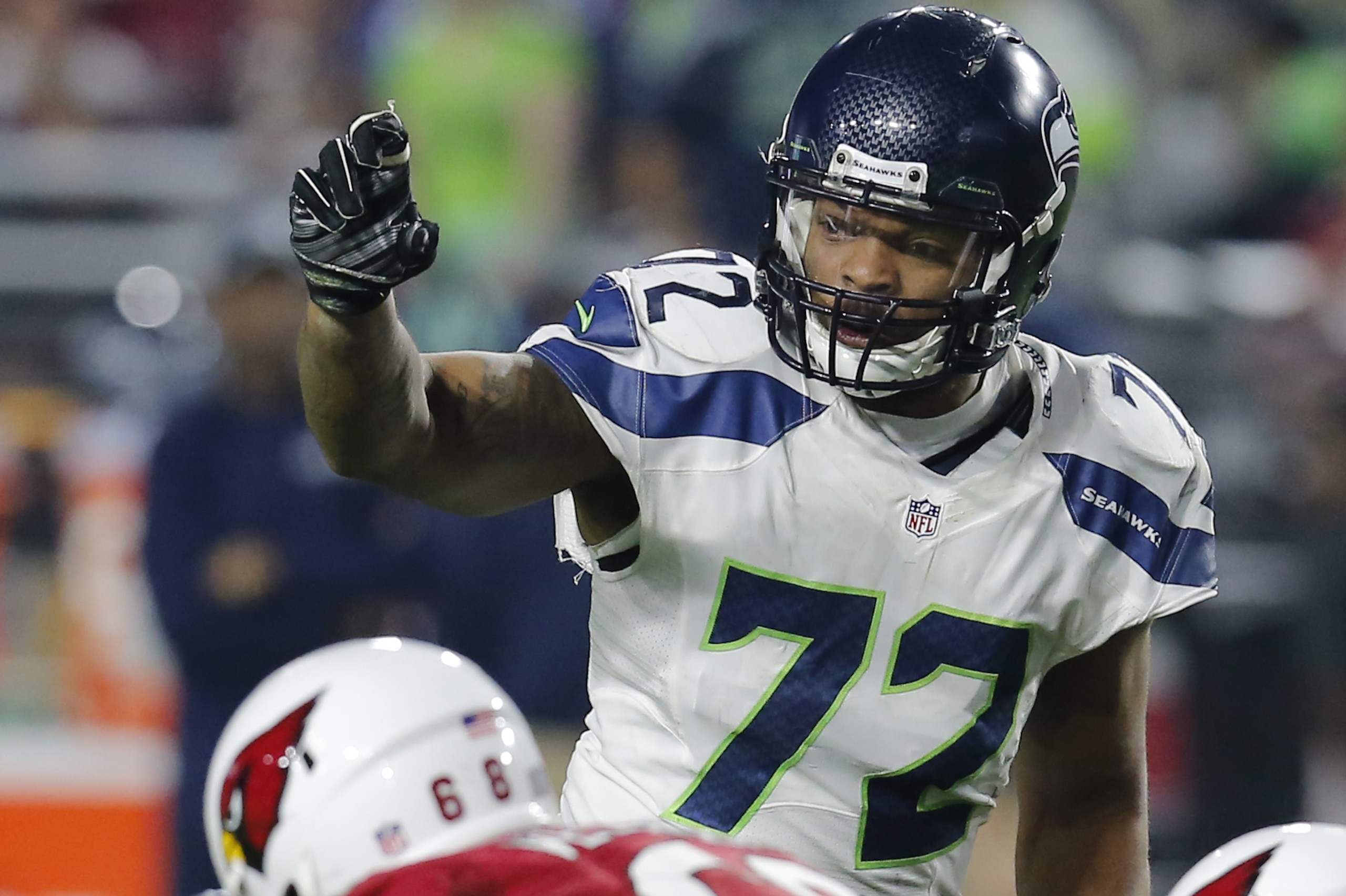
Michael Bennett should absolutely hold out if the Seattle Seahawks refuse to pay him. It shouldn't even be a question for the NFC West club.
Bennett is a key to the best defense in football. He's redefined his position and Seattle's scheme. That's the same scheme that's made the Seahawks an NFL powerhouse.
Just pay the man, already.
.jpg?w=2560 "Texans Titans Football")
.jpg?w=2560)
.jpg?w=2560 "Cardinals Giants Football")
Bennett has already hinted he'll hold out if he doesn't get a new deal. He made the claim during an interview with Khon 2 while rightly claiming he's outgrown the terms of his current deal:
"Of course, I think I’ve outplayed the contract that they gave me. It’s one of those things where you have to let your agent do the talking with the team and hopefully something good comes out of it. It never hurts to try.
Hawaii’s weather is great, so I’ll just keep it at that. When the weather’s not as nice as it is here, it’s harder to make that decision, so it just keeps it in my mind like hopefully something great comes out of it, but I don’t mind staying home for a little while.
"
Bennett feels his existing deal doesn't apply because of the many things he's asked to do to make Seattle's defense work. He made that clear during a phone conversation with NFL Media reporter Steve Wyche (h/t NFL.com): "I know a lot of people disagree because I don't put up all the numbers, but if you watch the games, I'm doing good things. They want me to play five positions but pay me for one."
This is the heart of the issue with Bennett's contract situation. He's essentially being paid as a traditional 4-3 defensive end when he's anything but. To illustrate and prove the point, here's a closer look at what Bennett does for the Seahawks' fearsome D.
The NFL's Chameleon
Bennett plays games with offensive blocking schemes. He's a defensive end, right?
Wrong. He is the NFL's very own chameleon.
Bennett is a master of disguise and a shapeshifter thanks to the way the Seahawks move him around pre-snap. Would-be blockers have no clue where he'll line up or what gaps he'll attack once the ball is snapped.
For an end, albeit in name only, he's incredibly dangerous whenever he slides inside.
Bennett can play every interior gap but is often most effective as a 3-technique in the B-gap between an offensive guard and tackle. That's where he lined up on a second-quarter play during Seattle's road win over the Washington Redskins in Week 5:
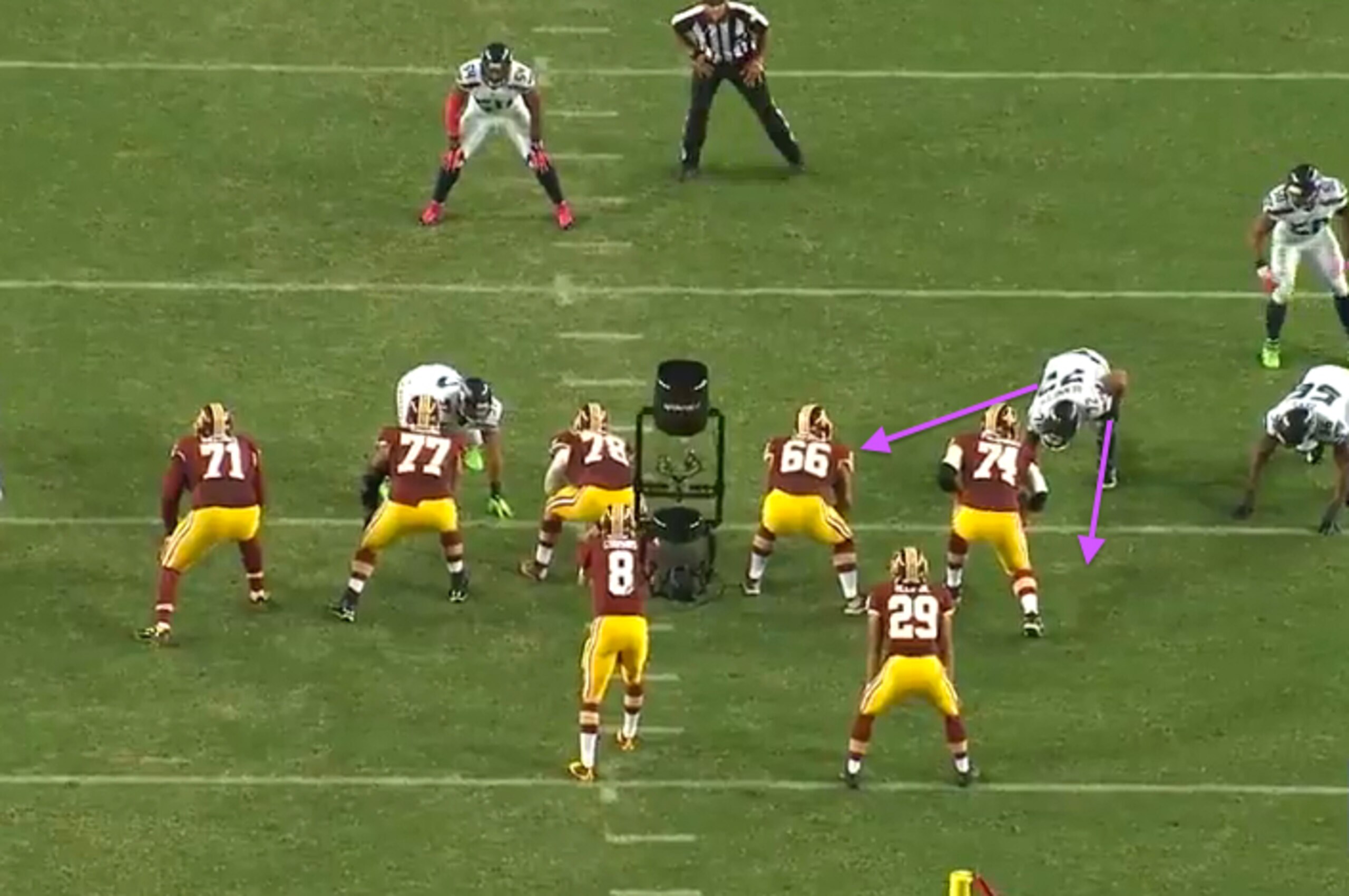
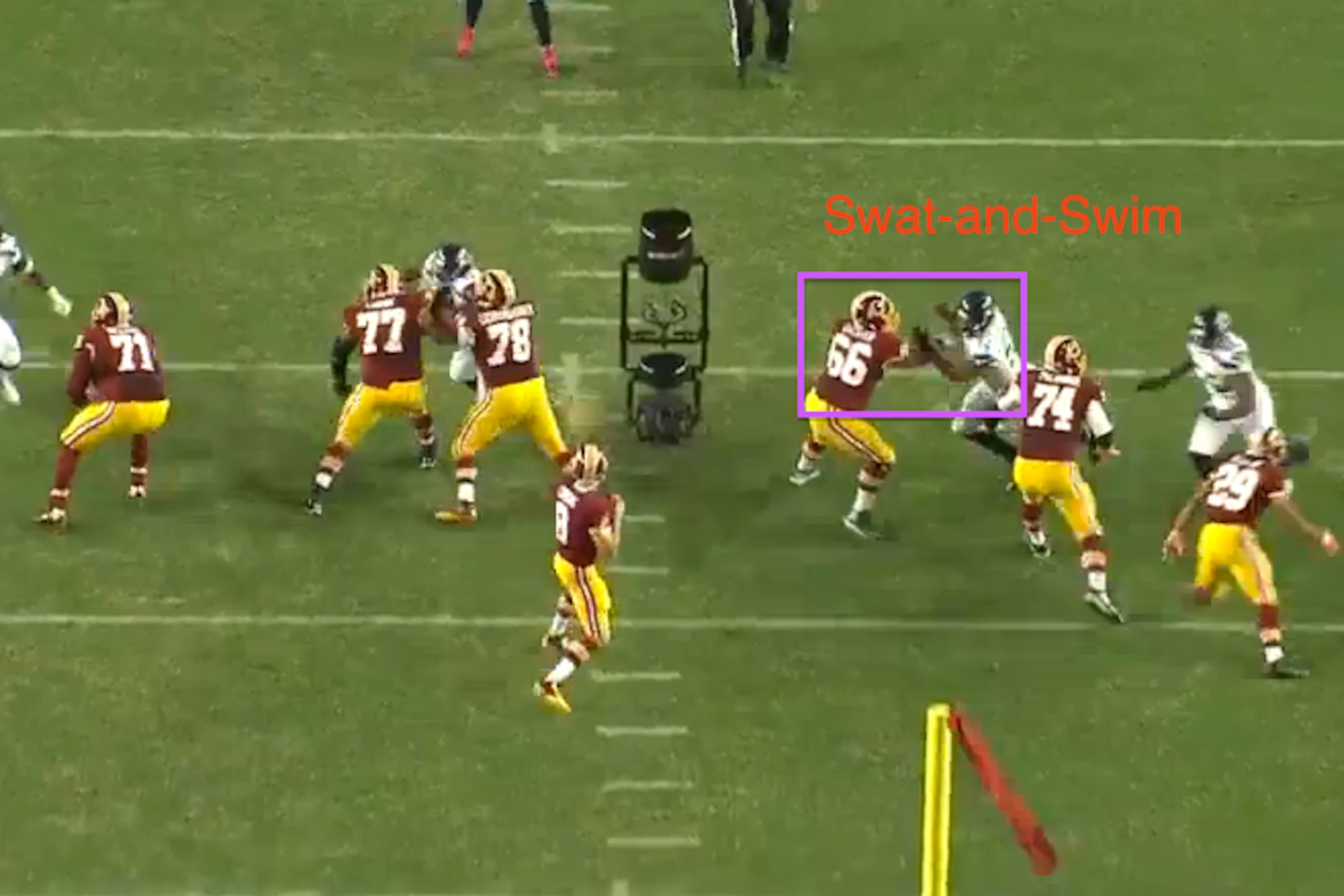
Notice just how wide Bennett lined up off the outside shoulder of right guard Chris Chester (66). He was practically aligned as a 5- or even a 6-technique over tackle Tyler Polumbus.
This wide-angled 3-technique stance is often known as "Eagle" in the parlance of defensive football. It gives Bennett plenty of options when choosing his rush path. He can loop to the outside, slant across a guard, or draw a double-team simply by taking a straight line through the B-gap.
In this case, Bennett opted to attack Chester's outside shoulder. He displayed excellent hands technique to produce a classic swat-and-swim move to split the B-gap and collapse the pocket in front of Washington passer Kirk Cousins:
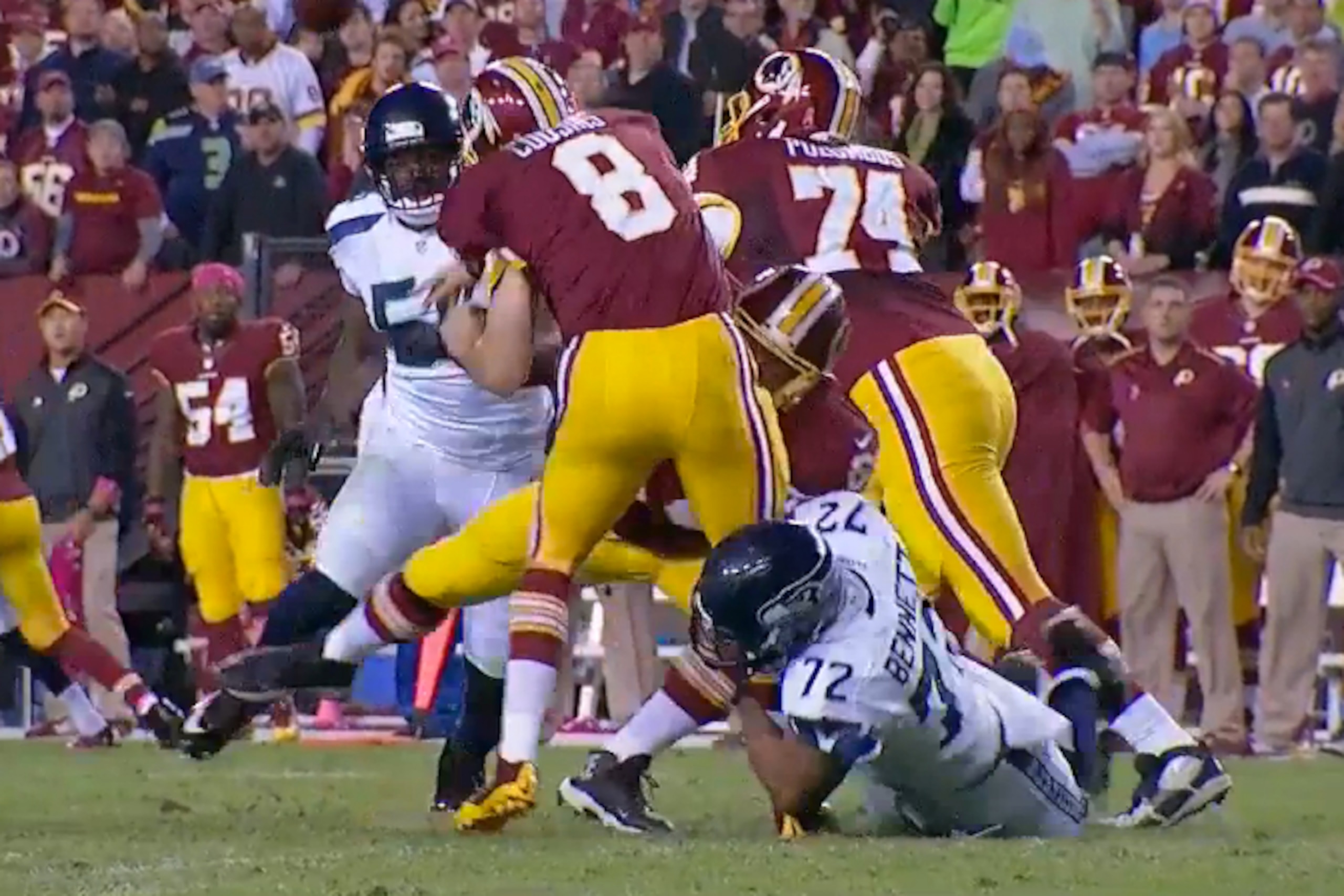
Once Bennett broke through the line, he quickly closed on Cousins and took the quarterback down low. The result was an incomplete pass, even though Cousins had running back Roy Helu Jr. wide-open in the middle of the field (sadly, not pictured):
But knowing where Bennett is initially isn't the same as knowing where he'll be once the play begins. As well as being a master of disguise, he's also a crafty shapeshifter.
He gave a great example of his chameleon-like skills on a 2nd-and-9 play in the third quarter of the narrow loss to the New England Patriots in the Super Bowl.
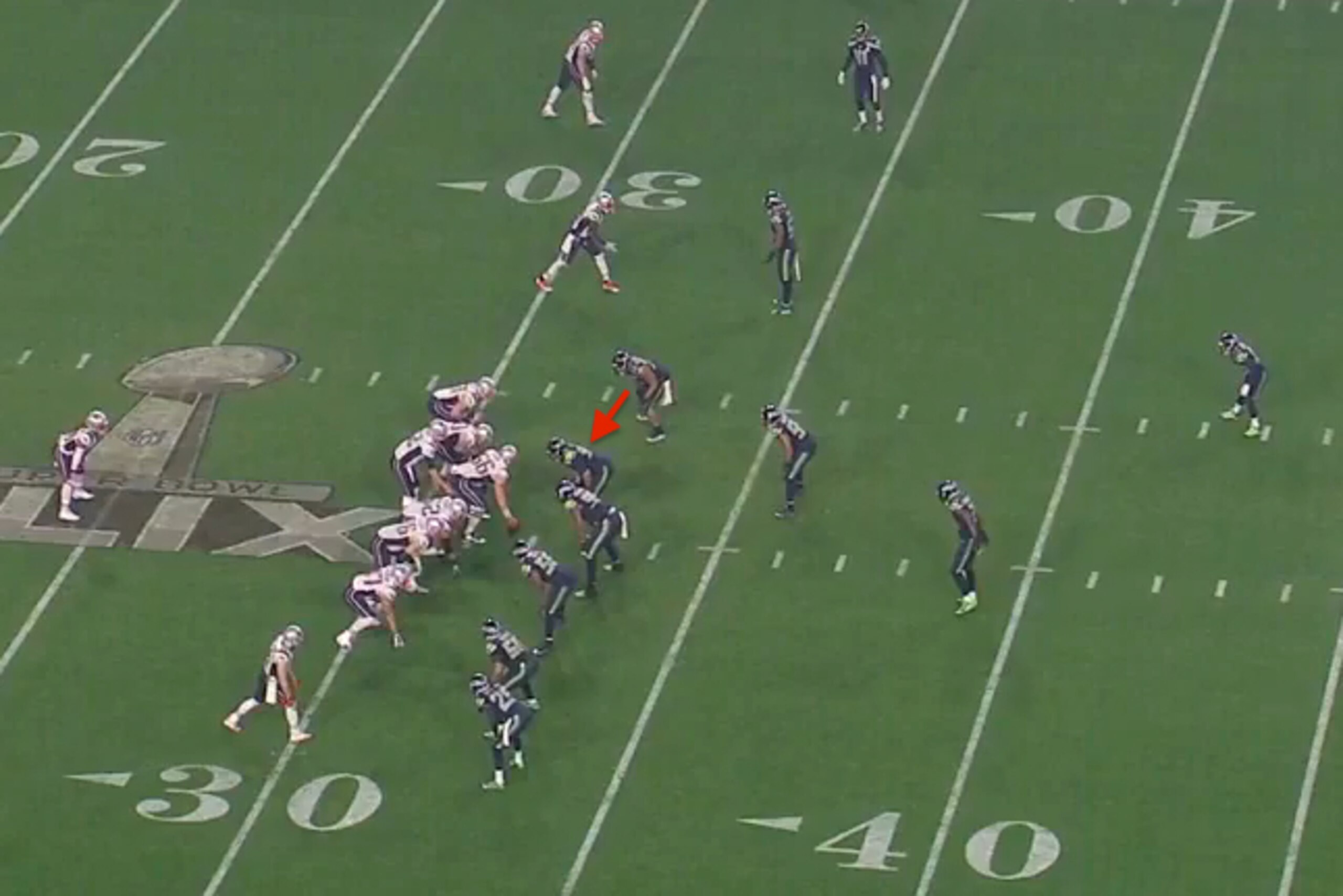
Bennett started out aligned in another wide-angled stance. He appeared to be getting ready to attack the edge as a rush end. But just prior to the snap, the 29-year-old darted inside and morphed from a 5- or 6-technique into a 3-technique:
He was now positioned between Pats left tackle Nate Solder and guard Dan Connolly:
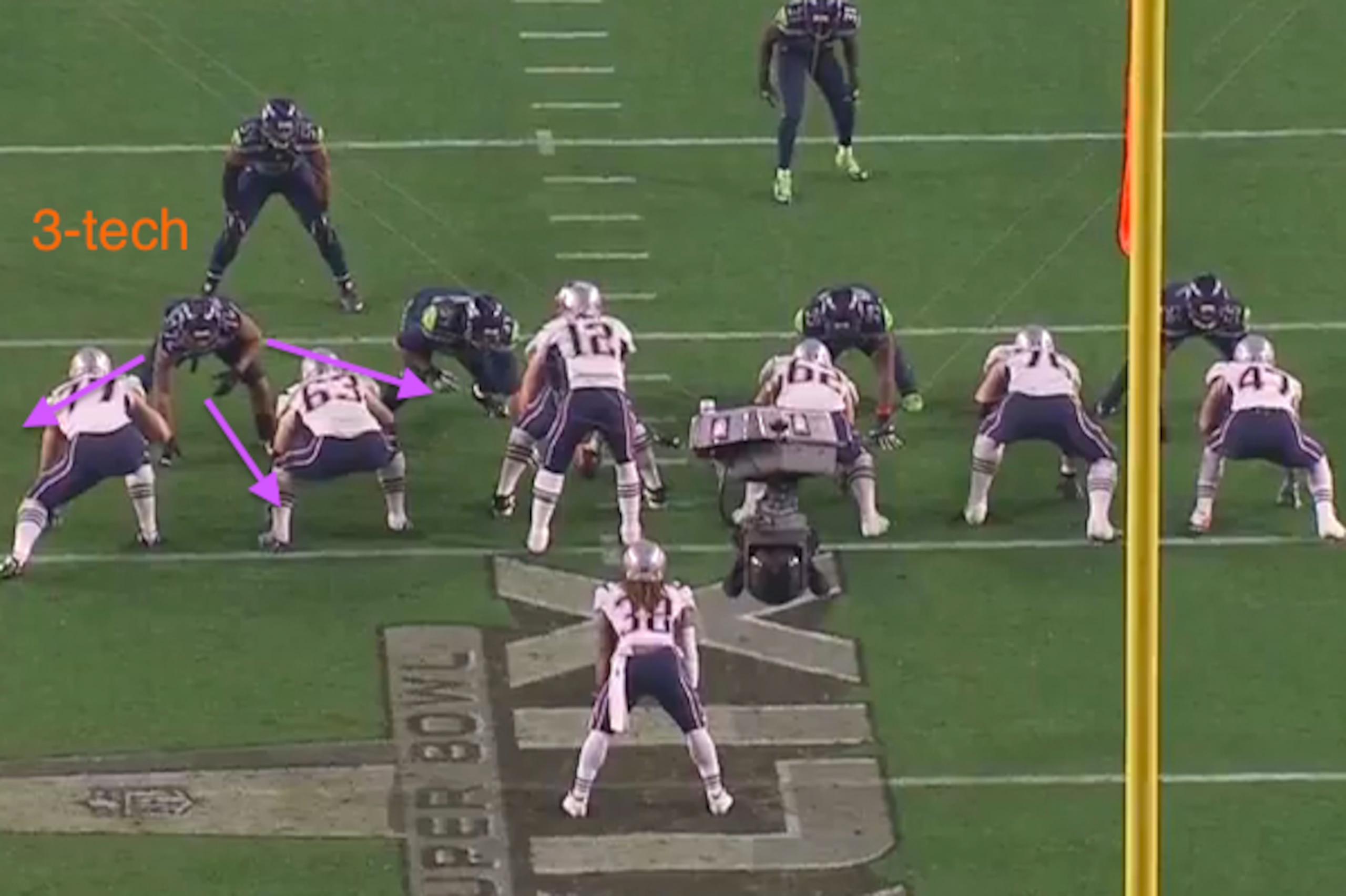
Again faced with multiple rush lanes, Bennett ran a stunt with veteran D-tackle Kevin Williams. The latter looped to the outside, while Bennett slanted inside Connolly and rookie center Michael Stork.
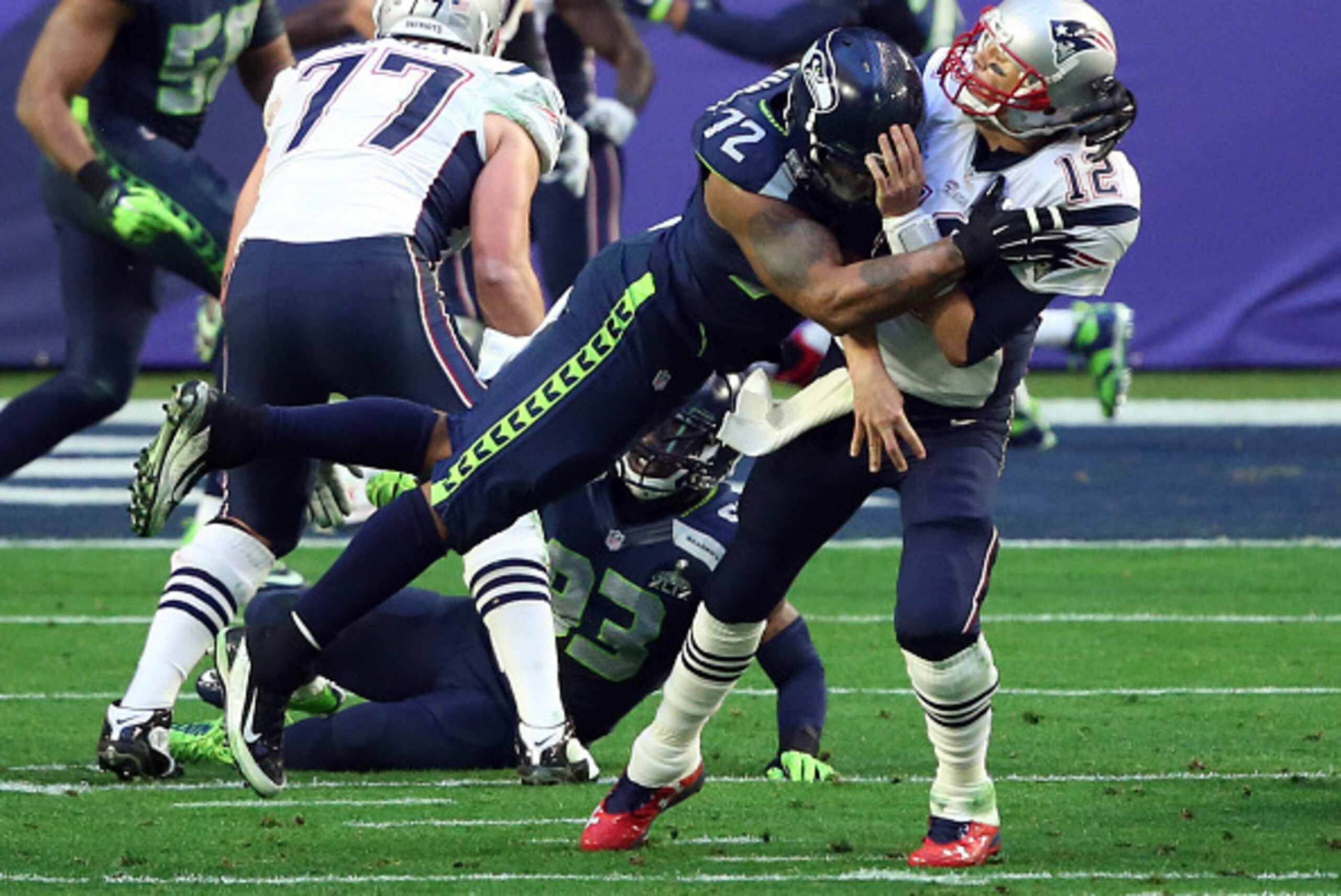
Bennett easily beat Connolly with speed and came clean through the middle to zero in on Tom Brady:
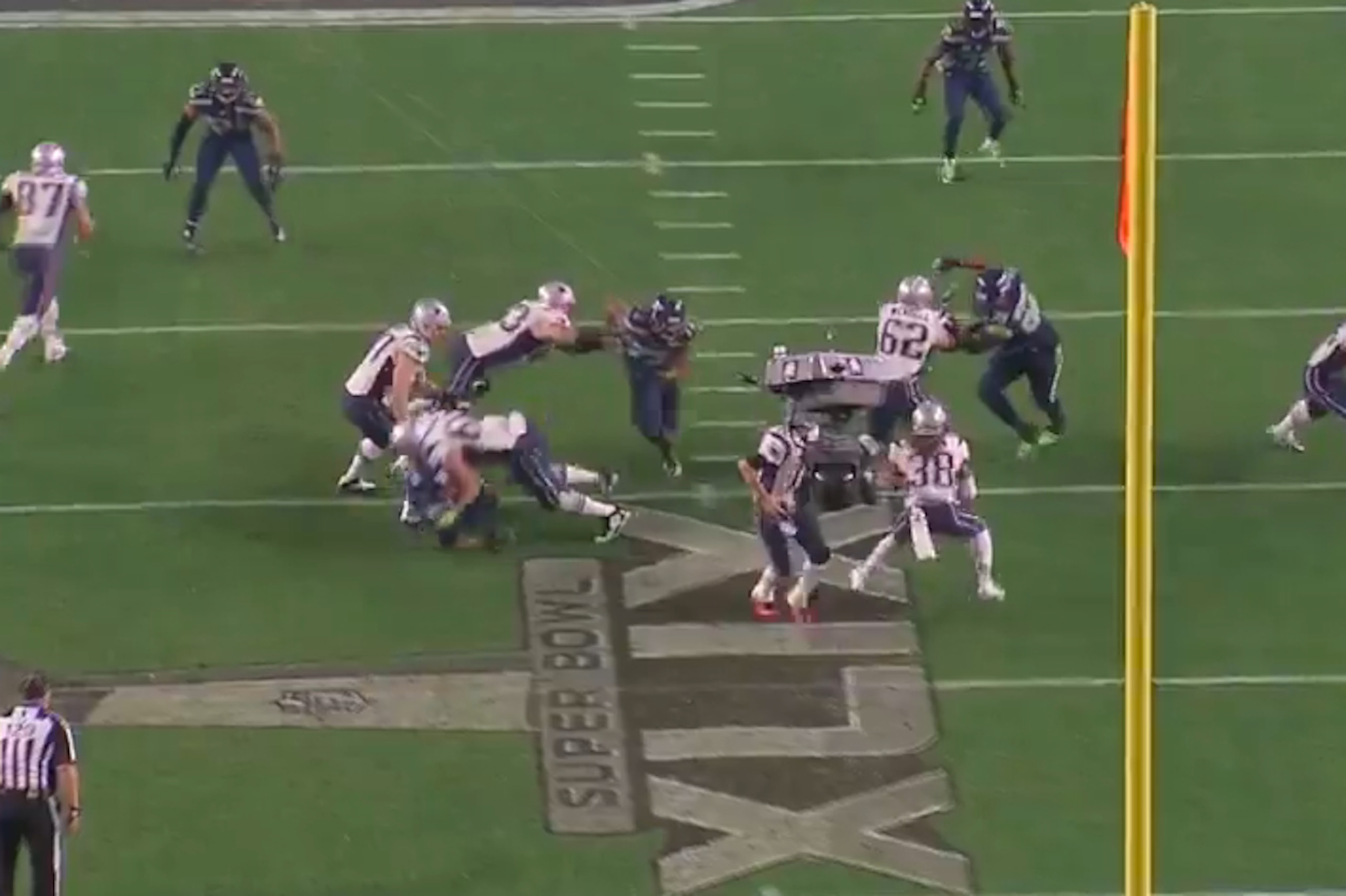
Bennett's rush meant Brady couldn't step up in the pocket and set his feet to launch a strike downfield. Seattle's star lineman was in his face so quickly that all Brady could do was sail a pass into the ground:

Answers on a postcard if you know where Brady's immediate receiver was on a play that was shockingly not flagged for intentional grounding:

But that wasn't the end of Bennett's destruction of the New England offense during one of the greatest performances in a losing cause in Super Bowl history.
Having overwhelmed a guard, Bennett switched his focus to the first-year anchorman at the heart of the Patriots O-line. On a 1st-and-10 play later in the third quarter, Bennett prepared to attack Stork.
He again lined up in the B-gap on the left side. But this time, Bennett tilted his stance so he was almost head-up over Connolly as a 2-technique. He was now better positioned to slant Stork's way:

That's just what happened once the ball was snapped. Stork couldn't handle the speed and power of Bennett's rush.
Notice how the rookie's inside arm was already working under Bennett's shoulder pad:

Bennett still powered through Stork's grasp, forcing the center to take hold of his jersey, an infraction that soon drew a flag:
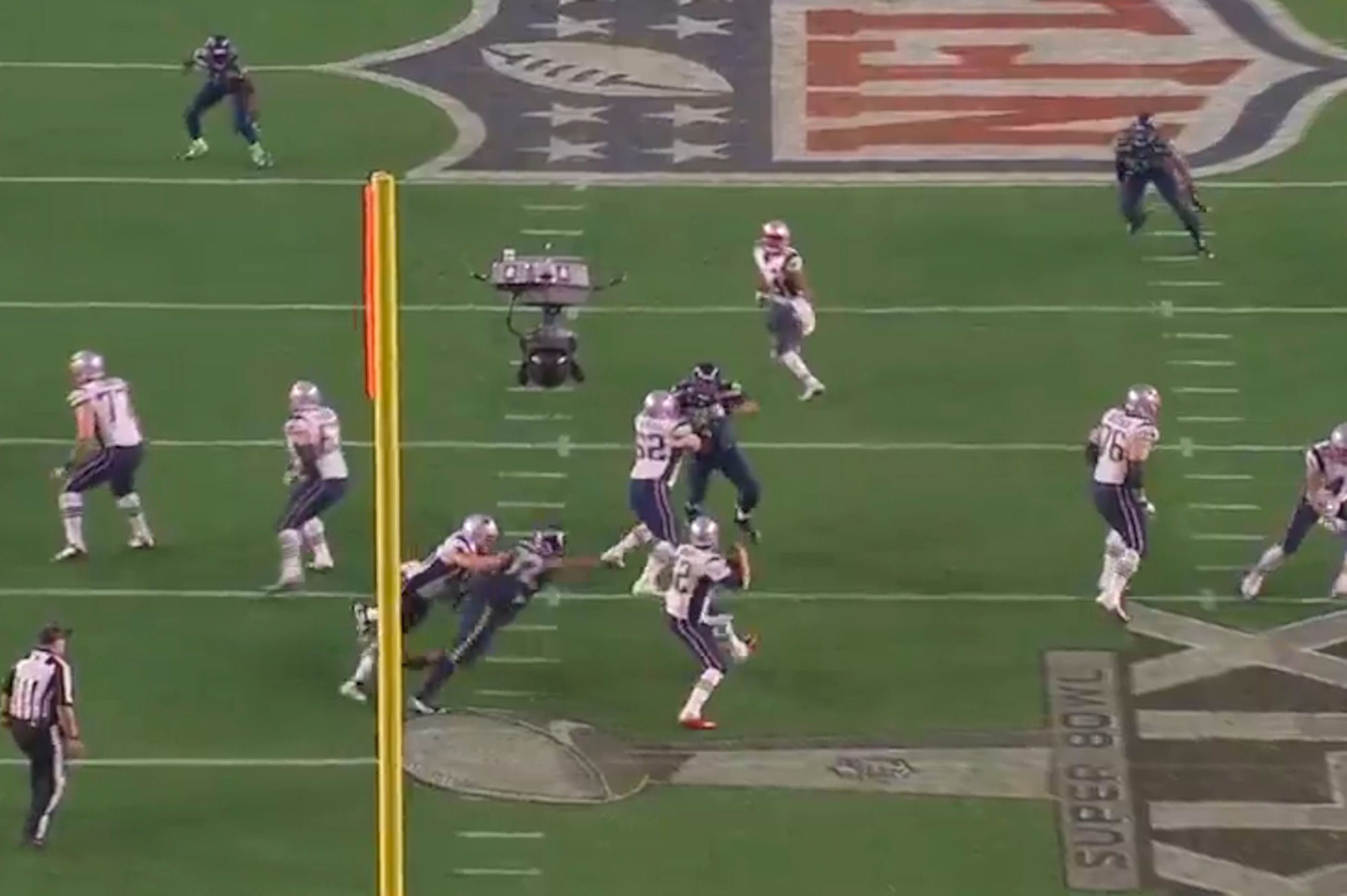
Here's a better look at Stork's offense, which cost New England 10 yards:

Often, a pass-rusher will consider a 10-yard loss incurred via penalty to be as good as a sack. That's a common theme between these three plays.
Bennett didn't get a sack on any of them. But on each occasion, he wrecked an opponent's passing game.
A frequent argument against a new deal for Bennett is his lack of sacks. Yet 15.5 quarterback takedowns in two seasons shouldn't be sneezed at, especially from a lineman who moves around so much.
More importantly, sacks aren't the only way to disrupt an offense. Bennett finds other ways every week.
One involves collapsing the edges both against the run and the pass.
Bennett provided a great example of the former late in the third quarter against Washington. He began the play at end lined up over premier left tackle Trent Williams:
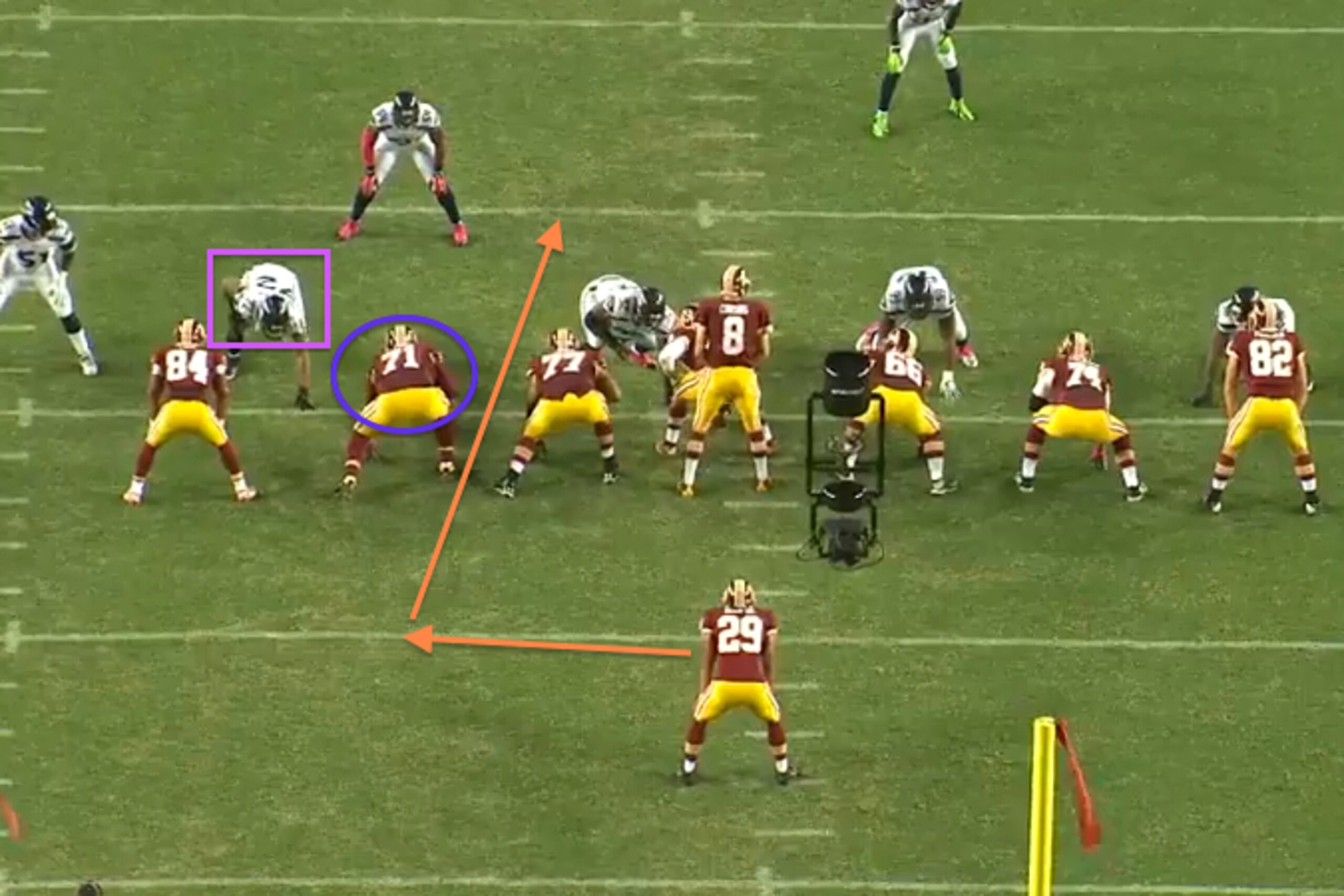
Washington was preparing a familiar zone-stretch, cutback run for Roy Helu Jr. But Bennett soon wrecked the play by taking away Helu's cutback lane.
He started by rocking Williams, a Pro Bowler who's one of the best run-blockers in the NFL, back on his heels:

By doing so, Bennett now controlled both gaps either side of Williams, the C-gap outside the tackle and the B-gap between the tackle and guard. Notice also how Bennett's efforts prevented Washington from getting a blocker on Bobby Wagner (middle of the picture), leaving the linebacker free to run to the ball.
This was a classic example of how a lineman should play two-gap defense.
But Bennett wasn't finished. He maintained his control over both gaps and kept Williams moving backwards. In the process, he took away Helu's cutback lane to the inside and forced the runner to continue pressing the play laterally:
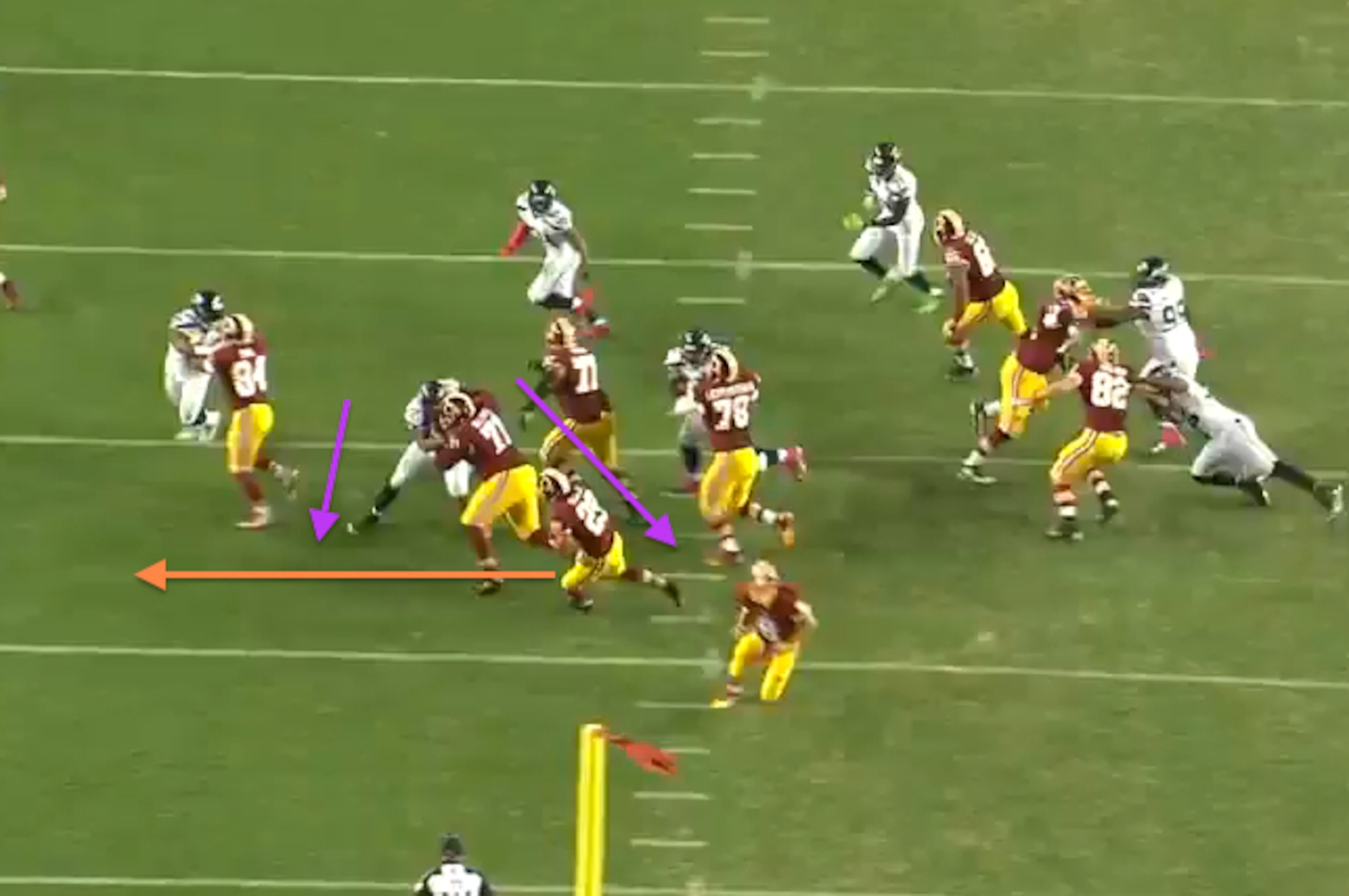
That's a win for any run defense, but especially one as expert in force and contain as Seattle's bruising unit.
Because Williams couldn't move Bennett, Helu had to bounce things wider still and maintain his path toward the sideline, even as the Redskins eventually got blockers to the linebacker level:
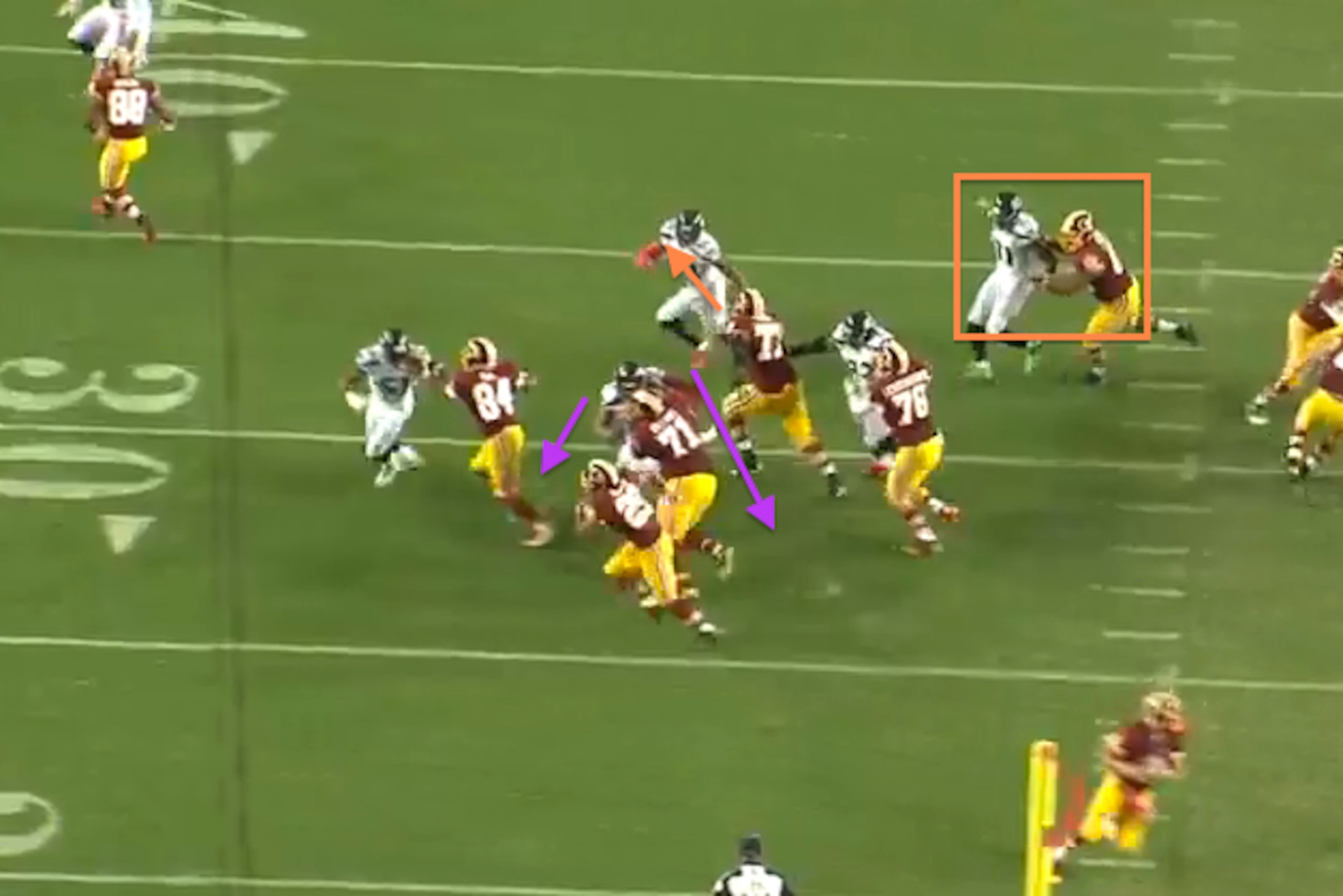
But Helu didn't even get that far. Bennett kept Williams moving back and even turned him enough to shed the block and swarm in on a gang tackle that dropped Washington's runner for a five-yard loss:
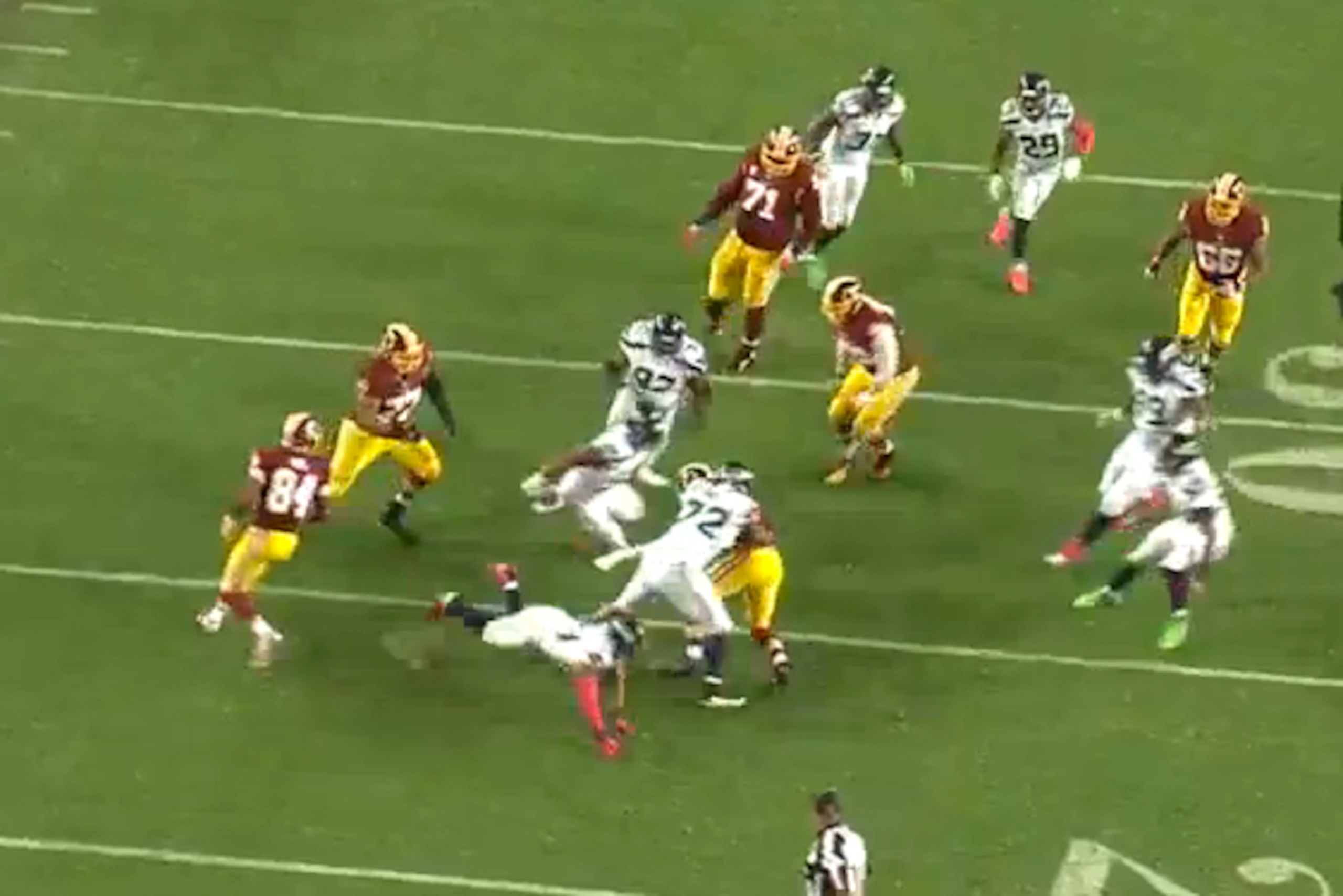
This type of thing just shouldn't happen to a dominant left tackle. But Bennett is one of the few D-linemen in football who can win in a variety of ways from wherever he lines up.
That was an example of his power against the run. What about his chops as a speed-based rusher off the edge?
Sure, Bennett's no Aldon Smith or Robert Quinn. But teams discount his talent as an outside pass-rusher at their peril.
He offered ample proof against the Jacksonville Jaguars back in Week 3 of the 2013 season. On a 3rd-and-5 play in the second quarter, Bennett lined up at end over the right side of Jacksonville's O-line:
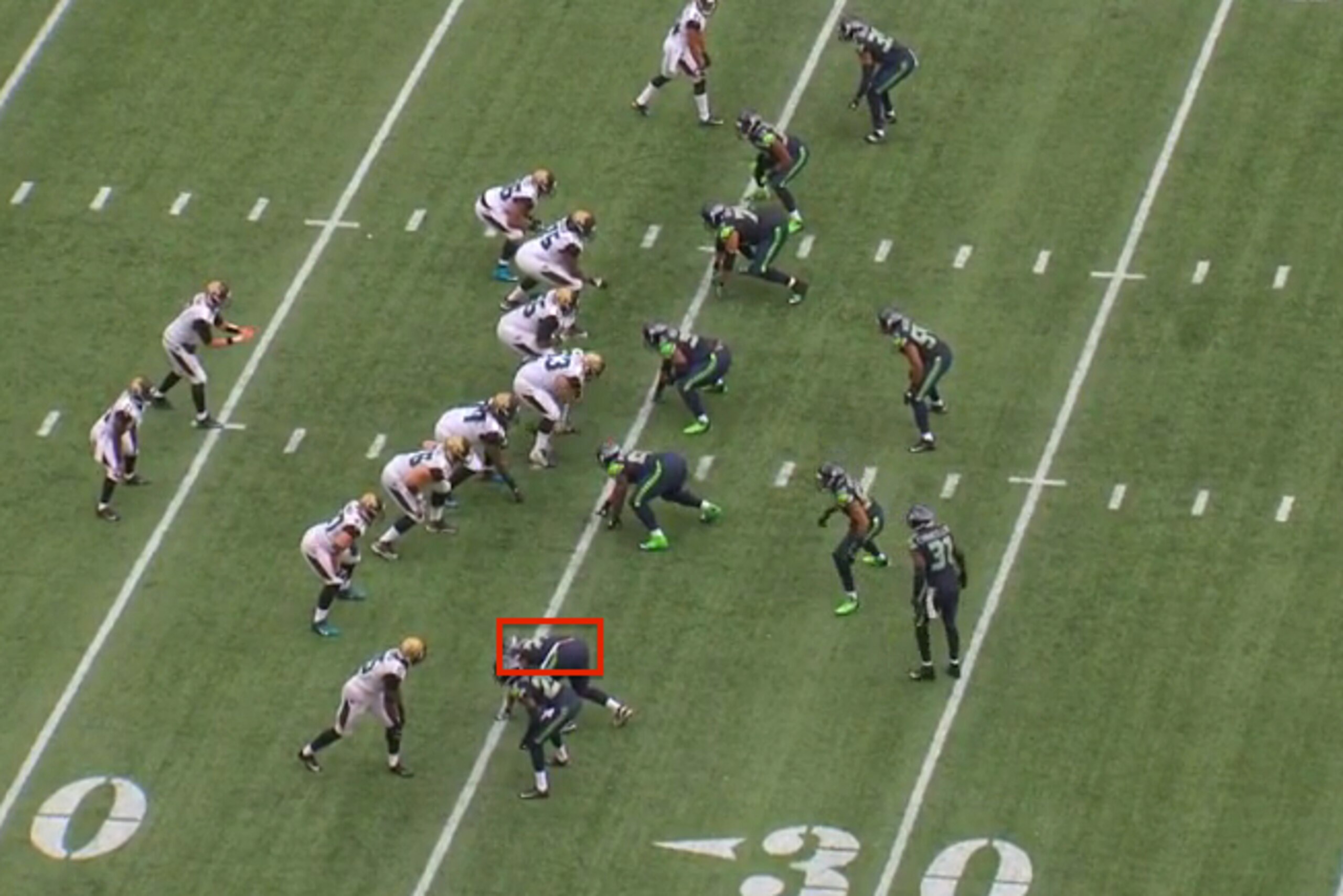
Bennett's alignment was very wide. In fact, he was positioned as a 9-technique over the outside shoulder of a tight end:
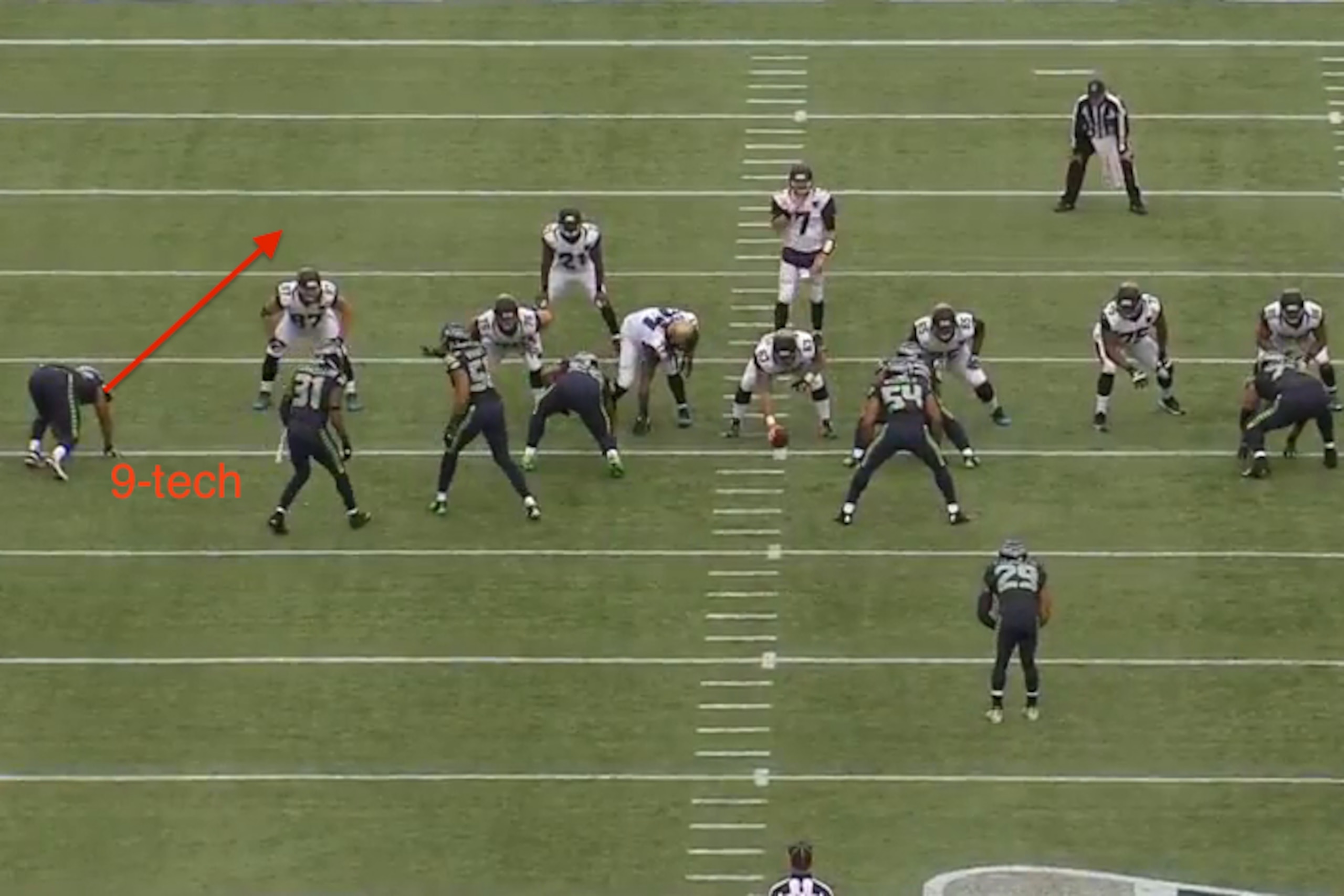
This was really a wide-9 alignment like the one the Philadelphia Eagles favored during the ill-fated days of their so-called "dream team." It's since become a very popular ploy with pass-rushers looking for a quicker takeoff and a more favorable angle for collapsing the edge.
Notice how Bennett was in a four-point stance. This is a sprinter-style alignment. It's pointless asking a lineman who isn't naturally dynamic off the edge to adopt this stance.
Bennett used it to blow by the tight end as if he wasn't there. Now the right tackle had to beat him to the corner:
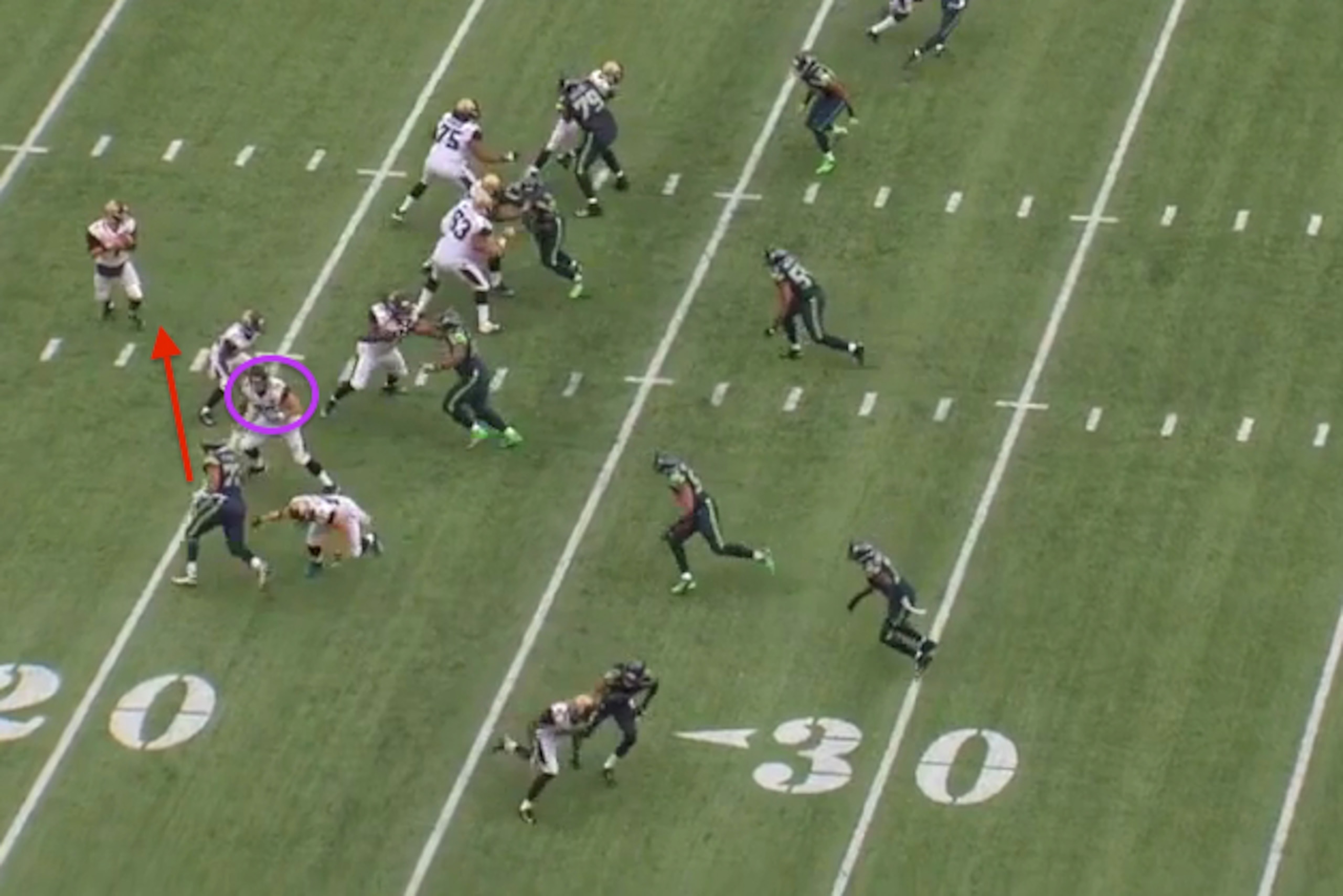
The tackle couldn't do it. Bennett deftly and swiftly dipped underneath before bolting around the corner to close on Jags quarterback Chad Henne:
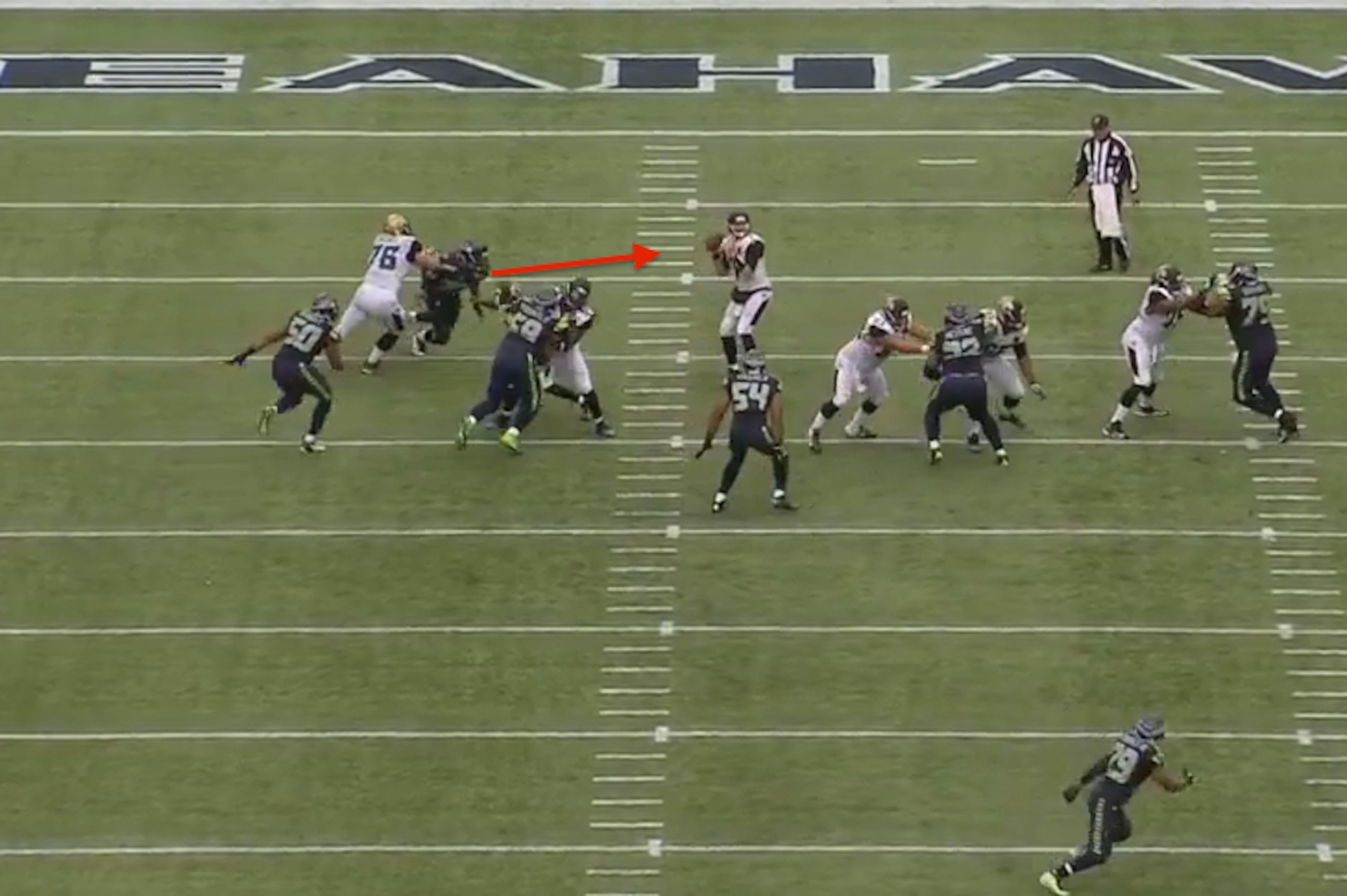
Bennett tripped Henne to notch a sack he also shared with D-tackle Clinton McDonald:
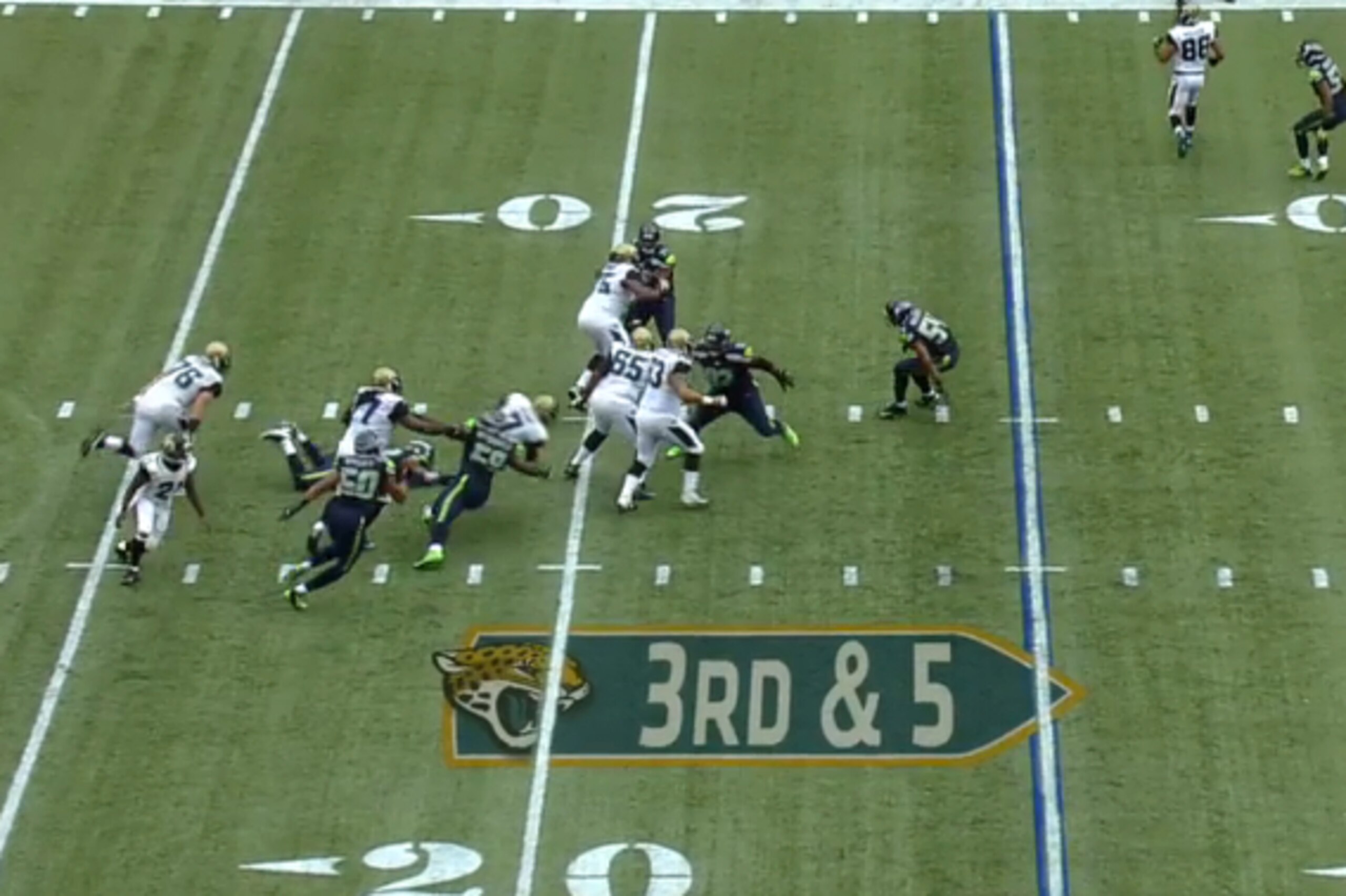
A lineman who can win as an outside speed-rusher as well as consistently dominate the interior with power is a rare beast indeed. Bennett's versatility lends tremendous flexibility to head coach Pete Carroll's hybrid defensive schemes.
Seattle's Week 10 win over the New York Giants in 2014 contained a good example of the wrinkles possible with Bennett in the lineup.
Big Blue faced 3rd-and-12 in the fourth quarter. Bennett began the play standing up. He was hovering along the line of scrimmage, trying to confuse quarterback Eli Manning and the Giants blockers about his intent:

New York didn't know whether Bennett would rush or drop. He stayed put, but his effect on the play wasn't reduced.
In fact, Bennett was positioned to cut off Manning's escape route from the pocket, an escape route he'd need as the Seahawks collapsed the edges of the pocket:
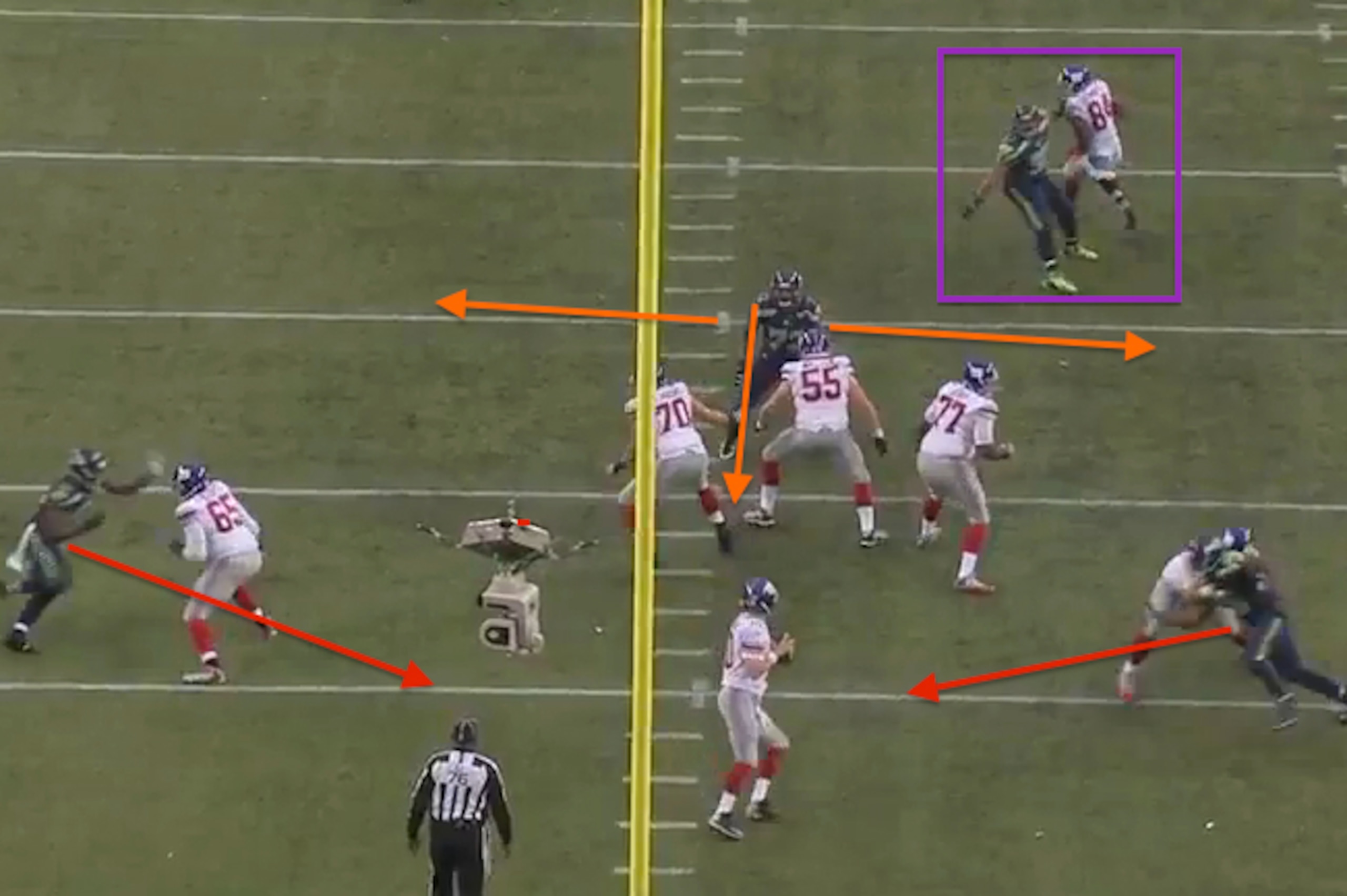
Bennett was also in a position to act as a robber against any shallow crossing routes underneath, a tactic the Seahawks utilized during their Super Bowl win over the Denver Broncos. Seattle put a lot on Bennett here, as fellow D-tackle Jordan Hill dropped off to cover tight end Larry Donnell.
Just by staying where he was, Bennett occupied a trio of inside blockers. That meant one-on-one matchups on the outside for edge-rushers Bruce Irvin and Cliff Avril:
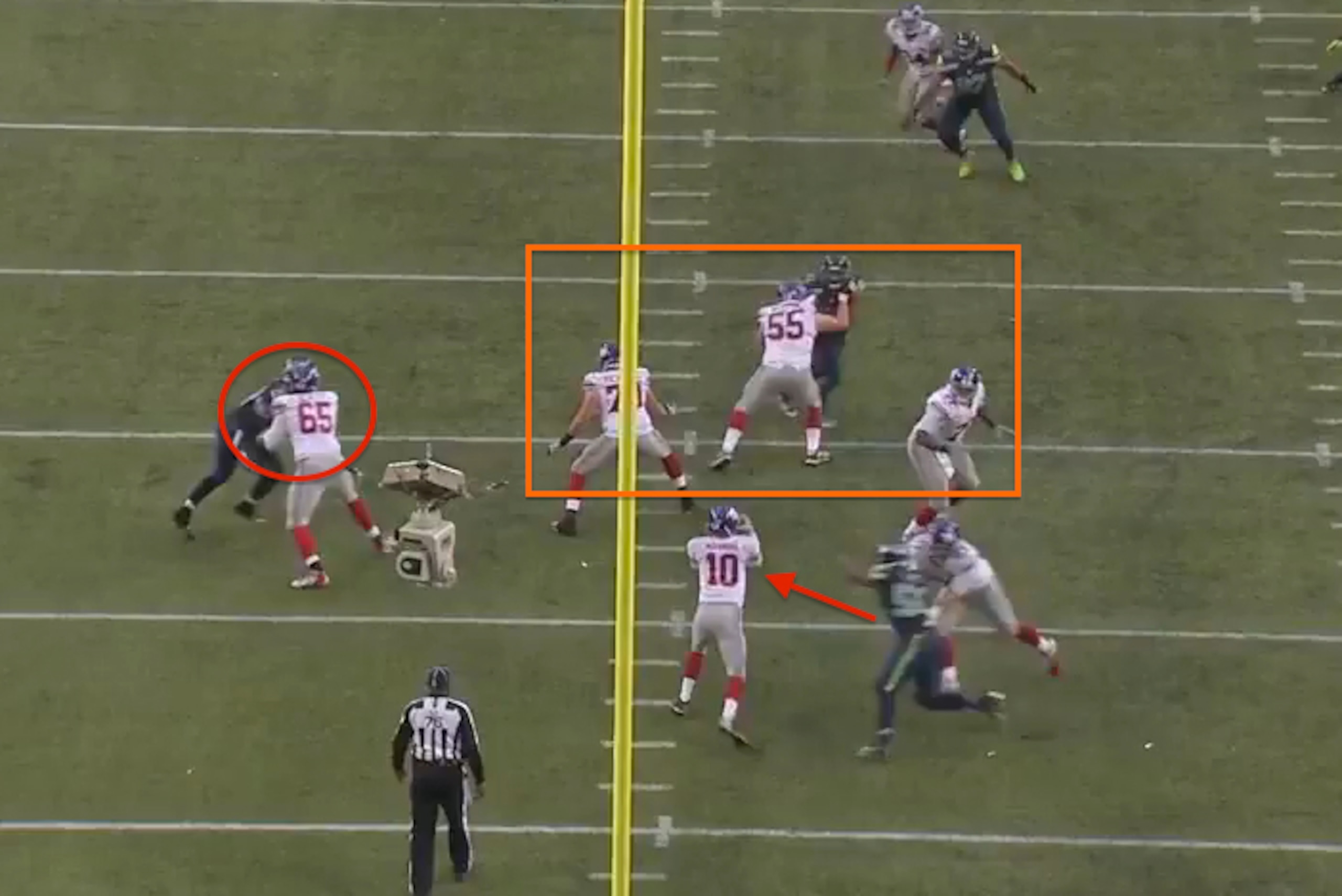
Avril's pressure forced Manning up in the pocket, where Bennett was waiting to take him down for a big loss:

Being able to stand a lineman up and move him around formations adds an invaluable level of unpredictability to both the coverage and pressure schemes. The point is that there aren't many linemen who possess the athleticism to do it.
Bennett is one of the few.
That's the issue facing the Seahawks. Can they really give up on an ultra-versatile moving part who's crucial to their defense?
It's a question that becomes tougher to answer considering the other looming contract issues facing the NFC West club.
Russell Wilson and What's More Important in Seattle: Offense or Defense?
The Seahawks need a long-term deal for Wilson, and they need it bad. But do they need it enough to make the NFL's half-sized Houdini the highest-paid player in football?
That's what B/R Insider Jason Cole believes it will take to sign 2012's third-round pick up for the long haul:
It's impossible to overstate Wilson's value to the Seahawks. He's been the catalyst who transformed a tough but limited team from a playoff contender to a Super Bowl winner.
His knack for manufacturing big plays is often the decisive factor for a team built to keep games close. Without Wilson, Seattle's formula of a power-based running game and tough defense probably has a 10-6 ceiling.
With Wilson, this team has the extra dimension it needs to stay atop the NFC for years. B/R analyst Matt Bowen detailed some of what Wilson adds to the offense during his look at the best players in the West:
The question here is whether Wilson is worth losing a player like Bennett. This strikes at a deeper question: Is offense or defense more important in Seattle?
Sure, Wilson is the spark that lit the touch paper for the Seahawks' championship success. But they wouldn't even be in the conversation if it wasn't for the defense Carroll brought to town in 2010.
That unit wouldn't even be in the mix among the league's best if it wasn't for Bennett. He's as important to the defense as Wilson and running back Marshawn Lynch are to the offense.
So, the question becomes: Would Seattle's defense be as effective without Bennett? Yes, the pass rush could be stronger, but imagine what the Seahawks' ability to bring pressure would be without Bennett.
Actually, don't imagine. Go back to the 2012 season for a depressing memory. The Seahawks were owners of a pretty stingy defense that season, but their mediocre sack totals (36, according to Pro-Football-Reference.com), cost the team in the playoffs.
There wasn't even a hint of pressure on Atlanta Falcons quarterback Matt Ryan as he passed his team to victory in the dying seconds of the divisional round.
Just like Wilson was the catalyst for the offense, Bennett's arrival, and to a lesser extent Avril's, was the spark that elevated the Seattle D to the league's elite.
Bennett is still the most effective pass-rusher on this team, as B/R analyst Chris Simms noted:
It's not as if the Seahawks are overflowing with standout linemen. Sure, there are some solid pros up front, but none offer the playmaking potential Bennett boasts. Take him out of the mix, and an already thin rotation goes from a team strength to a potential weakness.
Brian Nemhauser of Hawks Blogger recently told B/R's Stephen Nelson how strength in depth up front rates as a concern ahead of the new season:
Bennett Has Established a Niche, So Reward Him Accordingly
Niche skills always demand a premium. It doesn't matter if it's in sports or other walks of life. Bennett has established a niche as a roving agent of destruction up front in a 4-3 defense.
Hybrid D-linemen are rare, but no other 4-3 ends offer what Bennett does. Without his move skills and multiple ways to attack offenses, Seattle's defense just isn't the same.
His talent for creating pressure from a host of positions is essential for a scheme designed on the premise of rush, coverage and not a lot of blitzing.
It's no wonder Simms picked him as the unit's MVP for 2015 ahead of the likes of Wagner and a star-studded secondary:
For that prediction to come true, the Seahawks should pay Bennett accordingly for everything he does. He made that clear, via Bob Condotta of the Seattle Times: "Somewhere near the top seven at my position, top eight at my position. Not a lot of guys play inside and out (meaning both tackle and end). Not a lot of guys do what I do. So I feel like I should be somewhere near there."
Citing OverTheCap.com, Condotta also detailed where Bennett's deal puts him in the pay scale context of fellow players at his position: "That ranks him tied for 14th in average salary per year ($7.125 million) among defensive ends in a 4-3 defense, according to OvertheCap.com."
Bennett is being paid like a mid-tier 4-3 defensive end. But he's not a 4-3 defensive end. He's an all-purpose D-line playmaker.
ESPN's Terry Blount has described what an increased deal may look like in terms of numbers: "He signed a four-year, $28.5 million deal ($16 million guaranteed) in March 2014. But Bennett now wants to be paid among the top 10 defensive ends in the NFL, which would increase his contract to more than $10 million per year."
A holdout is Bennett's best way to prove his point. If he stays on his current contract, he won't be getting paid for most of the things he does.
Not paying him would be another hint that NFL teams still don't like defensive hybrids. Even in the era of multiple-front schemes, pro teams and coaches don't want square pegs for round holes.
At least not when it comes to contract time.
Just look at the player closest to Bennett, in terms of versatility and style, Muhammad Wilkerson. His team, the New York Jets, aren't in a rush to pay him.
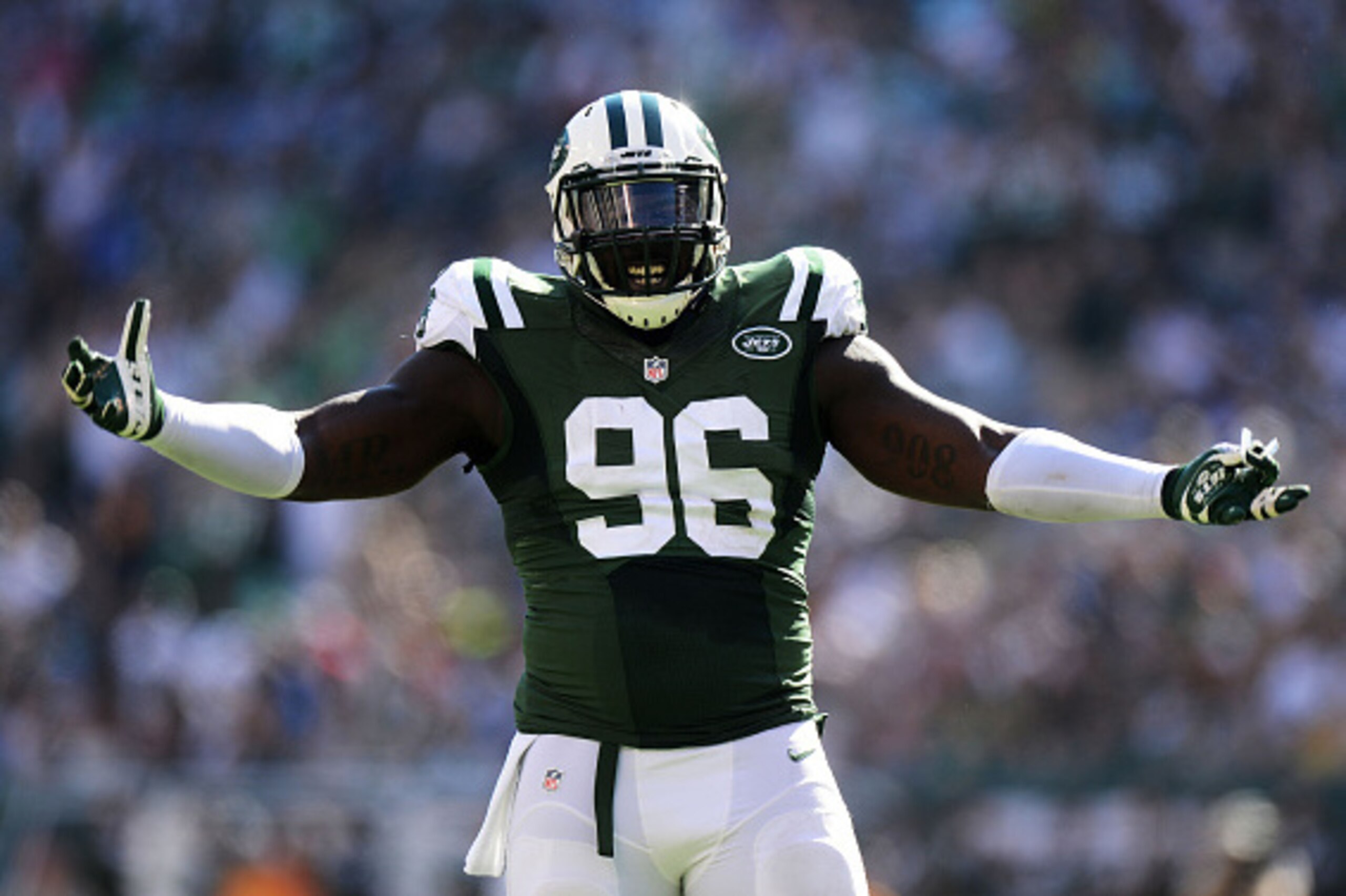
On the field, a team like the St. Louis Rams wants Quinn to rush from both end spots, slide inside and occasionally stand up. But when it comes time to pay him, you can bet they'll be assigning his value to one position.
Then it will be all about sack totals. But that's not the only way you judge today's breed of linemen.
The times they have a-changed. Today's hybrids are no longer just players who can rush from a three-point stance or standing up.
Now there is a new breed of D-line chameleons who will adopt different guises and make plays from multiple positions. Justin Tuck blazed a trail for this type of front-line jack of all trades back during the latter part of the last decade.
But now Bennett is the premier player of this new breed. He's redefined his position and Seattle's scheme.
Just pay the man, already.
All screenshots courtesy of CBS Sports, ESPN, Fox Sports, NBC Sports and NFL.com Game Pass.
All player information and statistics via NFL.com, unless otherwise stated.
.jpg?w=2560 "Broncos Chargers Football")

.jpg?w=2560 "MHJ Bought Own Jugs Machine")