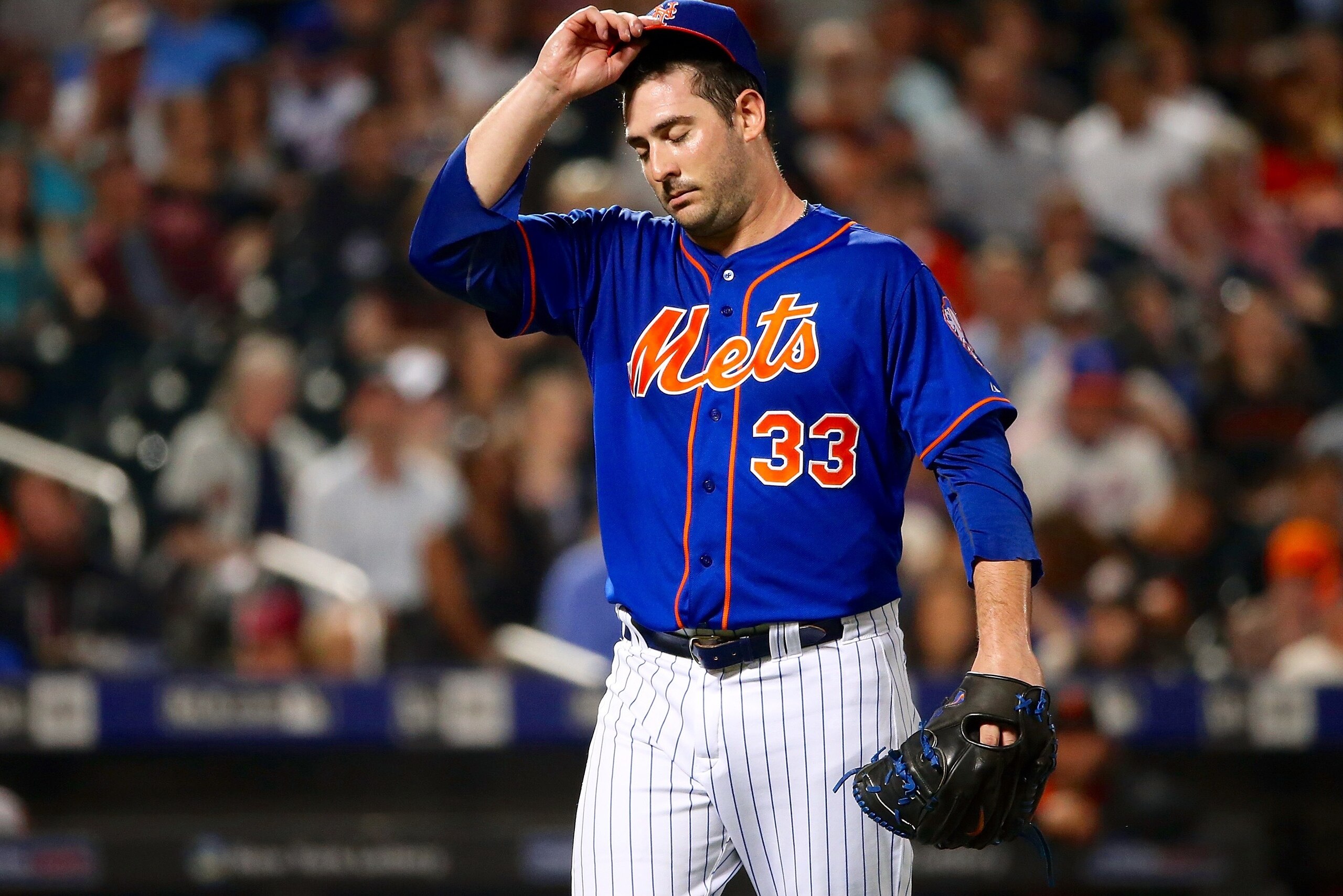


All of a sudden, the Dark Knight is getting lit up.
If you're not up-to-date on current affairs, Matt Harvey isn't doing so well these days. The star New York Mets right-hander had been looking human in three starts prior to his outing against the San Francisco Giants at Citi Field on Wednesday night, and then he pitched maybe the worst game of his career.
Harvey lasted just six innings against the Giants in the Mets' 8-5 loss, giving up seven earned runs on nine hits and two walks. Three of the hits the 26-year-old gave up left the ballpark, and he struck out only two batters.
TOP NEWS

MLB Testing Fielding Rule 🤔

Bold MLB Predictions For 2026-27 Offseason 🔮

Best Free-Agent Hitters 💥
And now, here we are surveying the wreckage of Harvey's last four starts in its totality. Be warned, it's not pretty:
| First 8 Starts | 54.2 | 56 | 8 | 42 | 4 | 1.98 |
| Last 4 Starts | 25.0 | 26 | 6 | 27 | 8 | 7.20 |
That's a bad stretch—bad enough to send Harvey's ERA skyrocketing by more than a run and a half from 1.98 all the way up to 3.62.
And given the circumstances, it's certainly bad enough to make us wonder if anything is wrong with him.
He is, after all, only 12 starts into his comeback from Tommy John surgery that ended his Cy Young-worthy 2013 season and sidelined him for the entire 2014 season. It was also just a couple of weeks ago that Mets skipper Terry Collins was wondering aloud whether Harvey was suffering from a dead arm.
So, maybe he's not just in a funk. Maybe he's hurt. Maybe he's fatigued. Or worse, maybe he's both.
Naturally, nobody's going to get Harvey to admit he's in the middle of a Tommy John hangover. We know this thanks to Marc Carig of Newsday, who reports that Harvey had this to say when asked about the possibility after Wednesday night's game:
If his word is good enough for the Mets, so be it. If it's good enough for you too, dear reader, same thing.
But why should we take Harvey's word for it when we can see what we can see for ourselves?
It's to the data we shall go. And here's a spoiler alert: It's not all happiness and sunshine.

How do you search for signs of injury in pitching data? According to a study by noted PITCHf/x guru Jeff Zimmerman, you can look at a number of different things.
Not surprisingly, one of them is velocity.
At least as far as this conversation is concerned, that's also known as Harvey's primary moneymaker. He normally throws really, really hard—harder than any other National League starter, in fact, according to FanGraphs' leaderboard of qualified starters.
And this, fortunately, leads us to some good news: Harvey's velocity is just fine.

According to Brooks Baseball, Harvey has actually been throwing harder more recently. His average release speed on his fastball through his first eight starts was 96.7 miles per hour. He was averaging 97.5 mph in three starts leading up to Wednesday's outing, and then once again he found himself in the 97-98 range.
What makes this particularly welcome news is what happened back in 2013. In the last two starts Harvey made before it was determined he needed Tommy John surgery, his velocity had taken a noticeable tumble. We're not seeing the same thing now, and that's worth a sigh of relief.
Rather than velocity, what's been getting Harvey in trouble recently has been his location. The eye test says he's been working up in the zone too much for his own good. And lo and behold, the data confirms that.
Per BaseballSavant.com, Harvey was throwing only 25.9 percent of his pitches in the upper two-thirds of the strike zone through his first eight outings. In three outings leading up to Wednesday, that number had risen to 32.2 percent. A plot of his pitches against the Giants shows that the trend didn't quit:
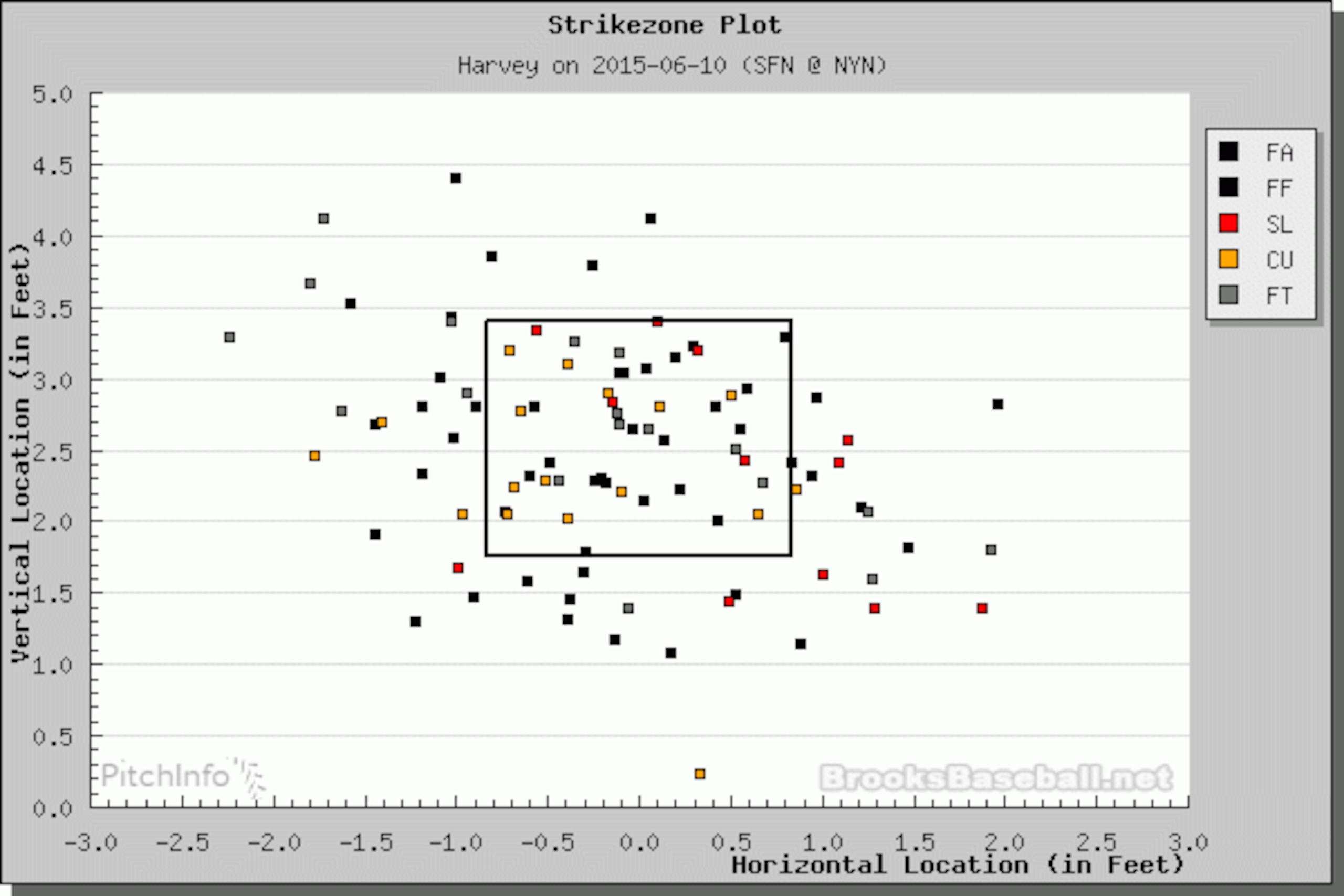
Now, what should be a bright side is that Harvey's trek into the upper two-thirds of the strike zone shouldn't matter. With his stuff, he can normally beat hitters pretty much wherever he wants.
Normally, yes, but what's also normally true is that Harvey makes his stuff that much more overpowering by putting it where he wants. Normally, his command is superb.
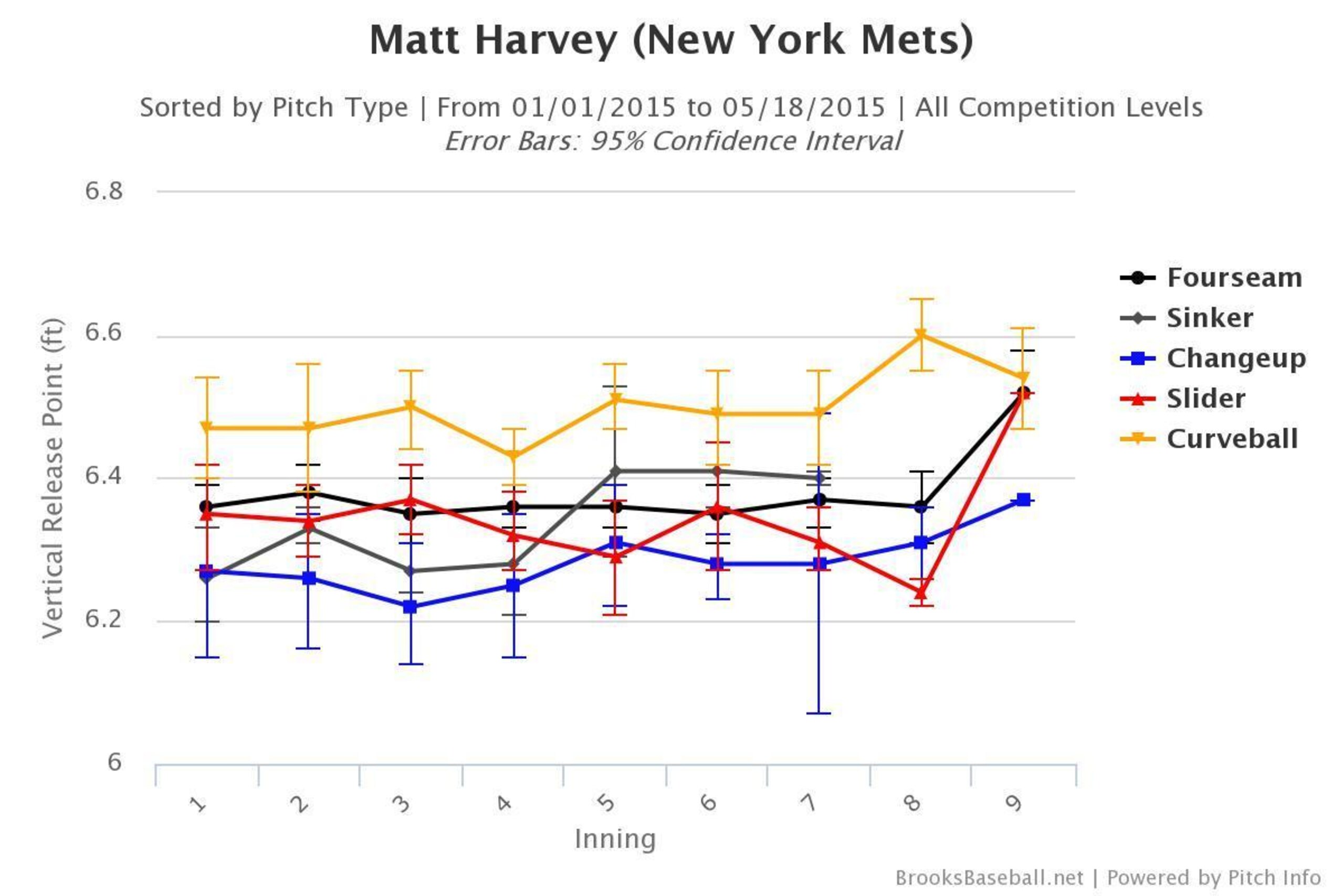
That it's no longer superb suggests there may be a problem with his release point, which is another thing Zimmerman hit on in his study. And looking at Harvey's release points from an inning-to-inning perspective, there appears to be a red flag.
Courtesy of Brooks Baseball, Harvey's inning-to-inning release-point consistency looked like this in his first eight starts:
And while the data from Wednesday night hasn't been factored in yet, here's Harvey more recently:
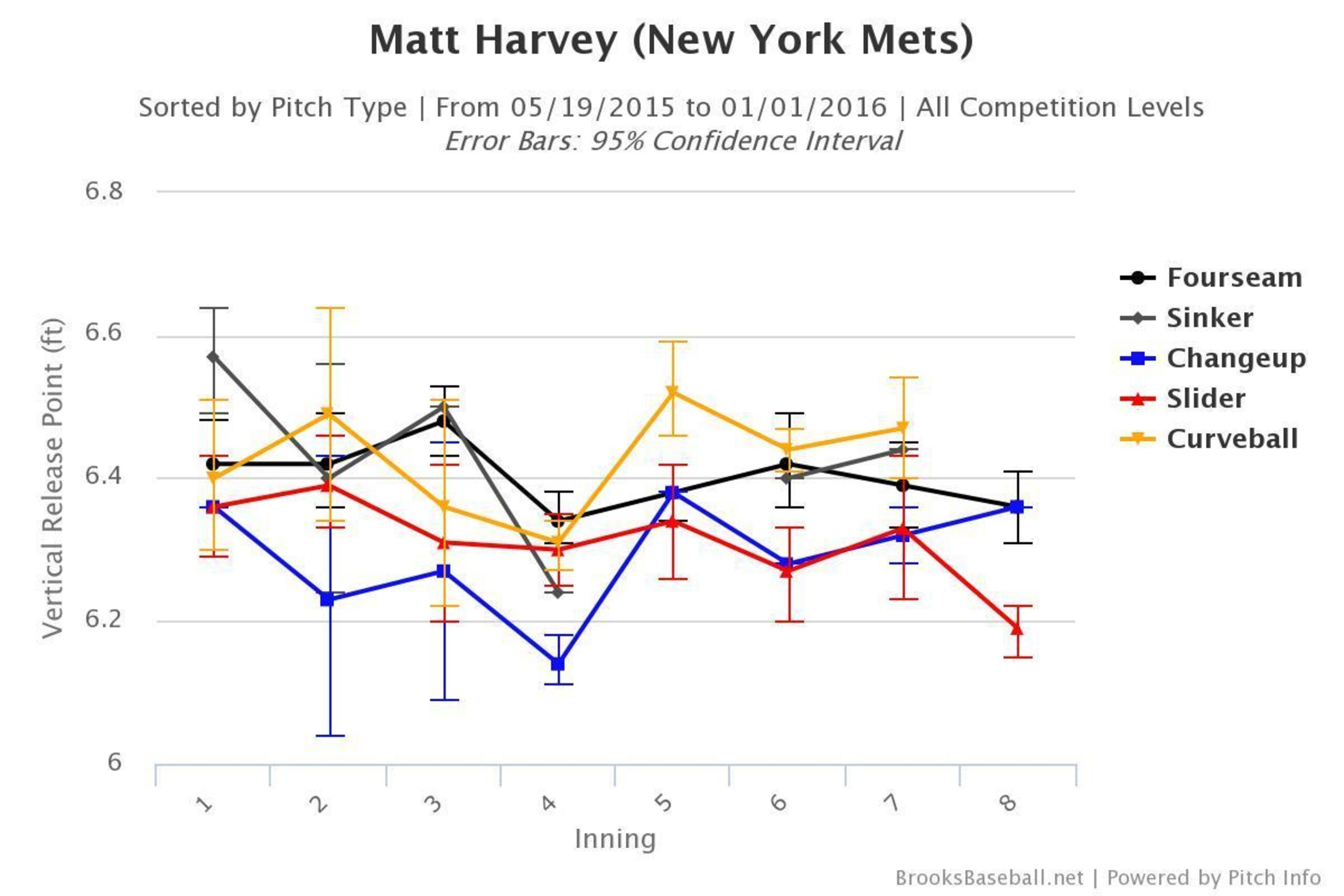
These lines are much more squiggly than the ones above. That's worrisome enough in its own right, and then you notice that Harvey's fastball release point has been going from nice and high early on to not-so-nice-and-high afterward.
So, where Harvey's velocity says all is well, his release point suggests that maybe all isn't well.
Mind you, this shouldn't be taken as a clear-cut indication Harvey isn't 100 percent healthy. It's entirely possible that Collins was and still is right about him going through a dead-arm period.
For that matter, he probably wouldn't be the only one. Hall of Fame hurler Pedro Martinez says 'tis the season for such things:
"The Mets need to monitor Harvey because this is the time when pitchers start to feel fatigue and tiredness.
— Pedro Martinez (@45PedroMartinez) June 11, 2015"
And of course, there's also the possibility Harvey isn't fatigued at all. Maybe he's just in a funk. Pitchers have been known to go into those and to come out of them at a moment's notice.
Either way, the Mets can only approach Harvey's situation one of two ways. They can shrug off his recent run of bad pitching as if it's just one of those things, or they can play it safe and alter his workload.
Harvey would no doubt prefer that the Mets choose the former. But knowing they were planning on limiting Harvey's innings this season, according to MLB.com's Paul Casella (via Sports Illustrated), and they were very recently toying with a six-man rotation designed, in part, to protect Harvey, here's guessing they'll choose the later.
And in light of the circumstances, that would be the right idea.
It's not obvious there's anything wrong with Harvey. But between his poor results and the apparent mechanical inconsistencies at the root of those, there's enough to suggest that the cautious path is the one the Mets should be treading right now.
Harvey's probably not going to like it if the Mets choose to play it safe with him. But whether he likes it or not, he's the kind of guy who's worth playing it safe for.
Stats courtesy of Baseball-Reference.com, Brooks Baseball and FanGraphs unless otherwise noted/linked.
If you want to talk baseball, hit me up on Twitter.





.jpg?w=2560 "Latest Peyton-Colts Rumors")