Why Pablo Sandoval Will Get out of His Season Slump Soon
The first two months of Pablo Sandoval’s five-year, $95 million contract with the Boston Red Sox have been a disaster.
The former World Series MVP has put up a meager slash line of .239/.303/.348 with just five home runs in 51 games played, while the Red Sox are toiling in last place in the AL East.
Little has gone right for Sandoval, but based on some advanced stats, his age and past performance, he should be on the verge a breakout, and it could come very soon.
TOP NEWS

MLB Testing Fielding Rule 🤔

Bold MLB Predictions For 2026-27 Offseason 🔮

Best Free-Agent Hitters 💥
At the crux of Sandoval’s hitting woes this season is his inability to find any success against left-handed pitching. Unless noted otherwise, all of the stats that follow are data from Fangraphs.com.
This season, Sandoval, a switch hitter, has two hits (both singles) in 44 plate appearances against lefties while batting right-handed.
Against right-handed pitchers, Sandoval is fairing much better. A look at his career numbers as a left-handed hitter versus right-handed pitchers compared to this season shows no drop off whatsoever.
(First, a quick note on Fangraphs’ weighted runs created plus, or wRC+. This is an advanced stat used to quantify a player’s total offensive value. Similar to OPS+, league average is 100, and every point above 100 is a percentage point above league average. Weighted runs created plus can be used to compare players in different parks, leagues or even different seasons.)

Sandoval is right on pace with his career average against right-handed pitchers. Though he has never struggled this badly against left-hand pitchers before, his performance has been on the decline for the past few seasons.
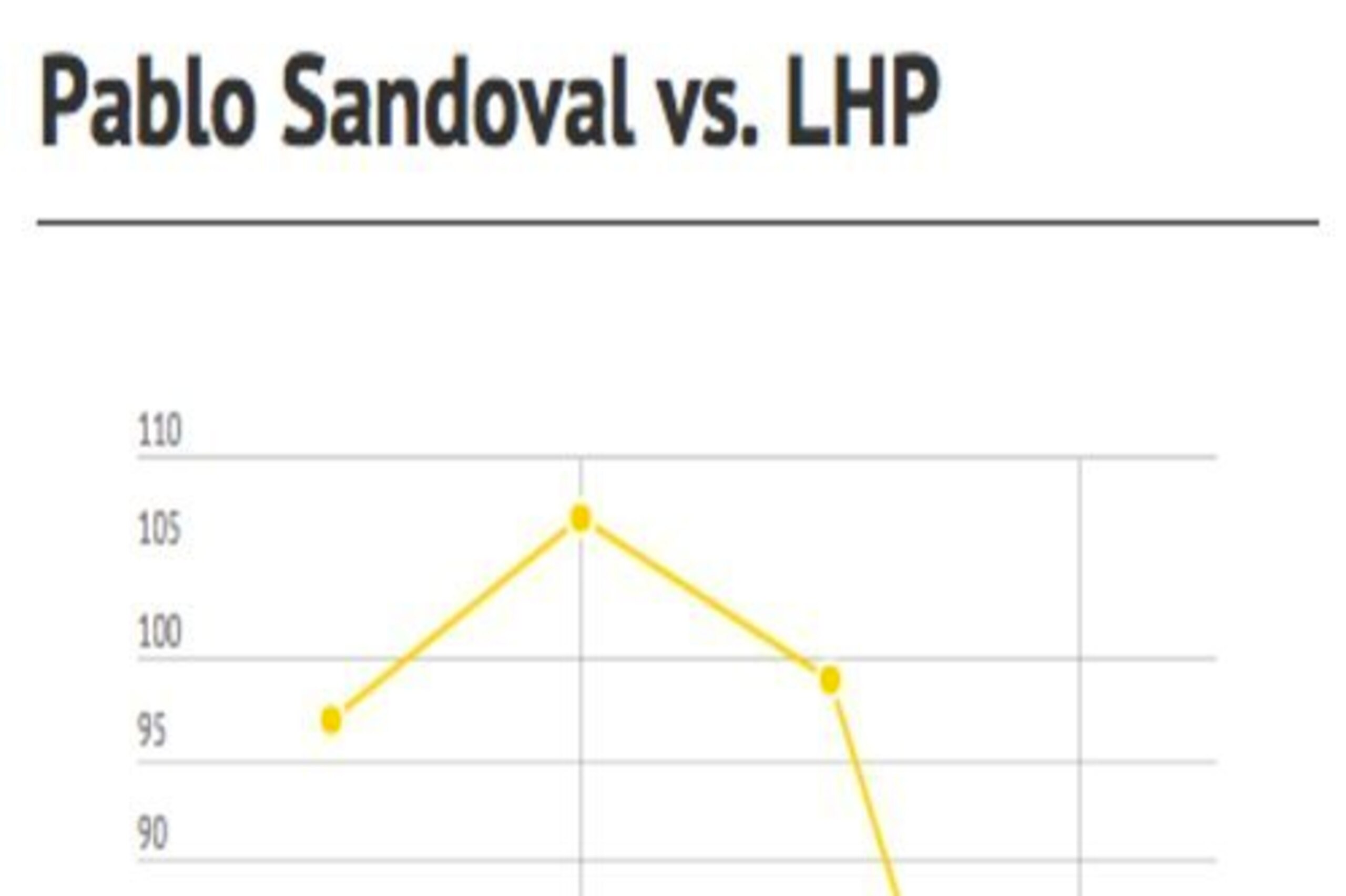
Sandoval’s wRC+ versus lefties this season? An unfathomable minus-73.
He’s averaged about 153 plate appearances per season from 2009 to 2014 batting right-handed against left-handed pitchers, and he only has 44 such plate appearances this season. That’s a small enough sample size to withhold jumping to the conclusion that he can no longer hit against left-handers.
Still, it’s a troubling trend, and one that is keeping him from being a productive player. Some have speculated that Sandoval might abandon switch-hitting altogether, yet aside from a handful of lefty-on-lefty at-bats due to a minor left knee injury, the Kung Fu Panda is sticking to his guns.
“If I’m OK, I’m going to bat right-handed (against left-handers),” Sandoval told NESN’s Ricky Doyle on May 24.
For what it’s worth, in 13 at-bats as a left-handed hitter against left-handed pitching this season, Sandoval is has four singles and no walks or strikeouts.
So should Sandoval give up switch-hitting? Either way, his overall numbers are going to improve. Sandoval typically hits better in the second half than the first, and the month of May has been the least productive month of his career.
Through June 9 of last season, Sandoval had a slash line of .242/.290/.398 and finished the year hitting .279/.324/.415. Those probably aren’t the numbers that the Red Sox were hoping for when they signed him, but they would be a drastic improvement over the hitter they’re currently seeing.
If Sandoval gives up on hitting right-handed, he won’t perform any worse against lefties than he is right now. If he sticks with switch-hitting, one adjustment he must make is to hit the ball the opposite way.
As a right-handed hitter, Sandoval has hit 26.3 percent of balls the opposite way for his career. This season, that number is down to 20 percent, suggesting that he has gotten a little pull-happy against lefties.
At age 28, Sandoval is still in his physical prime, and he’s already proven to be a well above-average hitter throughout his career. An adjustment as small as going the other way with a pitch could make a world of difference, even for a veteran player.
More encouraging stats from this season are Sandoval’s 20.5 percent line drive rate and his 11.6 percent home-run-to-fly-ball ratio, both better than his career averages, indicating that he still has the same ability to make good contact.
His .267 batting average on balls in play, a number that fluctuates mostly due to luck, is well below his career average of .310. This suggests that bad luck has also played a part in Sandoval’s decline in numbers, and that luck should improve moving forward.
Sandoval has not earned his salary with his performance so far, but his track record suggests that, with some minor adjustments and improved luck, a return to form is on the horizon.


.jpg?w=2560 "Chiefs, Steelers Eye WR Trades")