

Ranking Minnesota Timberwolves' Biggest 2015 NBA Draft Needs
As the Minnesota Timberwolves approach the 2015 NBA draft with the No. 1 overall pick in hand, they have a bevy of deficiencies to address.
The 2014 Kevin Love trade landed them a bunch of young assets, but they still need another sizable influx of talent in order to eventually reach the playoffs.
Point guard Ricky Rubio now has some explosive running mates in Andrew Wiggins and Zach LaVine, and veterans Kevin Martin and Nikola Pekovic are returning. Sprinkle in promising youngsters Gorgui Dieng and Shabazz Muhammad, and you have the beginnings of a dangerous core. When healthy, this group can put up points and scare some teams out West.
TOP NEWS

J-Dub, Wallace May Miss Entire Season
Celtics at Fault for JT-JB Beef? 🤔
Melo's Quote on Confidence 😎
In order to take a big step toward the playoffs, Minnesota must improve drastically on the defensive side while sharpening its offensive efficiency. What specific positions and tasks should it be targeting, and which prospects could best fill these needs?
3. Backup Point Guard
Although LaVine enjoyed some exciting games as the T-Wolves' primary playmaker during Rubio's absence, he's not the answer as a backup floor general.
Not only is the UCLA product an inefficient, unnatural fit as a decision-maker and distributor, but he's also more dangerous and effective as an off-guard or part-time handler. LaVine would be better off at the 2, whether he starts or comes off the bench.
Lorenzo Brown also spent a chunk of mop-up time at the point, but he hasn't shown enough command as a playmaker and shooter to secure the long-term backup role. His per-36-minute numbers are uninspiring: 8.0 points, 5.9 assists and an 11.0 player efficiency rating.
Minnesota should give strong consideration to targeting a point guard with its second-round pick. At the No. 31 slot, there should still be some attractive options available to groom as backup quarterbacks.
A talented upperclassman like Utah's Delon Wright could fall to that spot, or a risk-reward playmaker like Louisville's Terry Rozier might be on the board.
Wright would be a borderline steal if he slips to No. 31 overall because he offers elite playmaking instincts and stifling backcourt defense. The Utes star would be a significant upgrade over Brown.
He stands 6'5 ½" in shoes, and his 6'7 ½" wingspan allows him to pass and shoot over NBA-sized defenders. Wright's pick-and-roll prowess should translate nicely to the Association, as he brilliantly uses change-of-pace shiftiness and sharp vision to find opponents' weak spots.
His defensive prowess is equally valuable because the T-Wolves have holes all over the place. Wright would help start to build a culture that takes pride in defensive awareness and aggressiveness.
2. Backcourt/Wing Shooter
While Minnesota has several productive shooting guards and small forwards on its roster, it doesn't have nearly enough perimeter firepower.
The Timberwolves probably wouldn't have landed 30th in three-pointers per game if Kevin Martin had played more than 39 contests. But they still would have finished toward the basement, and they need more shooting than Martin, Wiggins and Muhammad can provide. Minny also hit just 33.2 percent of its triples—a number that needs to climb if the team wants to be relevant in today's NBA.
Will the Timberwolves add a 2 or a 3 with their No. 1 overall pick? They probably won't, because the values of this draft's top-ranked big men are too lofty to pass up.
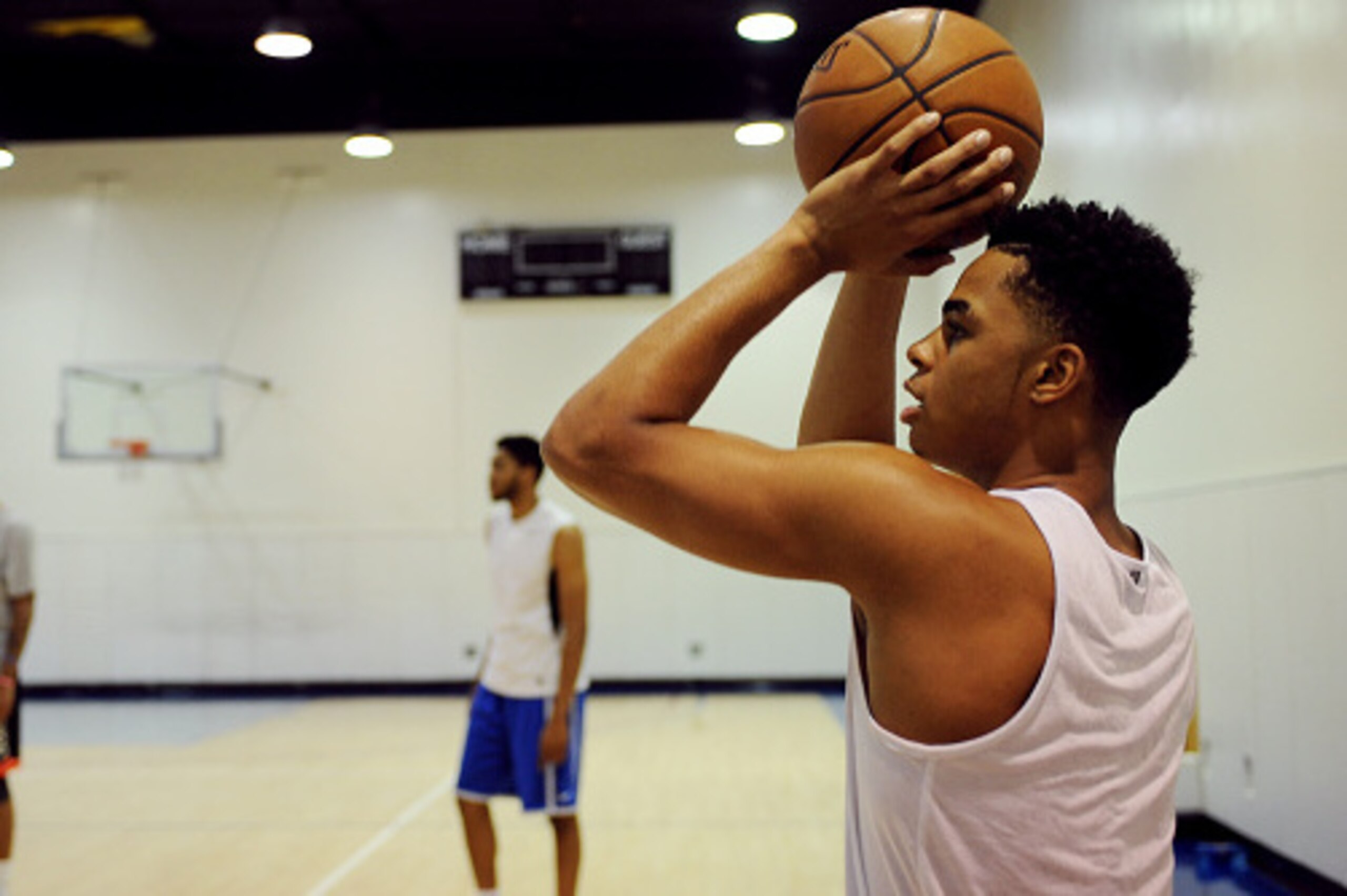
However, the Wolves will exercise their due diligence on Ohio State's D'Angelo Russell, who could operate as a legitimate shooting guard or point guard. ESPN.com's Chad Ford reported that Minnesota is at least interested in the 6'5" weapon.
"I am told [Minnesota head coach and team president Flip] Saunders is also a big fan [of Russell] and might be willing to move Ricky Rubio for the right deal," Ford said.
Whether the Wolves trade Rubio or not, the addition of Russell would give them a savvy youngster who has a great feel for the game and a natural shooting stroke. He attempted a high volume of triples as a freshman (231), yet he maintained a crisp 41.1 percent rate from beyond the arc.
Other options for a wing shooter include some second-round prospects they could tab at No. 31. Aleksandar Vezenkov from Cyprus has a picturesque, NBA-ready delivery, and DraftExpress.com projects Stanford's Anthony Brown as a good fit for Minnesota. The senior sharpshooter drilled 44.1 percent from downtown in 2014-15.
1. Frontcourt Versatility

Minnesota's most pressing needs are in the frontcourt, and it's not even close.
The current cast of power forwards and centers isn't versatile or dynamic offensively, and for the most part, those players are sieves on the defensive end. According to NBA.com, the Wolves allowed the league's highest opponent field-goal percentage at the rim (57.9) during 2014-15.
They don't have any legitimate outside shooters among their frontcourt corps, and there's not enough defensive mobility and rim coverage. B/R's Zach Buckley explains the club's personnel shortcomings:
"Nikola Pekovic is a bruiser on the boards and a smooth scorer in the low post, thanks to his combination of solid footwork and soft touch around the basket. But the 29-year-old has missed an average of 33 games in the past three seasons and is coming off surgery on his right Achilles tendon. Even when he's healthy, he offers limited offensive range and no rim protection.
Sophomore Gorgui Dieng brings a deeper bag of tricks inside the lines. But he's far more of a complementary piece than a featured one.
"
If you haven't heard yet, there are a couple of big men in the draft who could give Minnesota a much-needed boost.
Duke's Jahlil Okafor offers a powerful yet beautiful low-post skill set, and he's also shown the ability to face up a little bit. According to Ford, Saunders favors him over Kentucky's Karl-Anthony Towns.
But even though Okafor's game could expand and he flashed glimpses of defensive mobility, there are still questions about his overall versatility. Can he keep defenses honest with a pick-and-pop jumper, and can he truly protect the rim in today's hyper-athletic NBA?
Enter Towns, who's the best fit for what ails Minnesota.
Not only does he have the potential to reach Okafor's level in back-to-the-basket scenarios, but his range and dexterity will also yield more multifaceted production. Towns didn't shoot from the outside much at Kentucky, but he's exhibited more than enough three-point prowess during the predraft process.
Towns' paint protection will almost certainly outshine Okafor's. His quickness and length put an electric fence around the hoop in college, which resulted in 4.3 blocks per 40 minutes and the NCAA's best defensive rating (78.1). Expect him to bring respectability to Minny's defense—especially once he becomes more disciplined.
It's not a clear-cut decision for Saunders, but if he's approaching the draft from a needs-based perspective, Towns is the man for the job.
.jpg?w=2560 "Chiefs, Steelers Eye WR Trades")





.jpg?w=2560 "Raiders Sticking with Cousins")