Are the Cubs or Mets Better Positioned to Achieve Long-Term Success?
When the Chicago Cubs and New York Mets kick off a four-game series Monday, it'll be a clash of clubs with their eyes on the 2015 postseason.
But it'll be something else, too: a meeting of teams with the potential to be National League powerhouses for years to come.
Both the Mets and Cubs are on the rise, blessed with loaded farm systems and laden with nascent MLB talent. The question is this: Which team is better positioned to succeed long term?
TOP NEWS
Brewers Closer Blasts Tropicana Field Roof

Latest MLB Trade Rumors 👂
Tying HR Had Bauers Emotional
That obviously hinges on an array of unknowns; injuries, trades, signings and twists of fate can (and inevitably will) shape the fates of New York, Chicago and everyone else.
But based on the pieces each squad currently has, let's assess where they stand—now and into the future.
Chicago Cubs: Young Bats Hit the Big Leagues
In ranking the Cubs farm system No. 1 in baseball, ESPN's Keith Law offered the following observation:
"The past 12 months have seemed more like a coronation for the Cubs than one for the teams that actually played in the World Series. The hype around their system is justified by the talent in it, with the strongest collection of top-shelf hitting prospects I can remember since I started working in baseball. They have someone coming at just about every position other than catcher and first base, and most of them fare well both in traditional evaluation and in analysis of their performance to date.
"
The Cubbies aren't running away with anything. Entering play Monday, they sit at an even 15-15, 6.5 games back in the National League Central. But so far, Chicago's young bats are delivering on the hype.
Since his slightly delayed, much-scrutinized arrival, super-prospect Kris Bryant has banged out 21 hits in 81 at-bats, including six doubles and, on Saturday, his first career home run.
Infielder Addison Russell, acquired last season from the Oakland A's in the Jeff Samardzija trade, has flashed impressive pop out of the No. 9 spot in the lineup; eight of his 16 hits have gone for extra bases, including two home runs.
In the outfield, Cuban-born Jorge Soler has three home runs, 13 RBI and a .331 OBP.
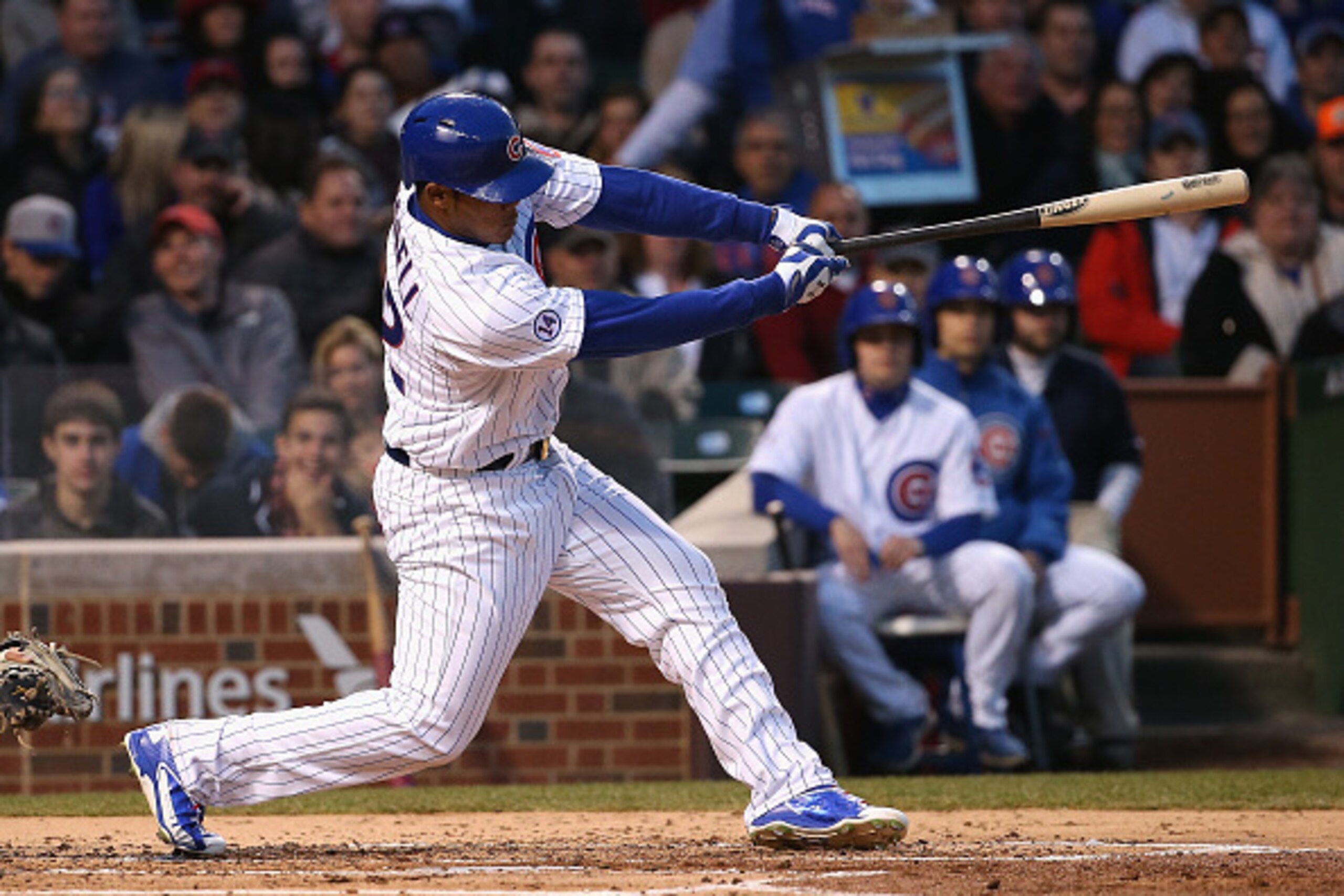
To that trio of rookies, add a pair of All-Stars, first baseman Anthony Rizzo and shortstop Starlin Castro, both under club control through 2019.
That's an offensive nucleus most teams could only dream of.
On the pitching side, Chicago's system isn't as stacked. And so far, many of the Cubs' woes have come on the mound, as their 4.31 team ERA attests.
On the other hand, Jon Lester—still an elite left-hander despite some early struggles—is inked for the next five seasons with a club option for 2021.
And Jake Arrieta, who has flashed ace potential, will be around until 2018, assuming the Cubs don't extend him first.
New York Mets: Strength of Arms
If the Cubs' foundation is their burgeoning bats, in New York, it's all about the arms.
Matt Harvey is the unquestioned ace, back from Tommy John surgery and throwing like he never left. Entering play Monday, Harvey owned a 2.72 ERA and minuscule 0.960 WHIP with 38 strikeouts in 39.2 innings pitched.
And the 26-year-old right-hander is still slinging gas, with an average fastball velocity of 94.9 mph, per FanGraphs.
Reigning NL Rookie of the Year Jacob deGrom, who has hit a few bumps in his sophomore campaign but boasts a solid 2.95 ERA, backs Harvey.
On the farm, meanwhile, the Mets have a pair of studs-in-waiting: right-hander Noah Syndergaard and lefty Steven Matz.

Syndergaard is headed for the big leagues and will make his debut Tuesday against the Cubs, filling in for the injured Dillon Gee, per Mike Puma of the New York Post.
Prior to his call-up Sunday, Syndergaard sported a stingy 1.82 ERA in the hitter-friendly Pacific Coast League.
Matz, likewise, is dominating the PCL, posting a 2.04 ERA with 38 strikeouts in 35.1 innings.
Matz has been so good, in fact, that he made the decision to call up Syndergaard less than a no-brainer.
"Steve's done a great job, too, but he's only pitched 30 to 35 innings or so at Triple-A," general manager Sandy Alderson said, per Mike Vorkunov of NJ Advance Media. "Got a lot of talent, got a lot of potential and what would be an equally qualified candidate."
We haven't even mentioned Zack Wheeler, an emerging front-line starter lost for the season to Tommy John surgery but under team control through 2019.
There are bats in the Mets system, too. ESPN's Law placed seven position players among the top 10 Amazin's prospects, including second baseman Dilson Herrera, who has hit .261 since an April 30 call-up.
At the moment, though, pitching reigns in Queens.
Which Team Has the Edge?
We'll tip the scales slightly toward Chicago for two reasons.
First, while it's true that you can never have too much pitching, in today's offense-starved MLB, a stockpile of high-upside, cost-controlled bats is a rare and precious commodity.
There's no guarantee the Bryant-Soler-Russell triumvirate will continue to rake, but it's as close to a can't-miss collection as you'll find in baseball.
Second, with all due respect to Alderson and the Mets front office, the Cubs have a secret (or not-so-secret) weapon in president of baseball operations Theo Epstein, the architect of this fertile farm and one of the most respected minds in the game.
When Epstein arrived on the North Side in 2011 after a curse-busting run with the Boston Red Sox, he inherited a franchise in disarray. Since then, he has methodically, strategically pushed the Cubs to the brink of contention.
Imagine what he'll do with this blue-chip core and ownership that, based on the Lester contract, is willing to open the purse strings.
Here's the bottom line: When you picture the future of the Senior Circuit, imagine the Cubs and Mets engaging in some epic battles.
Starting Monday, the future is here.
All statistics current as of May 10 and courtesy of MLB.com unless otherwise noted.


.jpg?w=2560 "Raiders Could Start Mendoza")

.jpg?w=2560 "Rodgers Iced Out on Plane 💎")

.jpg?w=2560 "Packers Safety Slams Refs 🤬")
.jpg?w=2560 "🚨 Week 8 AP Top 25 Poll")