

Biggest Takeaways from San Antonio Spurs' 2015 NBA Playoffs Debut
The San Antonio Spurs opened their 2015 postseason campaign on Sunday with a 107-92 loss to the Los Angeles Clippers.
L.A. had control for much of the game as San Antonio—a team whose regular season began on a sour note but closed in relatively dominant fashion—flashed back to its pre-All-Star break self.
But the loss had as much to do with the Clippers' strong play—a barrier that will remain lodged between the Spurs and their chances of advancing for the entirety of the series.
Plenty of basketball awaits, but after one contest, it's safe to start breaking down the first-round clash between two title hopefuls.
Surprising Lack of Dominance from San Antonio's Second Unit
1 of 5
Entering the series, the Clippers' shallow bench was viewed as one of the team's biggest weaknesses. Jamal Crawford was typically a one-man second unit for a squad that looked to play its starters until the last possible second.
Against some teams, that wouldn't be a major flaw. However, the Spurs—with their deep bench headlined by starting-caliber players like Manu Ginobili and Boris Diaw—were supposed to exploit the Clippers' gross lack of depth.
In Game 1, they didn't.
Granted, the Spurs' reserves did outscore the Clippers' 43-22, with the latter's bench turning in an expected performance as Crawford scored 17 of the 22.
However, San Antonio failed to take advantage of the opportunity. Ginobili had his moments, hitting a few big shots and notching seven boards and six assists. However, he shot just 3-of-10—hardly an acceptable clip from its fearless sixth man.
Diaw shot a similarly awful 2-of-12 mark—an even less ideal number given the team's limited frontcourt options, especially with a hobbled Tiago Splitter.
Both Patty Mills and Marco Belinelli enjoyed decent nights, combining to score 20, with the former logging a team-high plus-15 rating.
However, as a whole, the Spurs' bench failed to live up to expectations.
Seen as one of the squad's greatest strengths, the second unit—particularly the Ginobili-Diaw tandem—will have to make a significant jump going forward, especially as the series progresses and fatigue forces L.A. to play its non-Crawford reserves more than 31 total minutes.
Who Can Stop Blake Griffin?
2 of 5
Chris Paul may have headlined the Clippers' scoring attack, but with Kawhi Leonard and Danny Green on their side, the Spurs have the perimeter defense to match up with Paul going forward.
However, toying with matchups is a luxury the Spurs don't have with the Clippers' interior duo. As a classic power forward, Blake Griffin can't be defended by a small-ball lineup featuring Leonard at the 4.
In Game 1, actually, it appeared as though he couldn't be defended by anyone San Antonio threw on him.
Griffin finished with 26 points, and while he struggled out of the gate to put the ball in the basket, he attacked with a tenacity distinctive from his normal regular-season energy.
After seeing him make mince meat of Aron Baynes at the rim, one has to wonder: How is San Antonio going to stop Griffin?
The quickest fix seems to be integrating Tiago Splitter into the rotation more. Though he started, Splitter—coming off a calf injury—played just 10 minutes.
He's naturally a better post defender than Baynes, who is more of a physical body than anything else.
Of course, it will take masterful coaching in addition to a few lineup changes to slow down the force that is Griffin, but after one game, stopping the All-Star forward will surely be one of San Antonio's steepest uphill battles.
Tony Parker Is Not in Playoff Mode, but Kawhi Leonard Is
3 of 5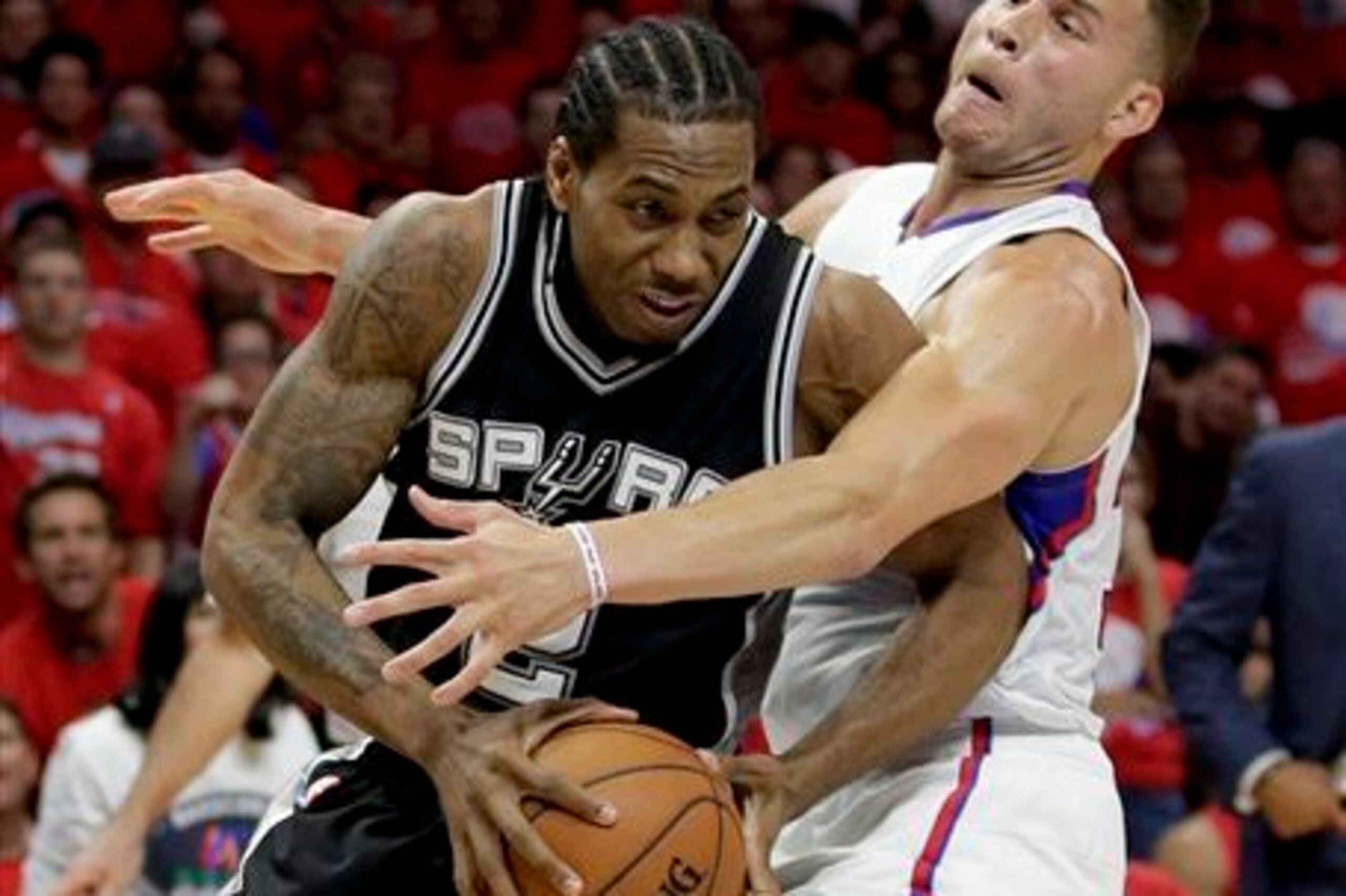
The second half of the Spurs' 2014-15 NBA season had two features.
First, Tony Parker—who had struggled leading up to that point to be his usual dynamic scoring and playmaking self—finally returned to vintage form. Secondly, Kawhi Leonard pitched in a closing few months that made it impossible to overlook his potential as a future top-10 player in this league.
Combined, these things had San Antonio surging down the stretch. Sunday night, though, only one of them was present.
Parker struggled, scoring 10 points on 4-of-11 shooting and managing just one assist.
It's possible he was a bit hobbled—he took two falls that had fans on edge after seeing him hurt for much of the season—but as a whole, he was hardly the player he needed to be.
Leonard, on the other hand, became the focal point of the offense when it became apparent that Parker wasn't ready to dominate. He pitched in 18 points on 7-of-12 shooting, also adding four steals and six rebounds.
He struggled to shoot free throws—more on that later—but as a whole looked ready to lead this San Antonio team should they need him to. He'll presumably get a more difficult defensive assignment in Game 2, where he'll have another opportunity to prove that his end-of-the-season performance was indicative of the play we should expect going forward.


The DeAndre Jordan Problem
4 of 5
DeAndre Jordan may have only scored nine, but overcoming his defensive contributions will be another one of San Antonio's biggest challenges entering Game 2.
Jordan began the contest with an emphatic block on Duncan and never looked back, anchoring Los Angeles' defense and protecting the rim to the tune of four first-half blocks, 14 rebounds and a whole lot of San Antonio misses.
As ProBasketballTalk's Kurt Helin tweeted, the "Spurs shot 17-of-37 inside eight feet. Credit DeAndre Jordan's defensive presence for a lot of that."
According to NBA.com's player-tracking box score, opponents went 3-of-10 on attempts that Jordan defended.
His long arms made it difficult for guys like Parker, Leonard and Ginobili to find opportunities to drive, while Tim Duncan and his interior partners seemed to consistently swing the ball out to the perimeter on solid possessions broken up by Jordan's presence.
He seems intent on commanding the paint, so San Antonio should look to stretch the floor more—though it will have to be done in a way that doesn't put them at a size disadvantage on the other end.
All in all, Jordan may not have filled the stat sheet but proved himself as a Defensive Player of the Year candidate in Game 1.
Sloppy Shooting
5 of 5
As a whole, San Antonio's effort can be summed up by its shooting percentages:
- 36.6 from the floor
- 30.3 from deep,
- and 53.8 from the free-throw line.
The first number is the result of Jordan's defensive dominance and the Spurs' inability to connect from deep—the second stat.
Danny Green was the poster child for missed threes, going 1-of-7 from deep in an overall 2-of-11 shooting effort. Despite good looks, he simply couldn't connect, a narrative that was present during the Spurs' rough patches this season.
San Antonio is a completely different team when he's an offensive asset. Should he bounce back in Game 2, he would help stretch the floor and take focus off his teammates.
Of course, he's known to slump, and if his Game 1 performance is a sign of things to come, the Spurs could be headed for an early playoff exit.
However, the most annoying part of the Spurs' playoff opener wasn't the missed open threes but rather the putrid free-throw shooting.
Having missed nearly half of their 26 looks from the charity stripe, the Spurs dug their own grave. It wasn't only the usual suspects like Splitter and Leonard. Ginobili split during his only trip, as did Green and Diaw.
As a whole, the Spurs lost the game as much as the Clippers won it. And while L.A.'s defense was and is going to be difficult to overcome—especially inside—the Spurs had and will continue to have good looks.
Going forward, they'll simply have to take advantage of them.




.jpg?w=2560 "Mahomes Asked OT to Leave Meeting")
.jpg?w=2560 "Jonathan Taylor Landing Spots 📍")

.jpg?w=2560 "5 Teams Eyeing Jonathan Taylor")
