

Biggest Adjustments Houston Rockets Must Make in Game 2 vs. Dallas Mavericks
The Houston Rockets had their way with the Dallas Mavericks for much of their Game 1, but even with that being the case, the Rockets will need to make adjustments to maintain their dominance in Game 2.
Prior to getting into adjustments, though, let’s take a moment and discuss what Houston did right, which was a lot. Most importantly, it had a balanced scoring attack, which is critical in the postseason. One player can only get you so far.
TOP NEWS

Brown with an all-time summary of relationship with Tatum

Heat, Giannis were down by 20+ in each of their 3 losses
Worst NBA Predictions 🫣
James Harden played high-IQ basketball, flowing toward the path of least resistance, finding the right pass when the defense stopped his penetration. Harden didn’t force the agenda but trusted his teammates to finish, and the result was 11 dimes, with five of them for three. He “only” scored 24, but his passing generated another 27 points.
In all, seven scorers hit double figures for Space City—and four of those topped 15.
That has to feel especially good to the Rockets, who were basically insulted by Mavericks owner, Mark Cuban in an interview with Grantland’s Kirk Goldsberry:
"[The biggest difference is] practice time. There’s no more predictable team than the Rockets. You know exactly what they’re gonna do. But James Harden is so good. That’s what analytics have begot. Right? Predictability.
If you know what the percentages are, in the playoffs, you have time to counter them. Whether you’re good enough to do it is another question. Because they are very talented, and James Harden, I think, is the MVP. Because that’s not a very good team over there.
"
The predictable, not very good Rockets hammered Dallas from every direction. And it looks promising.
If the Mavericks adjust and try to stop everyone, Harden will be left in one-on-one situations, and the Rockets will just be using their jab to set up the knockout punch. They got 35 out of Dwight Howard and Harden combined and won by 10. That bodes well for the series, but it’s still only one game.
The Mavericks will make adjustments, and the Rockets will need to as well. In particular there are three areas which should raise concern for Houston: Howard’s fouls, defensive rebounding and defending Dirk Nowitzki in the pick-and-roll.
Dwight Howard Fouls
Howard played 17 minutes and committed five fouls. How well he played was as much a story as how little he played. This facet alone could be the determining factor for the entire series.
While Howard was on the court, the Rockets won the battle in the paint 18-10, were 9-0 in second-chance points and outscored the Mavericks by 12 points total, per NBA.com/Stats. With Howard on the bench, the Mavs were up 48-32 in the lane and outscored the Rox 17-8 when given a second chance.
The Mavericks grabbed 12 of their 14 offensive rebounds when Howard was on the bench. They shot 50.0 percent from the field when he wasn’t playing and 32.3 percent when he was. They shot 37.5 (3-8) percent from inside the restricted area against Howard and 70 percent (21-30) when he was out.
Because when he was in, he was doing things like this:
In short, Howard was an emphatic, unapologetic, inarguable game-changer. The problem was: He couldn’t say in. And while one could argue that at least two of the fouls were “flop-enhanced”—certainly, Nowitzki “helped” the ref to make one call—if ticky-tacky is how things are going, Howard must adjust to that.
Get Defensive Rebounds
As alluded to previously, the Rockets struggled to keep the Mavericks off the offensive glass when Howard wasn’t in. This caused a problematic chain reaction.
For example, take this play with Tyson Chandler getting an easy putback:
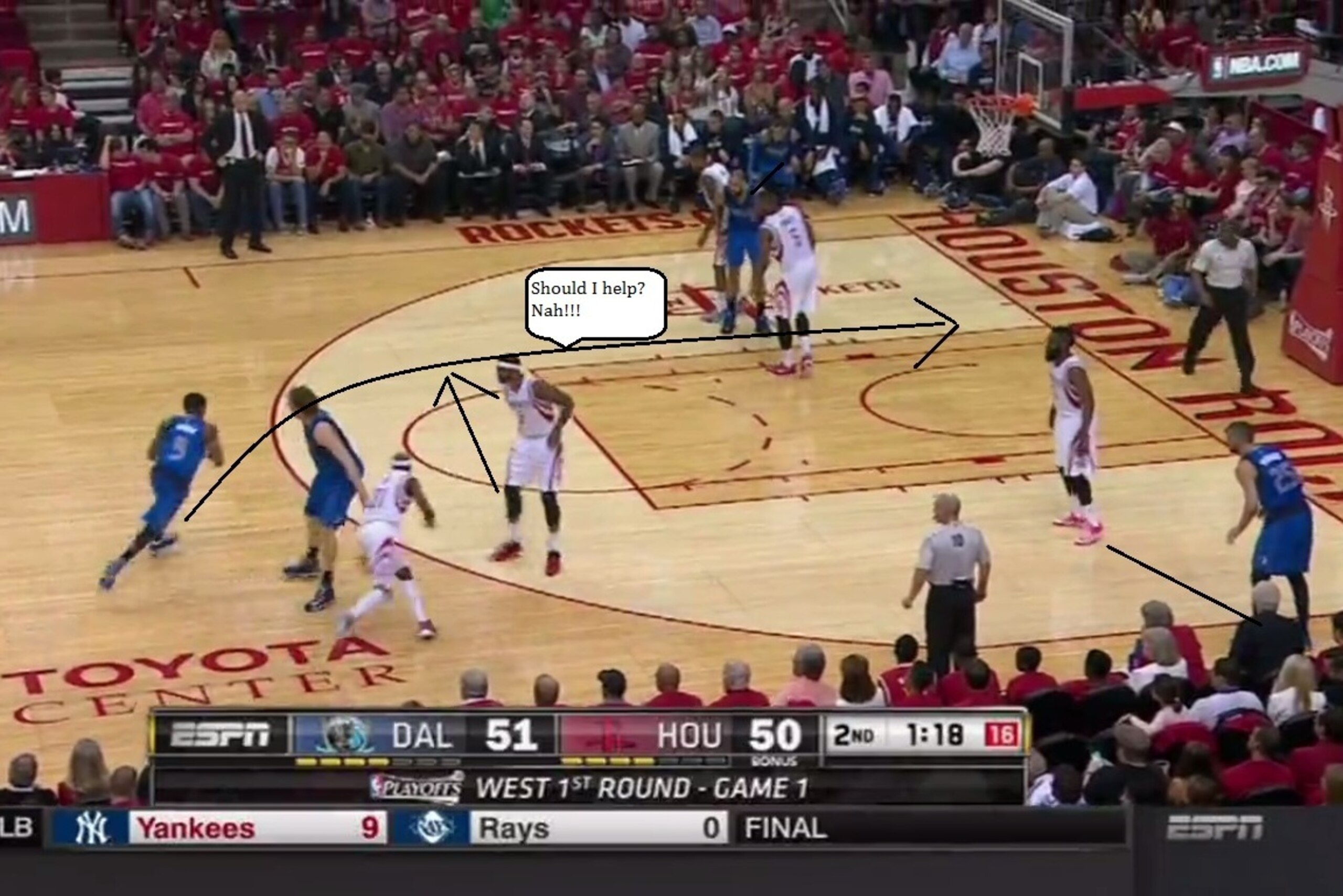
First, Nowitzki sets the pick on Jason Terry. J.J. Barea blows past everyone. Josh Smith doesn’t help on the play, and Barea gets to the rim unabated.
The only one who tries to help is Jones. To be fair, Trevor Ariza and Harden are both tethered by the three-point shooters at the baseline corners. If they rotate over to help, they’re giving up three to save two. Smith had no such excuse.

Barea misses the shot, but Jones isn’t in position for the board because he was challenging the shot. Smith doesn’t crash the glass. Neither does Harden. There’s no one between Chandler and the ball, so he gets the easy tip-in.
The Rockets must contend with Tyson Chandler's offensive rebounding, and that’s going to require putting a body on him. That also means the help defense must come from someone than the center, whenever possible.
Defensive breakdowns, such as the one Smith had, are going to cost the Rockets points, if not on the first chance, then on the second.
Keep Track of Nowitzki
Nowitzki has scored 31,598 combined regular-season and postseason points. Per Basketball-Reference.com, there are only five players who have scored more: Kareem Abdul-Jabbar, Karl Malone, Michael Jordan, Kobe Bryant and Shaquille O’Neal. So one would think that actually guarding him would be part of a game plan.
Here is Nowitzki’s highlight reel from Game 1. Pay attention to who is he is defending him and how:
On three plays, Jones guarded him. On one, Nowitzki got the putback. On one he scores on a jumper out of a fast break. And on the other five, Terry, Harden or Corey Brewer guarded him. Nowitzki didn’t get to score all his points by accident. He’s one of the greatest pure shooters in history.
I’m just thinking outside the box here, but it might be a good idea to defend him with someone who’s actually capable of stopping him. Dallas is going to eat Houston alive all series with Nowitzki if it's putting guards onto him.
Now, admittedly, the Rockets have employed switches all season, and they do it more frequently and better than most teams. That said, there are certain players who can’t guard Nowitzki, and Terry is one of them. The Rockets are going to need to devise a better strategy to keep up with the big German.
Granted, this is exacerbated by the problem previously addressed. If Smith switches on the driving Barea, that leaves Terry on Nowitzki. But that’s where the Rockets need to make adjustments and work out a whole “worst-case-scenario” game plan for when Howard is out—particularly if it’s for extended minutes.
These are minor quibbles, and the Rockets delivered a heavy punch to start the series. But, if they rest on their laurels, while Rick Carlisle makes adjustments, things can flip in an instant. For evidence of that, look back to the 2011 NBA Finals, when his changes helped the Mavericks come back and beat the Miami Heat.
But the Rockets are better, and if they fine tune their performance, there’s no reason to think they shouldn’t win this series.




.jpg?w=2560 "Mahomes Asked OT to Leave Meeting")
.jpg?w=2560 "Jonathan Taylor Landing Spots 📍")

.jpg?w=2560 "5 Teams Eyeing Jonathan Taylor")
