

Best- and Worst-Case Scenarios for New York Giants' Top 3 Picks
Offensive lineman? Defensive end? Safety?
The possibilities for the New York Giants in this year’s draft seem endless if they stick to the “best player available” mantra general manager Jerry Reese always claims to follow every year in his predraft press briefing.
What happens if the best player available comes at a position that isn’t necessarily a need? What happens if the Giants, who have eight picks this year, thanks to the extra seventh-round pick acquired in a trade with Denver for kicker Brandon McManus, don’t fill all of their needs?
Those are many questions and so few answers for a team that needs to hit a home run in at least the first three rounds of the draft.
As the Giants assemble their final value board ahead of the draft, let’s debate the best- and worst-case scenarios in each of the first three rounds.
The best-case scenario will look at the ideal pick who should be there when the Giants' pick rolls around. The worst-case scenario will look at an alternate selection who should be there in the event the best-case pick isn’t on the board.
Round 1 Best Case: OT Brandon Scherff, Iowa
1 of 6Everyone from head coach Tom Coughlin to general manager Jerry Reese to team co-owner John Mara have, at some point, publicly admitted that the offensive line is still a work-in-progress, especially in the running game, where, last year, the Giants finished 23rd in the league.
According to NFL Game Statistics and Information Systems, the right side of the Giants' offensive line struggled the most. Last year, that side of the line ranked 31st (2.55 average gain) and 28th (3.44 average gain) in rushing yards behind the right guard and right tackle, respectively.
Assuming the Giants believe that Justin Pugh, last year’s starting right tackle, is better off moving inside to guard, Iowa’s Brandon Scherff (6’5”, 319 lbs) is perhaps the safest pick they could make to add a road grader to that offensive line.
Scherff has the power to drive his man off the line and open the holes for the running game that all too often weren’t there last season on the right side of the line.
Scherff, who some draft analysts believe is better suited to play guard at the NFL level, has, according to NFLDraftScout.com’s Dane Brugler and Rob Rang, drawn comparisons to Cowboys offensive lineman Zack Martin, the first-round prospect whose name was linked to the Giants in the first round of last year’s draft.
If the Giants are truly serious about getting back to the playoffs, they need to make sure quarterback Eli Manning is protected, and the running backs have holes to exploit. Barring a surprise playmaker dropping to the Giants at No. 9, Scherff should be their man.
Round 1 Worst Case: OT La'el Collins, LSU
2 of 6According to the first-round mock drafts of CBSSports.com analysts Rob Rang, Dane Brugler, Pete Prisco and Will Brinson, all project at least one quality offensive tackle prospect to be on the board if the Giants stay in the ninth overall draft position.
If Rang’s mock-draft scenario in which he has Washington taking Brandon Scherff at No. 5 overall comes to fruition, LSU’s La’el Collins (6’4”, 305 lbs) would be a nice consolation pick for the Giants at No. 9.
Collins projects to right tackle at the NFL level, so he would probably be an instant starter for the Giants on their offensive line.
While not quite as polished as Scherff, there’s still a lot to like about Collins. Rang notes that the LSU offensive lineman has a thick, strong base, which makes it difficult to move him at the point of attack. Rang also observed that Collins has the strength to maul opponents in the running game.
That doesn’t mean that Collins isn’t without his warts, one of the biggest being his lack of elite balance and his occasional lack of patience. Regardless, these are all things that coaching can probably help smooth out.
As a result, Collins, if he is viewed as the “consolation” pick in the first round, wouldn’t be the worst decision the Giants make on Day 1, as the college senior has the potential to be a solid NFL offensive tackle for years to come.
Round 2 Best Case: CB Eric Rowe, Utah
3 of 6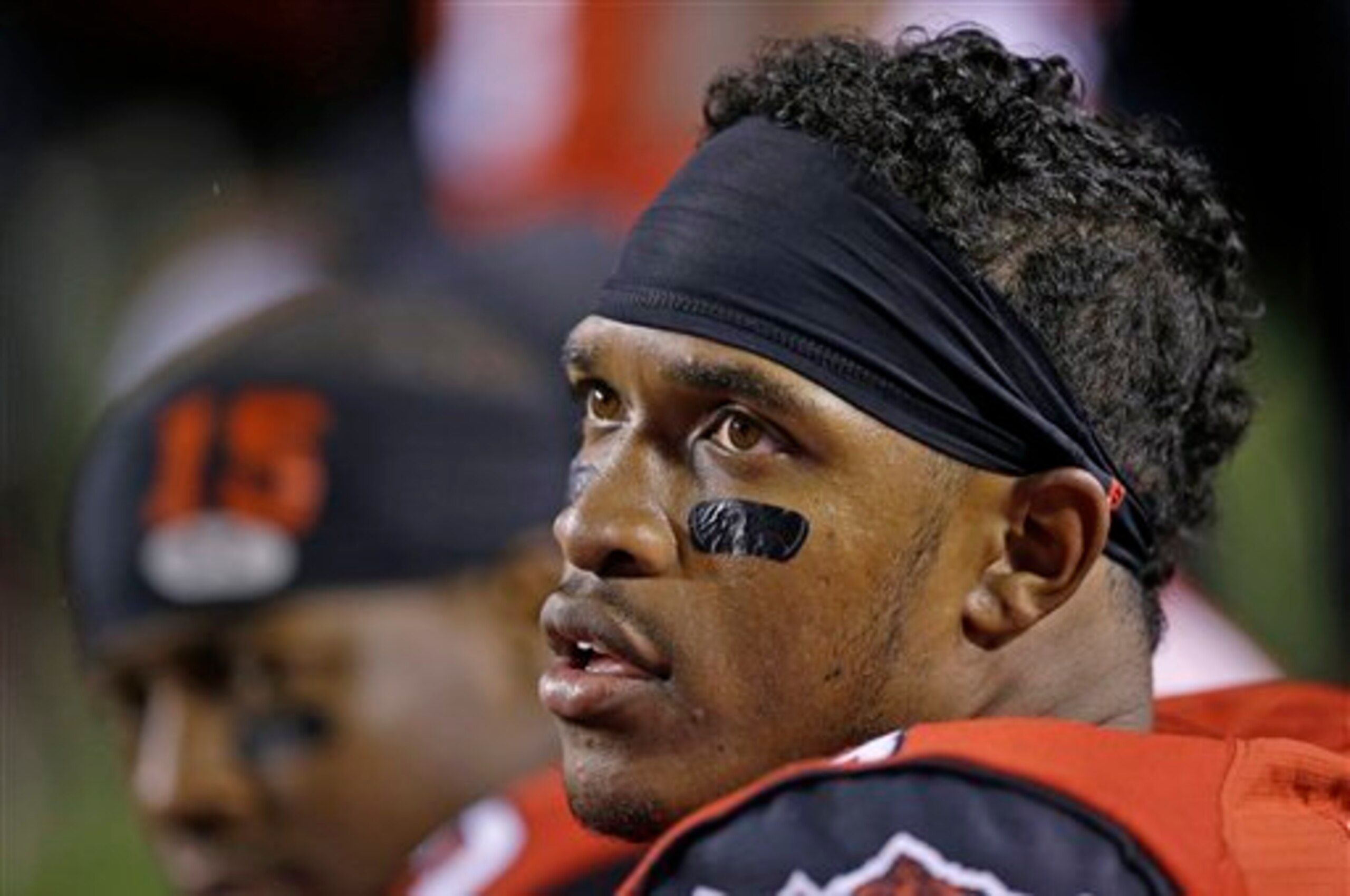
Projected to be a late-first-round/early-second-round pick, Utah’s Eric Rowe (6’1”, 205 lbs) was a top performer at the combine in every major category.
He is a taller, aggressive cornerback who doesn’t let receivers bully him in coverage. He's also a wrap-up tackler who’s not afraid to put a hit on a ball-carrier, though there are some draft analysts, such as NFLDraftScout.com’s Rob Rang, who believes that Rowe’s skill set is probably better suited for free safety, which just so happens to be a Giants need.
Rowe, who spent three years at safety before switching to cornerback, also has experience playing on special teams and at free safety, the latter being the position that Rang believes would be a better fit.
Given the value Rowe potentially offers—he can also line up as the slot cornerback—it will be interesting to see if the Giants pass on Rowe if he's sitting there in the second round.
.jpg?w=2560 "Chiefs Giants Football")
.jpg?w=2560 "Colts Football")
.jpg?w=2560 "Titans Colts Football")
Round 2 Worst Case: FS Damarious Randall, Arizona State
4 of 6
If the Giants are OK with Trumaine McBride and Mike Harris as their slot cornerbacks, they could potentially look to address the free safety spot.
One such player at that position who apparently has caught their eye is Arizona State’s Damarious Randall (5’11”, 196 lbs).
Randall, whom Bleacher Report’s Matt Miller reported visited the Giants earlier this month, is a projected second-round prospect, according to NFLDraftScout.com’s free safety rankings.
He might not possess ideal height, bulk or strength for the next level, but he is an alert player with good instincts, good foot speed and above-average ball skills for a deep center fielder type.
The Giants haven’t had a ball hawk playing center field for them since 2012, when Stevie Brown’s team-leading eight picks were also the second-most in the NFL that season.
If defensive coordinator Steve Spagnuolo is looking for turnovers, he is going to need defensive backs who can make plays in coverage. Randall appears to be a prospect who can deliver that at the next level.
Round 3 Best Case: DT Gabe Wright, Auburn
5 of 6Although the Giants have two very promising young players at defensive tackle—Johnathan Hankins and Jay Bromley—and newcomer Kenrick Ellis, a mammoth-sized run-stopper, they need to plan for the future.
Ellis, remember, is on a one-year contract. In addition, 34-year-old Cullen Jenkins is in the final year of his contract after agreeing to take a pay cut earlier this year, and Markus Kuhn, the team’s underwhelming, but hard-working, seventh-round draft pick from 2012.
One such late-Day 2 prospect who could help with that defensive interior rotation is Auburn’s Gabe Wright (6’3”, 300 lbs), who has an explosive first step that gets him into the offensive backfield quickly enough to disrupt things.
Rob Rang of NFLDraftScout.com notes that Wright has sometimes shown more fire for rushing the passer than he has playing the run, and that sometimes he charges upfield out of control.
However, Wright’s ability to navigate in and around the pit by jumping over players who find themselves on the ground serves him well in getting to ball-carriers to make the play.
Round 3 Worst Case: ILB Denzel Perryman, Miami
6 of 6At some point, the Giants are going to need to think about a full-time replacement for middle linebacker Jon Beason, who has two years remaining on his contract, but who also has had struggles with staying on the field since 2011.
One option for New York is to move Devon Kennard to the middle, though there’s some question as to whether that would be his best position moving forward, especially considering how promising Kennard has looked blitzing from the outside.
Instead, the Giants might consider Miami inside linebacker Denzel Perryman (5’11”, 236 lbs) who, like Beason, doesn’t necessarily have the ideal height, but who does play with those natural instincts and that proactive nature that oftentimes get him into the middle of the action.
The question with Perryman is whether he has the goods to be a three-down linebacker. His combine measurables—4.78-second 40-yard dash for instance—certainly raise concerns about his ability to drop into coverage.
The good news is that Perryman is an instinctive, smart linebacker who has shown himself to be a disruptive force once he zeros in on the ball-carrier.
Patricia Traina covers the Giants for Inside Football, the Journal Inquirer and Sports Xchange. All quotes, and information obtained firsthand unless otherwise sourced.
.jpg?w=2560)
.jpg?w=2560 "Cardinals Giants Football")






