


We all know LeBron James, Stephen Curry and Kawhi Leonard are the keys to the NBA's true title contenders, but a handful of less-celebrated talents will also have major impacts on the 2015 playoffs.
Making postseason noise isn't just about relying on stars. It's also about getting contributions from rotation players—some of whom might not come readily to mind when thinking about series-swinging difference-makers.
The lens narrows in the postseason, with matchup-specific strategies exploiting every conceivable weakness and amplifying every strength. Teams have the time to focus on stopping opposing stars and make sure their own primary threats are in positions to succeed.
That makes it easy to forget about the role players, the guys who sneak in while everyone is paying attention to the big names and quietly shift the balance of power in hotly contested series.
Here are 10 such players, none All-Stars and many non-starters, who are ready to make an impact on the postseason stage.
Shaun Livingston, PG, Golden State Warriors
1 of 10
The Golden State Warriors have been so good this year and gotten so many contributions from supporting players that you could go in any number of directions searching for an unsung hero.
The problem is everyone knows how defensively dominant Draymond Green is, how frighteningly versatile Andre Iguodala is and how deadly from mid-range Marreese Speights is.
That brings us to backup point guard Shaun Livingston, whom you might remember from such groin-punching incidents as, well, this one on Dirk Nowitzki, which earned Livingston a one-game suspension.
Livingston is much more than a low-blow artist, though. He's a major key to the Warriors' switch-happy defensive style. When he's on the floor with four other like-sized players, Golden State becomes immune to screens and causes total havoc in the passing lanes. It's not a strategy the Dubs trot out often, but even if Livingston shares the floor with, say, Green, Iguodala and Thompson in a scaled-back version of their small-ball attack, all three can pass off defensive assignments easily.
Not only that, but Livingston's post game is brutally effective against both backcourt positions. He's hit 51.2 percent of his turnaround jumpers this year, 76.2 percent of which have been unassisted, according to NBA.com.
Basically, throw the ball to Livingston down low, and you're guaranteed a high-percentage look.
Most importantly, he plays a vital role in allowing Curry to work off the ball.
As teams invariably do everything in their power to force the rock out of Curry's hands, having someone like Livingston to serve as a facilitator will pay dividends. And if opponents fail to capitalize on stretches where Curry isn't the primary ball-handler, they'll never slow the Warriors down.
Michael Carter-Williams, PG, Milwaukee Bucks
2 of 10
Apparently, the 2015 postseason hinges exclusively on ultra-lanky point guards without three-point range.
Michael Carter-Williams' inclusion here may seem surprising. After all, the narrative surrounding the Milwaukee Bucks this year has centered on their collapse following the trade that brought MCW in and sent Brandon Knight out.
But the numbers tell a different story.
With Carter-Williams on the court, Milwaukee plays to a net rating of plus-1.9 points per 100 possessions, according to NBA.com. That's not a spectacular figure, but when you realize the Bucks get annihilated whenever MCW is on the bench, it means a little more.
Milwaukee's net rating is minus-10.9 when he sits.
The East's No. 3 seed is going to be vulnerable—whether it's the uninspiring Toronto Raptors, offensively challenged Washington Wizards or perpetually banged-up Chicago Bulls. Assuming the Bucks retain their No. 6 position, that first-round matchup might be closer than most think.
If MCW sees extended minutes, the numbers say Milwaukee might even have a chance to pull off the upset.
Danny Green, SG, San Antonio Spurs
3 of 10
You can't survive the Western Conference gauntlet with just one elite wing defender.
It's a good thing the San Antonio Spurs have Danny Green alongside Leonard, forming what might be the most formidable defensive perimeter duo in the league.
If we assume the Spurs meet the Warriors in the Western Conference Finals, there will be challenging matchups all over the place. And as great as Leonard is, he can't shut down Curry and Klay Thompson by himself (at least we don't think he can).
Green gives the Spurs a second set of shackles to put on the Warriors, specifically, but he'll also come in handy against every other West team with more than one potent scorer.
Defense aside, Green also holds the NBA Finals record for most threes made in a series. So we know he can make a major impact on the offensive end as well.


Terrence Jones, PF, Houston Rockets
4 of 10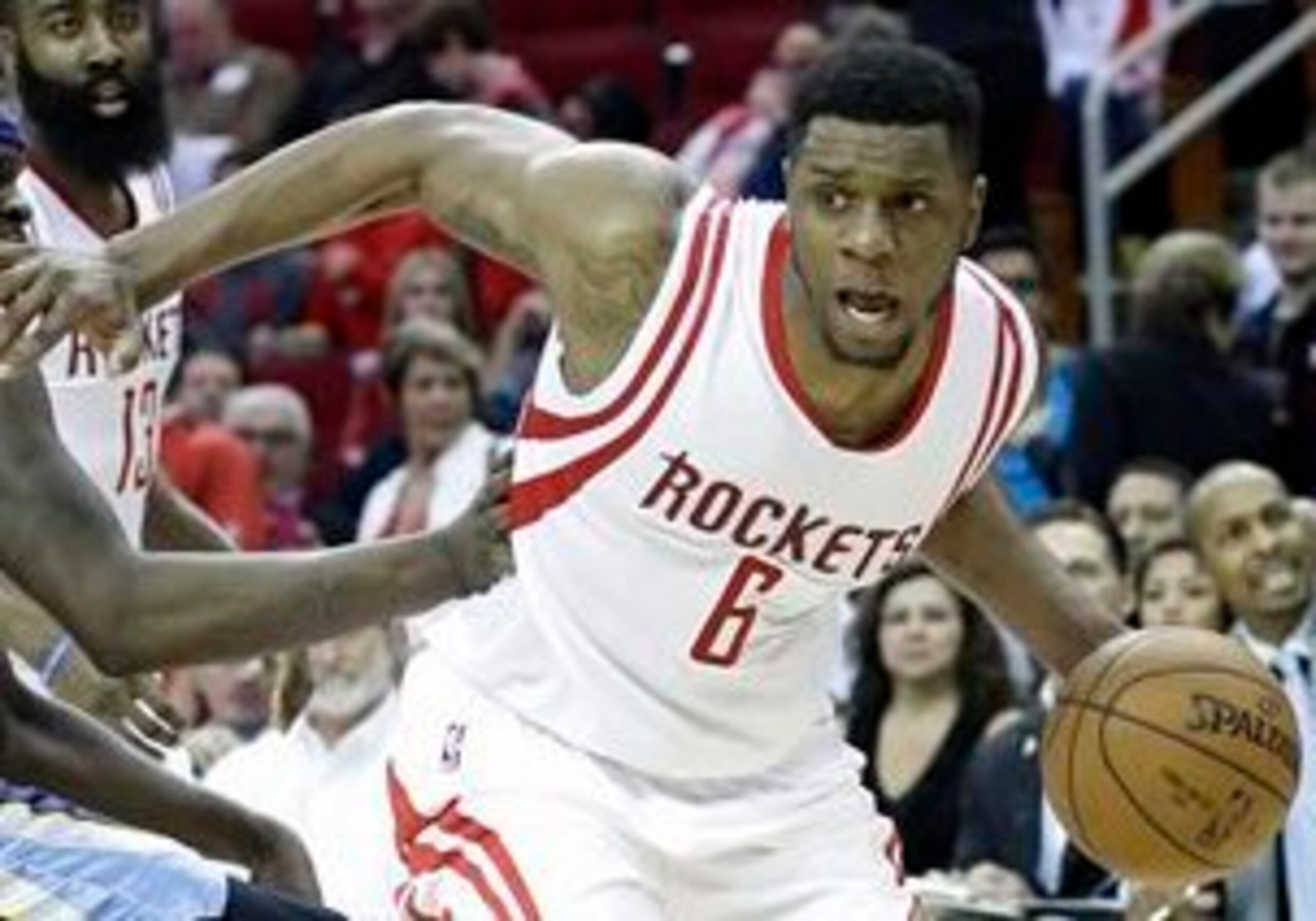
You know it, I know it, and James Harden knows it: The double-teams are coming.
They have to be.
Playoff opponents know the only way to stop the Houston Rockets is to stop Harden, and based on The Beard's MVP-worthy campaign, that's no easy task. But in a seven-game series with the benefit of total focus on one player and the time to draw up specific schemes, it's inevitable that teams will find ways to force the ball out of Harden's hands.
When that happens, the Rockets will have to rely on secondary options. If the hard-double treatment Curry gets on most pick-and-rolls with the Warriors is any indication, that'll mean the Rockets may have to lean on a power forward when Harden gives up the ball.
Enter Terrence Jones.
Jones has lost the majority of the 2014-15 season to injury, but he's relatively healthy now. A powerful athlete who rebounds and blocks shots well for his 6'9" height, Jones can also knock down the occasional three.
But there's not much in his profile that suggests he can make the quick decisions necessary for success as an outlet option when Harden is doubled. If he can take the pass, make a quick move toward the middle and find a shooter in a four-on-three situation, Houston will be in business.
If he can't, the Rockets will struggle to find ways to score.
Perhaps Harden will just use his strength to split double-teams, or maybe he'll simply barrel into them in hopes of drawing contact. If that's the case, Houston may not need a release valve like Jones.
But postseason teams are strategically sharp, generally. You'd have to expect them to find ways to force someone besides Harden to beat them.
Jones might be that someone.
Nikola Mirotic, PF/SF, Chicago Bulls
5 of 10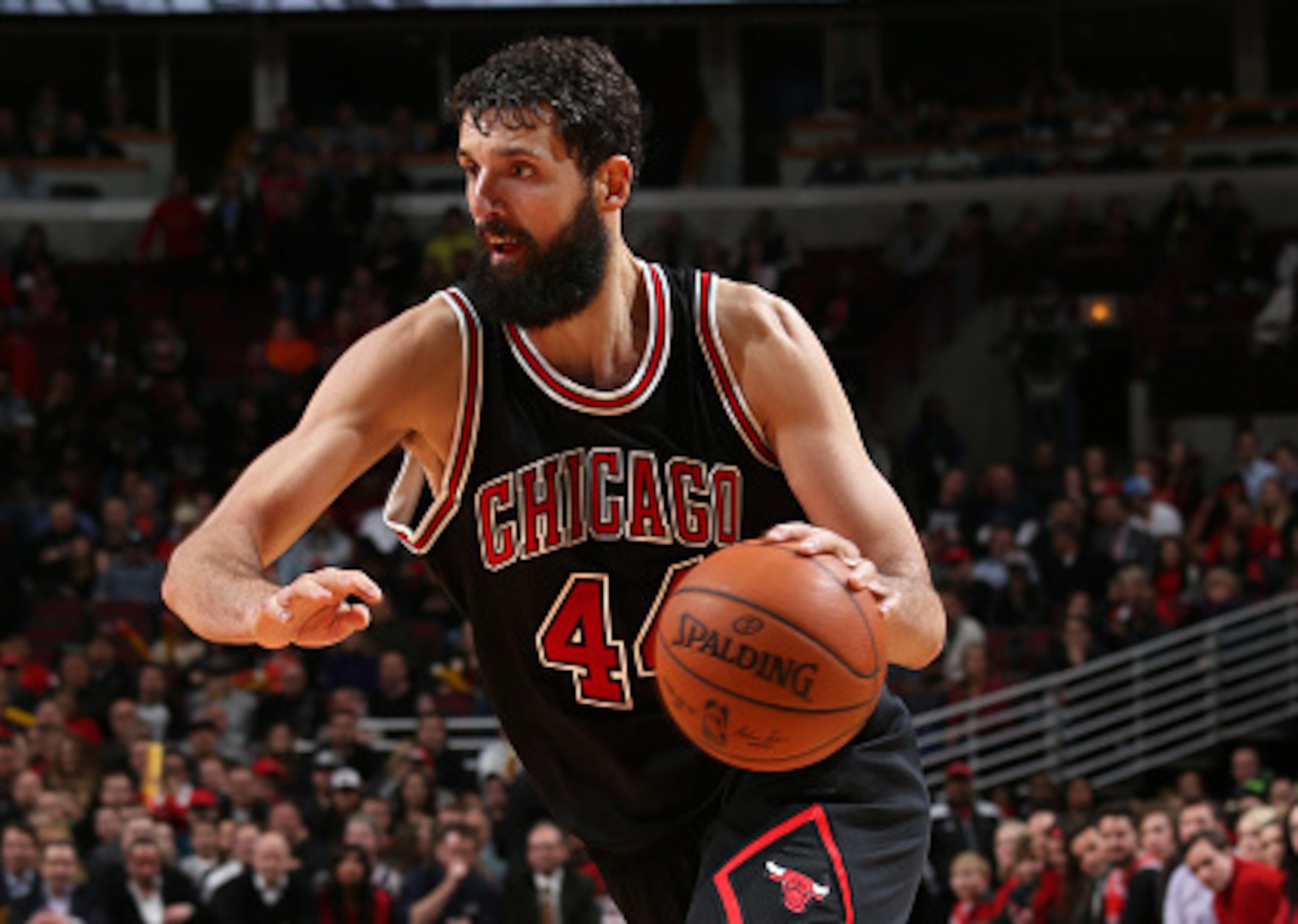
Quiz time: Who has the best on-court net rating on the Chicago Bulls?
It's not Joakim Noah or Jimmy Butler. Nor is it Derrick Rose.
Taj Gibson? Try again.
All-Star starter Pau Gasol? Nope.
Try rookie forward Nikola Mirotic, whose plus-6.1 points per 100 possessions is tops among all Chicago players, per NBA.com.
Now, that's just one number, and like a lot of on-off split stats, it's a little noisy. At the same time, there's no mystery as to why Mirotic has been such a positive force for the Bulls this year: He presents major matchup problems on offense and has shown surprising (if sporadic) skill on the other end.
Mirotic is shooting just a shade less than 31 percent from long range, but he's enough of a threat to force hard closeouts, which he exploits with strong straight-line attacks in the lane. And the space created by stationing a 6'10" forward primarily behind the three-point arc does wonders for the Bulls' offensive flow.
Maybe calling a potential Rookie of the Year winner an unsung hero sounds like a stretch. But outside of devoted Bulls loyalists and NBA diehards, most fans probably aren't aware of just how vital Mirotic is to Chicago's offensive identity.
If you're still not sold, try that quiz from earlier on some of your friends and see how long it takes them to name Mirotic.
Kent Bazemore, SG, Atlanta Hawks
6 of 10
As a preliminary matter, it's a shame that Thabo Sefolosha, whom RealGM's Shams Charania reported is out for the season with a fractured fibula, won't be a playoff participant.
But in opening up more opportunities for Kent Bazemore, Sefolosha's absence may actually improve the Atlanta Hawks' chances.
Bazemore is an athletic, rangy wing defender who lacks Sefolosha's reputation as a stopper but might actually be the more effective player on that end. Though still prone to ball-watching on occasion, Bazemore has quickness and length that Sefolosha lacks.
Not only that, but Bazemore has shown enough on offense to justify playing time ahead of Sefolosha anyway, according to Grantland's Zach Lowe, who tweeted: "Kent Bazemore's wing D becomes a key thing now, and he has shot well enough from 3—especially from the corners—to earn more time."
On the season, he's connected on 38.8 percent of his threes, a mark that will draw much more defensive attention than Sefolosha's 32.1 percent accuracy rate would have.
There'll be plenty of three-and-D responsibility heaped onto DeMarre Carroll's shoulders now, but Bazemore's potential impact on Atlanta's playoff run just skyrocketed.
Anthony Morrow, SG, Oklahoma City Thunder
7 of 10
One good way to pull off an upset is to get ridiculously hot from long range.
Oklahoma City Thunder guard Anthony Morrow is on fire from the moment he rolls out of bed in the morning, which makes him an ideal non-star candidate to inject some unpredictability into a playoff series.
Now, we're taking a bit of a risk assuming OKC will be a playoff team at all. The Thunder are currently locked into a battle with the New Orleans Pelicans for the West's eighth seed. Assuming Oklahoma City makes the dance, Morrow figures to have a lot to do with the outcome.
Get this: After making just 28.3 percent of his long-range tries in January, Morrow has drilled over 50 percent of his three-point attempts in February, March and April. He's not exactly being choosy either, as his 6.5 attempts per game from deep in April indicate.
It'll take a borderline miracle for the Thunder to threaten the top-seeded Warriors. But Morrow is a miraculous shooter—one who'll likely benefit from the copious attention the Dubs will pay to Russell Westbrook.
Don't say I didn't warn you.
Tristan Thompson, PF/C, Cleveland Cavaliers
8 of 10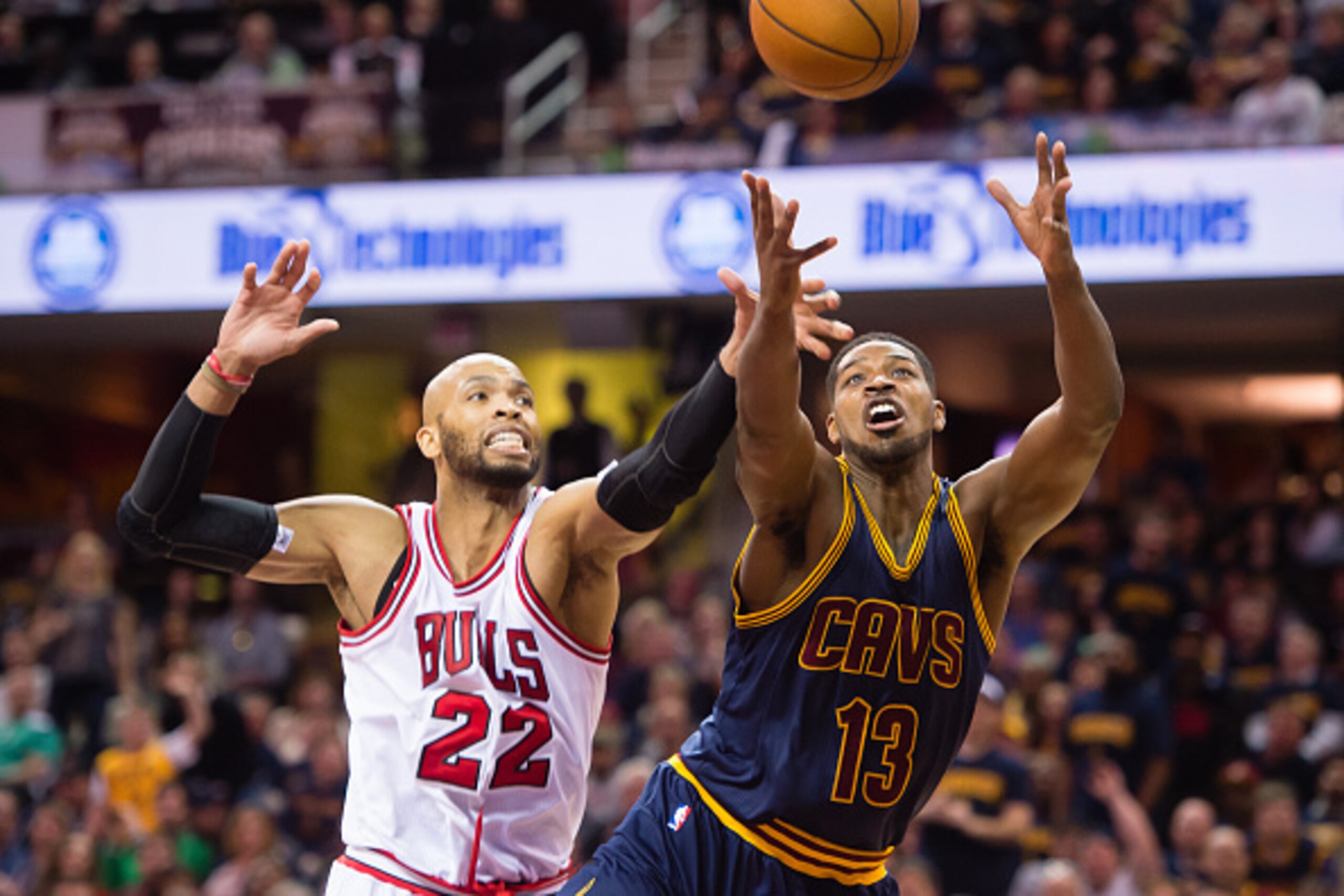
Tristan Thompson may feel like an afterthought on the Cleveland Cavaliers' star-studded roster, but his one major strength as an NBA player could make him a postseason stud.
In a piece for The Washington Post, Seth Partnow explained:
"Among players who have played at least 1,000 minutes, only Hassan Whiteside has contested a larger percentage of available offensive rebounds than Thompson’s 'chase rate' of 27.5 percent (per SportVU data, with “contesting” a rebound defined as being with 3.5 feet of the ball when the rebound was secured). Against teams which already struggle to rebound, this relentlessness could provide Cleveland those few extra possessions and easy baskets it needs to win.
"
Not just any easy baskets, either. The best kind of easy baskets: open three-point shots on kick-out passes in scrambled situations.
Thompson is merely a backup big, but he's a backup big with an elite skill who could create tons of high-yield offensive opportunities for his teammates.
Keep an eye on him this postseason, particularly under the boards.
Jeff Green, SF, Memphis Grizzlies
9 of 10
Here's a curveball: Jeff Green can have a massively positive, potentially series-swinging impact on the Memphis Grizzlies' postseason campaign.
If he stays planted on the bench.
Green has quietly torpedoed the Grizzlies' production since coming over in a trade from the Boston Celtics. When he plays, Memphis gets narrowly outscored by its opponents, posting a net rating of minus-0.4 points per 100 possessions, according to NBA.com.
A small number, sure, but one that stands out starkly against the team's overall rating of plus-3.3.
Oh, and when Green isn't in the lineup, Memphis crushes all comers, tossing up a net rating of plus-8.3.
This isn't rocket science, folks. And we're dealing with more than 2,000 minutes of data comprising half of a season. There's no getting around it: The less Green plays, the better the Grizzlies are.
Not every unsung hero has a happy song, I guess.
Meyers Leonard, C, Portland Trail Blazers
10 of 10
Even if the hallowed 50-40-90 mark is somewhat arbitrary (why is it any more impressive than, say, 49-44-91?), the fact that Portland Trail Blazers reserve center Meyers Leonard is on pace to join Steve Nash, Dirk Nowitzki, Larry Bird, Mark Price, Reggie Miller and Kevin Durant in that exclusive fraternity is remarkable.
As is Leonard's overall growth this season.
Blazers head coach Terry Stotts told Joe Freeman of The Oregonian:
"We've said it from the beginning that it was going to take some time. He's young, he's a big man, he didn't have a lot of experience. Things haven't come easy, but he's put in more work than anyone could imagine behind the scenes. It's good to see that all the work he's putting in is paying off.
"
Leonard still makes plenty of defensive mistakes, and it's generally an adventure when he puts the ball on the deck. But he's gradually turned into an athletic, floor-stretching force in limited minutes.
Against the right matchups, he could slot in alongside LaMarcus Aldridge to give the Blazers a fearsome perimeter quintet, creating loads of space for Damian Lillard to work.
Maybe that sounds like a small thing, and perhaps we won't even see Leonard log significant minutes in the postseason. But he's a unique weapon who could put his stamp on a series with a key triple or transition dunk at the right moment.
In a West this competitive, one play like that could make a world of difference.

.jpg?w=2560 "Mahomes Told Teammate to Leave Meeting")
.jpg?w=2560 "5 Teams Eyeing Jonathan Taylor")

.jpg?w=2560 "NFL investigating Eagles")
.jpg?w=2560 "Jonathan Taylor Landing Spots 📍")

