What College Coaches Really Think of Spring Football
It's not December, but this is Christmas time for Arkansas head coach Bret Bielema. Spring football: It's the most wonderful time of the year.
He may as well be a kid again.
"It’s the greatest time in the world to coach," said Bielema. "You don’t have a dark cloud hanging over your head of an opponent on Saturday. We’re not trying to beat LSU, Alabama or Auburn. You don’t have to worry about the task of a game plan.
TOP NEWS

Unranked CFB teams cause chaos in Week 8
Arch Reacts to 'Edgy' Sark Quote 🤣

More top teams upset and more takeaways from CFB Week 8
"It allows you to focus on everything that is right about football."
It's the right time to be Bielema. The Razorbacks won three of their final four games, including a 31-7 rout over Texas in the Texas Bowl, to finish with a winning record for the first time since 2011. There's some mojo around the program that hasn't been present in a while. The irony, of course, is that Arkansas still finished dead last in the SEC West.
But there is a contagious optimism in spring, even for coaches coming off of losing seasons. Texas Tech's Kliff Kingsbury and North Texas' Dan McCarney finished with 4-8 records and are tasked with getting back on the right track.
Everyone is 0-0, especially Pitt's Pat Narduzzi. He enters his first spring as a head coach after serving as a defensive coordinator for 11 years under Mark Dantonio at Cincinnati and Michigan State.
How each coach conducts his spring practice is like having a batting stance: Everyone does it a little differently. What they all want, though, is to come out better prepared for the chaos of the regular season.
Here's what they really think about college football's best season.
Keeping It Fun
Major college football is a multibillion dollar business, and it will never go back to what it was. There's a lot at stake—namely jobs at every level—week in and week out.
It is still a game, though.
To keep things loose, McCarney created the Mean Green Laugh of the Day. It can be anything that happened in practice that day. "Maybe someone fell asleep in a meeting and the position coach got him with a bullhorn," he said. "And everything is recorded, you know."
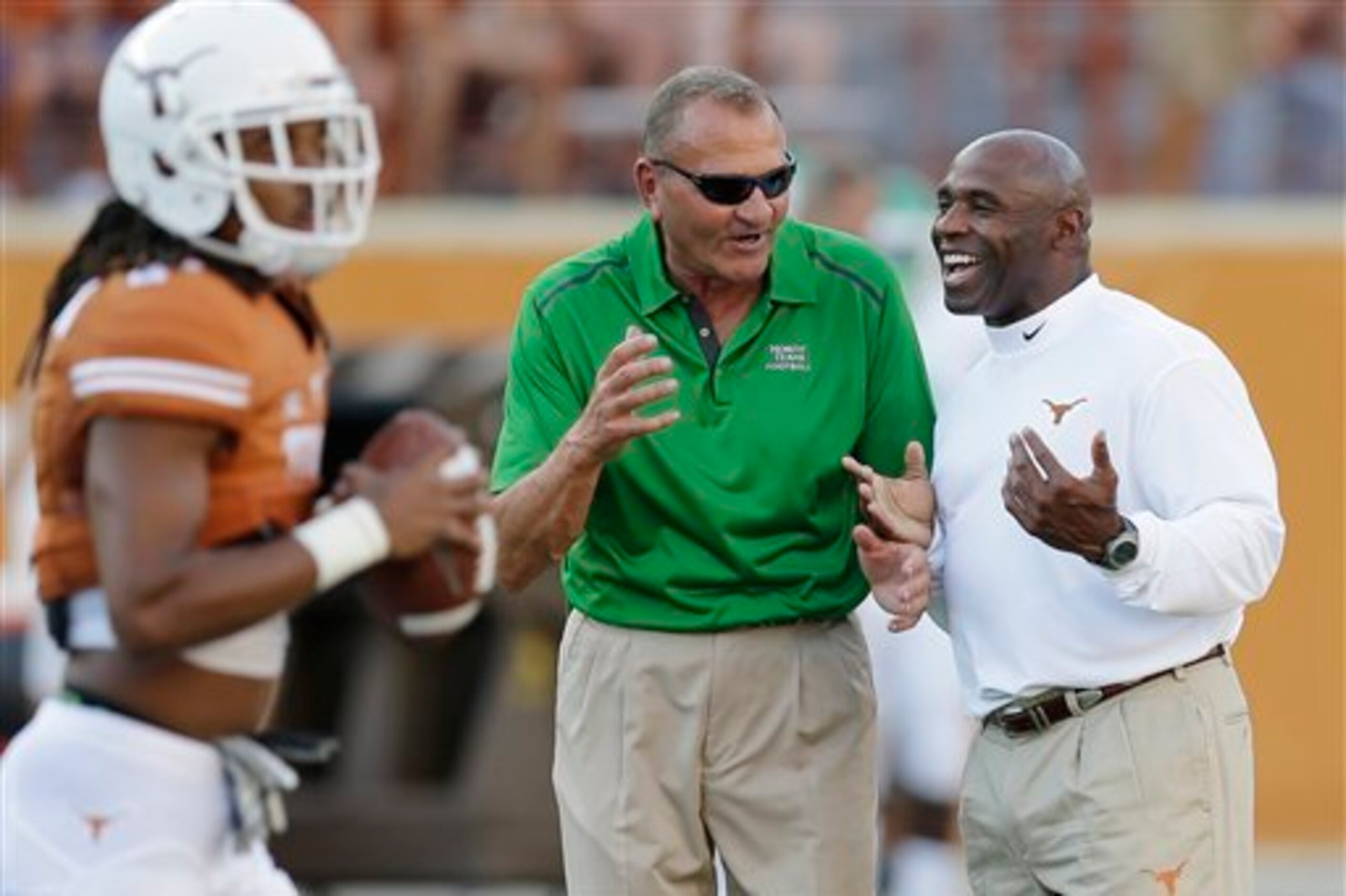
The program favorite, though, is the look-a-like contest. It's just like it sounds: Someone puts a player or coach's picture on a wall in the facilities building next to his respective doppelganger.
Who was McCarney's?
"Ernest Borgnine," he said, "and it wasn't a very becoming picture, either."
He pauses and then chuckles.
"If you can't laugh at yourself..."
Yes, coaches ride their players hard. They yell and they push players to their limits. The chaos and fatigue that exist in the regular season are created in the months between February and May when there are no opponents on the schedule. It's the ultimate form of preparation.
"It's about building faith and trust," Narduzzi said. "Take the Cotton Bowl against Baylor. We were down at the half, but because we had trust in one another, we were able to go out and play the second half. We didn't allow a single fourth-quarter point."
However, practices have to have an element of fun. There's too much hard work being put in for there not to be. Narduzzi likes to blast music and run around with his team. It's not a good day if he's not sweating. Standing around with a clipboard is the "old-school way of doing it," he said. "We're new school."
Bielema and Kingsbury love team-building competitions, both during and beyond spring practices. They are the crucibles in which team chemistry is organically grown. They range from paintball games to bowling, cookouts to dance-offs, as Kingsbury headed last spring.
"Your team grows more between that last play of the spring game to the first day of fall camp than at any other time of the year," Bielema said.
Competing All Day, Every Day, With Everyone
Bielema and McCarney have something in common. Both are former underrecruited players who ended up at Iowa trying to make a name for themselves. Spring football was their means to do it.
"When I was a player, I was an unrecruited walk-on," Bielema said. "I made my biggest gain in the program in my very first spring because I moved past people on the depth chart. I knew how to work. I could learn well, and I carried that over to the playing field. I’ve seen so many kids have a similar approach in our program."
Now on the other end of things, they see their players carving similar paths.
McCarney added, "You have walk-ons, guys coming off of redshirts, guys who have had disappointing careers so far. They all have something to prove."
Including early enrollees. The Razorbacks have seven freshmen early enrollees for 2015, many of whom are competing at positions of need. One player specifically, 4-star defensive tackle Hjalte Froholdt from Denmark, is taking first-team reps.
"He's played both the nose tackle and 3-technique," Bielema said. "He’s 6’5”, runs like a deer, learns like Einstein and plays like Rocky Balboa."
Bielema is a fan of early enrollees because they've already succeeded in academics and athletics. "They're not dumb," he explained.
It's true; there's something to be said for a teenager bright enough to handle three-and-a-half years of high school and football. With the rise of summer camps and seven-on-seven competitions, more football players are coming into college better prepared for competition.
Physically, there will be room to grow, but mentally, freshmen are catching up.
"Now, a lot of them do get homesick. There is that, " Bielema added. "Little Johnny should be going to prom, but instead he’s getting his head beat in for 64 plays in a Saturday scrimmage."
Kingsbury started two freshmen quarterbacks in 2013—Davis Webb and Baker Mayfield—and won eight games. He knows firsthand what they're capable of doing.
He isn't alone in this philosophy, but Kingsbury is a big believer that winning is a destination and competition is the road that gets you there. "That raises the level of play for everybody," he said. "You have your schemes, the things you want to tweak. But for us, spring is about watching your guys compete for their position."

Kingsbury comes across as cool and collected, someone who has it together all the time. And he is, and he does. However, he's not OK with the status quo. There has to be a level of discomfort every day. One of his bigger frustrations from 2014 stemmed from the fact that he didn't have quarterback competition in the spring. Webb, who played in 10 games as freshman in '13, was the only scholarship signal-caller available.
This spring, Webb, though recovering from a shoulder injury, has been competing with sophomore Patrick Mahomes. "With Davis and Patrick, each day knowing they have to bring it, it’s been huge," Kingsbury said. "They’ve improved dramatically. They’ve been protecting the ball more."
That competition is expected to continue into preseason practices.
Players Developing on Their Own
There's only so much coaches can do during spring. That's a technicality.
The NCAA allows coaches 20 hours a week to work with players and up to 15 spring practices. Beyond that, players are on their own. If they want to stay after practice and run routes, that's on them. If they want to watch film outside of meetings, it's their time.
But that's when the real growth occurs.
"The technology is there," McCarney said. "When I was in school, I had to drive from Iowa City to Cedar Rapids to get film.
"The best players are the ones who are willing to sacrifice their personal time to be better."
"The Mean Green got better today. Everybody wants to play. But to play winning football it takes accountability, reliability and durability!
— Dan McCarney (@NTCoachMac) April 3, 2015"
Bielema uses a buddy system with older and younger players. The idea, he explained, is to get young players into the right habits early. It's not just an on-the-field partnership either. He wants older players explaining to newer ones where the best places are to live and which foods are the best ones to eat at the training table.
Football, like all sports, is a game of "want to."
One of the most rewarding aspects of spring practices for coaches is to watch players grow knowing they put in the work on their own.
"Every guy has the one thing that makes them tick," Narduzzi said. "Great players are the ones who have the desire to do things—the things they're not as good at—on their own."
In between, coaches do what they can to develop players physically and mentally without crushing them. Those interviewed preferred three practices per week—and no back-to-back practices to keep players from physically breaking down.
"Because you don’t have games, you want to make spring practices physical, you want to bang 'em around pretty good, but you want these guys healthy," Kingsbury said. "There’s a fine line, but spring is a time to up the physicality because you want to make it a demanding environment. At the same time, you don’t want to have 300-play scrimmages."

Additionally, the coaches polled said they like about eight weeks of strength and conditioning in the winter to get players ready. Strength coaches have become the unofficial assistant head coaches. They're as important as anyone on the staff because of the amount of time they spend with players when coaches aren't permitted.
"Effort is great, but it’s a byproduct of getting better," Bielema said. "Take (former defensive end) Trey Flowers last year. This was a guy that could have left for the NFL but grew as much as anyone last spring because he developed on his mental and physical tools.
"When you have a player of elite status get better during spring, I know that someone who’s just beginning can get better as well."
New Beginnings
Things are even more wide-open for Narduzzi. This is a new coaching staff trying to earn the trust of players who have been there longer and know the program better.
This is Narduzzi's first spring as the head honcho of a college football program after spending years as an assistant. So how does it feel?
"Is there a difference?"
Don't know, is there?
"Not really."
Narduzzi wants to have fun. He wants to create competition, and he wants to win above all. But he also knows that he can't do any of that without earning the respect of his players.
It's a twofold approach really. Narduzzi employs the "I'll trust you until you give me a reason not to" philosophy and would like the same in return. He also understands, though, that the players have to buy into the concepts he's teaching.
If nothing else, time demands it. During the summer, players are mostly on their own. Not everything will be accomplished immediately, Narduzzi explained, but there has to be a solid enough foundation that players can conduct summer workouts without developing bad habits.
"That's the fun part, the challenging part," he said. "I'm kind of a builder in that way."
In their own way, every coach starts over each spring. Whether it's installing a new scheme or managing expectations, a blank whiteboard is a metaphor that carries a lot of different meanings.
Losing records? They don't matter. "It's in the past," said Kingsbury and McCarney.
Even surging programs have to wipe the slate clean. There's a danger in getting too caught up in media hype. Bielema knows his kids read social media, watch ESPN and the SEC Network. It's his job to bring them back down.
"The respect you have in college football? That rent is due everyday," Bielema said. "It’s not once a month; it’s something you pay daily."
And it is paid in the form of sweat and blood on the practice field. It's a tough time for the players. If winter conditioning did its job, they're better prepared—but not fully prepared. Coaches can't have that type of complacency.
They don't want it either. There's a joy in the challenge of player growth because there has to be an infancy to it. That infancy is now.
And, maybe, these coaches see themselves in their players. In a way, they're kids all over again.
"The players, they hate spring. They say 'I want the game, I want the game, I want the game.' But coaches? We love it," McCarney said. "The best time of day is when you're on the field with your players.
"If some coach says they'd rather be in a meeting room, well, they're B.S.ing you."
Ben Kercheval is a lead writer for college football. All quotes obtained firsthand unless noted otherwise.

.jpg?w=2560 "Mahomes Told Teammate to Leave Meeting")
.jpg?w=2560 "5 Teams Eyeing Jonathan Taylor")


.jpg?w=2560 "NFL investigating Eagles")
.jpg?w=2560 "Jonathan Taylor Landing Spots 📍")