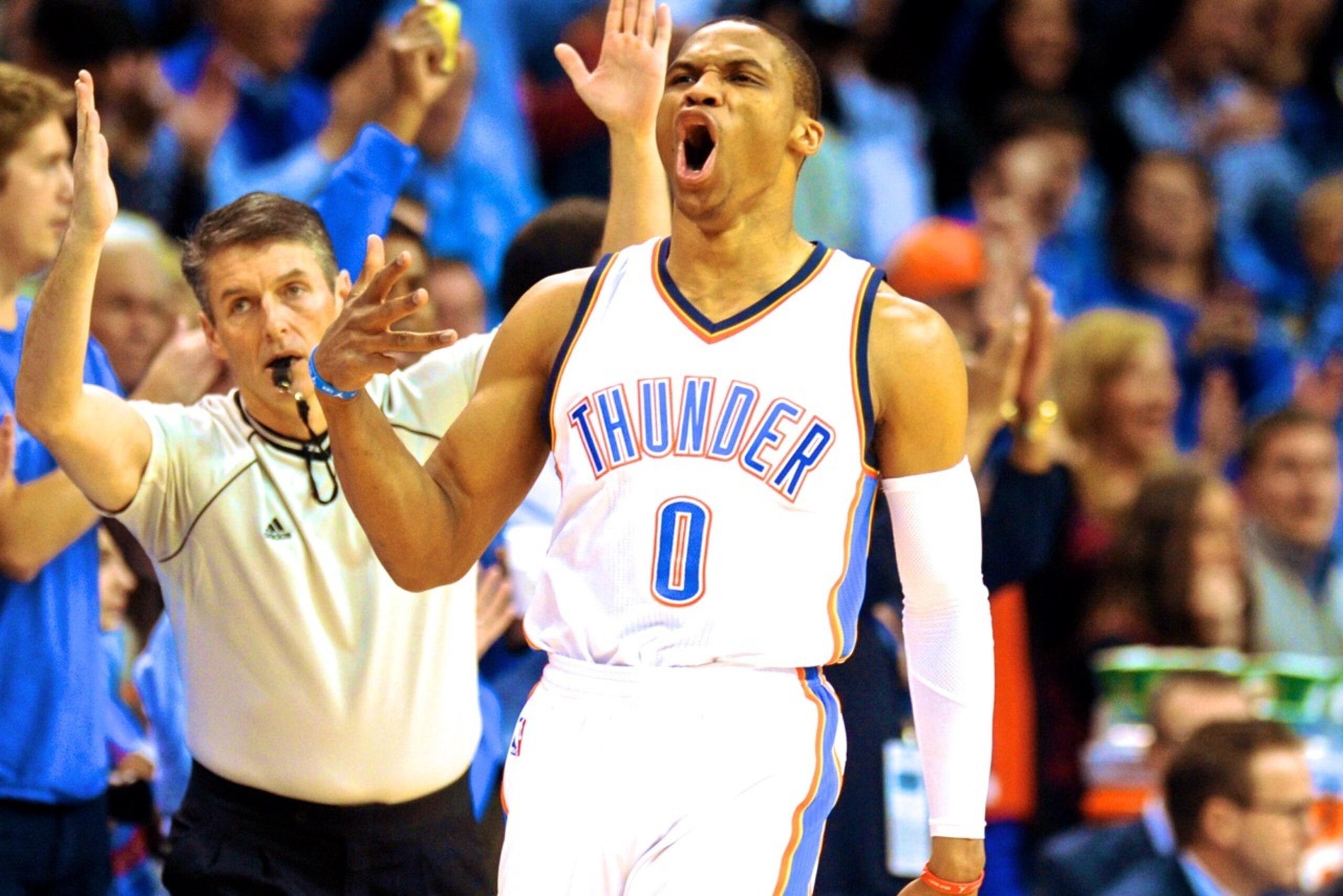


Russell Westbrook's statistical assault on the rest of the NBA is everything you want, don't want and can't fathom all at the same time.
To whittle it down even further: It's a season worthy of Russell Westbrook. The Oklahoma City Thunder point guard is simultaneously inciting deference, dread and disorientation as his team fights for the Western Conference's eighth and final playoff spot.
The foremost factor behind this crusade is beyond his control. Serge Ibaka hasn't played since March 11, and Kevin Durant is done for the season, leaving Westbrook to carry Oklahoma City the only way he knows how: by being more Russell Westbrook than ever.



Like always, this style of play is generating mixed results, good and bad, incredible and detrimental.
Let's start with the good.
Since Durant last played, Westbrook is doing his best Oscar Robertson impression, averaging 30 points, 10.2 assists, 8.8 rebounds and 2.1 steals per game. This is by no means a small-sample burst. Rather, it's an isolated portrait of his season at large.
Westbrook's per-game line is at 27.5 points, 7.2 rebounds, 8.6 assists and 2.1 steals. Only one other player has matched those statistical benchmarks before: Michael Jordan.
This is the appeal of Westbrook. He does things point guards shouldn't and normal human beings can't. He's currently tied for the second-highest usage rate in league history, he's the only point guard to rank in the top 100 of rebounding rate, and his player efficiency rating (28.6) is the 10th highest of any guard ever.
The season during which Robertson averaged a triple-double (1961-62) is actually a fair comparison when accounting for era differentials, as Bleacher Report's Adam Fromal shows:
So too is Magic Johnson's 1981-82 campaign, when he nearly duplicated Robertson's feat:
An even stronger correlation exists between Westbrook's season and Robertson's performance in 1961-62. The latter posted peerless totals while playing for a 43-win Cincinnati Royals squad that was bounced in the first round of the playoffs, and only two of his running mates contributed more than five victories to the cause.
Similarly, Westbrook headlines a Thunder team on pace for 44 victories, and just two of his teammates have cracked five win shares. And this is where the illusion of his profound impact, of his MVP candidacy, begins to unravel.
For all Westbrook is doing, the Thunder are not an elite unit. They are now on the outside looking in at the West's playoff picture and at the mercy of the eighth-place New Orleans Pelicans, who own the potential tiebreaker.
While Westbrook has been neutralizing defenses, the Thunder are struggling to play .500 basketball. They're 13-11 this side of the trade deadline, and their defensive standing has plummeted. What was a top-10 defense prior to Feb. 19 has been a bottom-two outfit since.
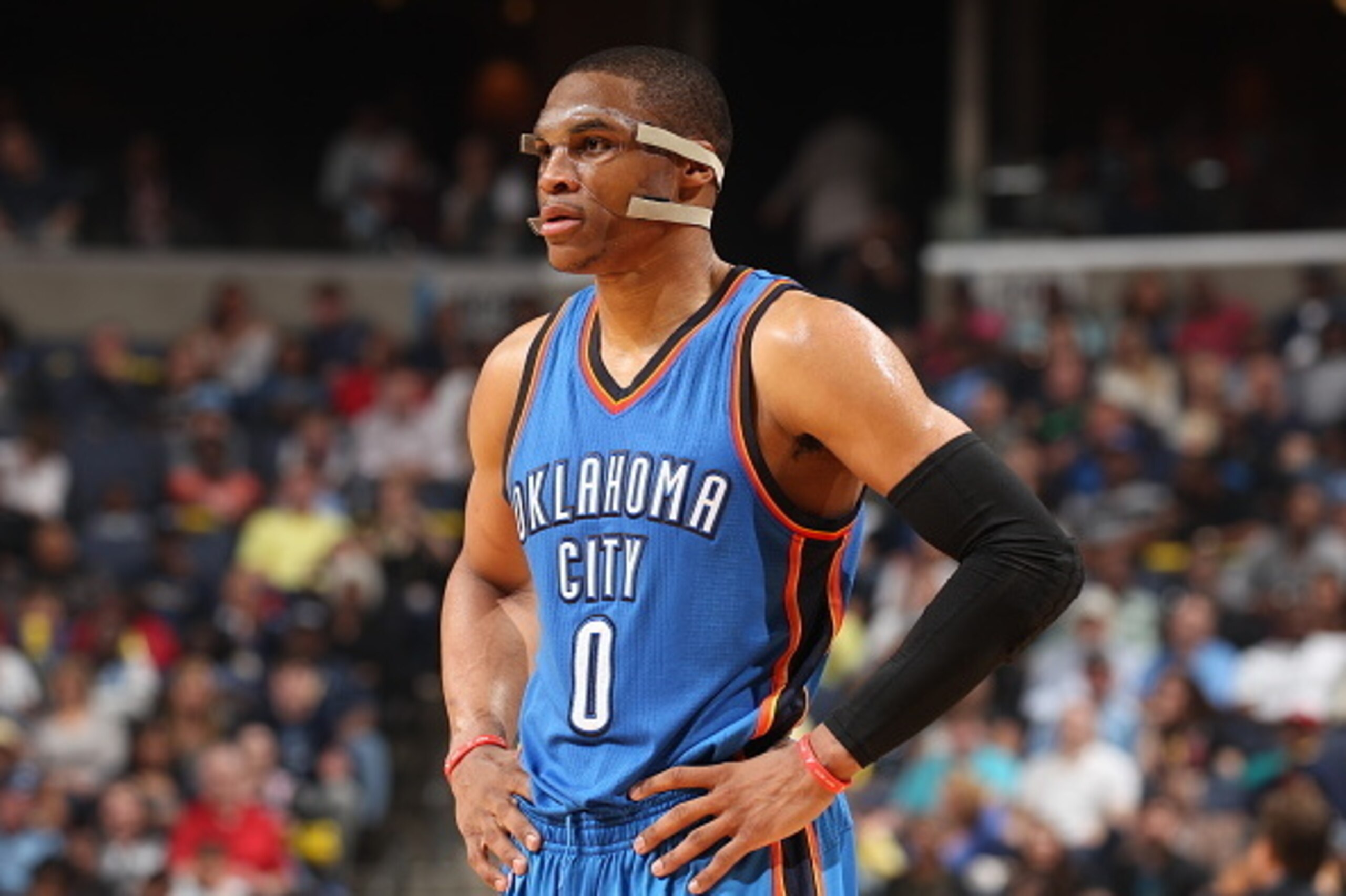
It's impossible to move forward without citing the personnel changes here. Enes Kanter is a sieve, and Ibaka's absence bilks Oklahoma City of a premier paint-policer.
Not surprisingly, the Thunder are one of the three worst shot-blocking groups since he went down. Westbrook, in turn, is trying to compensate on the defensive end by channeling his offensive recklessness.
Admirable? To a point.
Effective? Not at all.
Satchel Price expands for SB Nation:
"Westbrook has always been an aggressive perimeter defender, willing to attack passing lanes and muscle up opposing guards. That's often worked in the past in the form of forced turnovers that get him in the open floor.
That aggressiveness has gone overboard in the past few months, though, with Westbrook too often trying to force things and getting caught out of position. It's seems like he's lost some confidence in the big men behind him -- again, Kanter isn't Ibaka -- and that's led to a lot of gambling on risky plays instead of sticking to the system.
"
When Westbrook and Kanter share the floor, Oklahoma City allows 109.4 points per 100 possessions, which would rank as the NBA's worst defense.
More tellingly, Westbrook isn't making the Thunder better during this superhuman stretch. They're a net minus with him in the game, and though he drums up their offensive potency, it's not enough to counter the defensive hemorrhaging:
| With Westbrook | 842 | 108.2 | 109.5 | -1.3 |
| Overall | 1162 | 107.1 | 107.8 | -0.7 |
| Without Westbrook | 320 | 104.0 | 102.9 | 1.1 |
Sample size does matter in this case. The Thunder are averaging just over 13.3 minutes without Westbrook through their last 24 tilts, making it easier for the stats to work against him.
Fatigue also has to be a factor. Westbrook is the intergalactic cyborg that could, but he's logged 842 minutes over this span, nearly 100 more than anyone else on the team. And while that averages out to just 36.6 ticks per game—which is right in Westbrook's wheelhouse—he's carrying a nearly unprecedented workload. That's bound to take a toll.
But this isn't worth ignoring. Not even close. The Thunder are 1-14 against West playoff teams without Durant in the lineup (1-11 with Westbrook and no Durant), and they've lost six of seven—including the last four—at a crucial point in the season.
"We've never been in this position, so this is our first time fighting for a spot," Westbrook deadpanned following Oklahoma City's 113-88 loss to the San Antonio Spurs on Tuesday night, per ESPN.com's Royce Young. "It's definitely a different feeling for us, but at the same time all we can do is control our own destiny and come out every night and play at a high level."
If only this were true. The Pelicans actually control everything, from the season-series tiebreaker to the number of games left on their schedule. They're in the driver's seat the Thunder once called their own.
In the end, this does nothing to discredit Westbrook's energy levels and individual effort. It is, however, a wake-up call for anyone who thought—and is still thinking—that the Thunder are now Westbrook's team, or that he supersedes Durant's value in any way.
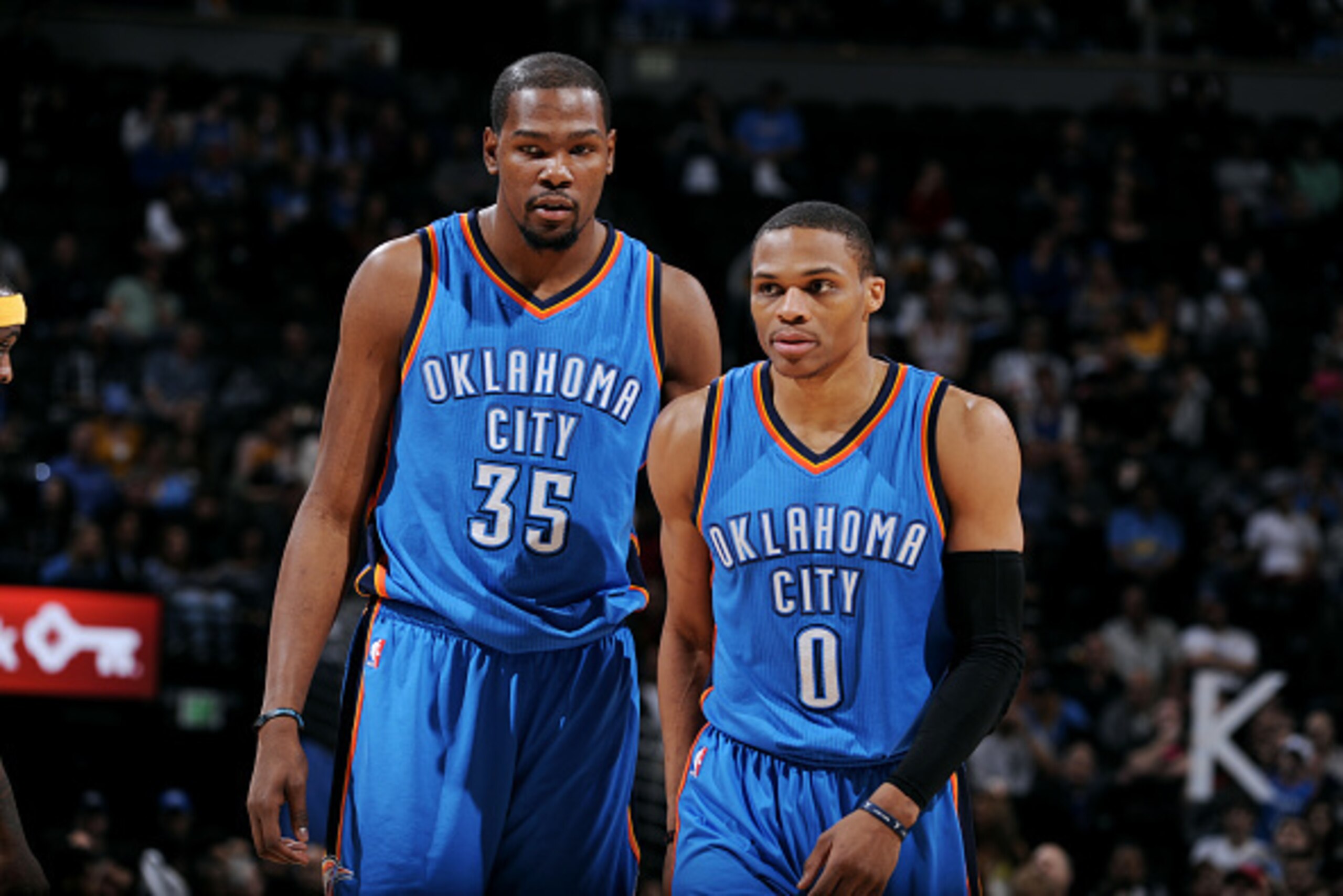
Durant led the Thunder to a 24-11 record in games he played without Westbrook last season, easily exceeding the 19-17 mark Westbrook has guided them to without him.
Yes, the cast was different in 2013-14. And sure, injury bugs didn't rip through the roster to identical consequence. But Westbrook's statistical onrush through these trying times does not belie reality: He's trying to salvage, to rise above, a situation only one player on the roster is capable of transcending.
And that one player isn't him.
*Stats courtesy of Basketball-Reference and NBA.com and are accurate leading into games on April 8 unless otherwise cited.

.jpg?w=2560 "Raiders Could Start Mendoza")

.jpg?w=2560 "Rodgers Iced Out on Plane 💎")
.jpg?w=2560 "Packers Safety Slams Refs 🤬")
.jpg?w=2560 "🚨 Week 8 AP Top 25 Poll")