

Indiana Pacers' Lackluster Defense Dooming Chance to Make 2015 NBA Playoffs
Just a few weeks ago, the Indiana Pacers looked to have finally put all the pieces together.
After a difficult and injury-filled start to the season, they were taking control of the race for the Eastern Conference’s final playoff spot and playing as well as anyone in the league. Optimism abounded, and they appeared ready to provide a stiff challenge in a first-round playoff series.
Now, the Pacers suddenly can’t stop anyone on defense, and just making the playoffs seems almost laughably improbable.
TOP NEWS

Brown with an all-time summary of relationship with Tatum

Jokic says booing fans not welcome in Denver
Worst NBA Predictions 🫣
The Pacers are currently three games behind the Brooklyn Nets (seventh) and two games back from the Miami Heat (eighth) in the loss column. That’s not an insurmountable gap with seven games left, but Indiana is headed in the wrong direction, having lost nine of their last 11 games. ESPN's Playoff Odds give them just a 17.3 percent chance of making the postseason after projecting an 89.2 percent chance just three weeks ago.
Over those last 11 games, since March 14, the Pacers have been allowing 109.7 points per 100 possessions, per NBA.com. That’s more than eight points worse than their season-long average of 101.5 and would rank dead last in the NBA if stretched across the entire season. If we look at a rolling five-game average of their offensive and defensive efficiency, this current implosion is pretty striking.
Small blips like this can often be a product of clusters of difficult opponents. However, there is no schedule buzzsaw to explain away this disastrous slide for the Pacers. In fact, if you compare that rolling average of defensive efficiency to a rolling average of their opponents’ season-long offensive efficiency, this stretch should have been a chance for the Pacers to improve their defensive performance. Instead, it's fallen apart completely.
The Pacers have been healthy, and while facing a soft patch in their schedule, the club has seen the foundation of their identity crumble. During this crucial stretch, they have really fallen off in two areas. The first—foul rate—is largely under their control. The second—opponent field-goal percentage—is a little less so.
Jared Wade of 8 points, 9 seconds hit on both areas in a recent breakdown of the Pacers defense focused on a five-game losing streak within this larger stretch of abysmal defense:
"
Four of five have made 9 or more 3-pointers against a team that had only allowed 7.1 makes from deep per game. And it wasn’t volume shooting: Those opponents hit 54.2%, 50.0%, 41.7%, and 52.2%, respectively, against a team that had allowed the opposition to make just 33.7% previously.
"
Four of five have shot 28 or more free-throw attempts (37, 31, 28, and 33, respectively) against a team that normally only allows 23.0 per game.
After a crushing 110-100 loss to the Houston Rockets on March 23, Roy Hibbert offered his assessment of what ails his team’s defense, agreeing with Wade on the free-throw problems, per Candace Buckner of the Indianapolis Star:
"In the years past, we've been able to earn no calls and get stops and I think the easier way out has been to foul, myself included. I haven't done a good job guarding my own man and sometimes my help rotation is not as good as it has been. Sometimes we foul and that's what's leading the guys to shoot a lot of free throws.
"
James Harden attempted 22 free throws in that game, symbolic of what has become a significant problem for Indiana’s defense. Prior to this 11-game slide, the Pacers' opponent free-throw rate (ratio of free-throw attempts to field-goal attempts) was 0.280, good for 17th in the league, per NBA.com. Since then, it has climbed significantly to 0.353—dead-last in the league over the same time span.
On average, a pair of free-throw attempts is the highest-value possession outcome an offense can hope for—an expected value of 1.506 points per possession this season, compared to 1.056 for all possessions. All of a sudden, the Pacers' opponents are getting to the line a lot more often and, as a direct result, are scoring more efficiently. That's a toxic combo.
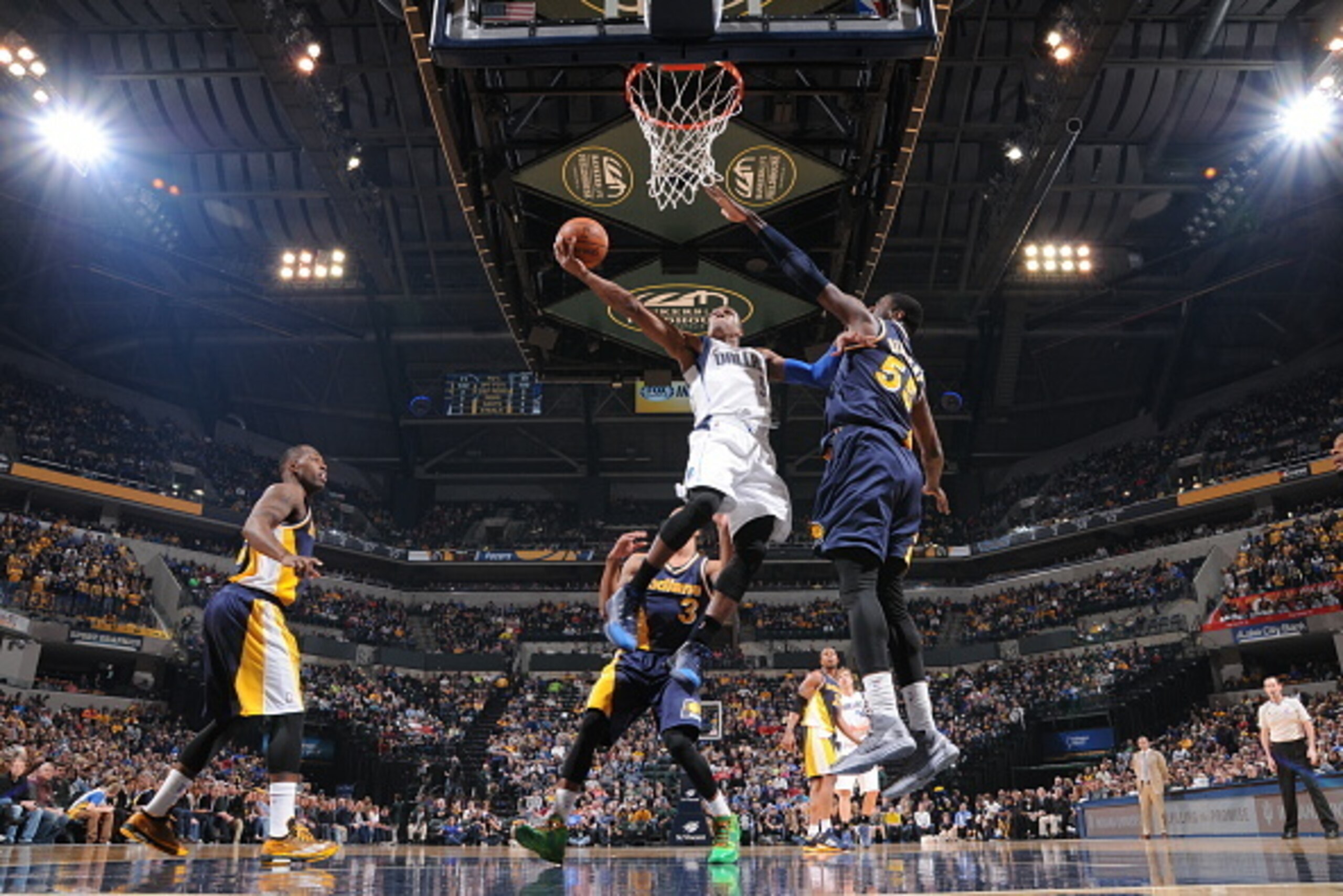
The other big issue is that opponents are suddenly making a ton of shots from the field against this defense. It may seem counterintuitive, but to some degree, this is outside the Pacers’ control.
What a defense can do is force teams to take tough, contested shots. Generally this pushes the percentages in their favor, but sometimes a shot goes in no matter how well it is defended.
For example, studies have shown that limiting three-point attempts is a much more stable measure of defensive effectiveness than limiting three-point makes, which is subject to the random noise of shot-making.
Over the past 11 games, the Pacers defense has been largely holding teams to the same shot distributions as they were previously:
| % of FGA | Restricted Area | In the Paint (Non-RA) | Mid-Range | Corner 3 | Above the Break 3 |
|---|---|---|---|---|---|
| First 64 Games | 30.5% | 14.6% | 29.7% | 6.2% | 18.9% |
| Last 11 Games | 28.9% | 14.9% | 29.9% | 7.6% | 18.7% |
But if we swap out the percentage of field-goal attempts for the actual shooting percentages from those areas, we can see that opponents are suddenly shooting much better from every location:
| FG% | Restricted Area | In the Paint (Non-RA) | Mid-Range | Corner 3 | Above the Break 3 |
|---|---|---|---|---|---|
| First 64 Games | 56.6% | 39.9% | 39.1% | 39.1% | 32.6% |
| Last 11 Games | 60.3% | 43.1% | 42.1% | 42.4% | 39.9% |
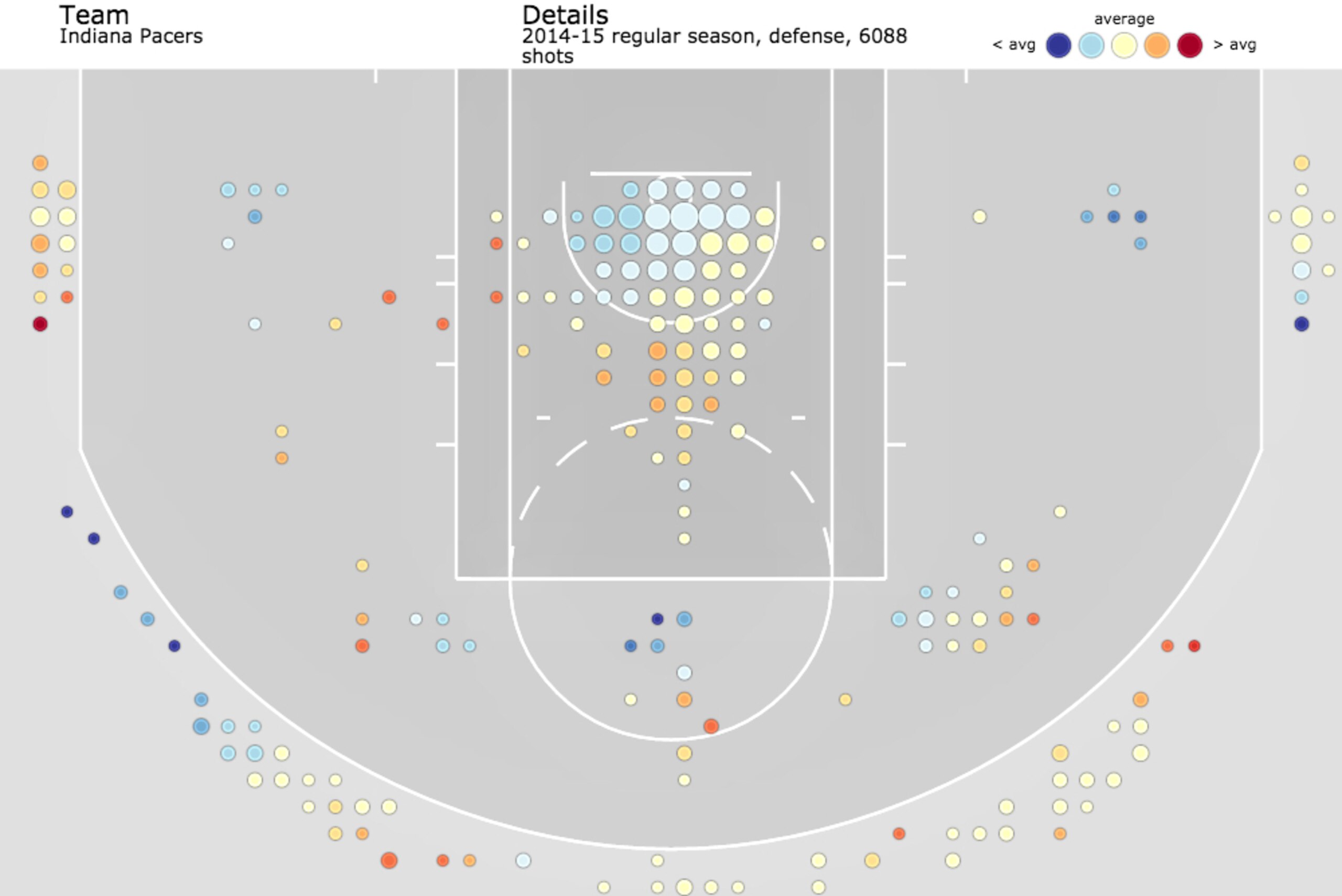
If you prefer a visual representation to a numeric one, check out the team’s defensive shot chart up to March 13:
Here's the chart for the 11 games since:
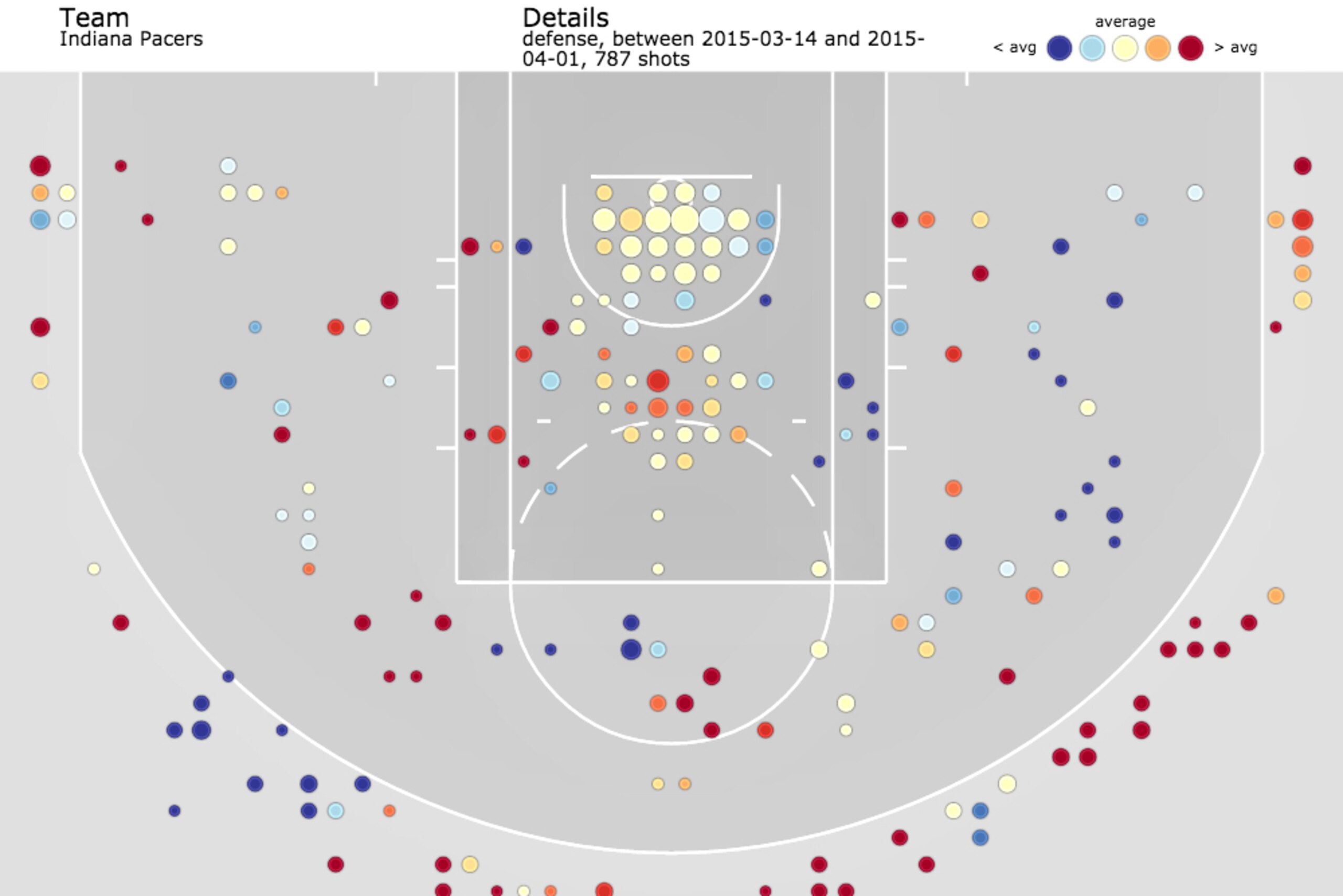
It's pretty jarring how much more effective teams have been against the Pacers recently from essentially every area of the floor.
I don't mean to imply that all of this can be attributed to the random noise of shot-making, but given that the Pacers have been getting blown out by middling offensive teams while allowing roughly the same shots they allowed earlier in the season, bad luck is clearly a factor.
That being said, this is the time of year when the best teams are supposed to be raising their levels of performance. Guaranteeing a spot in the playoffs means taking authoritative control of your destiny and removing any opportunity for shots to fall and for luck to spoil your plans.
The Pacers' season isn't over yet.
But if they want to keep playing, they're going to need to do a lot more on the defensive end to make it happen.

.jpg?w=2560 "Mahomes Told Teammate to Leave Meeting")
.jpg?w=2560 "5 Teams Eyeing Jonathan Taylor")

.jpg?w=2560 "NFL investigating Eagles")
.jpg?w=2560 "Jonathan Taylor Landing Spots 📍")

