

Don't Count out Chicago Bulls from NBA's Title Race Just Yet
If the playoffs started today, the Chicago Bulls wouldn’t go very far. They’ve been pretty awful lately.
In the month of March, they are 3-6. They’ve been outscored by 5.2 points per game, according to NBA.com/Stats. Only seven teams have a worse plus-minus. Their offensive rating is just 98.9, 23rd in the NBA. Their defensive rating is 104.0, which is only 18th.
And finally, their opponents have grabbed 19 more rebounds in each of their last two games. Pau Gasol has only registered eight boards in each of those, indicating the heavy minute load he’s borne all season might be weighing on him.
TOP NEWS

Jokic says booing fans not welcome in Denver
Worst NBA Predictions 🫣

Power Ranking Every NBA Team's Starting Lineup 🔢
However, the playoffs don’t start tomorrow. They start about a month from now. A lot will change before then, and it’s the team that will take the court when the postseason tips off that matters most.
Health
The dumbest argument in sports is referring to injuries as an “excuse.” Who is playing matters, regardless of the team. That’s because the team is who is playing. Literally.
If you take three of the six best performers off any team, including the leading and second-leading scorer, it's going to struggle.
The Bulls have been without All-Star Jimmy Butler, former MVP Derrick Rose and one of the league’s best bench players, Taj Gibson. So, of course, they’re going to be struggling. But the reality is that when the playoffs start, all three will be there.
Jimmy Butler has been out with a sprained elbow, suffered when ran into a hard screen against the Los Angeles Clippers on Mar. 1. Gibson has been out with a sprained ankle since Feb. 27.
According to K.C. Johnson of the Chicago Tribune, both are expected back soon.
Rose was projected to be out anywhere from four to six weeks after he had his meniscus trimmed on Feb. 27. He addressed the media on Mar. 9, saying, “I feel good. I’m in a positive place right now. Just trying to keep it positive and get the most out of these days.”
Furthermore, it was reported on The Boers and Bernstein Show on Mar. 17 that Butler and Gibson were practicing and that Rose was ahead of schedule. Things could change, but based on what we know now, they'll all be there for the posteason.
So the team that is in the playoffs isn’t the one that’s losing now. It’s the one that was winning before. When they’ve had their starting five and Gibson, the Bulls are 15-3. That, in all likelihood, is the team that will be in the playoffs.
The Bulls, as it seems they’re prone to do, are clawing through a series of injuries this season. But unlike in previous years, they are looking to be completely healthy for the playoffs for the first time since the 2010-11 season when they went to the Eastern Conference Finals.
The Streaky Derrick Rose
It seems some have written off an effective Rose being able to make an impact in the playoffs, but that doesn’t square with the logic or his history this season.
One of the key factors for the Bulls this year has been how much difference Rose can make for better or worse. The Bulls are 18-3 when he posts a fairly moderate 50.0 effective field-goal percentage compared to a paltry 11-14 when he doesn’t.
Part of the reason for his fluctuation is that there have been essentially three versions of Rose on the court this year: Rusty Rose, He’s Back Rose and Hurt Rose.
Through Jan. 9, Rose was trying to shake the rust off and find the mentality to attack the rim. There were some good games salted in, but they were mostly bad. Over the first part of the season, he averaged 16.9 points, 4.8 assists and 3.3 turnovers, per Basketball-Reference.com. He shot just 25.5 percent from deep.
Then Rose sat out the second leg of a back-to-back, on Jan. 10, and it was either the rest, the reflection or both that triggered something. He finally started to look like his old self.
From Jan. 12 to 25, Rose found his shot, drilling an effective field-goal percentage of 55.9 over an eight-game span. He averaged 22.6 points, 5.8 assists and 2.6 turnovers in 32.9 minutes. He shot 46.2 percent from deep.
He was also getting to the rim, where he was attempting 42.7 percent of his shots, per NBA.com/Stats. That was up from the 37.1 percent offered by Rusty Rose.
He was shooting better and getting to the rim more. He was setting up his teammates and his turnovers were down. He was approaching his former MVP-level of play.
Then, it was against the Warriors that Rose feels he may have hurt his knee.
"I’ve probably been playing on it for a month. I remember feeling something in Golden State and who knows? That could have been a sign telling me that something was wrong, and that was a month and two weeks ago. So, who knows when it happened? It could have happened that game, the previous game, who knows?
"
Over the next 11 games, Rose’s effective field-goal percentage fell to 41.1, suggesting that there was indeed a problem with his knee. (As an aside, here, Rose played hurt for a month, something his detractors have failed to take note of.)
During that span, he averaged 18.9 points and 5.1 assists and 3.5 turnovers. He shot just 21.0 percent from deep. Even with the bad games, Rose had occasional flashes of his MVP level, such as when he wreaked havoc on the Cleveland Cavaliers on the eve of the All-Star break.
So which Rose is going to be there in the playoffs? Because the meniscus was trimmed, there won’t be a chance of a re-injury. Hurt Rose won’t be there.
Coming back won’t be nearly as severe a challenge as when he had to shake off nearly two years’ worth of rust. And the more he plays in the postseason, the closer he’ll get to the “near-MVP” version of his game. He’s Back Rose can be expected to play.
The Importance of Butler and the Ironic Benefit of His Injury
The importance of Jimmy Butler is probably understated for the same reasons that the loss of Mike Dunleavy Jr. was. The Bulls are thin at wings, so when they are missing one of their starters, it has a huge impact on the team.
To put things in perspective, when the Bulls have had both of them, they’re 26-12, regardless of who else is playing.
When they’ve missed just one of the two, they are only 14-16.
Essentially, the Bulls have three true, rotation-level wings: Butler, Dunleavy and Tony Snell. When one of the three is out, they have to either resort to Doug McDermott (who needs another year of seasoning before he makes an impact) or play Nikola Mirotic out of position.
Or else, they have to play Kirk Hinrich at the 2, who has been increasingly abysmal. Since Butler was injured, the Bulls have been outscored by 47 points overall—and 44 with Hinrich on the court.
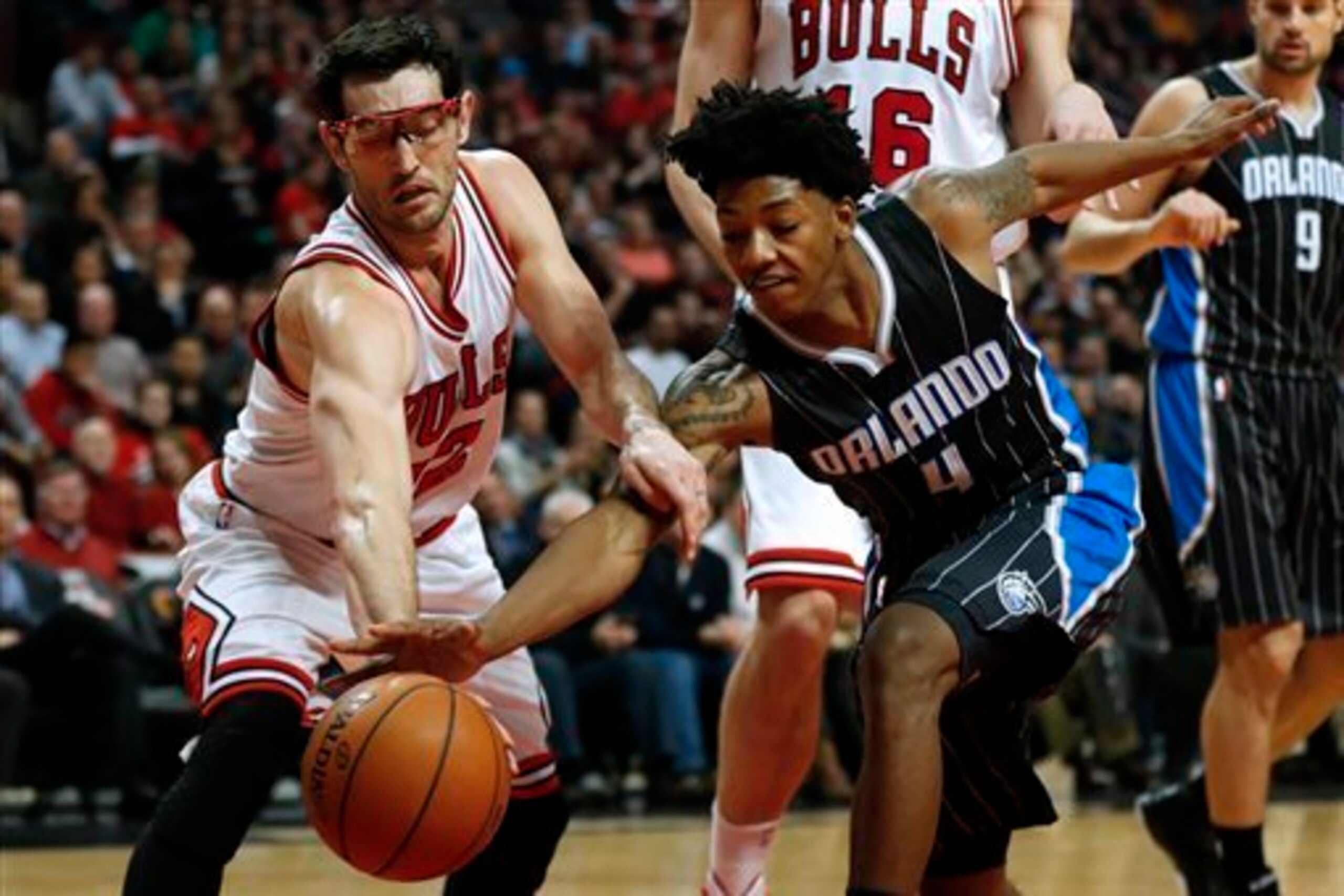
It's not all negative. All these injuries have given Snell the minutes to develop into a true rotation-caliber player. In fact, when Snell is in with the starters over Dunleavy, the Bulls' net rating is plus-9.6. When Brooks comes in and Rose plays the 2, Chicago’s net rating is plus-27.5.
Compare that with when Kirk Hinrich is in with the starters, and the net rating is minus-6.1, which is the worst lineup the Bulls have played at least 50 minutes.
Hinrich’s demotion is pretty evident. Both Aaron Brooks and Snell are starting over him, indicating he’s been pushed down in the rotation. And while some might argue that Tom Thibodeau is in love with Hinrich and will play him regardless, there’s a precedent that says otherwise.
In a very similar situation, when Butler started over Richard Hamilton in 2012-13 at the end of the year, he kept the starting spot and Hamilton almost faded completely from the rotation, even during the playoffs. Thibodeau’s history is that once you’ve leaped someone in the rotation, you stay there.
You can argue that the entire rotation is better because of Butler’s injury.
And the difference between now and the postseason isn’t just the difference between Butler and Snell or Rose and Brooks—it’s the difference between Butler or Rose and Hinrich. It’s playing their worst rotation player instead of their two best.
When the playoffs come, that won’t be the case.
Pau Gasol and the Power Forwards
Pau Gasol has played a lot of minutes this year—2,226 to be precise. That’s the most of any Bull. Coupled with his heavy workload, that’s problematic.
Only two other 34-year-olds have ever averaged 34 minutes, 18 points and 12 rebounds in a season: Robert Parish in 1988-89 and Wilt Chamberlain in 1970-71. Neither of them made it past the second round.
That has begun to come down, though, even with Joakim Noah having a more enforced playing restriction and with Gibson injured. Before the All-Star break, Gasol averaged 35.1 minutes. Since then, he’s averaging just 33.6. So what accounts for the difference?
It’s because of Thibodeau’s increased confidence in Nikola Mirotic, who has seen his playing time increase from 17.1 points to 26.8. And that has been a blessing to the Bulls down the stretch.
Mirotic has scored 101 fourth-quarter points since the All-Star break, the second most in the NBA behind only Russell Westbrook (102). His true shooting percentage is 63.1. He’s become a player Thibodeau can, and does, rely upon down the stretch.
Once Gibson returns, there’s reason to believe that Thibodeau will give all four of his bigs playing time and balance the minutes more evenly. He may even give Gasol a game off before the playoffs.
There is, of course, the other matter of defense and the problems that the Bulls have had this year, but again, that’s an issue that points back to the injuries and chemistry with their power forwards.
Through Jan. 19, the Bulls defense was awful by Chicago standards, a meager 12th in the NBA, surrendering 102.7 points per 100 possessions. Then, they had a team meeting and talked things out. From the team meeting to the game Gibson was hurt on March 1, the Bulls’ defensive rating was the sixth best at 99.0.
And we still have to account for the fact that Noah is coming into form. Before the All-Star break his player efficiency rating was 15.1, per Real GM.com. Since then, it's been 16.7. His energy has been better, and he's starting to resemble the First-Team All-NBA center he was last year.
On both ends of the court, the best of all four of the Bulls' bigs playing together is still ahead of them. And it looks like we'll see it in the postseason.
Conclusion
When viewing the Bulls' playoff future, it’s not about how they are playing right now, because right now they don’t have all their players.
The 15-3 team that has Rose, Butler and Gibson will be playing. The 26-12 team that has both Butler and Dunleavy will be playing. The 18-3 team that has the efficient Rose may very well be playing, if he can get a couple of regular-season games in before the postseason starts.
More importantly, the best possible rotation—the starters fleshed out with Gibson, Snell, Brooks and Mirotic—hasn’t really been seen yet. And they will be playing.
This could very well be a different type of year for the Bulls. Instead of playing great in the regular season, only to have a discouraging postseason, they could play their best ball when it matters most.
It’s not a guarantee. I wouldn’t even list the Bulls as favorites to come out of the East. But they have a very realistic chance if they can just get—and stay—healthy. They have the players they need, they just need to have the players they have.
.jpg?w=2560 "Mahomes Told Teammate to Leave Meeting")
.jpg?w=2560 "🚨 Week 8 AP Top 25 Poll")
.jpg?w=2560 "Baker Gets Glove From Rays 🧤")


.jpg?w=2560 "NFL investigating Eagles")
.jpg?w=2560 "Updates from EVERY NFL Game 🏈")
.jpg?w=2560 "CFP Bracket After Week 8 🏆")
.jpg?w=2560 "Steelers Roll Saints in Paris")