

Jimmy Butler and Tony Snell Give These Bulls Wings
The Chicago Bulls may not know what lies ahead for them in regards to Derrick Rose. But what they do know is that Jimmy Butler and Tony Snell are emerging as a pair of wings who can fly them into the future.
The voyage of Butler has been well chronicled. He’s in the midst of one of the greatest breakout seasons in history. And it’s impossible not to feel good about that. And now, Snell is having a Butler-esque sophomore season.
Like Butler, Snell had a great performance in his second summer league. And like Butler, Snell is finding his footing as he marches through his second year. In fact, four of the highest-scoring games of his short career have come in his last eight contests.
TOP NEWS

LeBron's Special Helicopter Deal

MJ Makes Record-Setting Donation 🙌
Shams: KAT, Hart Could Be Trade Names
For the first part of the season, Snell almost played himself out of the rotation. His struggles contributed to a loss of confidence, which led to less playing time, and the cycle spiraled.
But then, at the end of December, he “bounced.” He started hitting shots, and that gave him confidence, and that confidence led to more playing time, which resulted in more production.
The chart above shows this dynamic. The circles are Snell’s game score for each game. The line running through the chart is a polynomial trendline. What it means is that Snell’s numbers were trending down, but now they're building up.
What it also means is that this isn’t just a few good games from the man with the most punnable name since Jeremy Lin; it’s a couple of months.
And not only has he improved, but when he has been on the court with Butler, the pairing has looked better. Prior to Jan. 15, the duo was outplayed. But since then, the Bulls have outscored their opponents by 7.7 points per 100 possessions, compared to a mere plus-.8 net rating for the Bulls overall in that same span.
Analytics Agrees
A look at how analytics is shaping that future provides a window into why they are playing so well together. To explain how, the word "analytics" needs to be defined, though, as some seem to think that all it means is no mid-range shots and more threes.
Analytics is not just a simple rule about where to shoot from. It begins from the premise that basketball is, above all things, about possessions. With very few exceptions, teams take turns with the ball.
The team that scores the most points wins the game 100 percent of the time. Thus, if both teams have the same number of possessions, whoever scores the most points per possession will win the game, 100 percent of the time.
Therefore, analytics breaks the game down to the possession level. It asks: How can a team maximize its possessions and minimize the other team’s?
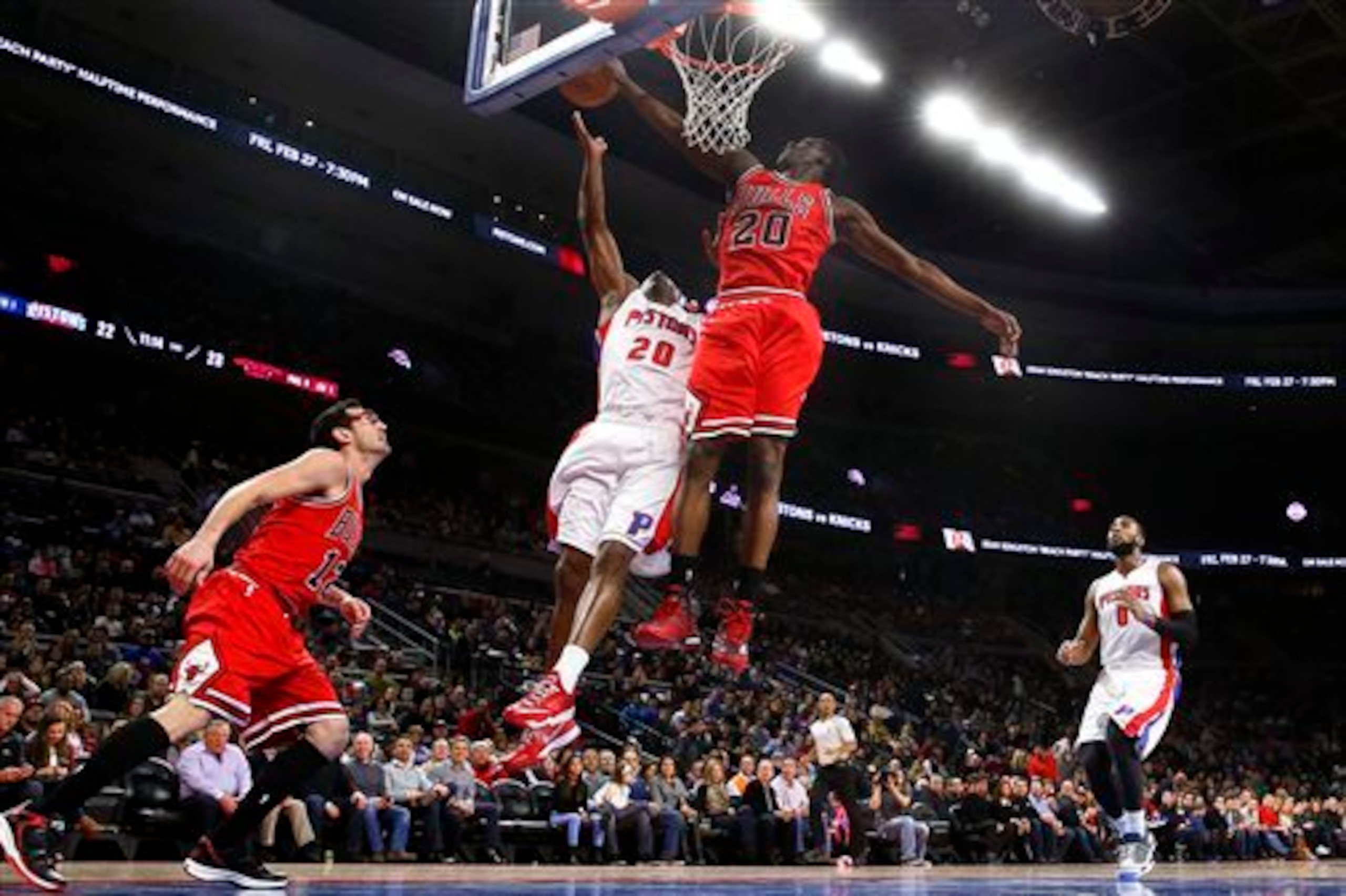
Part of that answer comes from looking at what range shots are going to render the greatest average return, but that’s hardly the totality of it. Who is shooting and how well guarded they are matters too. A wide-open Mike Dunleavy mid-range jumper is going to produce more points on average than a Joakim Noah three. So a mid-range is not always the “worst” shot.
When you break things down to the possession level, things get very interesting for the Bulls in light of their future. I looked at the number of points per possession used by each player on the Bulls. I defined a possession as a field-goal attempt, a turnover or .44 of a free-throw attempt (the reason it’s not half is that not all free throws use half a possession; drawing fouls shooting from three, technicals, flagrants and clear path violations can all result in “extra” free throws).
In the chart below, the size of the box indicates how many points a player scores per 36 minutes. The greener the box is, the more efficient he is. For Snell, it’s including his numbers since Jan. 16.
Notice that Snell’s and Butler’s boxes are dark green. They are not high scorers, but they are very efficient scorers. What makes them so potent is another interesting observation. There are three areas that offer the highest returns: the restricted area, the three-point line and the free-throw line.
This is the cornerstone of what’s called “Morey Ball,” so named for Houston Rockets general manager and Sloan Sports Analytics Conference founder Daryl Morey.
Below are pie charts showing how Snell and Butler distribute their scoring. Notice how both get the majority of their points in the efficient areas. (You can click on the tabs to go back and forth between players.)
It's intriguing how each wing scores. The plurality of Snell’s points come from the three, while the majority of Butler’s come from the restricted area or free throws—in other words, off of drives.
And in the modern world of analytics, that’s the daily double because they play off one another. Look how Butler’s drive here sets up the Snell trey:
But here, look how concern over Snell hitting the three freezes the defender, opening up the lane for Butler on the drive:
A Defensive Fit Too
Defense is going to matter too on any Tom Thibodeau team. Butler has already established his reputation as an elite defender, getting named to the All-Defensive Second Team last year. Now Snell is emerging as an elite stopper as well.
When the Bulls played the Cleveland Cavaliers in the last game before the All-Star Break it was Snell who took the primary responsibility of guarding LeBron James, and the result was impressive. Per ESPN Stats and Info:
"James went 6-of-15 with six turnovers when guarded by Tony Snell, including 3-of-11 on shots from 16 feet or farther... James finished with a minus-27, the third-worst plus-minus of his NBA career. The Bulls outscored the Cavaliers 93-66 with James on the court.
"
Defensively, the duo fit as well together as they do offensively as they offer different tools. Butler is a bull, (actually no pun intended that time). His strength makes it hard to go over him or through him.
Snell, on the other hand, is long. He's only 6'6", but his wing span is 6'11". He's great at getting those extensive extremities into passing lanes or using them to disrupt driving dribblers.
Between the two, they have the on-ball and off-ball defense taken care of.
The Bulls' young wings are an incredibly efficient pair that not only plays well but plays well together. They may not be enough to carry a team to a championship by themselves, but they are promising as second and third options to help a superstar.
If that’s Rose, it’s wonderful. But if he’s unable to go, Butler and Snell could be alluring to free agents. A ready-made contender fronted by a pair of two-way wings who score efficiently may be the key to landing the Bulls' next superstar.
Either way, Snell and Butler are emerging as bright parts of the Bulls' future.


.jpg?w=2560 "Grading WWE Raw 🔠")
.jpg?w=2560 "Viral Rams Coach Vid 🖕")
.jpg?w=2560 "Bijan's INSANE 1st Half 🤩")
.jpg?w=2560 "Injury-stricken Seahawks signing veteran RB")
.jpg?w=2560 "2 NFL Officials Suspended")
