
Top 10 NFL Free Agents Houston Texans Must Sign
General manager Rick Smith and head coach Bill O'Brien of the Houston Texans may have had their eyes on the field of NFL combine prospects at Lucas Oil Stadium last week. But the question of which free agents to sign and at what cost was still on their minds.
With only $10.9 million in cap space presently at their disposal, some existing contracts will need to be restructured. If enough cap flexibility cannot be negotiated, players will either be given their outright release or forced to test the market.
In an ideal world, the Texans would re-sign the greatly improved Kareem Jackson, keep longtime center Chris Myers and have the incomparable Andre Johnson retire as a member of the team that drafted him.
Consider that letting go of Johnson and Myers produces a savings of over $14.8 million. Jackson could command upward of $7-8 million per year once the free-agency bidding opens on March 10.
This figure for Jackson is based on the cap hit of the 12th through 16th cornerback as ranked by Spotrac. His evolution as a player has been significant. Is it enough to justify a deal similar the five-year, $35 million contract ($13,980,000 guaranteed) that makes Dominique Rodgers-Cromartie the 15th-ranked player in that group?
The reality is these three stalwarts may need to be sacrificed in order to secure these free agents. The validity of this statement is obviously dependent on which 10 players populate the list. Their selection was intended to generate a frank discussion of what steps this franchise must take to become legitimate contenders.
All salary figures provided courtesy of Spotrac. Stats courtesy of Pro Football Focus and Pro-Football-Reference.com.
Danieal Manning
1 of 10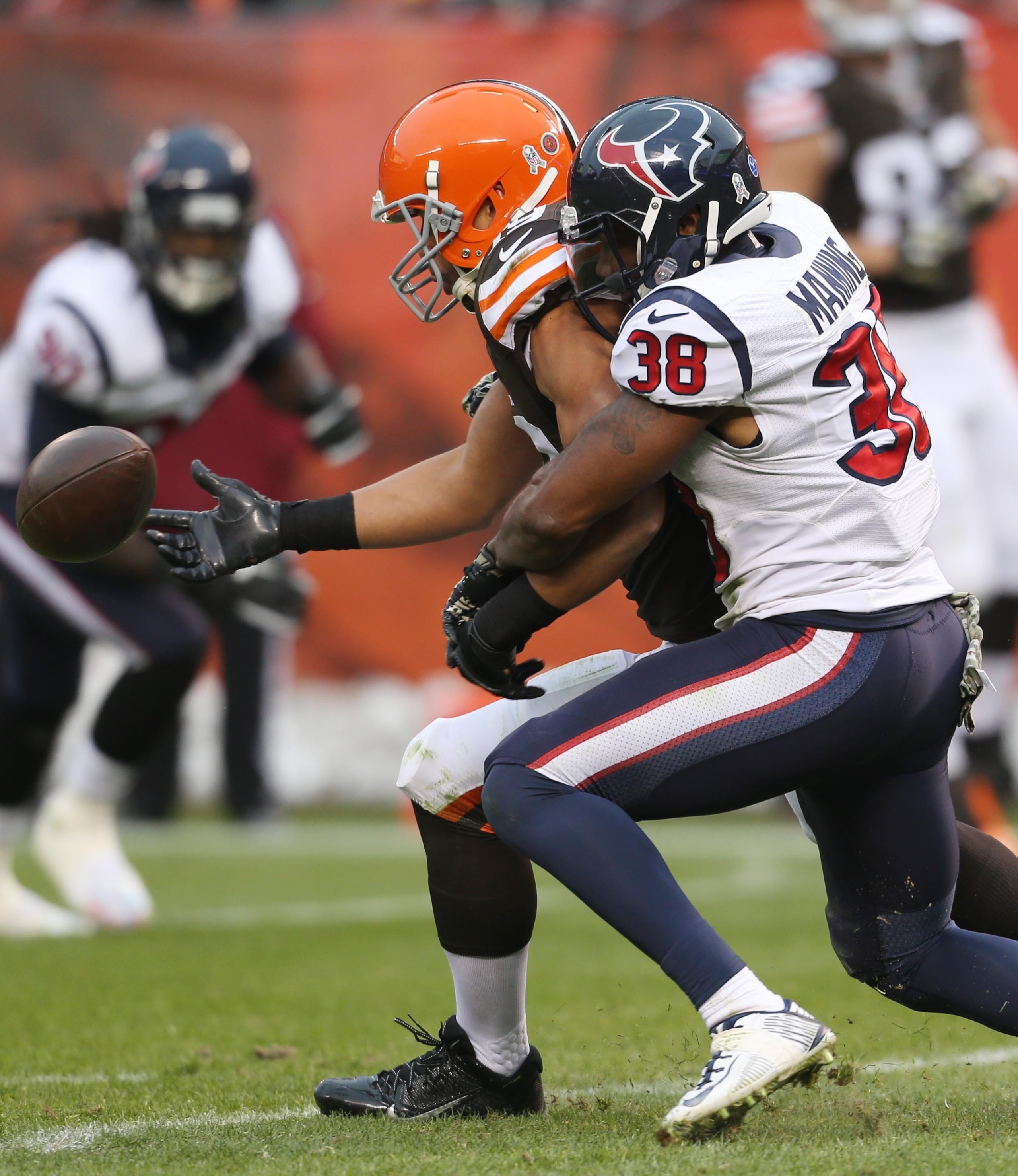
Chris Clemons was acquired during the 2014 offseason as a lower cost alternative to Manning. Clemons did not even make it out of the Texans' training camp, getting axed in the final cutdown.
Coincidentally, Manning suffered the same fate as a preseason invitee of the Cincinnati Bengals. He ended up in the Queen City because his refusal to take a reduction in pay from the $5.5 million he earned as a Texan in 2013 led to his release.
Although Rick Smith had to let him go, he told Manning, per the Houston Chronicle's Dale Robertson, “if an opportunity came, he’d bring me back.” Smith “kept his word” and signed him for the league minimum of $855,000. Manning was expected to act as a veteran presence and help steady a young defense learning a new system.
Defensive coordinator Romeo Crennel got more in the bargain than just the benefit of his experience. At 32, Manning played some of the best football of his career.
Pro Football Focus had him at the top of the list as the most efficient tackling defensive back in the league. He also provided solid coverage as a Cover 2 safety in sub-packages and did not allow a single touchdown all season.
The market for aging safeties is not highly competitive, which may keep Manning off the rest of the league's radar. Signing him to a two-year deal may buy enough time for fellow safety D.J. Swearinger to finally prove he was worth a second-round pick. In the meantime, the Texans cannot afford to let a player who is still playing at such a high level slip through their fingers a second time.
Kendrick Lewis
2 of 10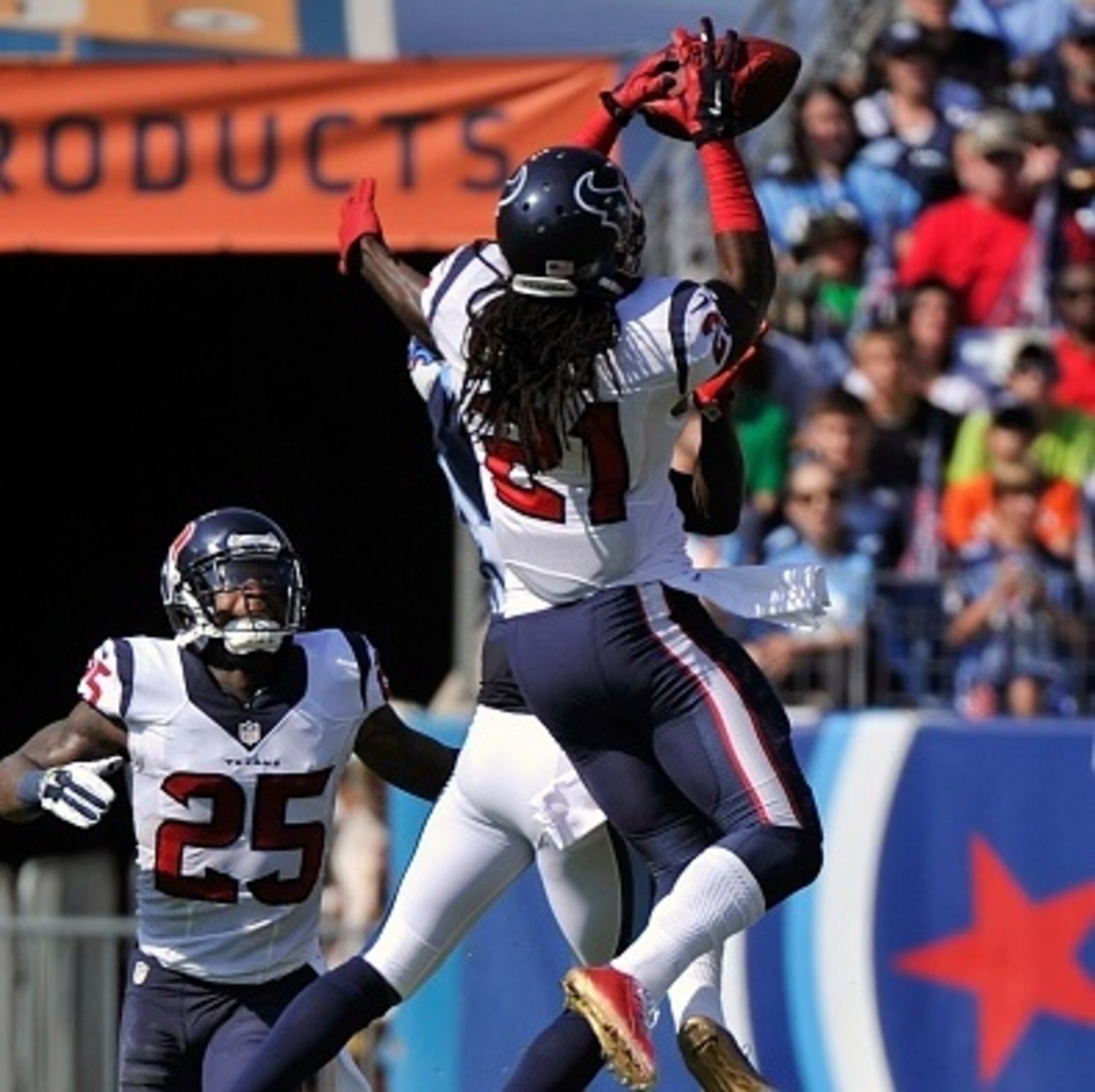
If not for Danieal Manning, Lewis would have been the most unexpected defensive surprise of 2014. Manning had the “prodigal son” angle going for him. Lewis had to prove he was not the goat in the second-biggest comeback in NFL playoff history.
When the Indianapolis Colts came back from 28 points down to the Kansas City Chiefs in the Wild Card Round of 2013 to win 45-44, Lewis took a bad angle on T.Y. Hilton that allowed him to score the winning 64-yard touchdown.
Lewis also gave up an earlier touchdown pass on a 12-yarder to Coby Fleener. He was so locked in on Hilton in the slot he failed to notice Fleener coming up the middle seam untouched. Basically, he was as responsible as any Chiefs defensive player for the meltdown.
No one in Kansas City shed a tear when the Chiefs decided not to offer him the coveted second contract. Even though he had fought his way into the starting lineup, his overall play appeared to be equivalent to the fifth-round pick he was.
Romeo Crennel had seen enough production as the Chiefs head coach to keep Lewis as his starting free safety for the better part of three seasons. With Manning off to Cincinnati and no other viable options at free safety for Houston, Crennel once again put his faith in Lewis.
This time that faith was amply rewarded. On the plus side, the Texans were seventh in net yards per passing attempt and third in interceptions. They allowed 28 passing touchdowns, ranking them 22nd, but only allowed 10 over the last seven games.
On the individual side, Lewis had 69 tackles, two interceptions and a passer rating of 69.3 against him, per Pro Football Focus. No one will confuse him with Earl Thomas or Devin McCourty, but he has found a home covering the deep half of the Texans secondary.
Before the 2014 season, Matt Miller of Bleacher Report ranked the top 75 safeties. Lewis was nowhere to be seen, while Chris Clemons was in the No. 15 spot.
Now Lewis is in line for a multiyear deal with a nice guarantee. Clemons has become a journeyman, trying out for three teams and appearing in just a single game for the Arizona Cardinals.
In the case of most players, NFL means “Not For Long.” It usually refers to staying on top. Kendrick Lewis knows for a select few, their trip to rock bottom can also be “NFL.”
Akeem Dent
3 of 10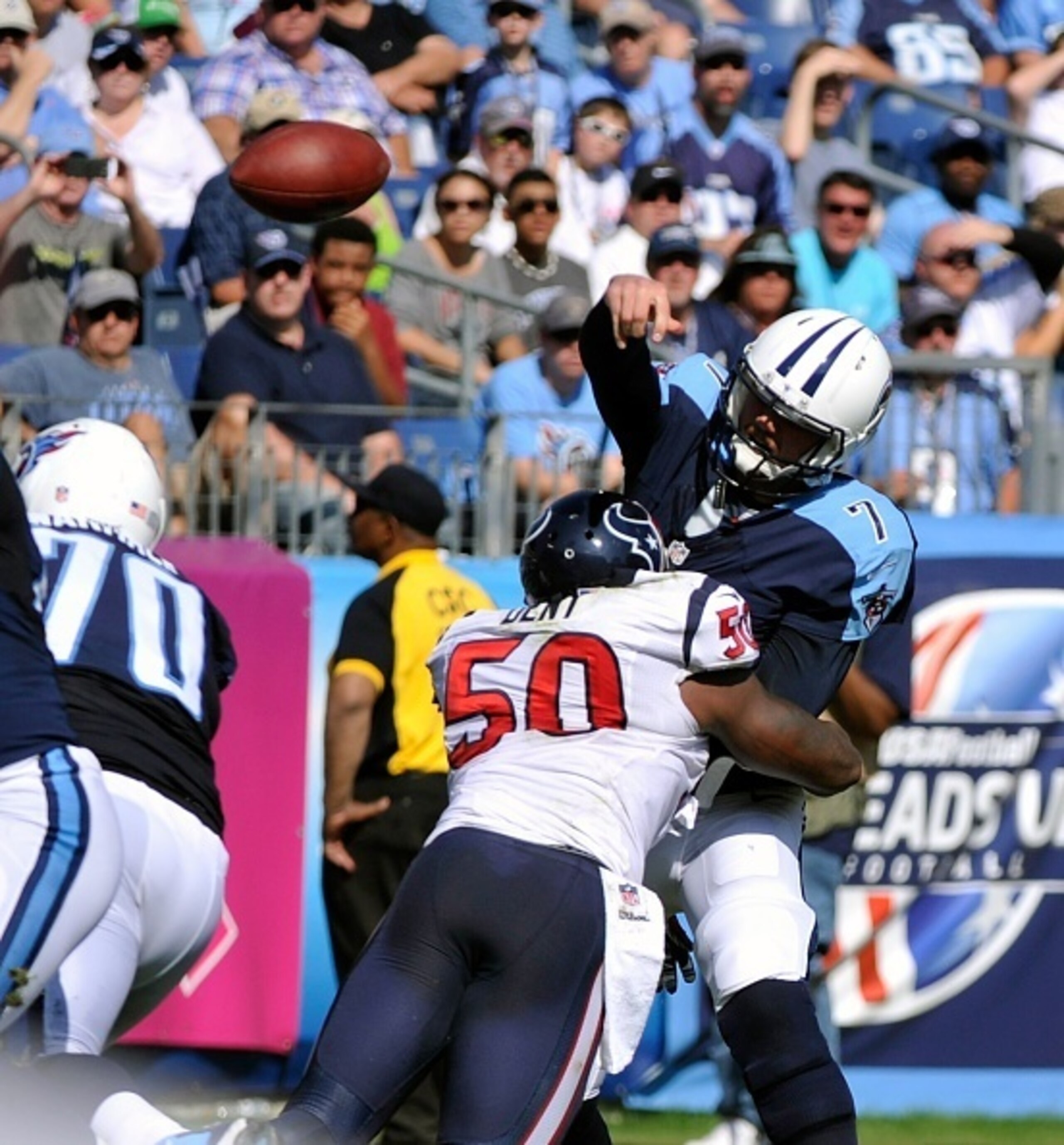
Dent played most of 2014 in a “dented” condition (pun intended). He dealt with ongoing neck and shoulder problems all year, limiting him to 227 snaps in seven of the last eight games, per Pro Football Focus. Those ailments did not prevent him from contributing on special teams the first seven games of the season.
His chance to get on the field finally came when Brian Cushing had to sit out the Week 8 game versus the Tennessee Titans. Dent, Mike Mohamed and Justin Tuggle divided up the snaps for the interior linebacker positions in that game.
Over the course of the season, the rotation favored Mohamed with the most reps outside of Cushing. Tuggle was in the mix early on due to his ability to play all three downs, but his shoulder problems worsened after Week 9. This gave Dent his shot at more playing time.
When on the field, his experience made up for his lack of ideal size as a 3-4 inside linebacker (6’1”, 242 lbs). The typical inside linebacker is usually considered an oversized run-stuffer with minimal coverage and pass-rushing skills. This is a nominally a two-down position, with a defensive back coming in on obvious passing situations.
Offenses are now mixing up the playbook so much, the traditional concepts do not necessarily apply. Defensive coordinators are looking for more versatility, with less emphasis on mass and more on maneuverability.
The Texans would rather carry another outside linebacker for pass-rushing purposes instead of having four inside linebackers on the roster. Mohamed has the most versatility outside of Cushing, so it comes down to Dent or Tuggle.
Dent has the edge over Tuggle, having played in both 3-4 and 4-3 alignments. He also has the advantage in actual playing time, something Tuggle would have to offset with his youth and physical ability. The smart thing to do is sign Dent and let the competition in OTAs and training camp determine who will be the third inside linebacker.

.jpg?w=2560 "Rams Eagles Football")

Ryan Mallett
4 of 10
The quarterback situation with the Texans is both simple and complicated. It is simple because the choices are few yet complicated due to the lack of a clear choice.
Brian T. Smith of the Houston Chronicle put it another way in trying to describe the current approach of general manager Rick Smith.
"Smith trying to build team with QB situation as-is, then find QB that fits new era. #Texans
— Brian T. Smith (@ChronBrianSmith) February 19, 2015"
This reads like a contradiction because it is indicative of a struggle between what the team has and what it really wants.
“As-is” translates to Ryan Mallett, and that was made clear during a Thursday press conference at the NFL combine. Drew Dougherty of the Texans' media staff provides the evidence.
""We're hopeful we get him back," Smith said during a combine press conference.
"
Moments later, when O'Brien addressed the media, he reinforced Smith's comments.
"We'd like to have him back in Houston," O'Brien said.
The “new era” would be defined as the equivalent of Brett Favre, Drew Brees or Russell Wilson dropping into Houston's lap—a franchise quarterback who would not require the investment of a high first-round draft pick, a once-in-a-decade incidence of good fortune.
Failing that, the consolation prize is Mallett. The alternative would be having Marcus Mariota’s stock dropping so far that he could be had for the 16th pick. Or Brett Hundley morphing into such a convincing facsimile of Teddy Bridgewater that Rick Smith would have to pick him.
The price for locking up Mallett, an investment with such a slim prospectus, would seem to be better left to Vegas oddsmakers than NFL executives. Nevertheless, Bob McNair, Bill O’Brien and Rick Smith will all have to sign off on it with the courage of venture capitalists intent on launching the next great success story.
And next on Shark Tank…
Derek Newton
5 of 10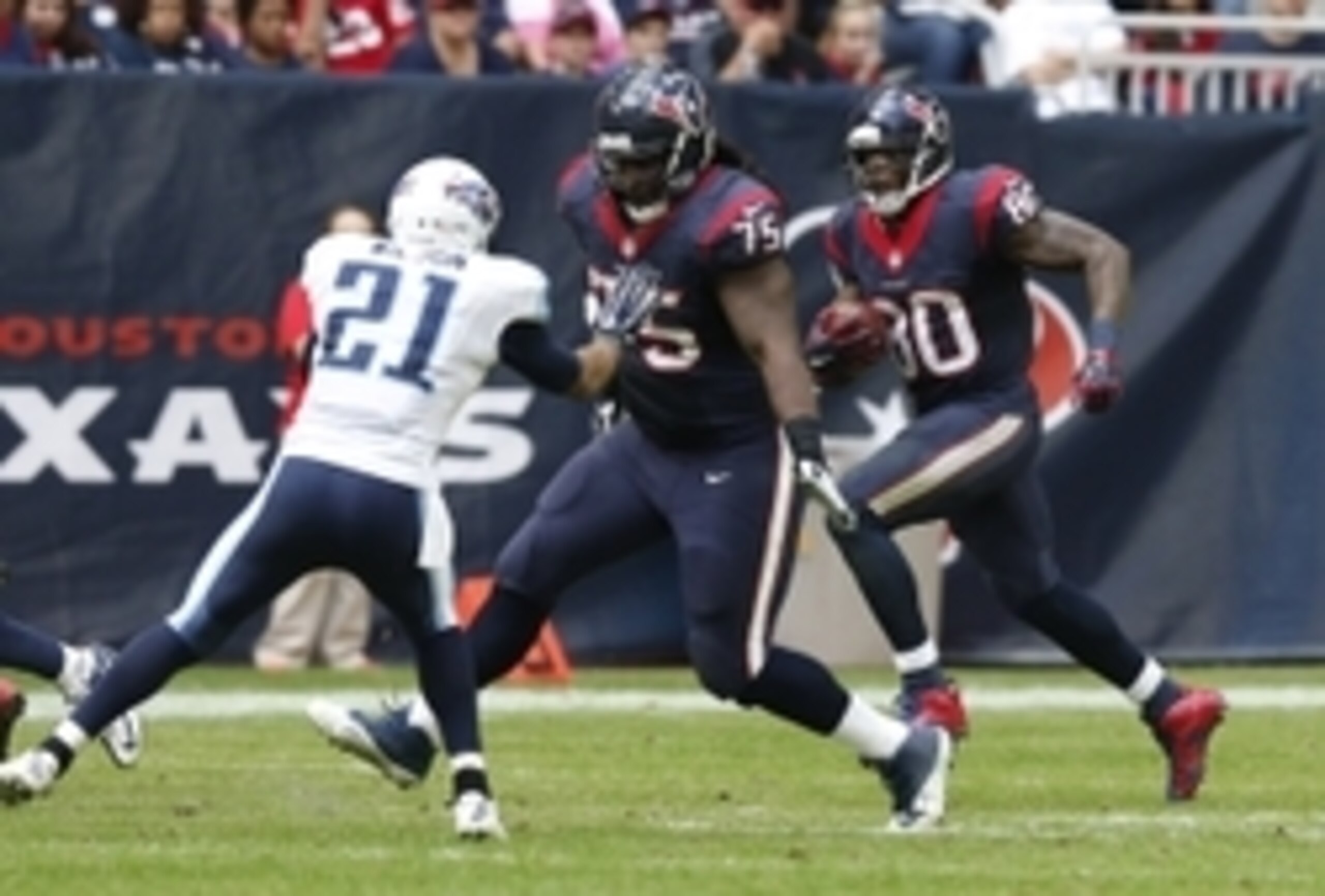
When Kareem Jackson stopped being the favorite whipping boy on the Texans, Newton was next up for that role. While Jackson came to the NFL as a first-round pick off a national championship team, Newton arrived in Houston as a seventh-round choice from Arkansas State.
Needless to say, he had further to go in order to make the grade. While his progress has not been as impressive, Newton is no longer a liability at right tackle.
Pro Football Focus recorded 44 quarterback pressures for Newton in 2014, and he allowed just two sacks all season. His pass protection steadied up in the last five games, as there were only seven quarterback hurries and no sacks over his side of the line.
The rushing attack also favored the right side, running 168 plays as opposed to 124 over the left. The most preferred direction was through the A-gaps over the middle with 183 attempts.
The other free-agent right tackles are either short on experience or long on price, although Ryan Harris and Eric Winston might be available at bargain rates. The 2014 cap hit for Newton was $1,446,064, which would put his new contract in the area of $8-10 million over three years.
Ryan Pickett
6 of 10
The team signed Pickett three weeks into the season after rookie nose tackle Louis Nix III was placed on injured reserve. The questions about Nix go beyond his meniscus surgery during his senior year and extend to his willingness to do what it takes to make it at the next level.
There are no questions about Pickett and what his ample 6'2" frame can accomplish. In the four games before his 340 pounds were added to the roster, opponents averaged 130.3 rushing yards per game. The average dropped to 104.7 per game over the rest of the schedule.
Pickett will turn 36 about one month into the 2015 season, pushing the envelope on NFL longevity to its limits. He averaged just over 20 snaps per game in 2014, according to Pro Football Focus. This workload could be maintained for at least one more year at something close to the league minimum.
During that time Bill O’Brien can decide whether Nix should be added to the ever-growing list of third-round draft picks (six and counting) Houston has squandered in the Rick Smith era.
Brooks Reed
7 of 10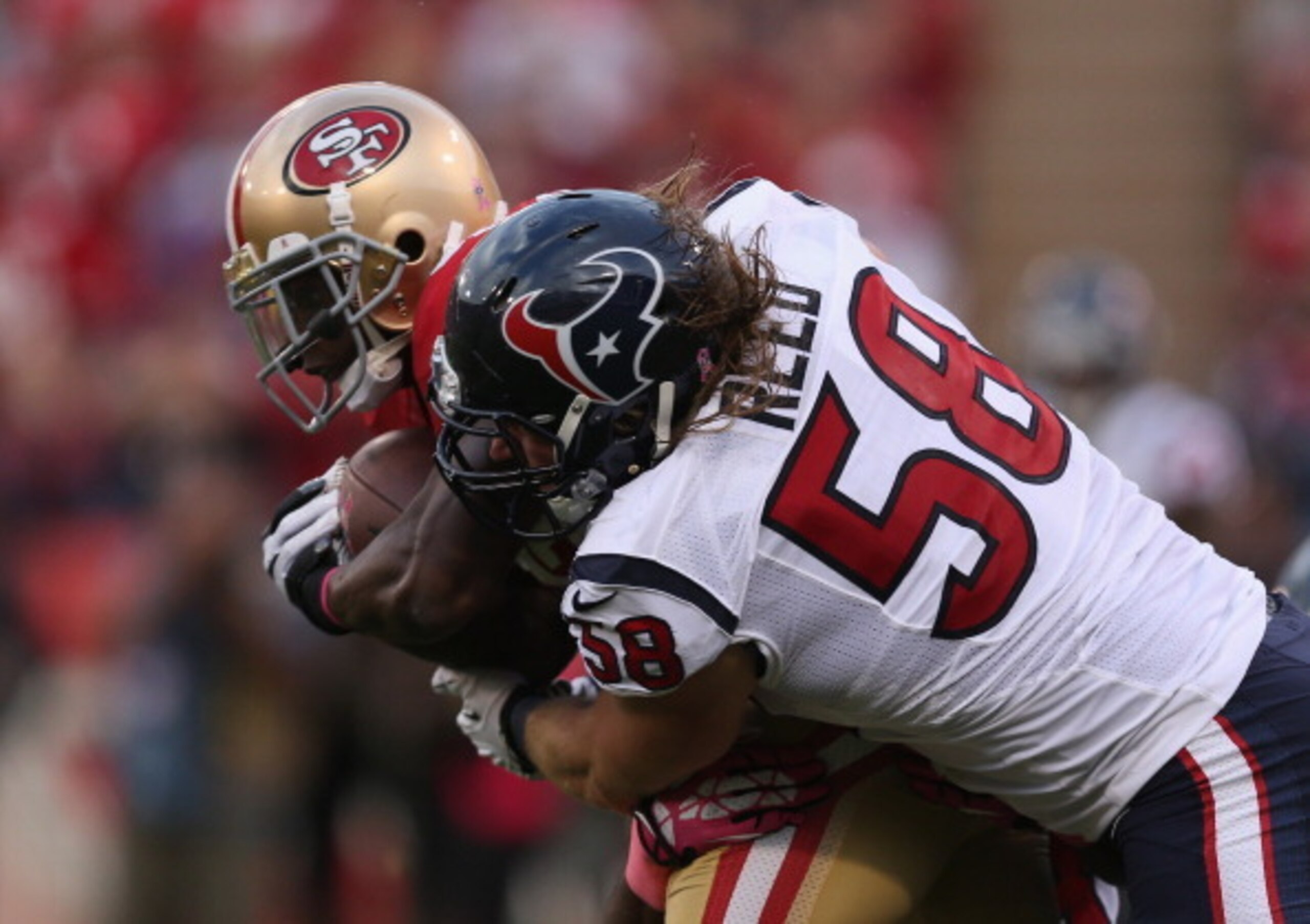
Any discussion about Brooks Reed will eventually get around to his skimpy sack totals. Any discussion about sack totals should quickly get around to their irrelevance.
The average NFL team had 1,024.3 offensive plays in 2014. The average number of sacks per team is 37.9. Therefore, sacks directly affected 3.7 percent of plays. The precise criterion for irrelevance may be debatable, but less than 5 percent seems a reasonable starting point for qualification.
Another sensible question: Do sacks affect the ability of your opponent to pass the ball effectively? The answer in 2014 was yes and no.
The Cincinnati Bengals had a total of 20 sacks but an opponent passer rating of 75.8. The Buffalo Bills led the league with 54 sacks and had an opponent passer rating of 74.5, the second-best figure in the NFL. The quarterbacks facing either of these defenses essentially ended up in the same place.
The Texans allowed a passer rating of 80.4, good for sixth place overall, and a perfectly average 38 sacks. By the way, the Bills were the only team ranked in the top six with over 40 sacks to their credit. Burying the quarterback may incite the fans but does little to affect his operational efficiency.
The value of a player like Reed goes beyond his sack numbers. He was on the field for 799 snaps of 1,077 total defensive plays, a participation percentage of 74.2. If less than 5 percent is in the vicinity of irrelevance, nearly 75 percent is well within reach of actual importance. (Note: The snap count for Reed is from Pro Football Focus; the total defensive plays is from Pro-Football-Reference.com.)
The Texans defense was seventh in points allowed, a great improvement over its 24th-ranked performance in 2013. Reed does not have a stat line to match the irrepressible J.J. Watt. He does deserve to share in the rewards that helped earn Watt the highest contract in the league for a non-quarterback.
The alternatives to not re-signing Reed are out there. Teammates Jeff Tarpinian and John Simon could try to take his place. Whitney Mercilus might move over to play the position for the first time since his rookie year. The least desirable option is to engage in a bidding war for free agents from 3-4 defenses like Jabaal Sheard, Sam Acho or Brandon Graham.
At the conclusion of the season, the Texans defense was “was in peak form,” in the words of Dale Robertson of the Houston Chronicle. Bill O’Brien understood it would take some time for the players to absorb Romeo Crennel’s system.
"(It isn’t easy) to install and learn right away. There are a lot of decisions that have to be made by the players on the field through communication based on what they see and the different packages that we put out there. You really started to see the defense come into its own here late in the season and play really well.
"
Without a plug-and-play replacement on the roster, why bring in a new player to go through the same learning curve?
Perrish Cox
8 of 10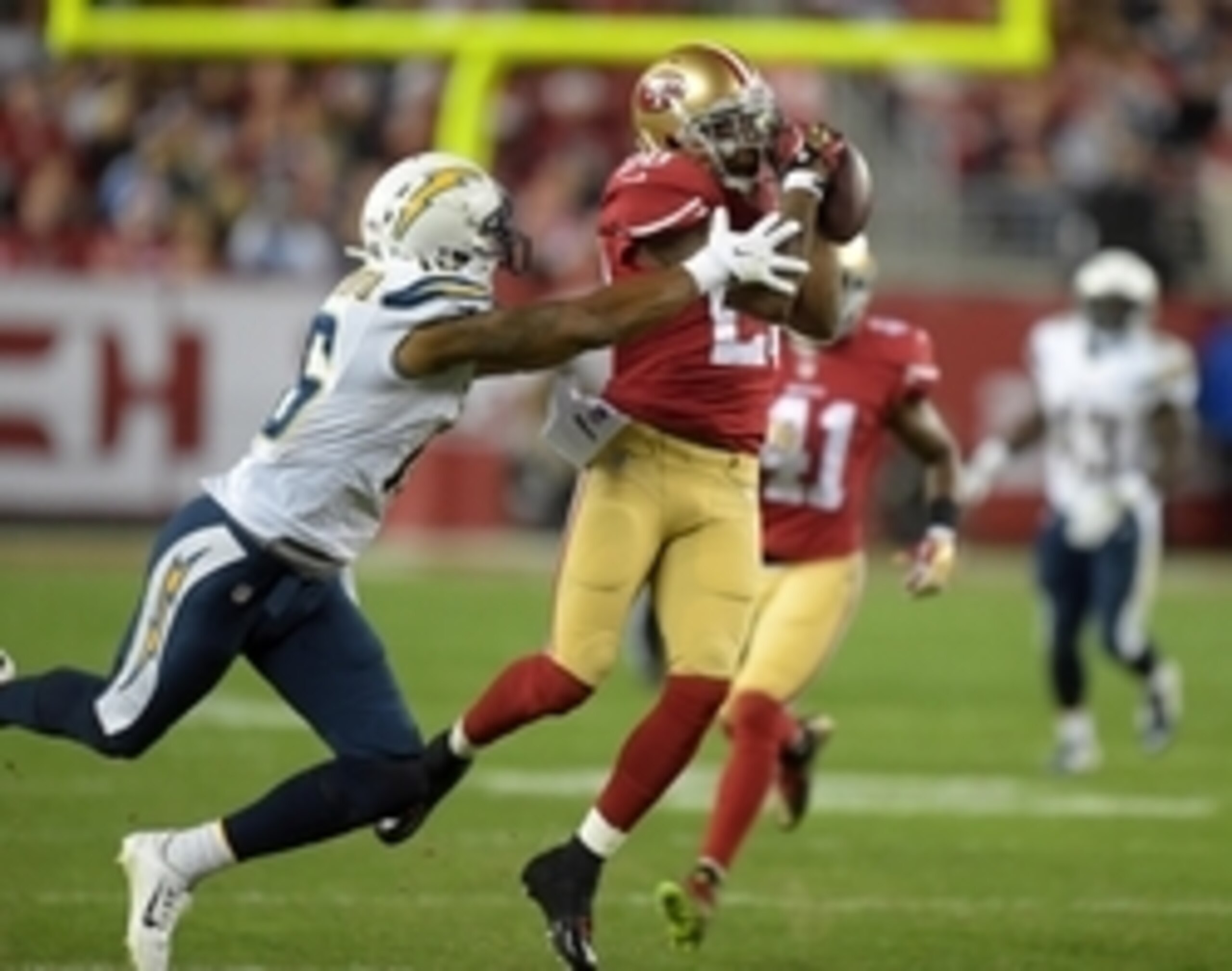
It would be hard to imagine that a Texans secondary without Kareem Jackson would also try to get by without Johnathan Joseph. It is equally difficult to see Joseph staying in Houston under his current contract.
He is the only cornerback with a top-five cap hit who is over the age of 30. Provided an extension could be arranged to reduce his cap impact, the team could go about finding someone to take Jackson’s place on the roster.
The ideal target would a player on the rise with a price tag of around $2 million per year. Cox fits the bill in both areas.
Cox has bounced around the league since being drafted in the fifth round in 2010 by the Denver Broncos. He spent 2011 out of football altogether, largely due to a sexual assault charge he was facing in Colorado.
The San Francisco 49ers signed him on March 13, 2012, days after his acquittal on those charges. He was released late in the 2013 season and then had a couple of cups of coffee with the Seattle Seahawks before being re-signed by the 49ers to close out the year.
The 49ers retained Cox for 2014, but he was stuck in the same place he had spent most of his career: as a special teams player and sometimes slot cornerback. Then first-string cornerback Tramaine Brock sprained his big toe in the season opener, which sidelined him for weeks.
Now Cox was starting for the first time since his rookie year and doing so under trying circumstances.
The defense was rocked by injuries to NaVorro Bowman, Glenn Dorsey and Aldon Smith. Ray McDonald, their best remaining pass-rusher, played under domestic violence allegations that the district attorney's office eventually dropped. The turf war between head coach Jim Harbaugh and general manager Trent Baalke that started before the season began worsened as the year wore on.
All Cox did was play the best football of his professional life, leading the team with five interceptions. He was joined in the starting lineup by cornerback Chris Culliver, who was also filling in for another injured starter, Jimmie Ward.
Both Cox and Culliver are unrestricted free agents, with Culliver having the bigger upside. The 49ers will not be able to keep both. They are nearly $3 million over the cap now and have over $15 million in dead money tied up in defensive backs Eric Reid, Jimmie Ward, Antoine Bethea and Tramaine Brock.
Culliver will be looking for starter’s money and a significant raise over the $1,580,719 he made in 2014. Cox banked just $695,000 and would probably be happy to sign for two years and a nice guarantee.
A small-scale commitment would allow the Texans to get enough reps for the young cornerbacks already on the roster without tying up too much money in the future. A stable situation for Cox would allow him to show the league he is more than an NFL journeyman in the making.
Brian de la Puente
9 of 10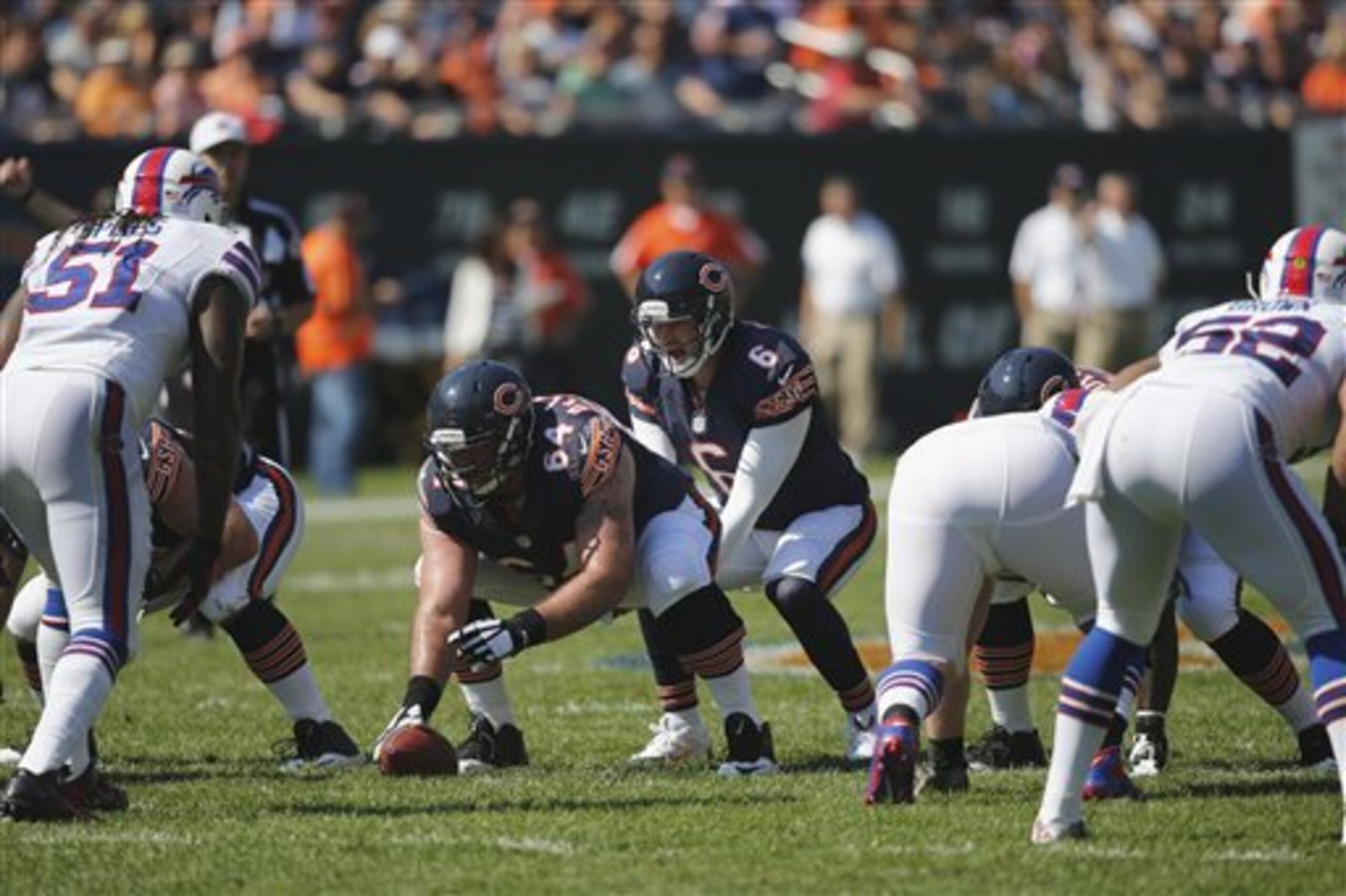
Now, we move on to Chris Myers' replacement. Ben Jones, the left guard last season, is presumed to be the Texans’ next center. What is the backup plan if he does not work out?
Jones has manned both guard positions in his three years in Houston competently if not spectacularly. However, playing guard is not the same as playing center. You have to handle the ball, keep your head on a swivel and be prepared to help either guard based on the play call.
He was good enough to be named second-team All-SEC at the position his senior year at Georgia. While defenses in the Southeastern Conference are typically the best in college football, the interior defensive players in the NFL are something else altogether.
The speed and size differential are hard enough to deal with, not to mention the complexity of the play calls on both sides of the ball. Jones may be up to the task, but whom will the team turn to if he is not?
De la Puente started at center for New Orleans Saints for 44 consecutive regular-season games and four playoff appearances from 2011-13. The line he was part of in 2011 won the Madden Most Valuable Protectors Award for that season.
He signed a one-year deal with the Chicago Bears for the 2014 season and substituted for center Roberto Garza after he suffered an injury in the season opener. Once Garza recovered, de la Puente played left guard for three games before an ankle injury took him out of the lineup.
The Bears signed Garza to a one-year extension just before the end of last season, so they do not need a center. Left guard Matt Slauson is expected to return to left guard, putting de la Puente out of a job.
Here is a guy who is accomplished, experienced and available. His cap hit for 2014 was $795,001, making him an affordable mentor for Jones or a capable substitute. He also has the versatility to play left guard if Xavier Su’a-Filo is not ready for prime time.
The Seattle Seahawks and New England Patriots have demonstrated how low-cost depth is the basic foundation for winning in the NFL. De la Puente is a building block Pete Carroll and Bill Belichick would both appreciate.
Kenny Britt
10 of 10
When it comes to Andre Johnson, you cannot discuss how to replace him. The issue becomes how to live without him.
Last season illustrated it could be done. The Texans carved out a winning record while Johnson had his lowest yards per game since 2005. Can this team continue to progress with similar production out of what has now become the No. 2 receiver?
The answer is "yes," but only if another receiver can be added who strikes fear in the defense. That usually meant a speedy vertical threat who could create separation and outrun the defense. Now that threat can be a tackle-sized tight end (Rob Gronkowski/Jimmy Graham) or a huge wide receiver with a ridiculous catch radius (Odell Beckham Jr./Mike Evans).
Dez Bryant, Demaryius Thomas and Julius Thomas are the only free agents who fit the description, and they are way out of the reach of the Texans. Jeremy Maclin, Randall Cobb and Torrey Smith look tempting, but it would require cap-busting deals to land them.
The draft is the only route to fill this need. If Curt Popejoy of Bleacher Report is correct, this wide receiver class does offer some possibilities. The Texans still need a third receiver to round out their passing attack.
General manager Rick Smith should take a look at a player who was considered a washout not long ago. We are talking about former bad boy Kenny Britt, who had nine police incidents in his first four NFL seasons.
Britt has not had any encounters with the law since 2012. And he had his best season since his second year with the Tennessee Titans, catching 48 passes for 748 yards and three touchdowns for the St. Louis Rams.
The Rams would surely like him back, even though they are already over the cap by $1.4 million. Their list of free agents is short, but the situation around quarterback Sam Bradford needs to be addressed.
Bradford has been on injured reserve since Week 8 of 2013 with consecutive ACL tears. His cap hit of over $16.5 million has less than $4 million of dead money attached to it. If there was any thought of cutting ties with the last of the megacontract No. 1 picks, this could be the time to do it.
General manger Les Snead and head coach Jeff Fisher made noises to reporters at the NFL combine that they expect Bradford to be back. Fisher said that, "We're counting on him, I'm betting on him, and if that doesn't happen, then we'll win games with someone else."
This makes the quarterback landscape in Houston look smooth by comparison, even if Ryan Mallett is a free agent. Would that be enough to convince Britt to make the move? It wouldn’t hurt to ask.
.jpg?w=2560 "Texans-Mixon Released Football")
.jpg?w=2560 "Grading WWE Raw 🔠")


.jpg?w=2560 "Bijan's INSANE 1st Half 🤩")
