

San Francisco 49ers: Will Vernon Davis Be a Cap Casualty?
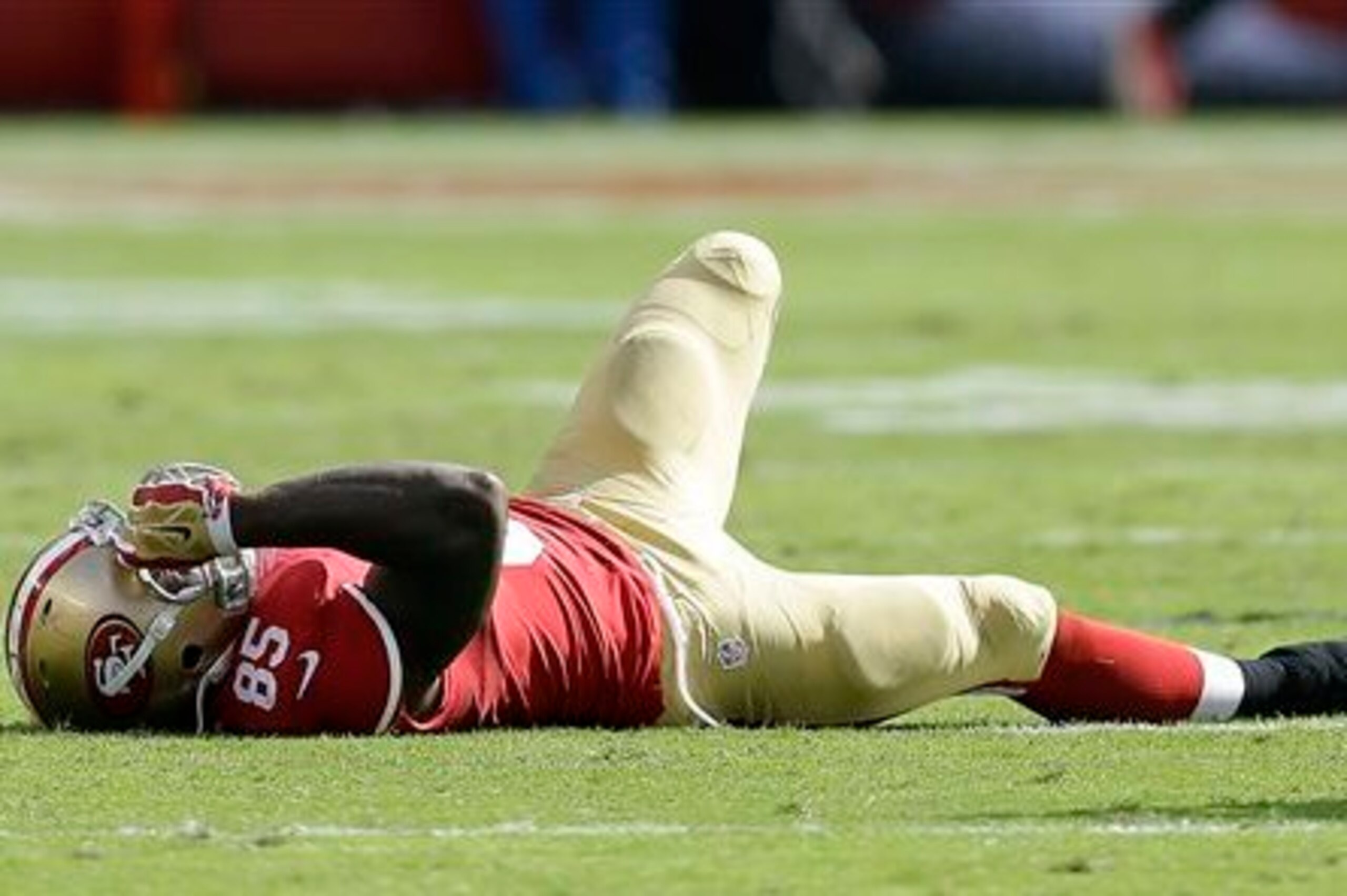
Should the San Francisco 49ers keep Vernon Davis around in 2015 or release him to save cap room?
The idea of asking that question seemed ridiculous prior to last season. Davis was coming off of a Pro Bowl season, where he served both as the 49ers’ chief deep-ball threat and red-zone target. His 16.3 yards per reception led all 49ers with more than two receptions, and his 13 receiving touchdowns nearly doubled Anquan Boldin in second place.
Cut Davis? That’s crazy talk. He even held out for a new contract before training camp last season—if anything, there was consideration of giving him more money rather than less.
TOP NEWS

New NFL Power Rankings 📊
The Robinsons POUND the Rock 🪨
Takeaways from Falcons' dominant MNF win
In retrospect, however, it’s possible 2014 was an outlier. Davis plummeted back to earth in 2014, catching only 26 passes—his fewest since his rookie season. His 9.4 yards per reception was the worst total of his career, and he only found the end zone two times.
Twice he suited up and ended up with no receptions, and he missed two more games with injuries. That’s four games in which he was a complete non-factor.

In eight of the remaining 12 games, he ended up with 21 receiving yards or less and no touchdowns—in fact, he didn’t record a touchdown after opening day. That leaves just four games—Dallas in Week 1, Chicago in Week 2, St. Louis in Week 6 and Oakland in Week 14—where Davis had any sort of positive impact on the game as a receiver.
His blocking skills dropped off tremendously as well. In 2013, Pro Football Focus had Davis listed as the fifth-best run-blocking tight end, with a grade of +8.1. That plummeted to -6.9 in 2014, making him the sixth-worst run-blocking tight end.
He seemed slow and lethargic at times, and he wasn’t nearly up to the standards his historical performance had set for himself.
Some of the drop-off can be attributed to injuries. Davis was slowed by ankle and back issues at times in 2014. Having turned 31 last month, you have to question Davis’ durability going forward.
In addition, it is possible Davis is just running out of steam. In his last three seasons, Davis has put up 41, 52 and 26 receptions. In the three years before that, he put up 78, 56 and 67 receptions—his worst year in that stretch was better than his best recent season. He’s getting up there in age; it’s possible that his career is simply over.
Cutting Davis would save the cap-strapped 49ers nearly $5 million against the salary cap in 2015. That would essentially be enough money by itself to sign the entire draft class, or be competitive in free agency for a player like Chris Culliver. You have to question, at this point, whether or not Davis is worth the money he’s owed.
To try to answer that question, I’ve gone back to one of my favorite analysis tools—the similarity score. I’ve done this with Colin Kaepernick the last couple of years.
Using a modified version of Football Outsiders' method, we can compare Davis to all receivers and tight ends, looking for people who have had the same trends in production over the past three seasons.
Specifically, we’re looking for players who saw a massive drop-off from one season to the next at or around age 30, while still having a Pro Bowl-caliber season the year before.
There are some issues with using this method for receivers rather than quarterbacks. First of all, nearly every single thing a quarterback does is recorded as a statistic, and you can use stats like rushing yards and yards per completion to approximate play style.
There are no stats that show how well Davis blocks, so we’re stuck comparing simply the receiving aspect of his game. As Davis is primarily a receiver, this isn’t a massive roadblock, but it is something to keep in mind.
Secondly, the role of the modern tight end is very different than it was 20 years ago. In many ways, the modern tight end is simply a bigger wide receiver.
To account for that, I’ve included all pass-catchers in the sample and eliminated smaller guys—this will bump tight ends up, as well as allowing taller and larger receivers to be included. The less like Davis a player is, size-wise, the closer the statistics would have to be for them to show up.
With that in mind, let’s look at the scores. I’ve put the entire list up on Google Docs, but here are the top 25 comparisons over a three-year stretch, as well as their stats in the season that approximates Davis’ 2014.
| Miles Austin | 2011-13 | 29 | DAL | WR | 24 | 244 | 0 |
| Sonny Randle | 1964-66 | 30 | STL | WR | 17 | 218 | 2 |
| Leslie Shepherd | 1997-99 | 30 | CLE | WR | 23 | 274 | 0 |
| Owen Daniels | 2011-13 | 31 | HOU | TE | 24 | 252 | 3 |
| Wayne Chrebet | 2001-03 | 30 | NYJ | WR | 27 | 289 | 1 |
| Courtney Hawkins | 1997-99 | 30 | PIT | WR | 30 | 285 | 0 |
| Jim Mutscheller | 1958-60 | 30 | BAL | WR | 18 | 271 | 2 |
| Doug Cosbie | 1984-86 | 30 | DAL | TE | 28 | 312 | 1 |
| Chris Chambers | 2008-10 | 32 | KAN | WR | 22 | 213 | 1 |
| Ron Kramer | 1963-65 | 30 | DET | TE | 18 | 206 | 1 |
| Dwight Clark | 1985-87 | 30 | SFO | WR | 24 | 290 | 5 |
| Frank Pitts | 1971-73 | 30 | CLE | WR | 31 | 317 | 4 |
| Derrick Ramsey | 1983-85 | 29 | NWE | TE | 28 | 285 | 1 |
| Todd Heap | 2009-11 | 31 | ARI | TE | 24 | 283 | 1 |
| J.J. Stokes | 2000-02 | 30 | SFO | WR | 32 | 332 | 1 |
| Willie Jackson | 2000-02 | 31 | 2TM | WR | 25 | 257 | 1 |
| Ken Dilger | 1999-01 | 30 | IND | TE | 32 | 343 | 1 |
| Ethan Horton | 1990-92 | 30 | RAI | TE | 33 | 409 | 2 |
| Dustin Keller | 2010-12 | 28 | NYJ | TE | 28 | 317 | 2 |
| Marcus Pollard | 2000-02 | 30 | IND | TE | 43 | 478 | 6 |
| Itula Mili | 2002-04 | 31 | SEA | TE | 23 | 240 | 1 |
| J.J. Birden | 1993-95 | 30 | ATL | WR | 31 | 303 | 1 |
| John Gilliam | 1974-76 | 31 | ATL | WR | 21 | 292 | 2 |
| Nate Burleson | 2010-12 | 31 | DET | WR | 27 | 240 | 2 |
| Vernon Davis | 2012-14 | 30 | SFO | TE | 26 | 245 | 2 |
| Average | NA | 30.2 | NFL | NA | 23.4 | 287.8 | 1.7 |
The closest overall comparison and the closest tight end comparison are both active, which is somewhat convenient.
Miles Austin had spent his entire career with the Dallas Cowboys through 2013. He started that year off strongly, with a 10-reception game against the New York Giants. However, that was his high point. He struggled for a few games before suffering a hamstring injury, which cost him a quarter of the season.
Even when healthy, he struggled, not showing the same explosive speed that he flashed earlier in his career. He managed only 14 receptions after opening day, and he was a cap casualty.

Austin was picked up in free agency by the Cleveland Browns and had something of a bounce-back season, with 47 receptions in only 12 games. No longer a game-changing receiver, Austin served as a more-than-serviceable possession receiver for talent-strapped Cleveland. That’s a good sign for Davis’ ability to bounce back.
There are some positive signs in the top 25. The top five comparables—Austin, Sonny Randle, Leslie Shepherd, Owen Daniels and Wayne Chrebet—all saw their receiving yards go back up after their disappointing seasons.
Two other comparables, in tight ends Ken Dilger and Marcus Pollard, went on to have several more productive seasons, with Pollard playing until he was 36 years old.
However, on aggregate, things don’t look so great. The average next season for the top 25 saw the players in question catch just 22 passes for 268 yards and a touchdown, continuing the drop-off they saw in the previous season. In general, this wasn’t a fluke year.
Even those who bounced up weren’t very long for the league. Three players—Chris Chambers, Dwight Clark and Willie Jackson—were done after the final season in the comparison. Eleven more lasted one more year and then were out of the league.
That’s certainly an argument against extending Davis’ contract—if 2014 wasn’t his last year with the 49ers, 2015 likely will be. The average number of seasons remaining for these players is just 1.5.
| Seasons | Number | Players |
| Active | 2 | Austin, Daniels |
| 0 | 3 | Chambers, Jackson, Clark |
| 1 | 11 | Keller, Burleson, Heap, Stokes, Shepherd, Hawkins, Birden, Ramsey, Gilliam, Pitts, Mutscheller |
| 2 | 6 | Mili, Chrebet, Horton, Cosbie, Randle, Kramer |
| 3 | 1 | Dilger |
| 6 | 1 | Pollard |
Is there a chance Davis can live up to his $7 million cap hit in 2015? It’s possible. Here are the best five next seasons for Davis’ top 25 comparables:
| Miles Austin | 2014 | CLE | 47 | 568 | 12.09 | 2 |
| Marcus Pollard | 2003 | IND | 40 | 541 | 13.53 | 3 |
| Owen Daniels | 2014 | BAL | 48 | 527 | 10.98 | 4 |
| Sonny Randle | 1967 | SF | 33 | 502 | 15.21 | 4 |
| Ethan Horton | 1993 | RAI | 43 | 467 | 10.86 | 1 |
It is, perhaps, somewhat telling that three of the top five players there—Austin, Daniels and Randle—had to go to different teams to have their bounce-back seasons.
Both Austin and Daniels were specifically cut due to high salary-cap costs, as well. Austin’s cap hit went from $8.2 million to $2 million, and Daniels' went from $6.25 million to $1 million, per Spotrac.
The simple fact of the matter is Davis’ cap hit is out of line with both his recent historical performance and what comparable pass-catching players managed to put up the next year, even in the best-case scenarios.
I do, however, think the best-case scenarios are more likely than the worst-case ones. Davis isn’t retiring, and if he comes back to the 49ers, he’ll be the starting tight end. His injury history is a bunch of minor nagging ones, as opposed to ACL tears or broken legs.
I expect he’ll continue to miss some time due to injuries and pain, but we’re not talking about him missing half the season, in all likelihood. He’d have the opportunities to bounce back.
Even then, though, I’m not sure Davis will return to the form he showed in 2013. My most optimistic projection for Davis in 2015 would be a 40-reception, 400-yard season with three or four touchdowns.
That’s almost twice as good as last season and on par with his 2012 numbers, but not exactly the most thrilling stat line out there. That’s the kind of production the 49ers could get out of a much cheaper free agent like Niles Paul or Charles Clay, resulting in a net savings.
It’s better to cut ties with a player a season too early rather than a season too late. This might be a season too early for getting rid of Davis, but considering the 49ers’ salary situation and the historical precedent of players who see a production drop-off like Davis did, I think it’s still in the 49ers' best interests.
Bryan Knowles is a featured columnist for Bleacher Report, covering the San Francisco 49ers. Follow him @BryKno on Twitter.

.jpg?w=2560 "Rams Eagles Football")
.jpg?w=2560 "Grading WWE Raw 🔠")


.jpg?w=2560 "Injury-stricken Seahawks signing veteran RB")
