

Breaking Down Kyle Korver's Red-Hot Shooting Season for Surging Atlanta Hawks
Atlanta Hawks sharpshooter Kyle Korver has been an elite three-point sniper ever since he entered the league out of Creighton in 2003. His picture-perfect stroke, combined with an ultra-quick release, makes him particularly deadly, and defenses routinely bend out of shape just to prevent Korver from getting his shot off.
On a championship-caliber Atlanta team that features elite ball movement, Korver's role as a shooting specialist has become even more useful and evident.
He's shooting 53.2 percent from beyond the arc, which is impressive enough. But the consistent and intense pressure he faces on every attempt magnifies how truly remarkable this season has been for him.
TOP NEWS

LeBron's Special Helicopter Deal

MJ Makes Record-Setting Donation 🙌
Shams: KAT, Hart Could Be Trade Names
According to Synergy Sports, Korver is shooting 53.1 percent on unguarded catch-and-shoots—along with a ridiculous 76.5 adjusted field-goal percentage, which accounts for three-point shots. On guarded catch-and-shoots, Korver is knocking down 54 percent of his long-range looks along with a 77 adjusted field-goal percentage.
To be clear: Korver is shooting it better when there's a hand in his face. If there ever was a mark of great shooting, that is probably as close as it gets.
His shooting numbers are even more remarkable when contextualized with volume. Check this: 150 of his 231 catch-and-shoot looks have been guarded, meaning 65 percent of his spot-up attempts are contested. He's still shooting it 53.2 percent from three-point range.
This can be chalked up to Korver's detailed focus on every aspect of his shot, regardless of how close a defender is to him. He recently told Jeff Zillgitt of USA Today about a 20-point checklist he has for each shot. Clearly, no other shooter in the league thinks about his jumper with this much precision.
Besides his shooting, Korver's greatest asset has always been his wizardry moving away from the ball. When Korver's defender gets caught napping for a split second, Kyle slides along the three-point line to lose him.
An even greater benefit of his activity is what it does for his teammates, as Grantland's Kirk Goldsberry has already pointed out: "Korver will never lead the league in scoring, but along with guys like Steph Curry and Danny Green, he’s among the NBA’s leaders in scaring; the mere risk of Korver getting off a clean shot terrifies opponents, and the defensive respect that terror commands opens the floor up for his teammates."
In terms of particulars, Korver is an expert cutter off fade screens and back screens, two types of picks set away from the ball that free an offensive player by having him actually flow away from the ball.
Here's Korver setting up Dante Cunningham of the New Orleans Pelicans on a fade screen from Paul Millsap. Even though Korver sees the play developing, he waits for Millsap to make contact before jetting to the weak-side corner.
That brief hesitation serves two purposes: First, it limits the chance of Millsap setting an illegal screen. Most illegal screens are actually the fault of the offensive player getting too jumpy and flying off the pick early. The big, who is not quite ready to get a piece of the defender, sticks a leg or hip out to make contact and gets whistled for a moving screen.
Second, it guarantees that Cunningham gets drilled by Millsap. Because Cunningham feels the contact, he knows he cannot simply wheel around to stick with Korver. He has to maneuver his way around Millsap in a roundabout fashion, meaning Korver can create significant separation with a quick burst of speed.
The obvious way to free Korver for a three-pointer is to screen for him. When he's parked in the corner or sitting idly on the wing, his defender is keenly aware that some sort of off-ball action is coming.
What's less expected, and particularly clever by Hawks head coach Mike Budenholzer, is the use of Korver as the initial screener.
Back screens with Korver as the pick-setter are particularly dangerous because they force the defense to make a difficult choice.
When a defender feels a back screen, his first reaction is to immediately scramble around it and not give up a lob at the rim. The defender who guards the screener, meanwhile, typically sits in toward the paint with the same anti-lob motive.
The result, therefore, is two defenders following one player, while the screener is left free.
That's what happens on the play below when Korver sets a back screen for Jeff Teague.
At the moment of the pick, we can already see New Orleans' Quincy Pondexter scampering toward the rim with no regard for where Korver might head next. And because Pondexter is now trailing Teague from behind, Korver's original defender, Cunningham, has to remain in the paint.
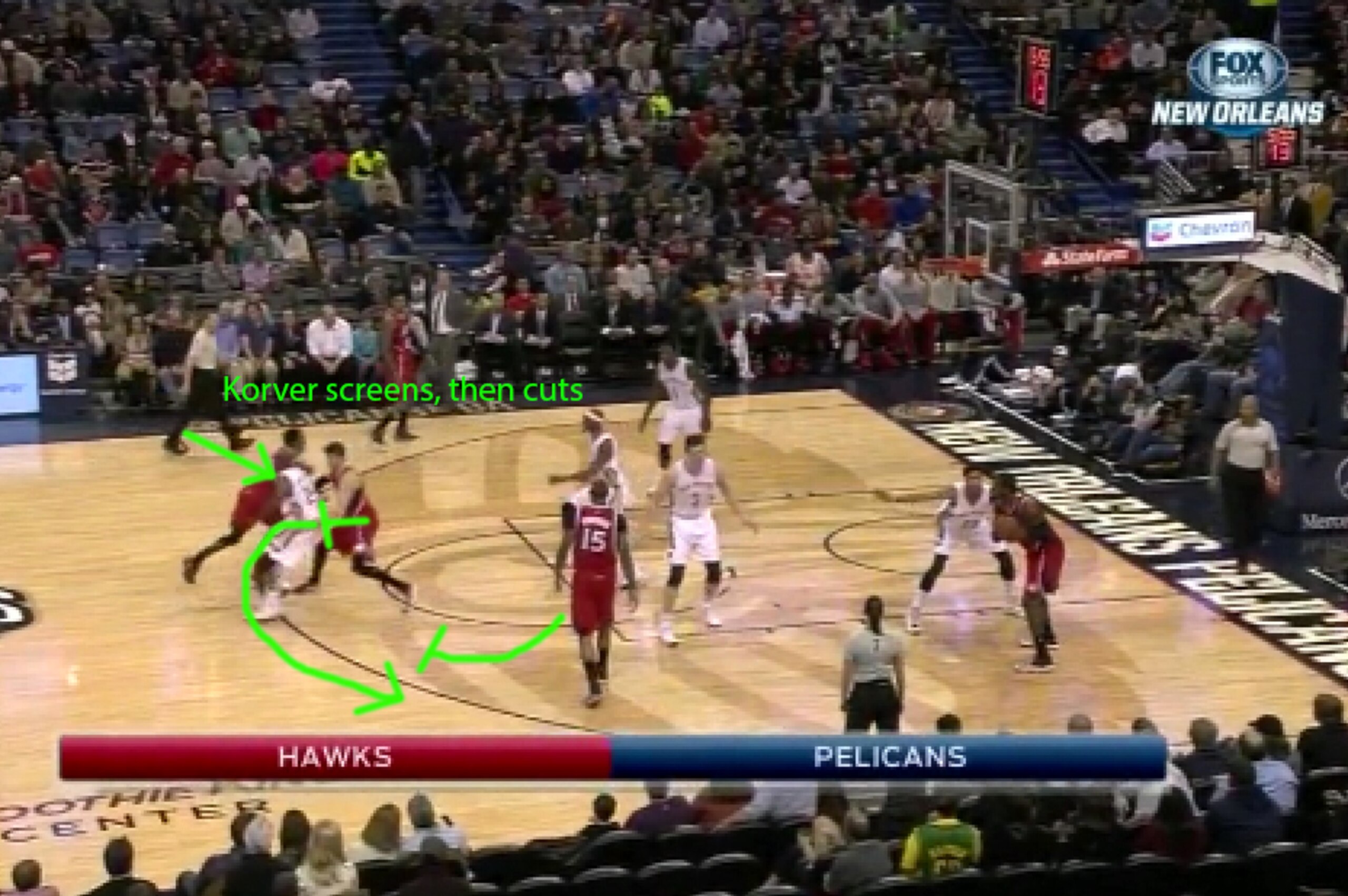
The easiest way for the defense to solve this back-screen dilemma is by switching. The only issue is a potential mismatch, but most teams are willing to risk it anyway.
Still, the key is that the switch is communicated quickly and effectively. If the big doesn't call out the back screen early, the defender getting screened cannot reverse his momentum to flawlessly execute the switch.
It's clear that Pondexter doesn't hear the switch call immediately here because he fights over the screen before changing course to chase Korver. But that momentary mixup is enough for Korver to peel off and come free.
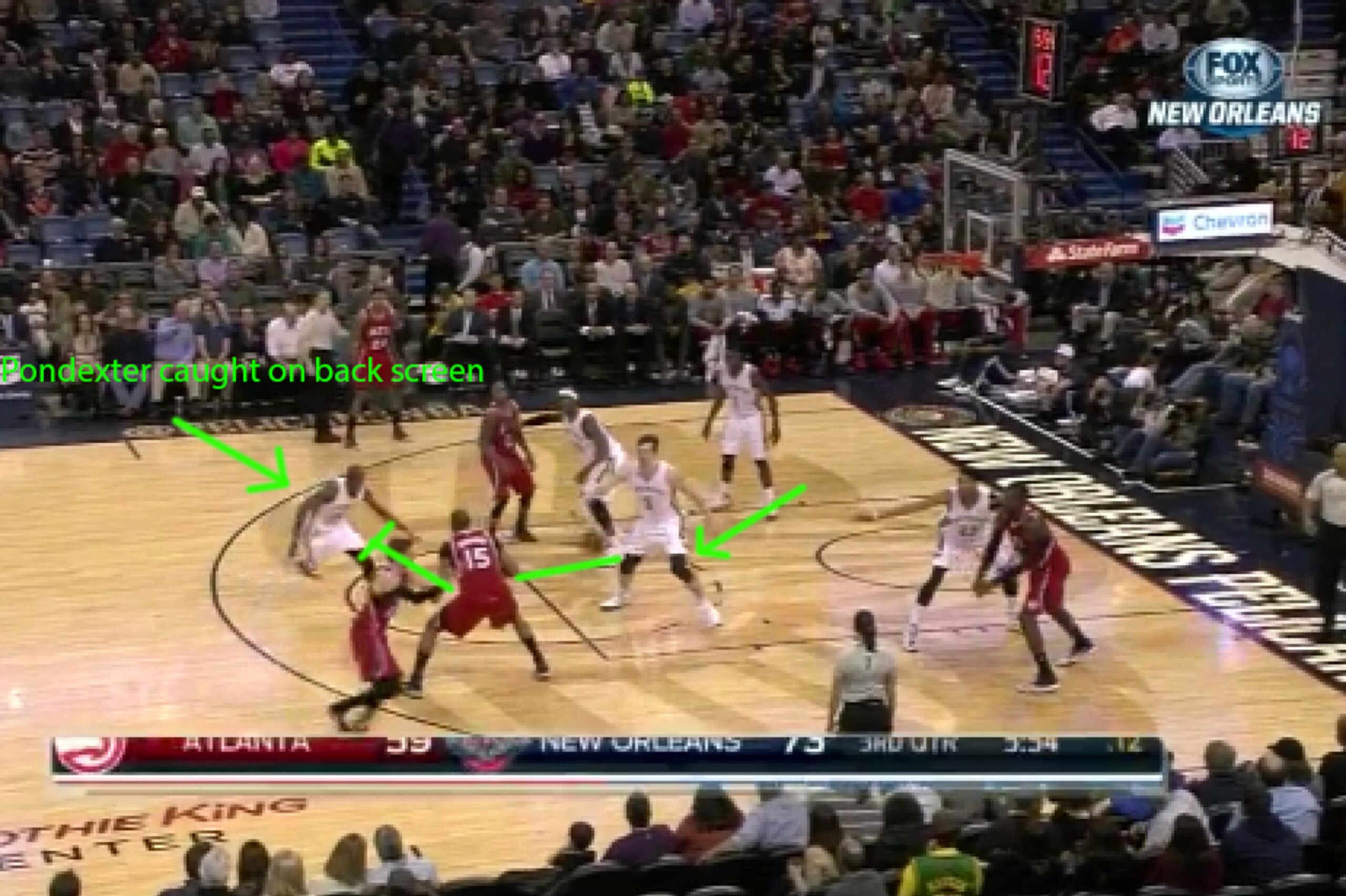
Budenholzer even adds an extra layer of deception by throwing in a screen for Korver from Al Horford. Omer Asik, who's guarding Horford, does not typically venture outside the paint and is late to help. The result is a Korver three-pointer.
Much of Atlanta's success offensively this season has stemmed from a pass-first mentality. As Korver himself noted recently on ESPN Radio's SVP & Russillo, this has been the most he's enjoyed playing basketball during his entire career, via Peachtree Hoops:
"For me, personally, in my 12 years, this is the most fun I've ever had playing basketball. We play true team basketball. We play a team game on offense, we play a team game on defense. Everyone talks about us not necessarily having the superstars, but I feel like we have a bunch of really good players who have just bought in to playing together.
"
Due to the limited time of the 24-second shot clock, most offensive teams use an initial action before folding into spread pick-and-roll.
The Hawks challenge the offensive status quo—mostly a result of Budenholzer's time as an assistant coach under Gregg Popovich of the San Antonio Spurs—by shuffling through multiple looks before settling for a late-clock pick-and-roll.
The other key to Atlanta's offense is that the looks feature options as opposed to directives. While the occasional play will try to get X player the ball in Y location, most of the Hawks' plays give ball-handlers choices. The result is that opposing defenses cannot key on one particular area or player.
Here, Korver zippers up to the catch at the top of the key—a common play-starter in which a wing comes off a down screen before catching the ball from the point guard.

The most typical NBA action to follow this cut is a ball screen from the opposite big, who is Mike Scott in this case. Instead, Budenholzer has Horford lift to the elbow to catch from Korver, followed by the threat of an immediate back screen by Scott.
Korver has a choice here. If he senses the Minnesota Timberwolves defense overplaying Scott's screen, he can immediately shift gears and head toward Horford for the dribble handoff. Andrew Wiggins, Korver's defender, is trying to stick chest-to-chest with Korver and is particularly sensitive to any back screens.

Korver uses this overreaction to pivot and head toward the ball, which leads to an open three-pointer.
There have been plenty of great shooters to cycle through the NBA over the years, but very few have moved away from the ball like Korver does. His ability to shake his defender despite overbearing pressure is world class.
Throw in Budenholzer's cleverness as a play designer, and you have a recipe for an unbelievable shooting season from one of the league's best bombers.


.jpg?w=2560 "Grading WWE Raw 🔠")
.jpg?w=2560 "Viral Rams Coach Vid 🖕")
.jpg?w=2560 "Injury-stricken Seahawks signing veteran RB")
.jpg?w=2560 "Bijan's INSANE 1st Half 🤩")
.jpg?w=2560 "2 NFL Officials Suspended")
