

Legion of Boom Exposed by Patriots' Game Plan in Super Bowl Loss
The Seattle Seahawks didn’t lose Super Bowl XLIX to the New England Patriots because of one unfathomable play call that kept the final score 28-24.
They didn’t fail to defend their 2014 championship because of that botched throw in the final seconds by quarterback Russell Wilson. And one jumped route wasn’t why they fell short of giving wide receiver Jermaine Kearse his own David Tyree legacy catch.
No, instead a single moment of shame when Wilson’s interception landed in the most unlikely set of hands (those belonging to Patriots cornerback Malcolm Butler) is a different sort of memory.
TOP NEWS

New NFL Power Rankings 📊
Takeaways from Falcons' dominant MNF win
The Robinsons POUND the Rock 🪨
"It definitely hurts," Wilson said in his postgame press conference, via Terry Blount of ESPN.com. "I hate the feeling that I'm the one who lost it."
The Seahawks will be haunted by what didn’t happen in that space of time: Many other mistakes by a usually concrete defensive unit should have been erased.
A different play call or a ball placed more accurately would have made other memories fade into blissful irrelevancy. We would have forgotten how often the Seahawks' feared Legion of Boom was beaten by a game plan that exposed a defensive weakness while also capitalizing on a key injury. ESPN's Ed Werder noted this stat:
Of the 17 passing touchdowns the Seahawks allowed during the regular season (a league low), 11 went to tight ends. And they also allowed 13.7 yards per catch during five games against a top-10 tight end (by receiving yardage).
Those numbers were noted prior to Sunday when I explored how the Seahawks would go about the business of stopping, or at least somewhat limiting Patriots tight end Rob Gronkowski. It became clear that assigning a linebacker—any linebacker at all—to Gronkowski would lead to embarrassment, and eventually points.
Yet there was linebacker K.J. Wright in the second quarter, isolated against Gronkowski and forced to stay with him on the outside. At one point nearly two full strides were between tight end and linebacker as they sprinted downfield.
The rest was an easy pitch-and-catch for Gronkowski and his quarterback Tom Brady, who finished with 328 passing yards against a defense that had allowed only 185.6 per game during the regular season.
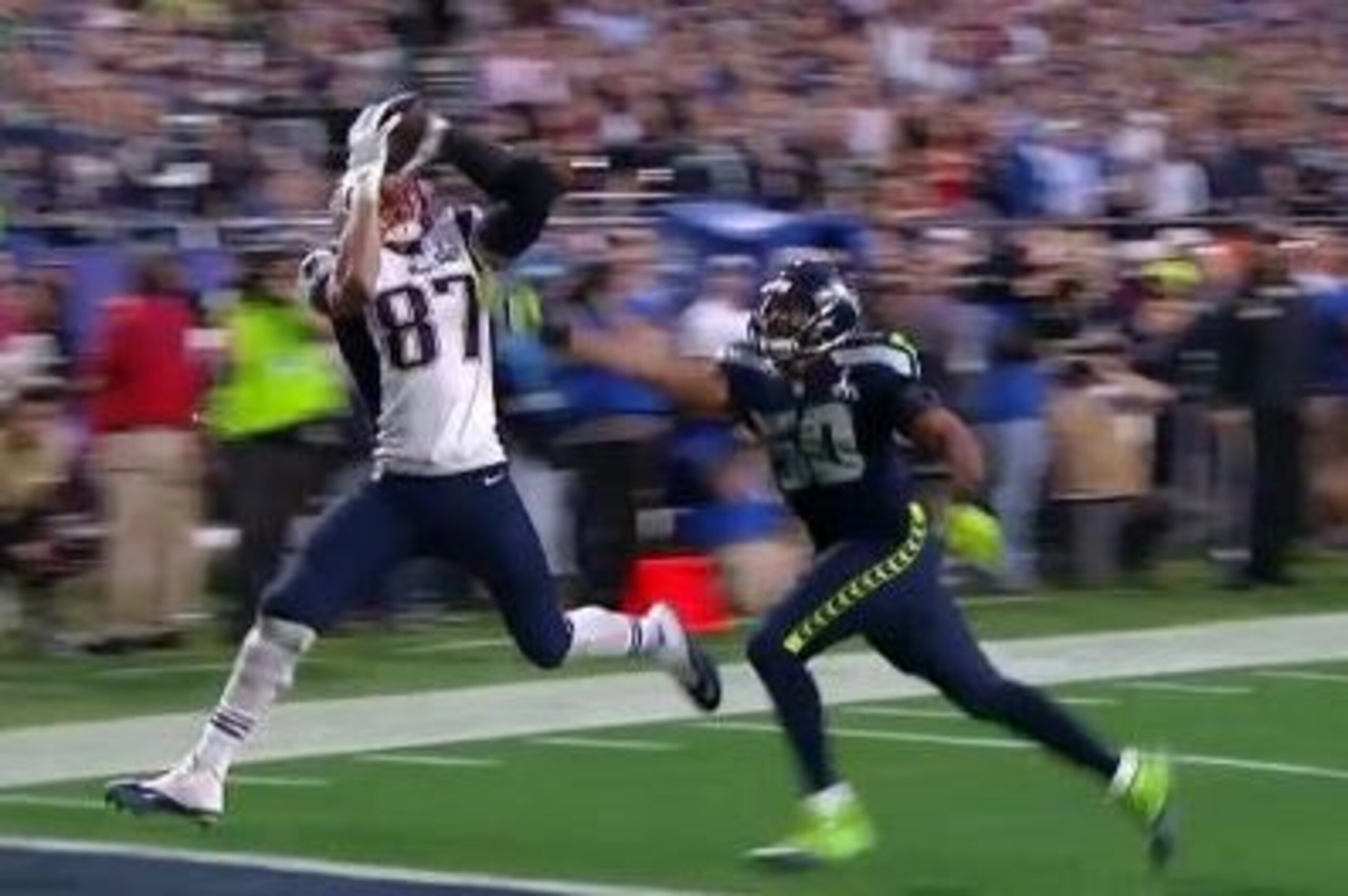
That connection was one of Brady’s four touchdown passes, and Gronkowski gained 22 of his 68 receiving yards.
Another attempted intermediate connection between the two would later be intercepted by Seahawks middle linebacker Bobby Wagner, a product of intense pocket pressure and Brady being forced to hurry his throw. But the Seahawks were overmatched against Gronkowski and left to absorb punishment when it mattered most.
With 6:52 left in the fourth quarter, New England was down by three points, trailing 24-21. Brady then orchestrated a 10-play drive in which he completed eight passes for 65 yards. Gronkowski was on the other end for 33 of those yards, including a 13-yard gain when he roasted Wright again, and a 20-yarder on a quick slant up the middle that allowed him to run free in plenty of green space after escaping the grasp of safety Kam Chancellor.
The New York Daily News' Ralph Vacchiano had this to say:
The approach was to strike quickly with short passes, run in the open field then rinse and repeat.
By doing that, Patriots head coach Bill Belichick neutralized the threat of an imposing Seahawks pass rush. Despite the two interceptions, he also reduced the impact of cornerback Richard Sherman and a Seahawks secondary that swarms to generate turnovers. If Sherman and safety Earl Thomas are reduced to tacklers in the open field, an element of what makes the Seahawks defense so threatening is gone.
That strategy was most evident in the Patriots’ use of wide receiver Julian Edelman. He was targeted 13 times and finished with nine receptions (including the game-winning touchdown) for 109 yards, most of which came after the catch.
Darren Page commented on Brady's aDot (average depth of target) stat:
A shining example of Edelman’s success and the Seahawks' inability to match his speed up the middle came in the second quarter.
Brady lined up facing a 3rd-and-9 on Seattle's 35-yard line, meaning a stop likely would have kept points of any kind off the board in a game that finished with a four-point gap. Edelman came in motion, settling in the left slot. Then he sprinted across the field.
The Patriots offense leaned heavily on lateral movement and a passing game built on speed and timing. On this play and so many others, intricate timing between Brady and his receiver made the play exceedingly difficult to defend.
Then speed after the catch made it impossible, with nickelback Tharold Simon grasping at nothing while Edelman turned another short completion into a long gain (23 yards).
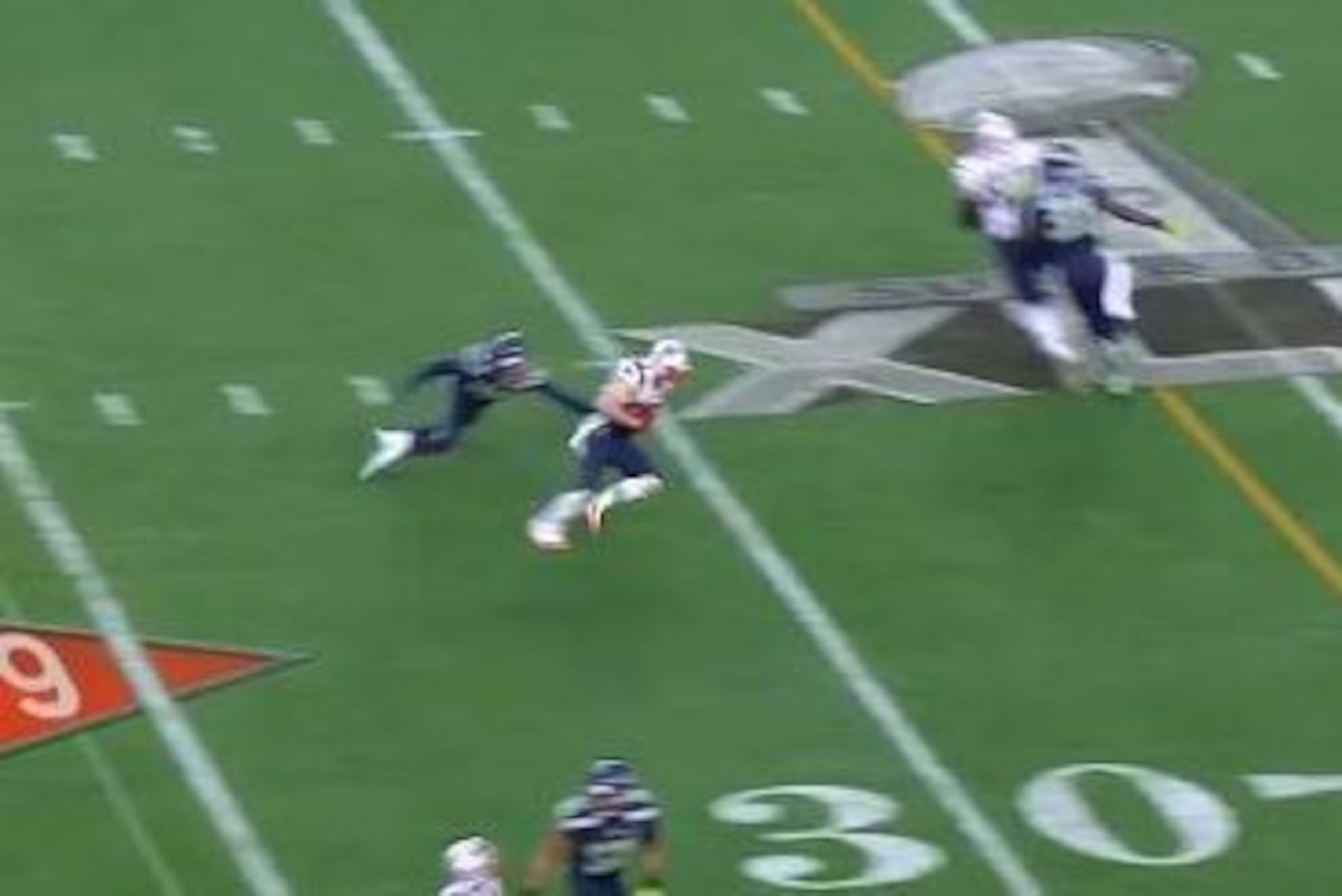
That catch and run prolonged the drive and set up Brady’s first touchdown pass, an 11-yard strike to wideout Brandon LaFell.
The Patriots utilized quick slants, out routes and screens to minimize risk and gain yardage in small chunks. The result was three 20-plus-yard receptions for Edelman, along with 64 yards on 11 catches for running back Shane Vereen. That’s another weakness Belichick identified, as throughout the regular season Seattle allowed an average of 43.8 receiving yards per game to running backs, according to Football Outsiders (ranked 18th).
Vereen’s most significant contribution as a receiver ignited the Patriots’ game-winning march downfield when he made a one-handed eight-yard catch.
Injuries played their part for the Seahawks too, most notably forcing Simon into a less-than-ideal situation.
Staring nickelback Jeremy Lane had early success against Edelman, highlighted by his intercepting Brady in the end zone. But he suffered a gruesome arm injury in the first quarter while returning that interception. Simon then struggled mightily after being pushed into a larger role, giving up two touchdowns while the Patriots overcame a 10-point deficit during the fourth quarter for the first time in Super Bowl history.
Lane saw limited action this season because of another injury (a groin problem). But he was highly effective as a slot cornerback when healthy while posting a passer rating of 59.1 in coverage, according to Pro Football Focus.
He was sorely missed, though so was the trademark physicality from the Seahawks defense overall that should have limited Gronkowski and made sure short passing also meant short gains.
In many ways the Super Bowl felt similar to the NFC Championship Game. Once again the Seahawks didn’t complete a pass until late in second quarter (5:36 mark), and once again a game that didn’t feel close on the field for much of the first half was kept well within reach where it mattered: the scoreboard.
But there would be no miracle this time. Instead the Seahawks had to settle for a completely meaningless near-miracle because of misfortune, mismatches and missed plays.
.jpg?w=2560 "Rams Eagles Football")

.jpg?w=2560 "Grading WWE Raw 🔠")


.jpg?w=2560 "Injury-stricken Seahawks signing veteran RB")
