Los Angeles Clippers Must Remember Who They Are Soon
Have you ever watched a movie where the main character begins the film unpopular and nerdy, goes through some sort of makeover and ends up being cool while neglecting his or her true friends in the process?
The Los Angeles Clippers have undergone a similar makeover, but as the playoffs near they must remember who they are in order to achieve their lofty goals.
Entering this season, the tendencies of players such as Chris Paul and Blake Griffin were well-known. Paul was the ideal point guard, always looking to set up his teammates. Griffin was a supremely athletic yet punishing power forward who could score in the paint as well as anyone.
TOP NEWS
LeBron Scolded Embiid 😯

Trades That Should've Happened During NBA Offseason 🏀

'Over-Under' Predictions for Every NBA Team's Record 🔮
While those skills certainly have not diminished, their tendencies have changed. The same can be said for Doc Rivers, who preached defense first with the Boston Celtics but has relied on offense with the Clippers.
There are goals the team would like to accomplish this season, such as winning the division again, but the one that matters the most is bringing home an NBA championship.
If the Clippers want their own parade down Figueroa Street, they need to continue what they are doing well while utilizing the strengths that got them this far in the first place.
Blake Griffin's Power Game
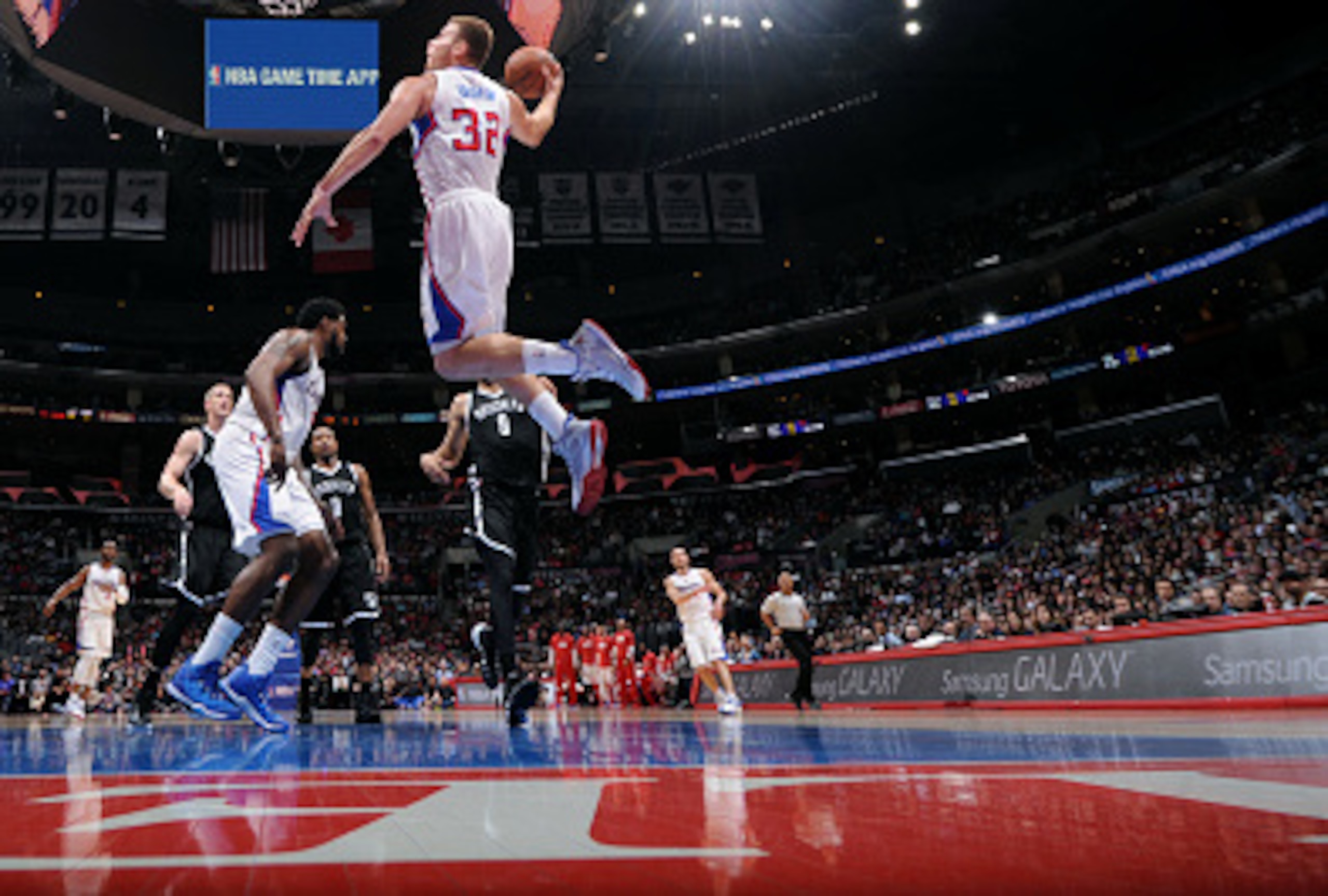
Upon entering the league, Blake Griffin became one of the most productive scorers in the paint. During his first two seasons, Griffin took 72.6 and 70.2 percent of his field-goal attempts from within 10 feet, connecting on over 56 percent in both seasons, per Basketball-Reference.com. This season his percentage of field-goal attempts within 10 feet has dropped to 51.7 percent.
It is no surprise that Griffin's improved jumper has altered his offensive tendencies. As Dan Woike of the Orange County Register notes, Griffin wasn't ready to alter his shot early in his career:
"Blake Griffin first met [shooting coach] Bob Thate inside a Santa Monica gymnasium in the summer of 2010, before Griffin’s rookie season. The two men talked about Griffin’s shot. They even went through a workout.
Griffin, though, wasn’t ready for a change.
'At that point, I was just trying to get my feet under me, Griffin said.'
"
Griffin's form, balance and jumper consistency have improved dramatically the last two seasons. However, his aerial highlights and overall dominance in the paint have been somewhat sapped.
Griffin's average field-goal-attempt distance has increased each season, from 7.2 feet as a rookie to 10.5 this year, according to Basketball-Reference. This is one of the reasons why the Clippers are scoring less per game in the paint. Last season, the Clippers ranked 13th (41.9) in points in the paint, compared to 28th (36.5) this season, per Team Rankings.
Furthermore, his rebounding numbers have taken a hit as well. Some of his regression can be attributed to DeAndre Jordan's development into one of the best rebounders in the league. Griffin's penchant for shooting has reduced his rebound totals as well.
Seth Partnow of Nylon Calculus wrote an excellent article discussing how jump-shooting bigs impact their own offensive rebounding totals. He wrote: "The farther from the basket big men play, the less chance they have to snare offensive rebounds. A simple comparison of average FG distance (with end-of-quarter “heaves” removed) and offensive rebound percentage demonstrates this effect."
Here's the chart:

Griffin fits perfectly into this study, as his offensive rebound percentage and totals have been affected by his average shot distance. Griffin grabbed 3.3 offensive rebounds per game as a rookie, compared to 2.0 this season.
| 2010-11 | 7.2 | 3.3 | 10.2 |
| 2011-12 | 7.7 | 3.3 | 10.7 |
| 2012-13 | 8.3 | 2.3 | 8.7 |
| 2013-14 | 8.8 | 2.4 | 7.7 |
| 2014-15 | 10.5 | 2.0 | 6.5 |
Although Griffin's developed jumper has improved his offensive arsenal, it has also limited his primary strength: scoring in the paint. The Clippers will need Griffin to be at his best shooting the ball and scoring near the basket to have the type of success they are looking for in the playoffs.
Chris Paul's Penetration
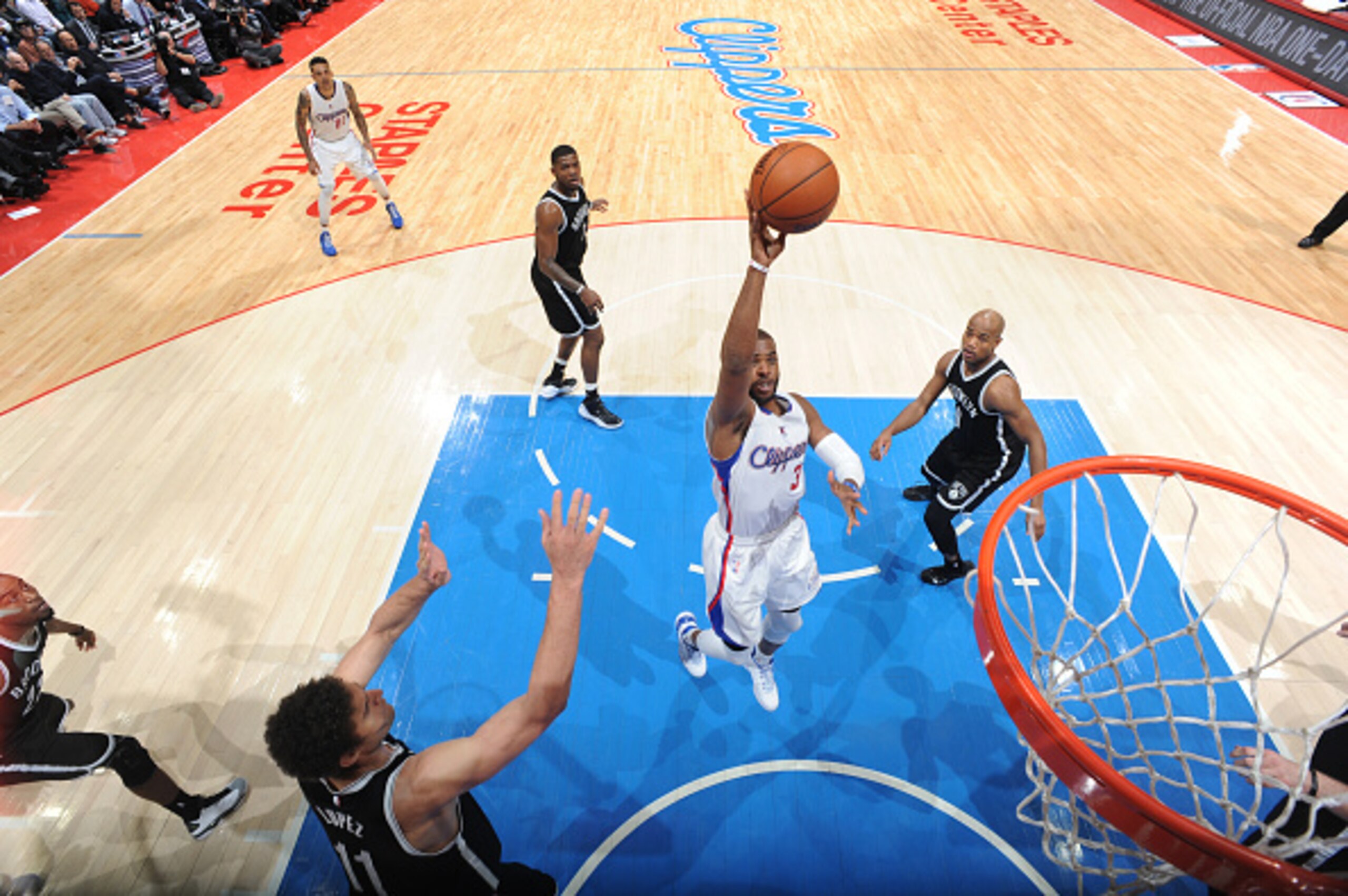
Known as one of the best points guards in the league, Paul's staple has been his ability to penetrate and find teammates for easy baskets. His excellent handles and change-of-pace attacks make him extremely difficult to defend.
During his six seasons before being traded to the Clippers, Paul thrived by attacking the rim. 24.7 percent of his shots came within three feet of the basket, according to Basketball-Reference. That number has fallen by nearly half, sitting at 13.3 percent with the Clippers.
Injuries, a more refined offensive game and partnering with Griffin provide context as to why that percentage has fallen. However, Paul had never taken less than 80 percent of his shots from inside the arc until he became a Clipper. He has yet to reach that mark in Los Angeles.
Paul needs to stay in attack mode, because his drives are so lethal he draws multiple defenders every time he penetrates, especially on pick-and-rolls.

In the play above, Paul attacks off a DeAndre Jordan secondary-break screen. Paul sets up his defender, Eric Bledsoe, so that he can rub off Jordan's outside shoulder and turn the corner, creating separation. This allows Paul to attack immediately without changing direction to navigate around the screen.
Paul then occupies Miles Plumlee by downshifting a gear and drawing him toward the strong-side corner, where Goran Dragic is defending J.J. Redick. Paul is creating space for Jordan to roll to the rim and Griffin to trail into his hot spot at the top of the key.
P.J. Tucker sinks to help defend Jordan's roll, and Gerald Green is forced to make a decision: jump out on Griffin to take away the jumper or leave Jamal Crawford alone on the weak side of the floor. Green gets caught in the middle, and Paul hits Griffin for an easy jumper.
This is the type of attack that Paul can bring each time down the floor. Due to the weapons around Paul, the more he attacks, the more open looks his teammates receive.
The problem is that this season, Paul's free-throw rate is at a career low, while his three-point rate is at a career high, according to Basketball-Reference.
This tweaked version of Paul is likely the product of Doc Rivers' pleading, according to ESPN.com's J.A. Adande:
"I'm always going to say he should shoot more. I'm a coach who believes in aggressive point guards. Chris wants the right balance, but I'm sure I drive him crazy at times. I'm a believer in aggressive point guards, because I believe it puts so much pressure on the defense every time.
"
Rivers might be right, as it is hard to argue against anything the Clippers offense has done this year, especially now that they have overtaken the Dallas Mavericks as the league's most efficient one, per NBA.com.
Either way, Paul's weapons are lethal when he is attacking and creating open looks for them. The more Paul attacks, the easier things become for the other four players on the floor, especially in the playoffs.
Doc Rivers' Defense
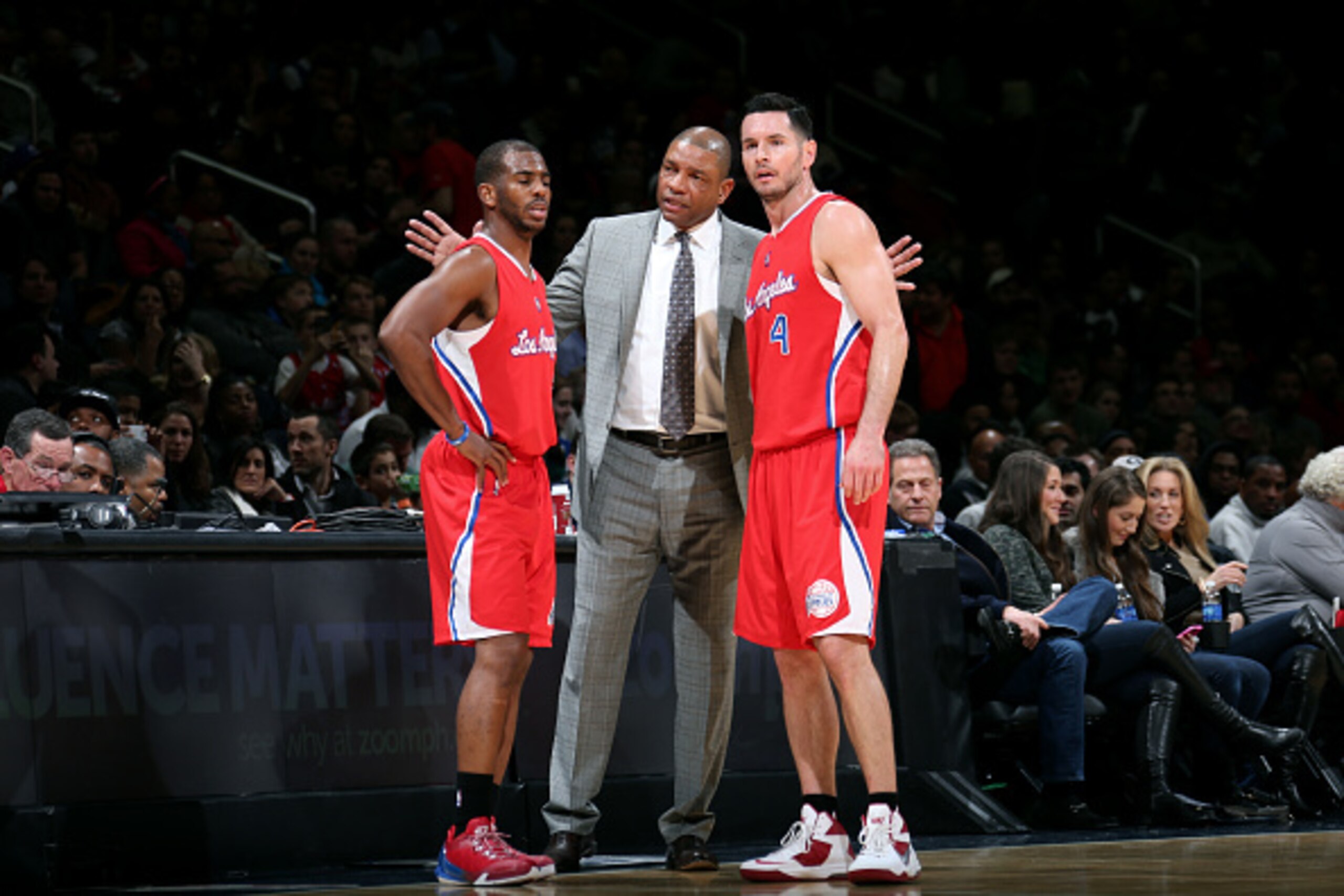
Easily the most disconcerting item left on Rivers' slate is team defense, an area of expertise many expected him to instill when the Clippers acquired him during the summer of 2013.
Rivers' defense finished seventh (102.1) in defensive efficiency last season but struggled in the playoffs (108.6, according to NBA.com). This season has been worse, as the team ranks 15th (103.4) in defensive efficiency.
The team's effort has come and gone, which is the root of the problem. When the Clippers are engaged, they can stifle opposing offenses. This was especially the case when the defense held two top-10 offensive teams, the Portland Trail Blazers and the Mavericks, to 94 and 100 points, respectively, within a four-day span.
Although the offense has been great since Rivers arrived, the team must have an identity. He needs to make sure the players are held accountable for their defensive mistakes.
The rotations have to be crisp. The effort needs to be there from all five players on the floor, and everyone must pay attention to detail. When watching the Clippers play, it is easy to see a disconnect between defensive-minded players like Matt Barnes and Jordan and most of the others.
Rivers came to town with a reputation as a good defensive coach. Now it is time for that reputation to pay dividends.
Overall, the Clippers are playing well and have enough talent to win in the playoffs. It sounds crazy saying that the top-rated offense in the league needs its two best players to adjust their games or that one of league's better coaches needs to perform better, but the previous results speak for themselves.
The Clippers have faltered in the playoffs and must play at their peak capacity to make it to the conference finals. Perhaps a mixture of the new Paul and Griffin with a bit of the old ones would allow the team to reach its full potential. Nonetheless, Rivers must improve the team's defense using the philosophy that won a title with the Celtics.
Unless the Clippers want to be the cool kids who lose their identities by evolving, they must embrace their roots. They need to focus on what they do well and combine their new skills with old, reliable ones.

.jpg?w=2560 "Terrell Owens Being Sued for Defamation")
.jpg?w=2560 "Buyers or Sellers for NFL's Most Surprising Teams 🏈")
.jpg?w=2560 "CJGJ Shares Cryptic Post 🤔")