
Power Ranking College Football's 6 Best Returning Running Backs for 2015
What's that? The value of running backs is being diminished? There are quite a few backs in college football right now who'd like a word or two about that.
2014 was the year of the running back in college football. Melvin Gordon, Ameer Abdullah, Tevin Coleman, David Cobb and Ezekiel Elliott all had banner seasons—and that was just in the Big Ten.
There was also a wealth of young running backs, like Nick Chubb from Georgia and Samaje Perine from Oklahoma, making names for themselves. Which backs will join them among the best in college football in 2015? The answers are in the following slides.
Unless hampered by injuries, all running backs on this list must have at least led their team in rushing.
6. Dalvin Cook, Florida State
1 of 7
Jameis Winston was the star of Florida State's offense, but freshman running back Dalvin Cook was the spark.
Cook didn't get a ton of meaningful playing time until Oct. 11 against Syracuse, when he rushed 23 times for 122 yards. However, his breakout game came two games later when the Seminoles had to come from behind to beat Louisville on the road. Cook carried the ball only nine times in that game but accumulated 110 yards and scored twice.
In Florida State's final three games—against Florida, Georgia Tech and Oregon—he went over the 100-yard mark. As far as impact freshmen go, Cook gave his team a jolt in a way many others didn't.
For that, he just makes the cut.
"Everything they say about Dalvin is true. I think his best years are still to come," Armwood High School coach Sean Callahan told Martin Rickman of Sports Illustrated. "It took Florida State half the season to figure out he’s their best running back. For me it would’ve been the first game. I would’ve just let him run."
The Seminoles will be a new-look team in '15, as Winston is among several players who either declared for the draft or will have graduated. As such, Cook is the No. 1 guy on the ground for Florida State now that Karlos Williams is gone.
Barring injury, his 2014 numbers—170 carries for 1,008 yards and eight touchdowns—should definitely go up.
5. Royce Freeman, Oregon
2 of 7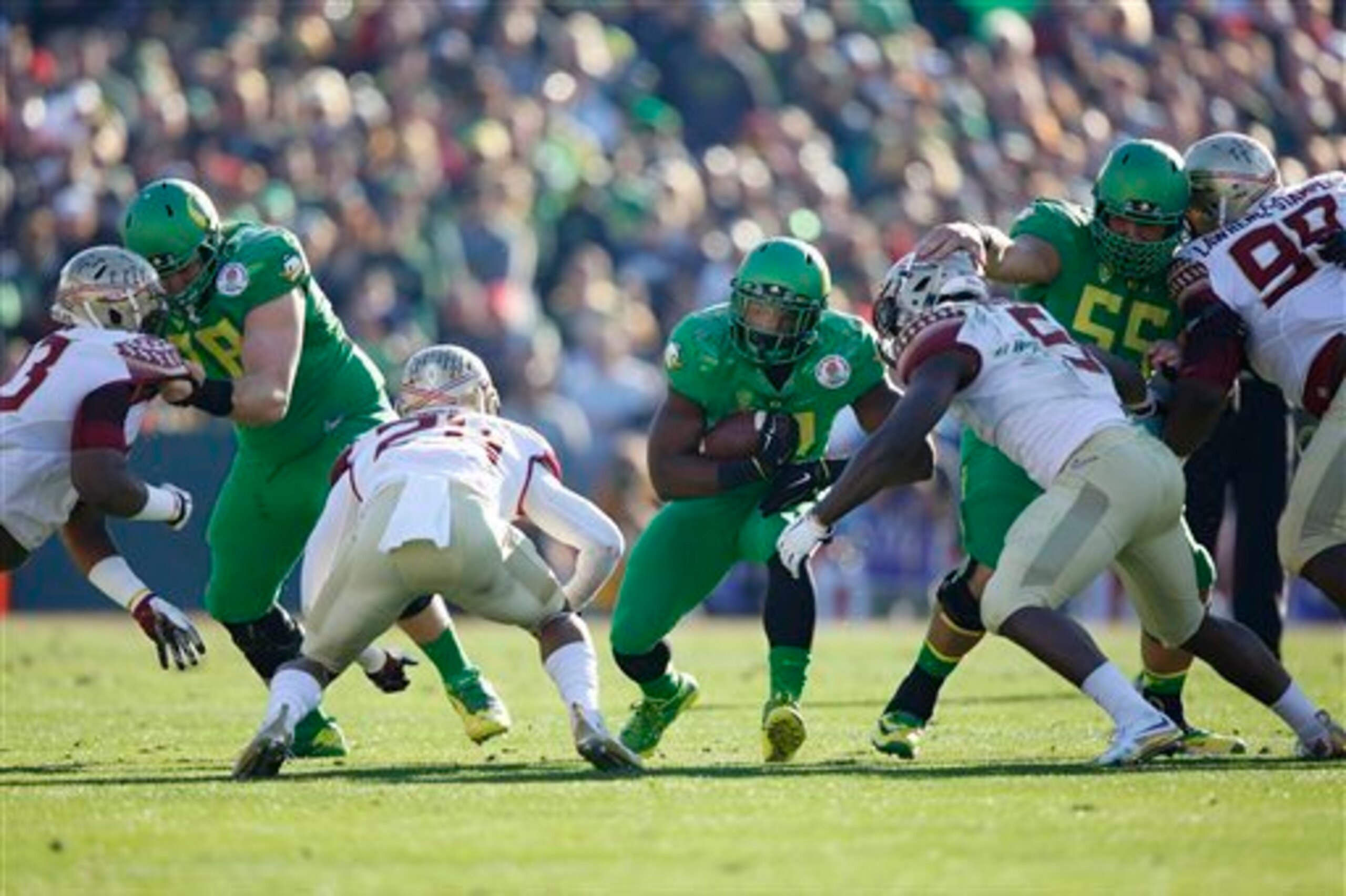
If you're still under the impression that Oregon is a finesse team, then you haven't (1) been paying attention to the Ducks lately and/or (2) been bulldozed by freshman running back Royce Freeman.
B/R's Adam Kramer profiled Freeman in October, and what you should take away from it is no freshman should look like Freeman does. Listed at 6'0" and 229 pounds on his bio, Freeman is the every-down power back Oregon has sorely missed in recent years.
He accumulated 1,365 yards and 18 touchdowns in his first collegiate season. Without a doubt, he'll be a focal point of the Ducks offense going forward. Though Freeman was pretty much nonexistent in the College Football Playoff (just 66 yards in two games), he should be back and better than ever next season.
The question for Freeman is whether he can stay healthy in order to be a bigger factor in key games down the stretch.
4. James Conner, Pittsburgh
3 of 7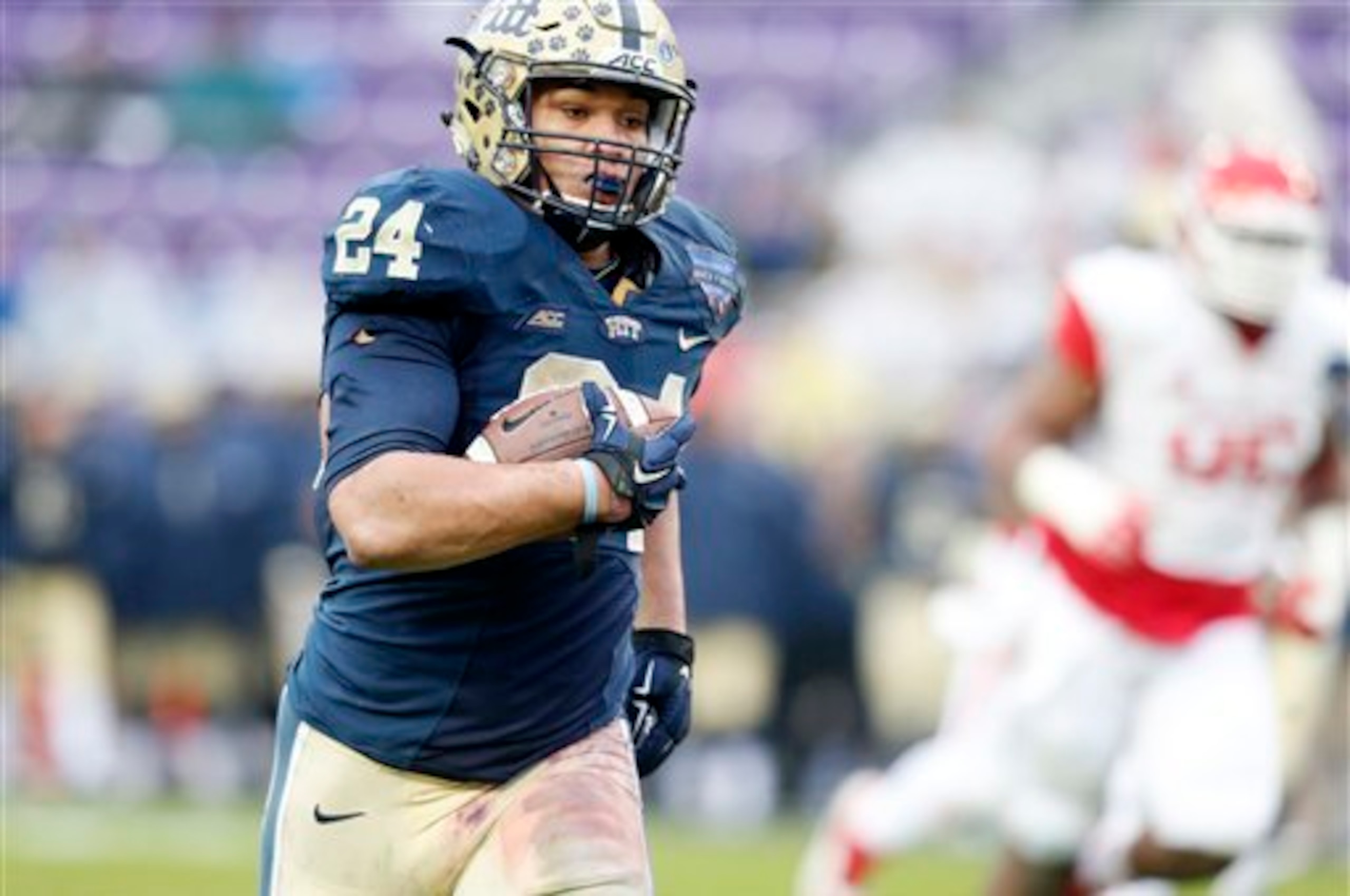
Need a workhorse running back? Here's one James Conner for you.
First-year coach Pat Narduzzi inherits one of the most productive (yet one of the more underrated) backs in the country in Conner. As a sophomore, he ran the ball 298 times—seventh most in the country—for 1,765 yards and had a whopping 26 touchdowns. Three times, he went over 200 yards in a game.
No one else in Pitt's backfield came close to matching that kind of production. Conner should be able to put up similar numbers in 2015.
As a defensive-minded coach, expect Narduzzi to place an emphasis on controlling the game and field position. There's no doubt Conner is going to fit right in with that philosophy.

3. Nick Chubb, Georgia
4 of 7
Was there an understudy who stepped into a starring role better than Nick Chubb did in 2014?
With Todd Gurley sidelined first by an NCAA suspension and then a season-ending ACL injury, Chubb ended up being the go-to guy for the Bulldogs. All he did was finish with 1,547 yards and 14 touchdowns.
Keep in mind that Chubb didn't become the starter until the sixth game of the season against Missouri. At no point during his time as a starter did he finish under 143 yards in a game against a Division I FBS opponent.
If ESPN.com's Edward Aschoff had to choose a running back in the SEC, he'd want Chubb:
"With his elite vision, quickness, burst, toughness, strength and endurance, Chubb, who is both elusive and a downhill runner, averaged a league-high 7.1 yards per carry (6.7 vs. the SEC). He eventually set the SEC bowl record of 266 yards on 33 carries in Georgia’s win against Louisville, which owned a top-10 rush defense, in the Belk Bowl.
"
The Bulldogs have a deep group of running backs. With a new quarterback in '15, there might not be a reason to ever pass the ball. Chubb is going to get plenty of touches and plenty of video game-type stats.
And he's only going to be a sophomore.
2. Samaje Perine, Oklahoma
5 of 7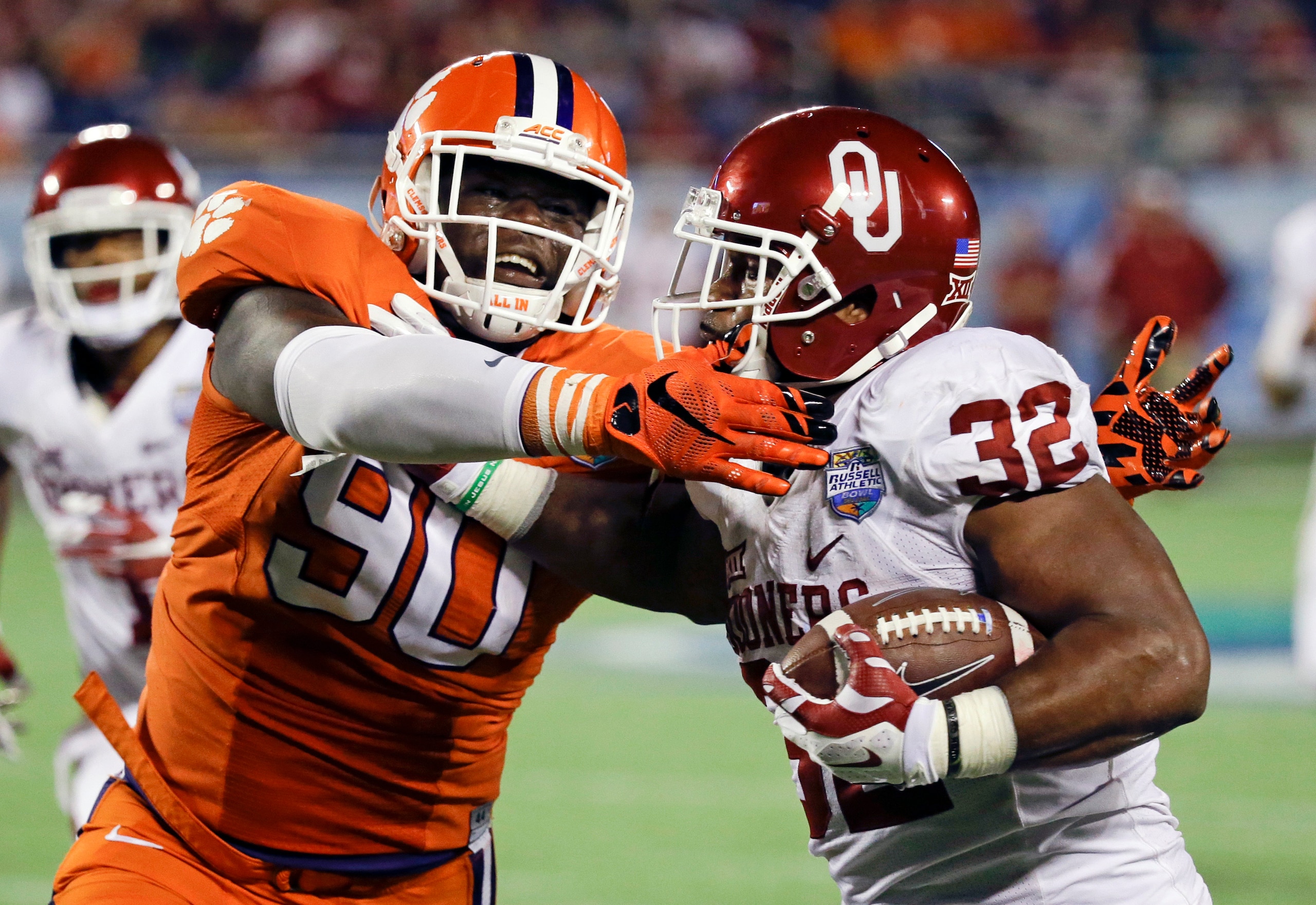
2014 was supposed to be the year that quarterback Trevor Knight broke out for Oklahoma. Instead, freshman running back Samaje Perine became the cornerstone of the Sooners offense.
Perine finished eighth in the country with 1,713 rushing yards and 131.77 yards per game—both stats ranked No. 1 among freshmen. He also had 21 touchdowns on the ground.
The Sooners again dealt with quarterback injuries and identity struggles, which ultimately led to head coach Bob Stoops releasing co-offensive coordinators Josh Heupel and Jay Norvell.
Lincoln Riley, formerly of East Carolina, will run Oklahoma's offense in 2015 with an "Air Raid" flair. While the Pirates led the American Athletic Conference in passing and went about 60-40 in the pass-run ratio, Riley knows where his best weapons are.
Until Oklahoma's quarterback situation is settled and the wide receivers step up, Perine is the offense's most reliable skill player. There's no reason why he shouldn't have another huge year as a sophomore.
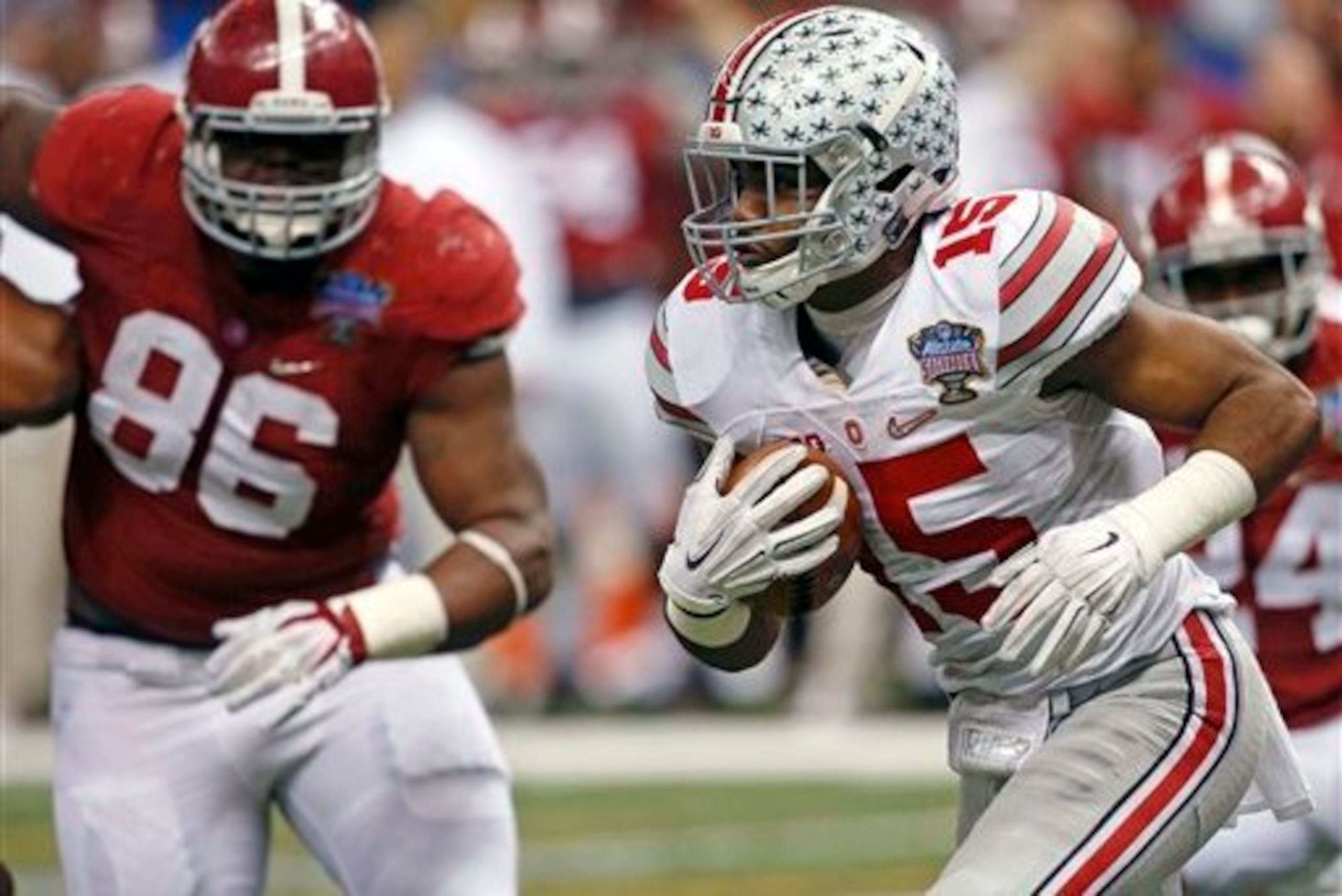
1. Ezekiel Elliott, Ohio State
6 of 7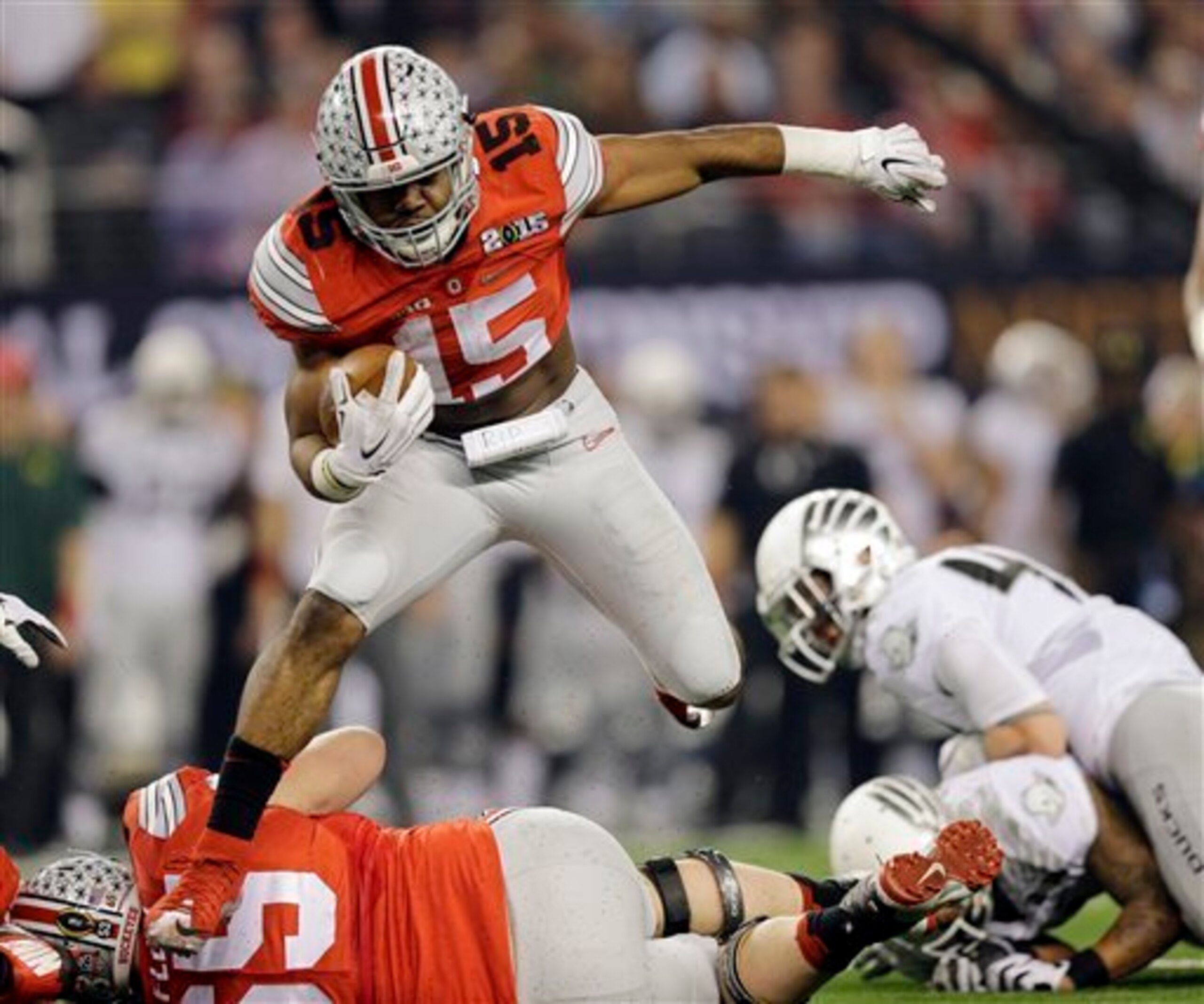
Let's conclude this list with a quick poll.
Did you tackle Ezekiel Elliott in his final three games?
A) No.
B) LOL, nope.
C) Presenting oneself in front of a loaded cannon seems most unwise, so no.
D) Yes. (Stop lying.) OK, no.
Put simply, there's no other running back who enters next season with more momentum than Elliott. The Ohio State running back was overshadowed throughout the year by Wisconsin's Melvin Gordon and Nebraska's Ameer Abdullah, among others.
With a playoff spot and a national championship on the line, though, Elliott came through.
In a Big Ten championship win over Wisconsin, he carried the ball 20 times for 220 yards and two scores. Against Alabama in the Sugar Bowl, he notched 230 yards—also on 20 carries. And in the College Football Playoff National Championship, he carried the Buckeyes offense with 246 yards and four touchdowns.
As crucial as quarterback Cardale Jones was for Ohio State during that miraculous run, Elliott was every bit as important. He has it all: size, speed, patience and vision.
He won't be overlooked next fall.
The Best of the Rest
7 of 7
Here's a short list of running backs who didn't quite make the cut but deserve recognition all the same. Players on this page might have been slowed by injuries or have previously shared responsibilities.
Derrick Henry, Alabama
2014 stats: 172 carries, 990 yards, 11 TDs. Now that T.J. Yeldon has declared for the NFL, Henry is primed to become Alabama's go-to running back.
Leonard Fournette, LSU
2014 stats: 187 carries, 1,034 yards, 10 TDs, five 100-yard games. Fournette became the feature back by the end of the season and should pick up where he left off next year.
Kareem Hunt, Toledo
2014 stats: 205 carries, 1,631 yards, 16 TDs. He only played in 10 games because of an ankle injury, so it'd be good to see if he can make it through a whole season.
Paul Perkins, UCLA
2014 stats: 251 carries, 1,575 yards, nine TDs. Perkins was a productive back for the Bruins and is on the cusp of being a touchdown machine for them. A new quarterback in 2015 should help.
Jonathan Williams/Alex Collins, Arkansas
2014 stats combined: 2,290 yards, 24 TDs, averaged 5.5 yards per carry. It's tough to separate Williams and Collins, who make up the two-headed monster for the Razorbacks. They're both excellent.
Ben Kercheval is a lead writer for college football. All stats courtesy of cfbstats.com.
.png?w=2560)
.png?w=2560)
.jpg?w=2560 "Chiefs, Steelers Eye WR Trades")