Breaking Down What Makes Stephen Curry Lethal in the Pick-and-Roll
When Stephen Curry's name is mentioned among the league's best guards, his unparalleled shooting dominates the conversation.
He consistently nails pull-up three-pointers in transition. He can come off pick-and-rolls or dribble handoffs and fire it from deep while off balance. His trigger is so quick that defenders must close out on his shot all the way to his body.
It's mesmerizing in its uniqueness. But lost in the frenzy surrounding Curry's lethal jumper are his other abilities—namely his passing and finishing around the rim.

There are plenty of great shooters around the league, and many of those players can weave around screens for pull-up threes or mid-range looks. Only a few of those guards, however, can distribute under duress or generate consistent rim pressure.
In the pick-and-roll, it's these ancillary skills that leave defenses with little chance of stopping the Golden State Warriors.
When Warriors head coach Steve Kerr first scouted Curry as general manager of the Phoenix Suns, he saw a lot of Steve Nash-like qualities to his game.
"Steve was more of a playmaker first," Kerr told Antonio Gonzalez of The Associated Press. "But the skillset is very similar, just the incredible hand-eye coordination and the ability to beat you with the pass, the dribble and the shot is a pretty rare combination."
Defending ball-screens is easy against one-dimensional guards. If the ball-handler is primarily a shooter, the on-ball defender applies pressure and fights over the screen while the defensive big stays high up the floor to contest jump shots.
If the ball-handler is a driver, the on-ball defender will give space and can go underneath the screen. The defensive big, less concerned with a jumper of any kind, can sink in to protect the rim and contain the ball.
With Curry, there's no right choice. It's really a matter of preference and playing the percentages—which, according to advanced metrics, means forcing mid-range jump shots.
In terms of defensive scheme, Curry is an ace at reading the coverage and making the appropriate decision. As his career has advanced and his reputation as a shooter has taken over, defenses have adjusted by hounding his personal space and living with anything he does below the three-point line.
In pick-and-rolls, this leaves the defensive guard vulnerable to getting lit up by a screen. Such tight defense means the on-ball defender cannot swivel his head or take even a millisecond to peek behind. He has to react instantaneously should Curry make any move to the rim, and any momentary lapse leaves him susceptible to a blow by.
That's what happens to K.J. McDaniels of the Philadelphia 76ers here. He's so concerned with Curry's shot that when Draymond Green throws Curry the ball in the corner, McDaniels aggressively jumps into the play.
For most defensive players, an initial closeout on a shot is followed by a quick half-step backward to put the defender in a better guarding position.
That's not possible with Curry because he's capable of firing a three-pointer even with a player all over him. When Green runs in to set the screen, McDaniels turns his head only to get clipped by the pick. With better defensive spacing, it would be easier for him to see it coming.
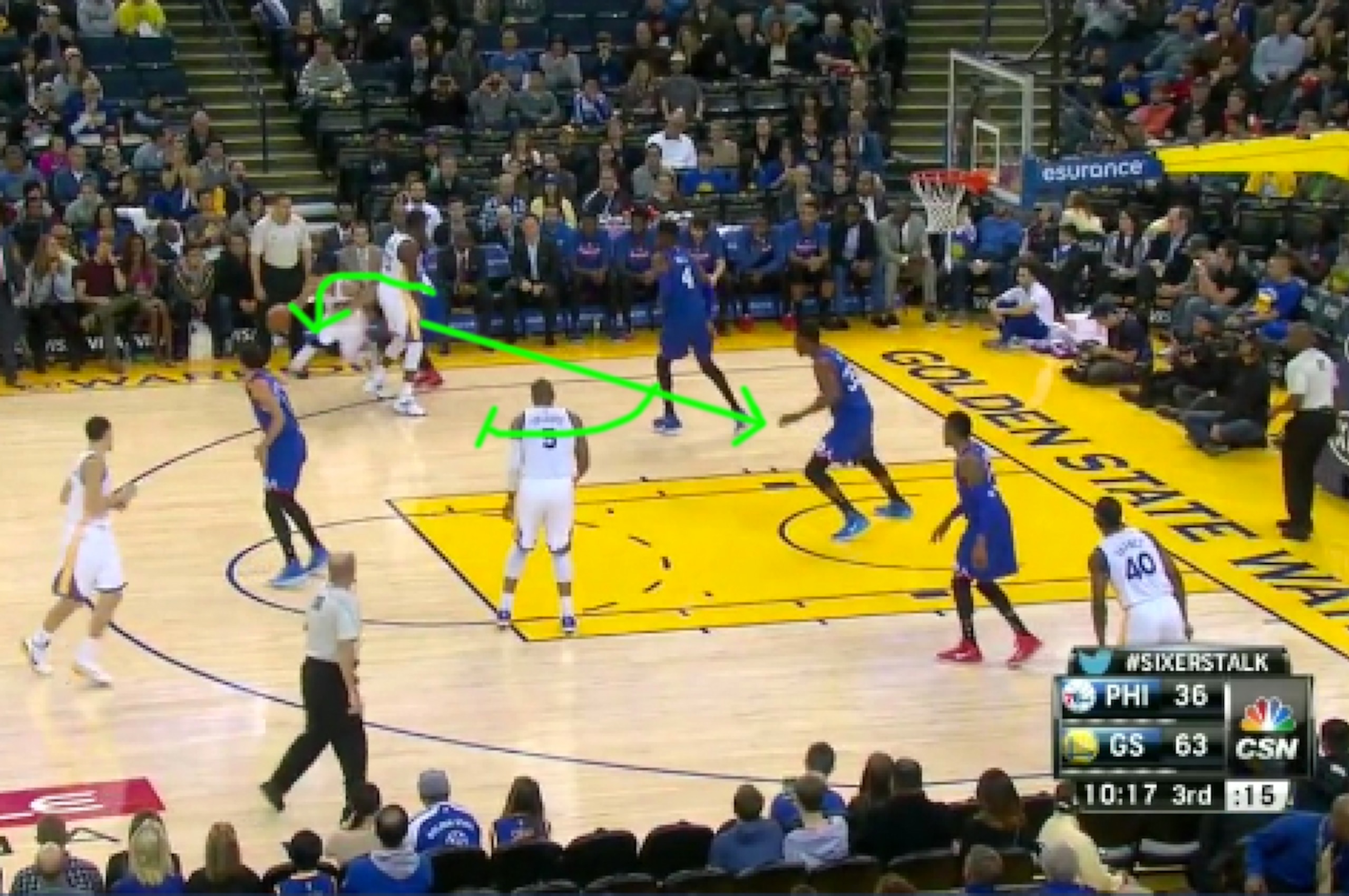
The worst outcome of any pick-and-roll in the initial action is a quality screen gets set. This puts the defensive big at a huge disadvantage because he must guard two players until his teammate can recover.
In this case, Nerlens Noel must contend with a rolling Green and Curry. He flies at Curry because he's the most dangerous player, and Curry throws a nice one-handed, overhead pass for a layup.
Another aspect of the high ball-pressure that leaves defenses vulnerable is in transition when defensive communication is more likely to break down.
Even if the defensive game plan is to fight over screens and push Curry below the three-point line with rearview pursuit—a term for recovering to the inside shoulder of the ball-handler while staying in his air space from behind—it's up to the big to assess the situation rationally.
In practical terms, this means quickly analyzing where the screen is set and adjusting the pick-and-roll coverage accordingly. If a screen is set well above the three-point line, it's more prudent for the guard to go under the screen to protect against dribble penetration and force Curry to shoot it from 28 feet. Even though he's a great shooter, it's a poor shot in the big picture.
For the big, this means he yells "under! under!" or whatever terminology the team uses for that defensive movement.
When Green sets a transition ball screen for Curry against the Detroit Pistons on this play, Brandon Jennings pursues over the top. This is problematic for Greg Monroe because the screen is set so far away from the basket.
Jennings' decision to go over leaves Monroe to defend Curry with 25 feet of room. He's now in the position of having to stop him from shooting a three-pointer or getting to the rack, a tough situation for a big.
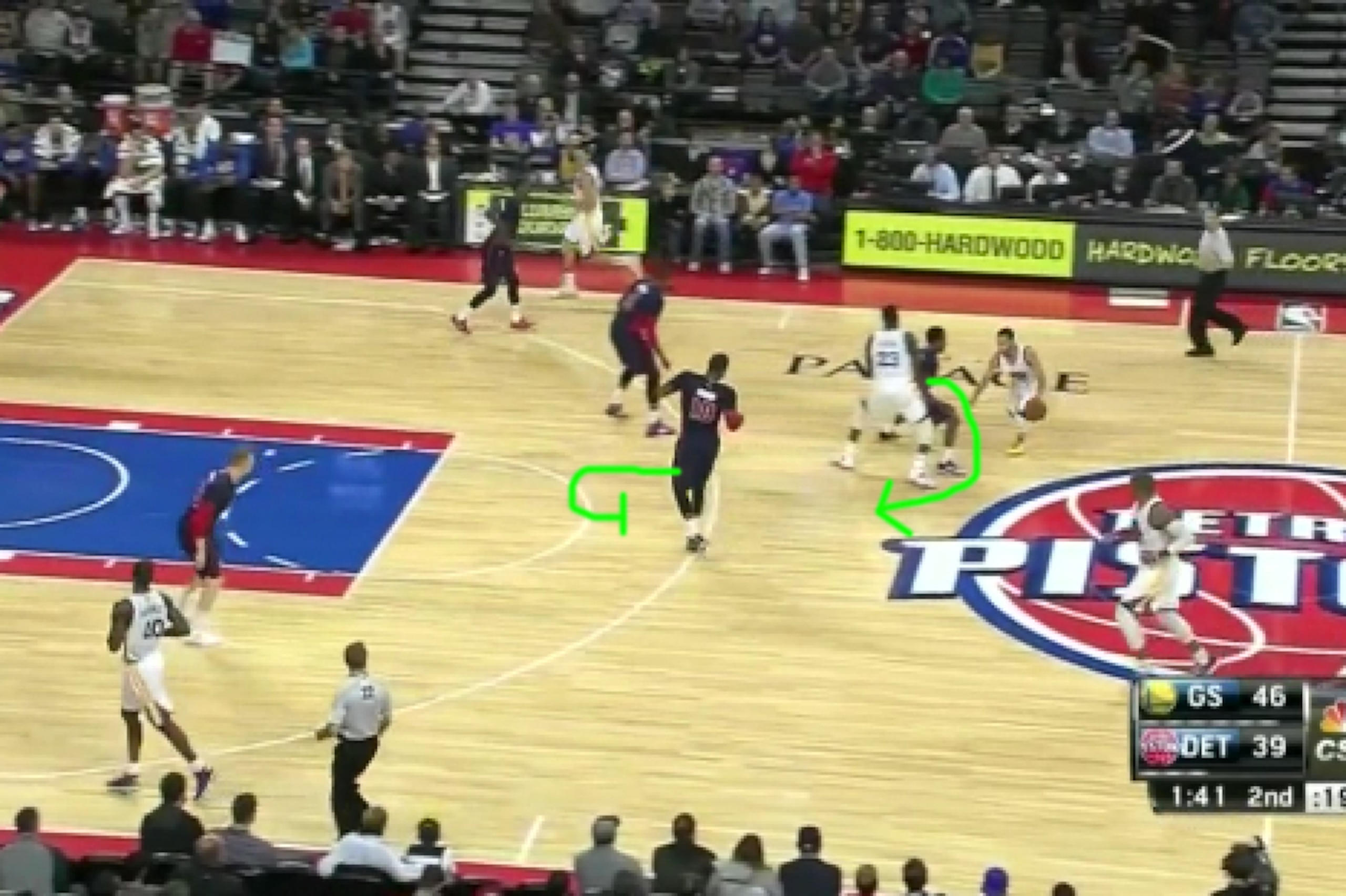
Curry sees he gives up too much room and bangs a three.
The easy solution is communication, but amid the chaos of transition it can sometimes disappear.
If Curry weren't a good passer, none of these wild pull-up shots would bother defenses all that much. Statistically, however, Curry cannot be ignored in any facet of his offensive game. Even LeBron James has a weakness as a jump shooter—he's good, but not great.
Curry, however, literally has no statistical weakness to exploit.
On pull-up jump shots, he averages 1.17 points per possession, according to Synergy Sports (subscription required)—a rate that puts him in the 98th percentile in the league. He's shooting 38 percent from three-point range on 7.8 attempts per game, an impressive clip considering the volume.
In non-post-up situations around the rim, he's shooting 62.1 percent, which puts him the 84th percentile. On runners, arguably the toughest shot in basketball that teams willingly allow to prevent layups, he's shooting 61.5 percent—good for the 94th percentile.
So what if you pressure him and make him pass? No problem. He's generating 1.059 points per possession in all pick-and-roll possessions including passes, which puts him in the 84th percentile.
There's nothing to leverage with him. Sure, pull-up mid-range shots are statistically inferior to threes and rim pressure, but giving Curry open shots in that middle area of the floor is only going to build his confidence and potentially light a fire that could be damaging in the long run.
The pick-and-roll is the origin of all this chaos. Curry is a fine isolation player and can score without the help of a screen, but all the options created by a pick make him unbelievably difficult to handle.

.jpg?w=2560 "Chiefs, Steelers Eye WR Trades")