RG3's Comeback May Seal Jay Gruden's Fate with the Washington Redskins
It might not be at the end of this season. It may be during or following next season. But Robert Griffin III's return to the starting quarterback role could seal head coach Jay Gruden's fate with the Washington Redskins.
Self-sabotage is a strange and tragic thing. It's the kind of flaw many people have, a personality quirk that keeps psychiatrists in work.
In Gruden's case, his act of self-sabotage was unavoidable. It came when Colt McCoy couldn't continue in Week 15's 24-13 loss to the New York Giants.
.jpg?w=2560 "Titans Giants Football")

That meant Gruden had to turn to Griffin. He had to turn to the struggling young quarterback he had publicly eviscerated then ditched barely a month earlier.
But Gruden's strange move toward his own professional assassination actually came while McCoy was still on the field. That's when, even without Griffin under center, Gruden called a drive perfectly tailored to the skills of 2012's second overall pick.
ESPN 980 reporter Chris Russell described the concepts at work on the opening drive against Big Blue, a drive capped by a Kai Forbath field goal:
Play-action passing from moving pockets set up by read-option misdirection. If Griffin was an action figure, that would be the instruction manual to make him work.
Watching McCoy run Griffin's offense, the first question that echoed loudly inside my skull was: "Why weren't you running this with Griffin?"
Why, instead, did you waste most of this season trying to make a quarterback who's better on the move into a pocket passer? After all, failures in the pocket are why Griffin was sent to the lumber in the first place, per Mike Jones of The Washington Post:
"Gruden had benched Griffin because of his struggles in the pocket, and because his inconsistencies in that department limited the offense. But Gruden said that in order to succeed in spite of Griffin’s limitations, he and his staff would have to use creativity, and that the team as a whole would need to execute better.
"You can build around his strengths, and if our running game is effective then yes, we can move the pocket and help him out in that regard. Obviously, the third downs have been an issue all year for all three quarterbacks, and that’s something we have got to correct as a group. The quarterbacks have got to continue to see the progressions, go through their reads and try to get the ball out of their hands. We have got to do a better job in the pass pro. It’s a combination of things, but overall, it’s very important for us to try to take as much pressure off of Robert as we can with a good balanced attack."
"
If you find yourself screaming "finally!" at your computer, tablet or mobile phone screen, don't feel bad. You're simply expressing the sentiment the majority of Redskins fans must be feeling.
Making things easy for your quarterback by playing to his strengths and calling a balanced game. Isn't that the basic requirement of any coach?
The fact that it's taken Gruden this long to do what he was supposedly hired for, has to raise serious questions about his long-term suitability for the job.
That question may have been, temporarily at least, answered. NBC Washington reporter Dianna Marie Russini has stated Gruden will be back next year:
However, Zac Boyer of The Washington Times didn't seem as convinced:
What's most likely is that Gruden's future will hinge on how well Griffin's comeback goes. Because if franchise management isn't asking why it's taken so long for Gruden to tailor his offense to the quarterback it believes in, it certainly should be.
Owner Dan Snyder and general manager Bruce Allen should've been asking that question when they saw Griffin put together an impressive performance against the Giants.
He passed for 236 yards and a score. But perhaps just as important, Griffin ran for 46 yards. Those numbers proved that the player who has been blighted by serious injuries for nearly two seasons still has the legs to run a dual-threat offense.
That's exactly what he was doing against Big Blue. Griffin was allowed to move the pocket on designed rollouts that got him away from pressure and let him play quickly.
ESPN.com Redskins reporter John Keim described how the moving pockets had a positive effect on Griffin's performance:
After the game, Griffin referenced how the play-calling had helped him settle, per Jones:
There's that word rhythm again. That precious quality was most obvious during a sequence of four plays on Griffin's second drive.
After being very conservative (rightly) when Griffin first entered the game, Gruden and offensive coordinator Sean McVay started to open things up.
Griffin soon hit three passes off play action, with a run by Alfred Morris wedged in between. Griffin connected with Pierre Garcon, Niles Paul and then Santana Moss.
These weren't short-range, safety-first completions either, as Liz Clarke of The Washington Post detailed:
That drive ended with Griffin's nine-yard toss to running back Chris Thompson on 3rd-and-4. The play could function as an object lesson in how to make things easy for a quarterback.
It started with manipulating Big Blue's defense with formation. Washington deployed "11" personnel, one tight end, one running back and three wide receivers.
The Redskins put DeSean Jackson on one side of the formation. On the same side, Andre Roberts lined up in the slot with Jordan Reed next to him as an in-line tight end:

This spread the Giants out and challenged their man-coverage shell. New York wanted to pressure Griffin with a Cover 0 blitz, something many teams have attacked the former Baylor ace with inside the red zone.
But Washington had the perfect call ready to beat this blitz. Once the ball was snapped, Thompson released behind the pressure on a circle route:

This gave Griffin a quick throw to make. All he had to do was dump the ball over the blitz to his running back who had a clear path to the end zone:
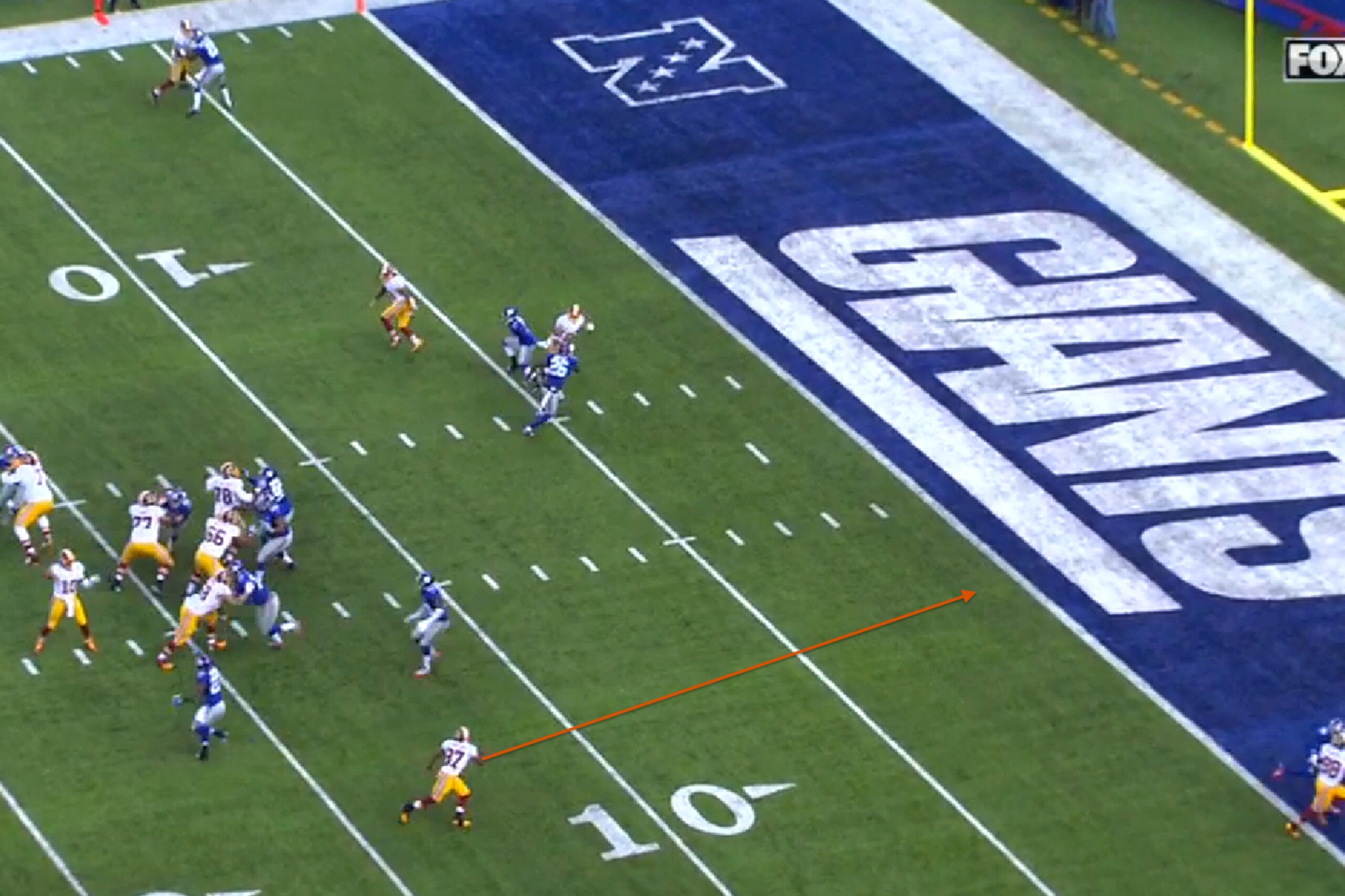
This was the kind of Kansas City Chiefs-style play I've endorsed for this offense all season. Griffin wasn't dropping back and standing tall in the pocket before launching a perfectly faded ball to the back corner of the end zone that dropped into his receiver's hands as gently as a basket of fruit from the heavens.
Instead, he was quickly releasing the ball to beat pressure and connect with a player on the run and in space. These type of plays will always work best for Griffin because they mask his basic flaws.
You know what those are by now. They were still on display against the Giants.
Griffin still had trouble holding on to the ball and took some sacks he shouldn't. That's a chronic issue emphasized by statistics provided by Bleacher Report's Jason Cole:
He also struggled when his first read was taken away. This fundamental weakness has plagued Griffin since he entered the pros.
It recurred again on a crucial play against the Giants, as Russell detailed:
These are the things Gruden was hired to fix. But they must be fixed within a framework that still allows Griffin to succeed. That framework must include his ability as a runner.
The recent narrative has been that Gruden can't run a read-option offense because Griffin's surgically repaired knees and ankles won't hold up to its demands. He now lacks the speed and agility to pose a threat as a ball-carrier.
Well, that argument was flatly refuted by two third-quarter scrambles that accounted for 27 yards. The first was a 23-yard, bob-and-weave masterpiece that even included a sledgehammer-like stiff arm on safety Antrel Rolle.
Griffin showed everybody that he can still punish a defense with his legs. That's bad news for Gruden.
It's bad news because it refutes the party line that pocket failures mean Griffin's career should be doomed. Instead, the truth is that it's Gruden job to find the right balance between pocket mechanics and Griffin's mobility.
That's a balance 106.7 The Fan host Grant Paulsen hinted at as he watched Griffin torment the Giants as a runner:
It's also a balance Gruden has often seemed reticent to try and achieve. Even after the positives of the moving-pocket offense against Big Blue, Gruden channeled his inner scrooge, per Jones:
Gruden's problem is that he wasn't hired to make Griffin something he isn't. He was hired to make him a success.
McCoy's injury showed Allen and Snyder how Griffin can still work as a functional quarterback in this league. It showed them the template for a Griffin-friendly offense.
In this context, it's easy to see some pressure in Gruden's decision to give Griffin the chance to reclaim his job, per another report from Jones. The coach knows his bosses want Griffin in there.
Gruden doesn't want to find out what would happen if he makes them choose, as ESPN 980 reporter Kevin Sheehan discussed with B/R's Adam Lefkoe:
If Snyder and Allen have been eyeball to eyeball with their coach over Griffin's future, it's easy to believe "the other fellow just blinked."
If he has, then Gruden finds himself in a very strange situation. He's almost damned if he does, damned if he doesn't.
If he still can't win with Griffin in the next two weeks, or at the very least improve his game, questions about Gruden's future will certainly resurface.
But if he does win via an offense geared to Griffin's read-option skills, Gruden will have no more excuses for not getting the best out of the supposed franchise quarterback. Instead, he'll be stuck running an offense he doesn't like.
When he made the decision to bench Griffin, it looked like a gamble that would decide his fate. But instead, it could be the success of the injury-enforced comeback by the quarterback he didn't want, that really determines how long Gruden keeps his job.
All statistics via NFL.com.
All screen shots courtesy of Fox Sports and NFL.com Game Pass.