The NFL's Toughest Out: Jamaal Charles and the Old-Fashioned Chiefs
The Kansas City Chiefs cannot stop the run. They allow 4.8 yards per carry. Five teams have rushed for 125-plus yards against them. They should not be able to beat good opponents.
The Chiefs cannot throw downfield. They average just 10.2 yards per reception, one of the lowest figures in the NFL. Their longest passing play of the season is 34 yards. They practically don't even have a No. 2 wide receiver. They should not be able to beat good opponents.
The Chiefs have only intercepted four passes. They have allowed 25 sacks, with Alex Smith enduring five- and six-sack games. Beyond Jamaal Charles and pass-rushers James Houston and Tamba Hali, they are completely lacking in marquee talent. They should not be able to beat good opponents.
TOP NEWS
.jpg?w=2560 "Chargers Mack")
Every Trade's Best Trade Asset 🔁
.jpg?w=2560 "Green Bay Steelers Football")
Insiders: Cowboys Overpaid for Porter
.jpg?w=2560 "Seahawks Cardinals Football")
MHJ's Potential Trade Value 📉
But the Chiefs just upset the Seahawks. They blew out the Patriots in September. They have beaten the Dolphins, Chargers and Bills, three fellow wild-card contenders of various threat levels. They lost to the Broncos and 49ers by seven and five points. With their season-opening faceplant against the Titans a distant memory, it is clear that the Chiefs can beat good opponents.
How are they doing it? The Chiefs are like a 1970s throwback team: They win because of running game creativity, because of red-zone offense and defense and because of a knack for smart situational football. They may not be the NFL's best team, but their conservative style and detail-oriented approach are making the Chiefs the league's toughest out.
Power and misdirection

Opponents know Jamaal Charles and Knile Davis are coming, often right up the middle. The Chiefs have run between the tackles 213 times this season, according to NFLGSIS.com. That's 21.3 carries per game (division is fun after 10 games!) and 35 percent of the Chiefs' total plays.
Stopping Charles and Davis is another matter. The Chiefs have gained 985 yards between the tackles, 30 percent of their total output. In a league full of spread formations and 65-35 pass-run ratios, the Chiefs offense is an old-school inside-to-outside ground attack, with bursts up the middle setting up opportunities on the perimeter, and vice versa. Here are the Chiefs' NFLGSIS rankings on up-the-middle and outside runs. They show a team that knows how to jab to set up its outside haymakers:
| Runs | NFL Rank | Yards per Rush | NFL Rank | |
| Up the Middle | 113 | 2 | 5.33 | 2 |
| Right End | 38 | 11 | 5.92 | 9 |
| Left End | 37 | 11 | 6.65 | 4 |
It makes sense for the Chiefs to focus their offense on Charles, one of the league's best all-purpose running backs, and Davis, a gifted power-rusher who came cheap because of (not quite solved yet) collegiate fumbling issues.
But the Chiefs' commitment to an inside-out rushing game goes beyond just force-feeding their running backs. They use a diversity of running plays, misdirection and careful sequencing to keep opponents from crowding the box to stop the inside zone or plunge. Let's examine a long third-quarter drive against the Seahawks in detail to see just how the Chiefs diversify their running game to keep defenses off balance:
1st-and-5, Chiefs 33—Charles runs off left end, pushed out of bounds for six yards: Charles takes the handoff on a little "delay," and left tackle Eric Fisher drops back as if to pass protect, then leads Charles, catching the Seahawks defenders trying to rush Smith. It's an unusual design, like a draw play to the outside, and it uses the defense's pursuit to the Chiefs' advantage.
1st-and-10, Chiefs 39—Alex Smith passes short right to De'Anthony Thomas for 10 yards: This is a read-option concept. Smith fakes a shotgun handoff to Charles, then throws a screen to Thomas. The Chiefs have three receivers bunched to the right near the field numbers, but the Seahawks kept eight defenders crowded in the box. Screens like these punish the defense for loading up to stop the inside run.
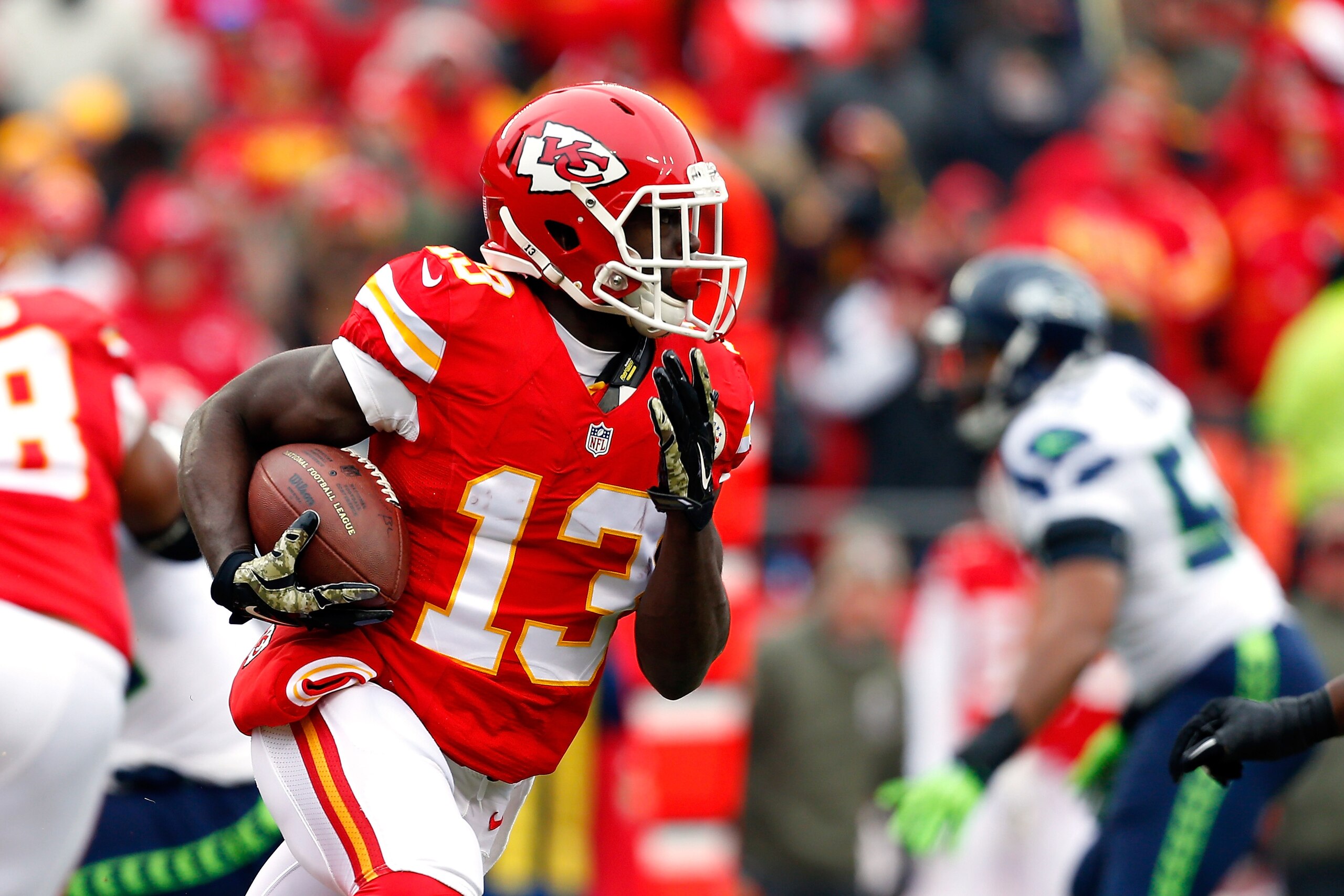
1st-and-10, Chiefs 49—De'Anthony Thomas runs off right end for seven yards: Thomas motions across the formation from the left slot and takes a "jet sweep" handoff. Smith fakes a pitch left to Charles after giving up the ball. Another misdirection tactic.
2nd-and-3, Seahawks 44—Charles runs up middle for four yards: A "power" run from the shotgun, complete with a guard folding into the hole. Smith adds a fake screen to a slot receiver after the handoff to freeze the defense. Note how the Chiefs keep setting up 2nd-and-short while avoiding third down altogether.
1st-and-10, Seahawks 40—Thomas runs off left end for seven yards: Yet another reverse, this time in the opposite direction. The Chiefs sell this play as a Charles run to the right—not just with a fake to Charles and the whole offensive line slanting right, but by motioning Travis Kelce to the right before the snap. Thomas has seven carries for 56 yards, all of them on rushes to the outside, since earning a regular role in the offense in Week 7.
2nd-and-3, Seahawks 33—Charles runs up the middle for eight yards: The Chiefs opt for a three-tight end formation now that the Seahawks have been softened up by misdirection. The Chiefs used three-tight-end groupings 55 times in their first eight games, according to the Football Outsiders internal database. That's a high rate for an unusual formation, and the Chiefs averaged 4.9 yards per carry and (more surprisingly) 8.1 yards per pass attempt with three tight ends on the field. It's just another way to get the best Chiefs personnel on the field, create better rushing opportunities for the backs and use the running game to create opportunities for a passing game devoid of downfield weapons. Speaking of which:
1st-and-10, Seahawks 25—Smith passes short right to Dwayne Bowe for nine yards: Smith fakes a shotgun handoff to Charles. Thomas bubbles out toward the sideline and waits for a screen. The Seahawks defense gets taffy-pulled—Kam Chancellor can be seen racing out of an underneath zone to chase Thomas—so Bowe gets an easy catch.
2nd-and-1, Seahawks 16—Charles runs up the middle for four yards: Thomas goes in motion before the snap, just as he did for the jet sweep. It's easy to see how the Chiefs' running and passing plays are designed to work in sequence.
1st-and-10, Seahawks 12—Charles runs off right tackle for one yard: The Seahawks defense finally stiffens in the red zone.
2nd-and-9, Seahawks 11—Smith passes short right to Knile Davis for eight yards: This is a routine screen, but Davis comes within inches of setting up 1st-and-goal. Screens are yet another way to get the ball in space on the perimeter against defenses that are not exactly terrified that Junior Hemingway is going to beat them 50 yards downfield.
Davis got stuffed on the next play, so this beautifully creative sequence, which at times looked like the Chiefs were beating the Seahawks at their own game plan, ended with a short field goal. That's unusual for the Chiefs, who are one of the NFL's best offensive and defensive teams in the red zone.
Tough when it matters
The Chiefs' win over the Seahawks was essentially a red-zone victory. The Seahawks reached the red zone five times and came away with two touchdowns and two field goals. The Chiefs reached the red zone four times and scored three touchdowns and a field goal. The Seahawks gained 74 more yards, picked up five more first downs and won the turnover battle, but too many seven-for-three-point tradeoffs tilted the game the Chiefs' way.
The Chiefs offense ranks third in the NFL in red-zone touchdown rate and is tied for ninth in goal-to-go rate. On defense, they rank second and third in the same categories. All of these rates come from NFLGSIS.com, and they are confirmed by high-tech metrics like the ones used by Football Outsiders. Red-zone conversions and red-zone stops not only made the difference in the Seahawks and Bills' wins, but they kept the Chiefs within striking range until the final moments of the 49ers' loss.
The Chiefs have not allowed a rushing touchdown all season, so it is natural to focus on their run defense in the red zone. The Chiefs allow just 2.8 yards per rush in the red zone, but that is almost exactly the NFL average. The Chiefs are better at stopping the run in the red zone than they are in other situations, but they are not outstanding.

More surprisingly, the Chiefs allow just 2.5 yards per pass in the red zone, when the NFL average is 3.3. The Chiefs are especially effective at stopping third-down passes in the red zone: 22 pass attempts, nine completions, four touchdowns, one first down, two sacks, a pair of fourth-down stops.
Both the Chiefs offense and defense are designed to work well in close quarters. The offense, as we have seen, has almost no deep passing component. All of the counters, reverses, screens and fakes stretch defenses horizontally instead of vertically, allowing the Chiefs to use the same concepts that worked at midfield to score three-yard touchdowns. On defense, coordinator Bob Sutton loves to crowd defensive backs at the line of scrimmage and threaten with complex blitzes. He can do that in the red zone without fear of getting burned deep, though Sutton is more likely to fake the blitz and drop his defenders into zones near the red zone, fooling quarterbacks into quick throws and putting defenders in position to tackle receivers before they score.
Who needs long passes when you have YAC?
This may be the greatest secret of the Chiefs' success: On third down and eight or more yards, Alex Smith is 29-of-39 for 363 yards and 19 first downs. That's right: The guy who cannot throw deep and has no deep receivers is completing 74 percent of his 3rd-and-long passes, and not many of them have been five-yard dumps to Charles on 3rd-and-15.

The Chiefs generate much of this 3rd-and-long yardage after the catch: According to the Football Outsiders internal database, 155 of those 363 yards came after the catch. Charles, Davis, Thomas and fullback Anthony Sherman all have conversions of 3rd-and-12 or longer that started as screens or quick hitters over the middle. Smith has been sacked five times on 3rd-and-long, so the news is not all good, but the Chiefs consistently manufacture enough first downs (or at least enough yardage to boost the field position game after a punt) in tough situations to suit their ball-control game plans.
Defenses, meanwhile, are just 20-of-40 passing for 221 yards on 3rd-and-long, with only nine first downs and five sacks. James Houston, Tamba Hali and Sutton's flash-mob blitzes do their best work on 3rd-and-long, when Sutton can justify the use of one of his wacky 1-4-6 personnel packages.
Just as the Chiefs tilt the field when they score a touchdown while holding an opponent to a field goal, they gain a nudge from an extra 3rd-and-long conversion per game. The ability to force an incomplete pass on 3rd-and-goal or convert 3rd-and-12 with a Charles scamper may not be as flashy as the ability to throw 50-yard touchdowns, but the Chiefs have tailored their entire franchise philosophy to make the most of this close-to-the-vest style.
Slow and steady
Red-zone efficiency, rushing diversity and surprising 3rd-and-long capability work in harmony for the Chiefs. The team is designed to play a particular brand of football, and Reid, Sutton and the coaching staff commit to it and design their tactics around it. The Chiefs have one of the slowest-paced offenses in the NFL, which limits possessions and keeps games close. Davis and Thomas give them an advantage in the return game. They are conservative on fourth downs—four of their five conversion attempts this season came when trailing in the second half—because they are built to punt and play defense instead of taking unnecessary risks. It's old-fashioned football, and it's not high-percentage football, but the Chiefs are great at it because it suits their talent, and they squeeze every advantage for all it is worth.
The Chiefs can ride this throwback football into the playoffs. Two upcoming Raiders games should take them to nine wins. The Cardinals, Steelers and Chargers are all tough but beatable, and the Chiefs may catch the Broncos with several offensive weapons unavailable in two weeks. An 11-5 record is possible. So is a division title: That Patriots blowout, combined with a Rams victory, gives the Chiefs some interesting tiebreaker advantages over the Broncos.
Once the Chiefs reach the playoffs, anything can happen, as last year's mind-blower against the Colts proved. The Chiefs played their brand of football perfectly in the Colts' loss until Charles, Davis, Houston and others got hurt in the second half. With a little more experience and some injury luck, the Chiefs can make serious playoff noise. They know the top contenders very well, and those contenders know them. But knowing the Chiefs is not the same as beating them.
Mike Tanier covers the NFL for Bleacher Report.
.jpg?w=2560 "Giants Football")