Philadelphia Eagles vs. Green Bay Packers: Breaking Down Green Bay's Game Plan
On a short week, the 7-2 Philadelphia Eagles are scheduled to enter Lambeau Field to face the Green Bay Packers. Green Bay, at 6-3, is no easy task, but the Packers haven't put together a resume that would have them in the playoffs if the season were to end today.
Philadelphia, with a half-game lead in the NFC East, would be playing in the postseason, though. A matchup between these two NFC playoff hopefuls could potentially even be the tie-breaker for a wild card spot or in playoff seeding.
For Green Bay's title hopes, this is a highly significant game. Coming off a bye week two weeks ago to face a team with a limited amount of practice time between games, the Packers should be the freshest team on the field. Against a well-conditioned Eagles team, though, the squad must execute on both sides of the ball to give them a chance for a victory at home.
TOP NEWS
Bears' Santos Wanted to Kick 58-Yarder
Picking Each NFL Division Winner 🔮
.jpg?w=2560)
B/R's Expert Week 7 NFL Picks 🔮
Offensive key: Let Aaron Rodgers throw late in the down
Green Bay's offense doesn't work the same way as Philadelphia's. Though both squads have the same goal of putting points on the board, they go about it in different ways.
Philadelphia's head coach and play-caller Chip Kelly loves to run a no-huddle high-tempo offense that utilizes quick passes; Green Bay's approach doesn't totally coincide with Kelly's beliefs.
There are no-huddle elements in the Packers' offense, but quarterback Aaron Rodgers likes to hold onto the ball. When watching his highlights of his nearly record-breaking performance on Sunday night against the Chicago Bears, this becomes evident.
Rodgers likes to move around and look downfield for an opportunity to gash the opposing defense, not just to chip away against a team. Sometimes, this can frustrate fans, as they believe he "holds the ball too long." It even prompted the Milwaukee Journal-Sentinel to create a poll asking the question, to which 73 percent of the respondents answered that Rodgers does indeed hold the ball too long.
Without him holding onto the ball on occasion, though, the deep throws he's able to hit aren't going to be made. For Green Bay, this is a huge element to its offense, as the Packers are second in the league in completions of over 40 yards.
The deep ball also keeps defenses honest, forcing them to cover every inch of the field, allowing the Packers to continue their efficiency, as they rank first in the league in quarterback rating.
On the flip side, the Philadelphia Eagles defense is fairly boom or bust when it comes to covering the deep ball. Eagle defenders allow enough 20-plus yard gains through the air to rank them in the bottom quarter of the league defensively. And as good as Green Bay is at getting completions of 40-yard or more, the Eagles defense is as bad in surrendering such big plays. It ranks next to last in the league in that category.
The busts are evident on that side of the ball: The Eagles secondary just isn't very talented, or at least not talented to stop the deep ball. The booms, though, come from the front seven. When regarding sacks, Philadelphia ranks second in the league.
As Fran Duffy of PhiladelphiaEagles.com noted in his postgame study of last week's matchup with the Panthers, Philadelphia's pass rush was a big a reason for the Eagles' prime-time victory.
"For the final sack of the game, it’s a second-and-9 in the fourth quarter. Graham again beat left tackle Byron Bell off the edge for the ninth quarterback takedown of the day to cap off a dominant performance by the defense. On all of these sacks, I could’ve easily shown how tight the coverage was on the back end as well, because Monday was another one of those games where the defensive front and secondary worked in concert to limit a dangerous offensive attack.
"
Green Bay can take advantage of Philadelphia's defensive weakness, the deep ball, by playing to the strengths in their passing game. With two potential Pro Bowl receivers in Jordy Nelson and Randall Cobb, plus emerging rookie Davante Adams, the high-flying passing game could drop a ton of points against the Eagles.
For that to come to fruition, though, the Packers' offensive line, must hold together. Four of the five Week 1 starters have sustained some sort of injury over the course of the season. The only healthy lineman, Corey Linsley, wasn't even slated as a starter until a preseason injury vaulted him into the lineup.
Fans will play the results on Rodgers. If he gets sacked by a top-two team in sack production, he'll be "holding onto the ball too long." But if he hits a 40-yard touchdown to Cobb or Nelson, they'll be celebrating his greatness.
Green Bay can't afford the former. Against the Eagles, the Packers offensive line must limit mistakes and the talented Eagle pass rush and keep Rodgers from hitting the grass.
Defensive key: Stack the box, but maintain consistency in coverage
Eagles running back LeSean McCoy currently has 641 yards and two scores on the ground in just over half a season. His 3.7 yards per carry is a career low. McCoy had averaged 4.8 yards per carry or higher in three of his last four seasons.
So what's wrong with the Philadelphia Eagles' running game? According to Matt Lombardo of NJ.com, the teams' 200-plus-yard performance Week 6against the New York Giants could have explained the situation.
"Sure, the Giants only kept between six or seven men in the box against the run Sunday night, unlike most teams that have stacked the box with eight, especially on pass rushing downs. New York's strategy freed up the middle of the field for McCoy and Darren Sproles to thrive.
"
McCoy also had choice words after the game, as featured in Lombardo's piece.
"I am here to play ball...The thing that really blows me away is that if we weren’t that good as a running team, then why does every team come here and stack the box if we’re not that good. But that is for you guys to write about and talk about and the radios and all that. I don’t mind at all, I have thick skin.
"
The possibility that Philadelphia is good at running the ball but that teams are so frightened by their potential that they over-correct is absolutely a possibility. In 2013, the Eagles averaged 257 yards per game through the air. This season, it's up to 290 yards per game, which ranks fifth in the league.
Against the Carolina Panthers, Philadelphia's most recent match, this was evident. Backup quarterback Mark Sanchez, in as the starter after Nick Foles sustained a broken collarbone, was able to hit on only 54.1 percent of his throws and threw two touchdowns. Yet he was still able to pass for over 300 yards in a 45-21 victory.
Taking deeper look at the game against Carolina explains how Philadelphia's inefficient offense still turned in a productive performance.
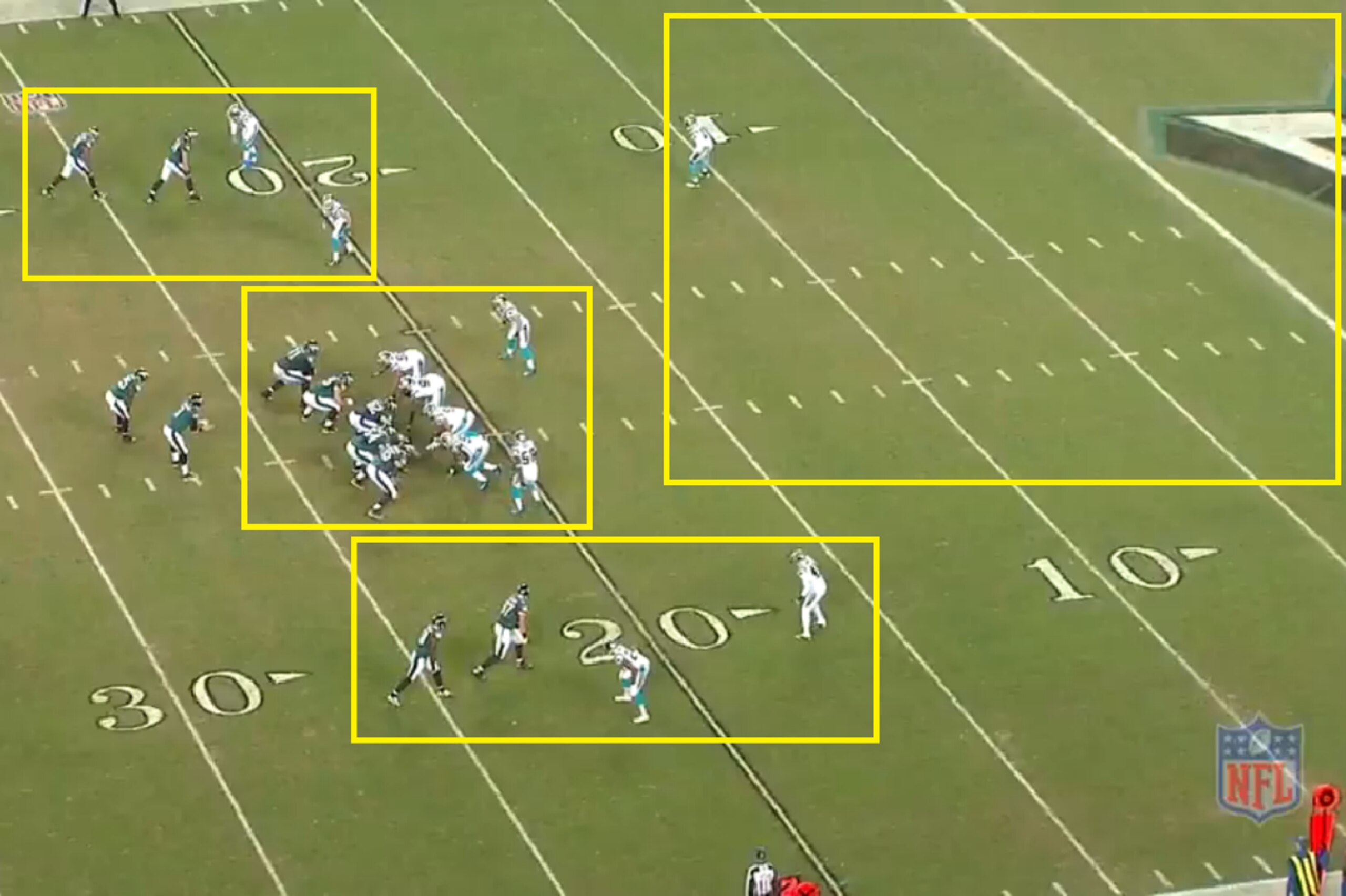
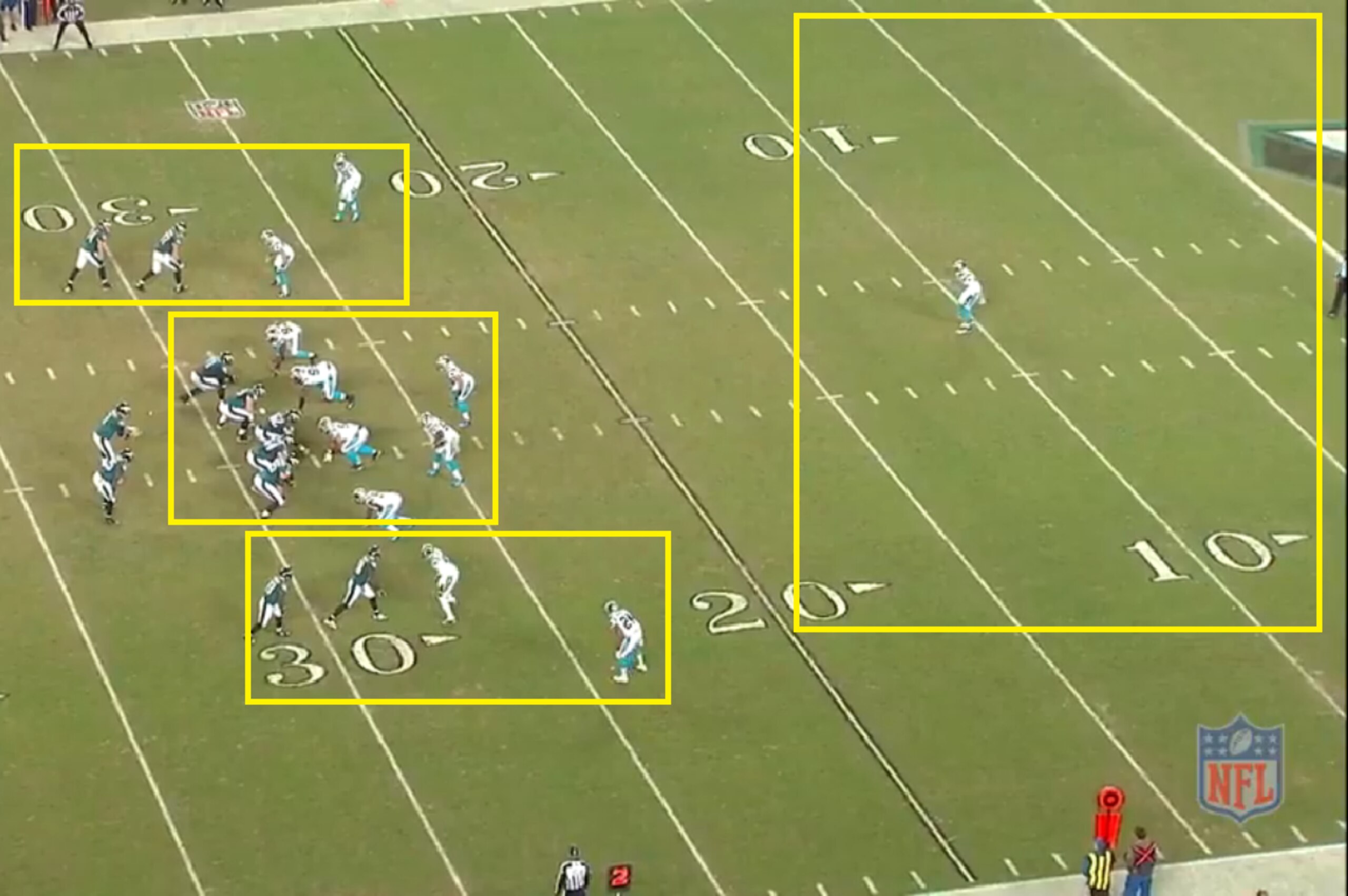
This was a 2nd-and-10 play on Philadelphia's first drive of the game. The Panthers decided to attack the spread formation with an interesting approach: playing tight to the line of scrimmage pretty much across the formation.
The defense was split into easy to read sections for the quarterback. Up high was a safety. Against two receivers on each boundary were two defensive backs, giving the Eagles numbers to win in the short to intermediate passing game. In the box, five Eagle linemen were facing six Panther defenders, giving Carolina the advantage should Philadelphia run the ball.
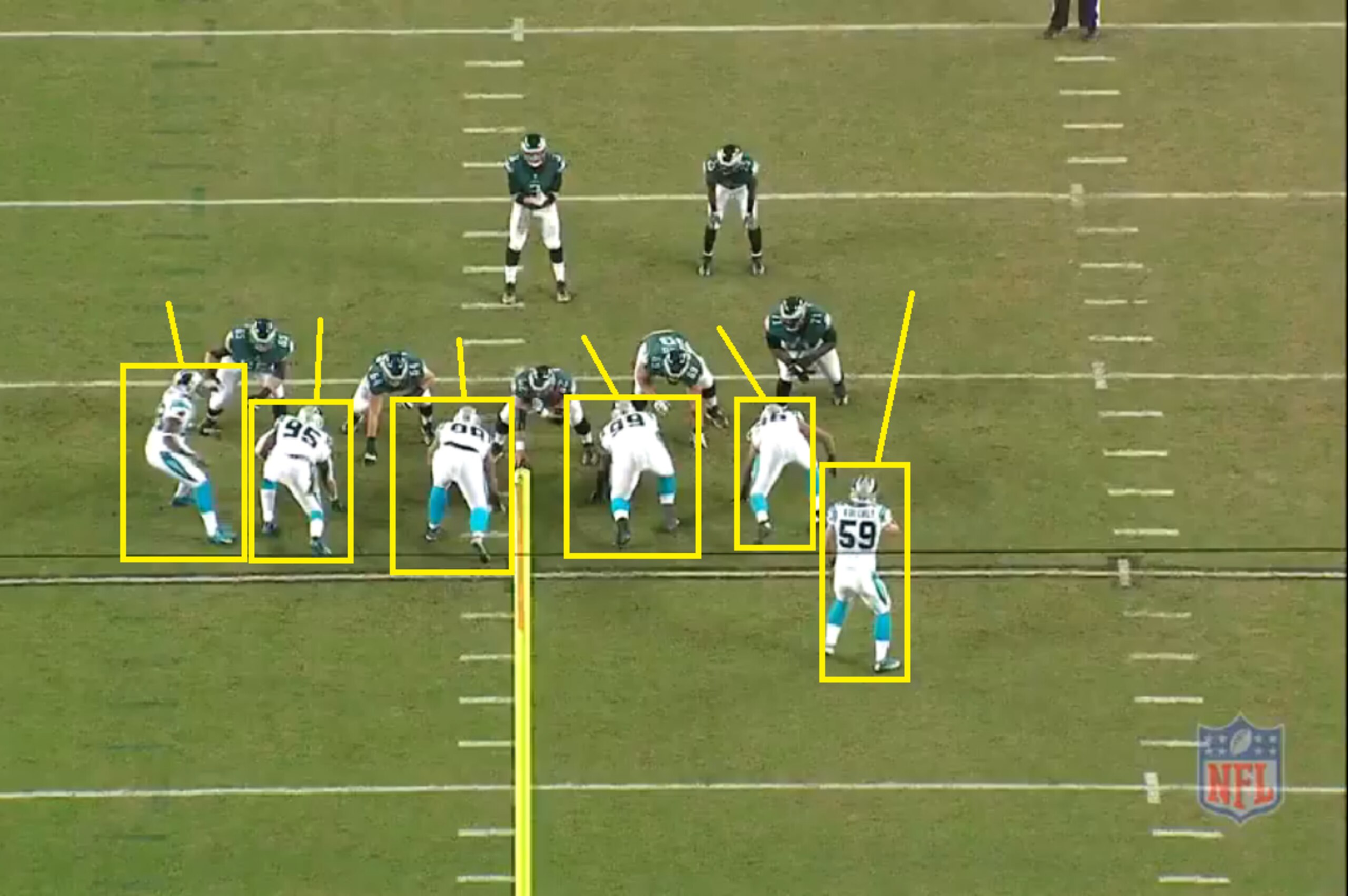
The end zone look gives a good explanation of what Carolina was trying to accomplish in the box. With a man assigned to each gap, and with one more Panther than Eagle accounting for them, Carolina went out of its way to stop the run—even to the point of potentially giving up a big pass play
With four receiver split out, most teams go into a dime defense, with only five men in the box. Carolina went the other way, keeping six men in the box like a nickel defense, which many teams choose to match up against three receiver sets.

The call was for an outside zone run. Despite the numbers disadvantage, the Eagles were going to test the Carolina defense early. The two key defensive players would be the defenders controlling the outside gaps.
On the side to which the play would be run, the linebacker must prevent McCoy from getting outside of him. Meanwhile, the linebacker would be unblocked, allowing him to fill a gap, though he still would be responsible for keeping containment on a cutback.
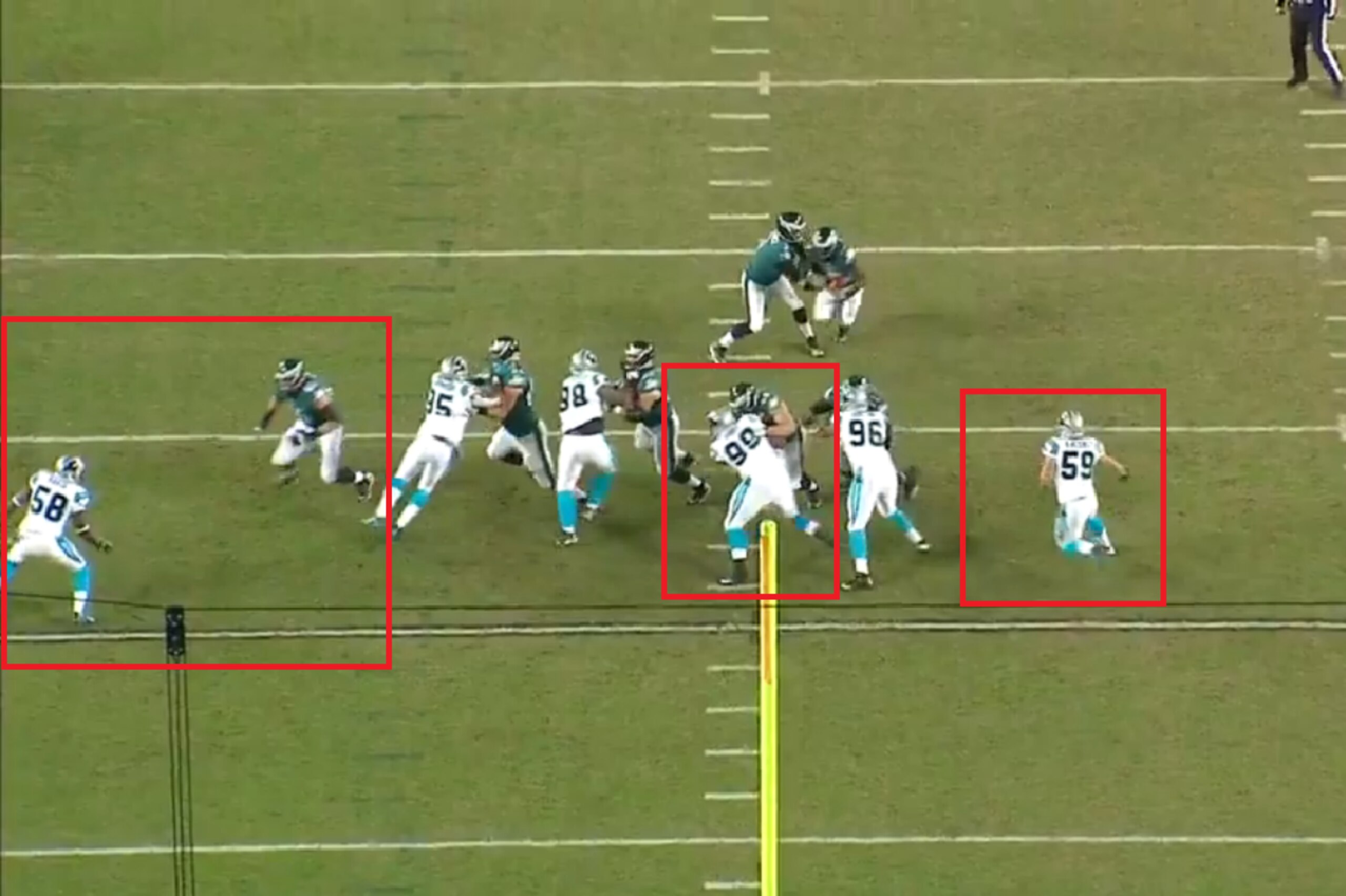
When McCoy got the ball, the play was not looking promising for the Eagles. Carolina had won the numbers game. On the left, the linebacker still had not engaged with an offensive lineman, meaning McCoy couldn't go outside immediately. In the middle, the defensive tackle was closing in on what seemed like the only running lane the back had in the center of the field. On the right, the unblocked linebacker was looking to make a play on any potential cutback.
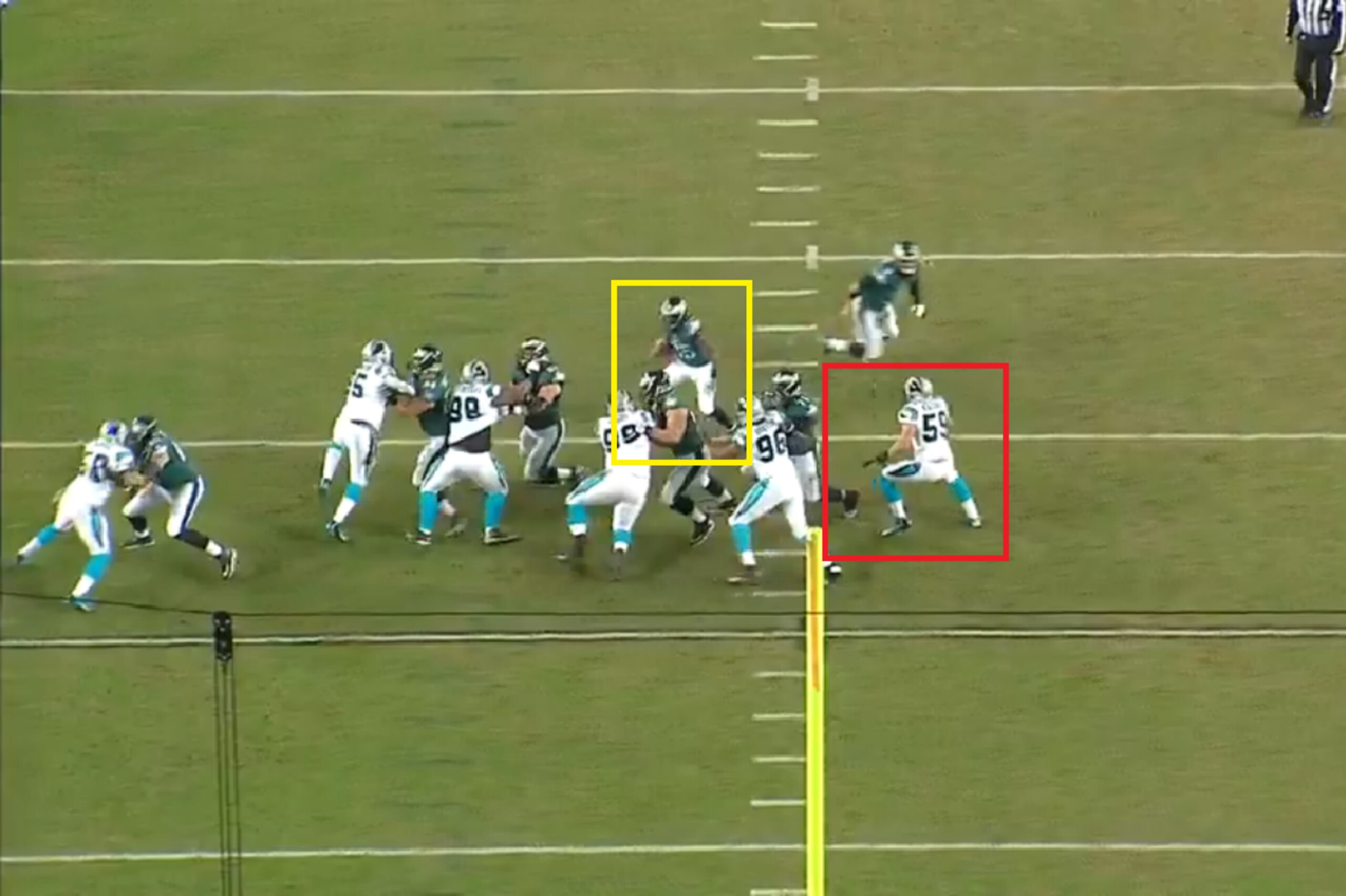
With nowhere to go, the back-side linebacker closed in on McCoy.
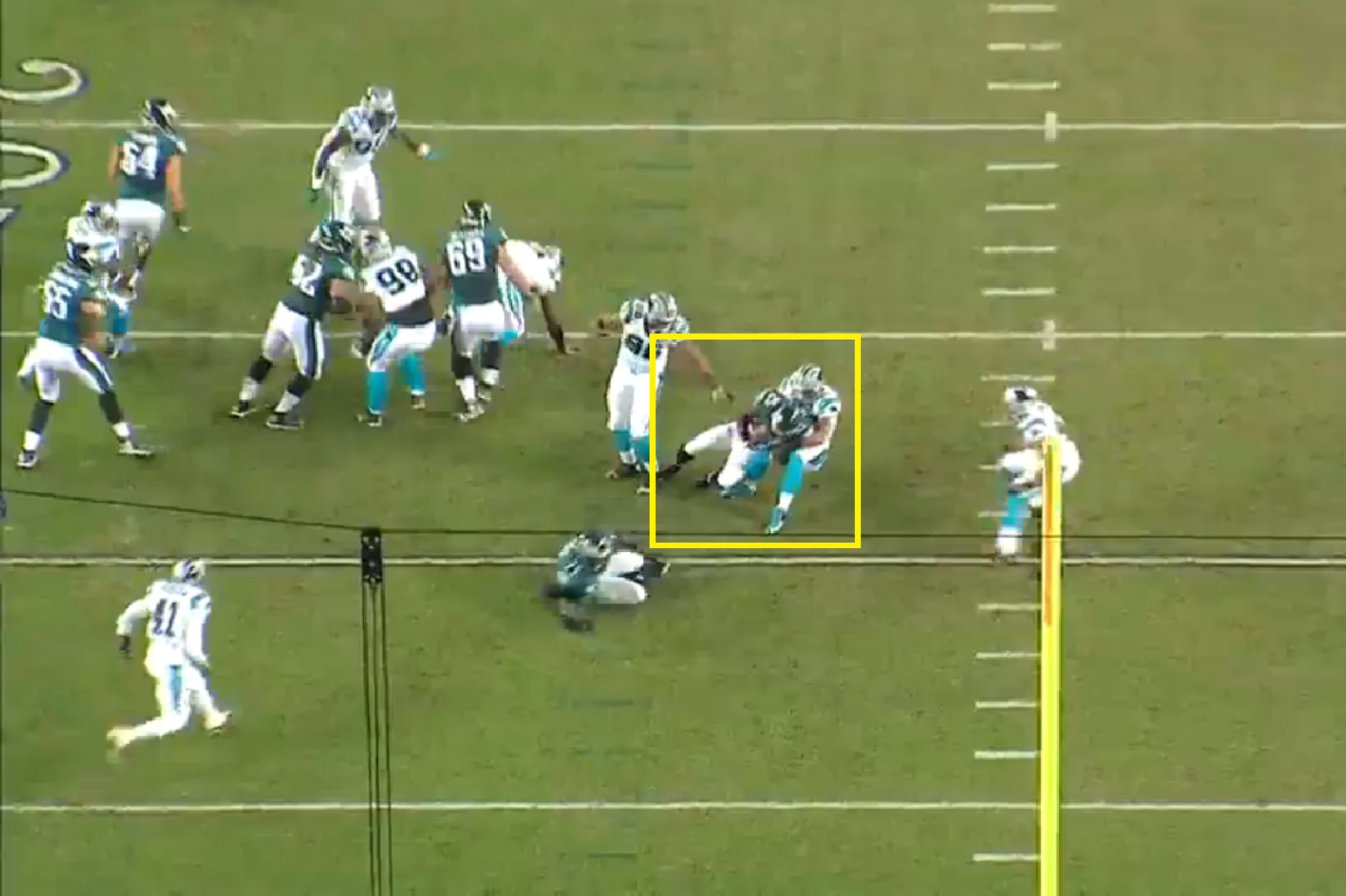
The play resulted in a one-yard gain.
One play does not make a game, though. Realizing the Eagles couldn't win against that front in the run game, head coach Chip Kelly began to call passing plays in that situation.
Above is a play from their second drive of the game. Again, it was at around the same field position and on a second and ten. It was again out of a two-by-two bunch, and Carolina again attacked the offense with one high safety, two DBs on each boundary and six in the box.
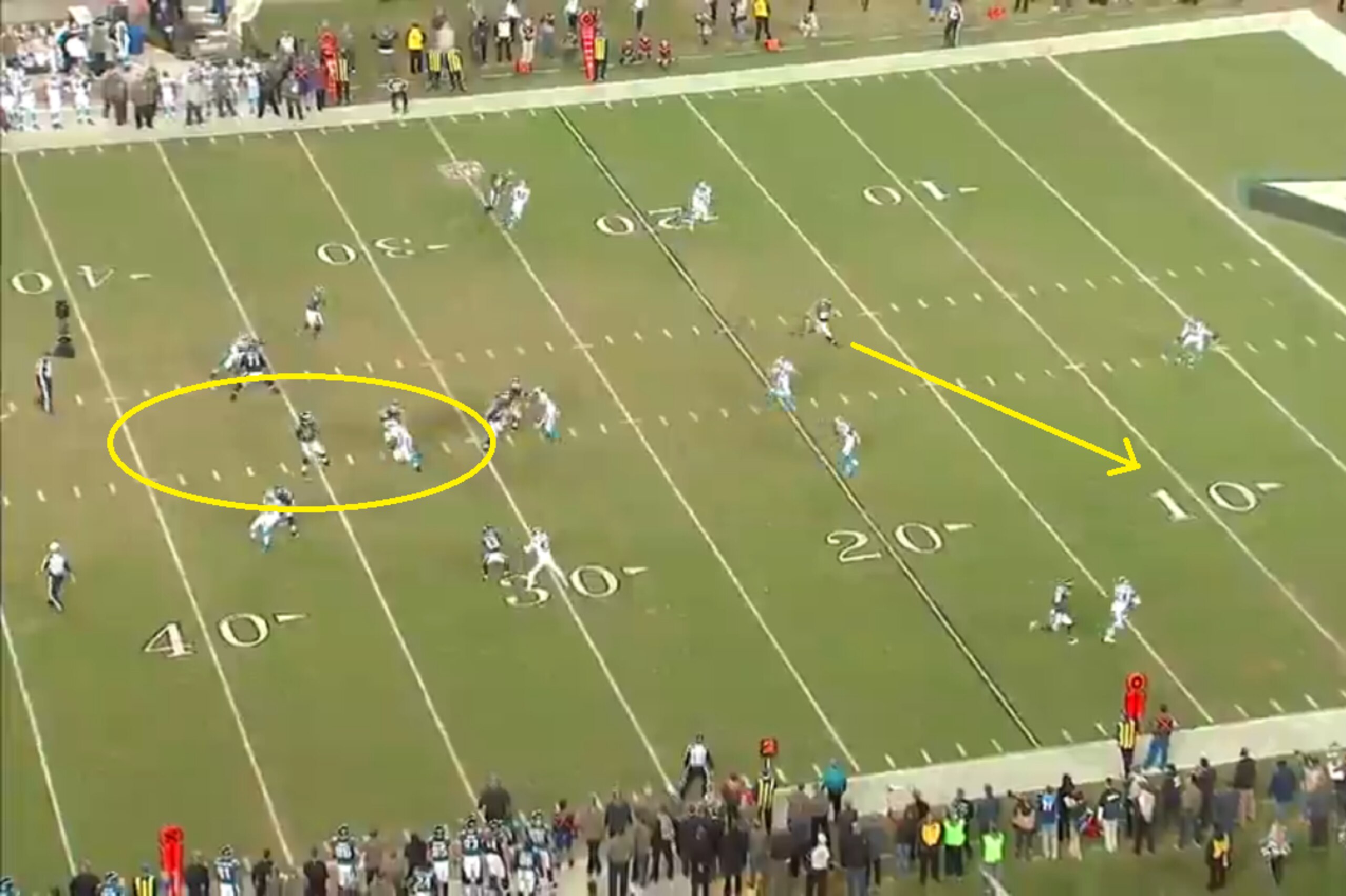
This time, though, the Eagles had the advantage on passes underneath the high safety. The Eagles offensive line was even able to give Sanchez time on the play. Flying across the field, between the first line of Carolina's coverage and the high safety, was an Eagle tight end, ready to make a big play.
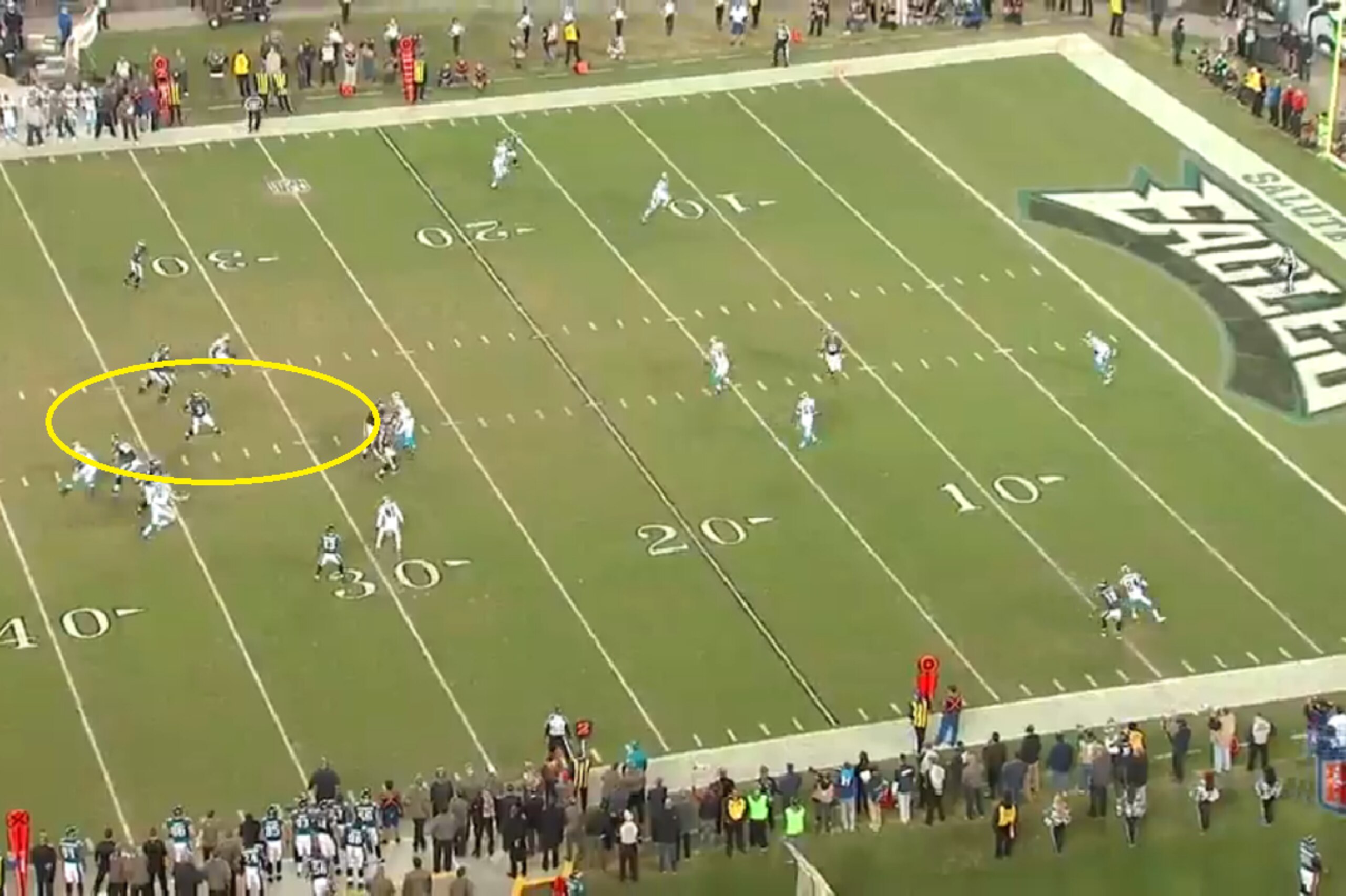
Sanchez stepped up in the pocket to get some space, and with a pocket the size of a 15-foot net, he had all the time in the world to get the ball to his target, who caught the ball inside the Panthers 10-yard line.
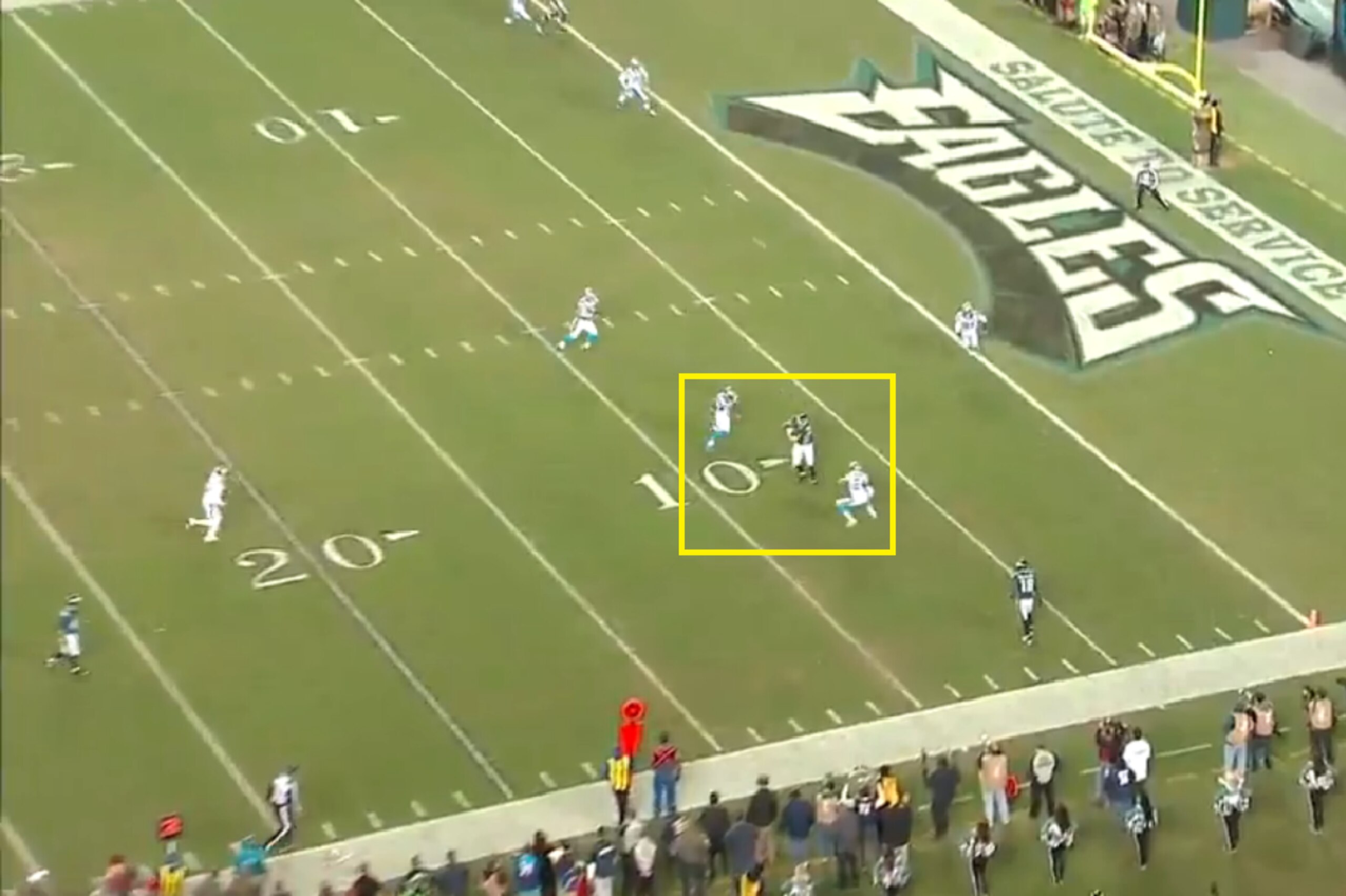
Kelly's offense adapts. Sanchez wasn't proven to be efficient in his first start of 2014, but his offense is built to give him every move to succeed. Carolina didn't choose the wrong defense to attack Philadelphia with, they just didn't execute.
The Packers, who rank fourth in the league in interceptions, have been able to put together 22 sacks over the course of the season and have limited quarterbacks to a 80.2 quarterback rating, making them the sixth-most efficient passing defense in the league.
With likely limited numbers in the passing game due to the number of bodies needed and/or expected in the run game, the Packers will need to be as efficient as possible to come out with a win against the hyperactive spread team.
Luckily, the squad's performance against the pass has warranted hope. With Green Bay's "Nascar" package and Clay Matthews recently playing inside linebacker, the team can get as creative with stopping the Eagles as the Eagles will be when attacking them.
Final thoughts
For Sunday's crucial game against the Philadelphia Eagles, the Green Bay Packers must perform well on both sides of the ball. Their playoff hopes could depend on this game down the line.
On offense, the Packers' offensive line must hold together to give quarterback Aaron Rodgers the time he needs to get off the deep ball. Philadelphia, while good at racking up sacks, isn't the team that can match up well against Green Bay's receivers for very long.
Defensively, the Packers must stack the box to eliminate the run game which NFL teams are so scared of facing when the numbers aren't in their favor. For the Eagles to not take total advantage of the passing game, though, the back end of the defense must step up.
If Green Bay can win those two battles, they have a good shot at coming out of the weekend with a victory, one step closer to clinching a playoff spot.