Can Washington Redskins' Season Be Saved by Ground-and-Pound Offense?
Put yourself in a linebacker's shoes just for a moment. Now imagine you're facing the Washington Redskins circa 2012. You have this super-fast, ultra-athletic quarterback to do deal with, one who could take off at any moment. Not only that, but he's just as likely to hand off to an unheralded bowling-ball-shaped, low-round running back who's deceptively quick and a nightmare to tackle.
Worked out who you'd focus on yet? Not easy is it? That's the bind the Washington Redskins put linebackers and safeties across the NFL in on a weekly basis two seasons ago.
They did it via a ground-and-pound formula combining the dual-threat skills of quarterback Robert Griffin III with the workhorse temperament of bruising runner Alfred Morris.
.jpg?w=2560 "Chargers Mack")
.jpg?w=2560 "Green Bay Steelers Football")
.jpg?w=2560 "Giants Football")
The Redskins led the league in nearly every meaningful rushing category that season and, by no coincidence, finished 10-6 and made the playoffs. Current Washington head coach Jay Gruden needs to revive that formula to save a flagging first season in D.C.

Gruden's Redskins currently prop up the NFC East at 3-6. But with Griffin back in the fold after yet another injury absence, and Morris beginning to show signs of life, the ground-and-pound offense can save Washington.
On their own, neither Griffin nor Morris account for very much in terms of frightening defenses, or at least confusing them. Yet together, they form a potent one-two punch that leaves defensive coordinators scratching their heads for answers, while their players resemble elephants chasing chickens.
That's how things are supposed to work. But it's been tough sledding for Morris without Griffin for most of this season.
He hasn't managed a 100-yard game since Week 10 of last season. Morris' yards and average yards per rush without Griffin in the lineup have been dismal:
| Week | Game | Carries | Yards | Average |
| 3 | Away vs. Philadelphia Eagles | 23 | 77 | 3.3 |
| 4 | Home vs. New York Giants | 12 | 63 | 5.3 |
| 5 | Home vs. Seattle Seahawks | 13 | 29 | 2.2 |
| 6 | Away vs. Arizona Cardinals | 13 | 41 | 3.2 |
| 7 | Home vs. Tennessee Titans | 18 | 54 | 3.0 |
| 8 | Away vs. Dallas Cowboys | 18 | 73 | 4.1 |
Of course, there are some mitigating factors to consider here. For one thing, division foes such as the Philadelphia Eagles and New York Giants are now old hands at combating Washington's familiar zone-stretch run.
It's also fair to say that Morris has encountered some pretty tough run defenses along the way. The Arizona Cardinals and Seattle Seahawks are ranked third and fourth against the run, respectively.
However, those are merely excuses to hide the fact that Morris is not anywhere near as effective when defenses have the freedom to make him the primary focus.
Instead, Morris is a different animal when would-be tacklers have to also worry about a running quarterback. That's been proven by Morris' performances in his last two games when Washington has featured greater mobility under center.
With crafty scrambler Colt McCoy suited up against the Dallas Cowboys in Week 8, Morris rambled for over four yards a carry. Included in that effort was a 29-yard gain at the start of the third quarter, the type of big play this rushing scheme used to produce on a regular basis.
Morris' numbers and effectiveness were even more impressive and obvious in Week 9 against the Minnesota Vikings. Redskins.com writer Brian Skinnell detailed the stats, while also referencing Morris' belief that Griffin helped make the difference:
"While they were on the wrong end of a 29-26 final score against the Vikings on Sunday afternoon, the Redskins' offense, thanks in part to the return of quarterback Robert Griffin III, was able to get things rolling in their rushing attack, which had seen a dip in production in recent weeks as the team went for a more pass-heavy approach.
Totaling 122 yards on the ground, Alfred Morris led the way with a season-high 92 yards of his own, while Griffin III added 24 yards rushing.
...
As the Redskins ground game got rumbling again, Morris doesn’t believe that it was a coincidence it happened on the same game that Griffin III returned to action.
'Especially having Robert back in there – who can run – you throw that back into the mix and teams have to scheme for it, he said. 'If not, he can make them pay and that definitely opens up lanes for running backs.'
"
It's only natural that defenders who are half focused on whether or not Griffin will run, thus paying less mind to Morris, helps create holes and bigger plays for the two-time 1,000-yard runner.
But leaning on the run is also a massive help to Griffin. This is still a young and extremely raw quarterback, one not yet capable of picking apart coverage with his arm.

One of Griffin's major failings is his inability to look beyond his first read and progress quickly to secondary targets. That's the main reason why he often holds on to the ball longer than a back-to-back screening of The Lord of the Rings trilogy.
The reality is that when this running game is clicking, Griffin often doesn't need to look beyond his first read. That's because his primary receiver usually faces single coverage while the bulk of a defense is stacked in the box awaiting another rushing attempt.
Remember how much quicker Griffin got rid of the ball as a rookie? Or the big gains through the air the Redskins created from passing concepts that featured only one or two receivers running patterns?
Both of those things were only possible because of the success of the ground-and-pound offense.
Consider Griffin's first touchdown pass in a Washington uniform, coming in Week 1 against the New Orleans Saints, as the prime example. The play started with the Saints loading the box with eight people by bringing safety Malcolm Jenkins down to stop the run:

Once Griffin faked a handoff to Morris, all eight members of the New Orleans' front keyed in on the run:

That left two receivers against three defensive backs, single coverage on the outside and a deep free safety:
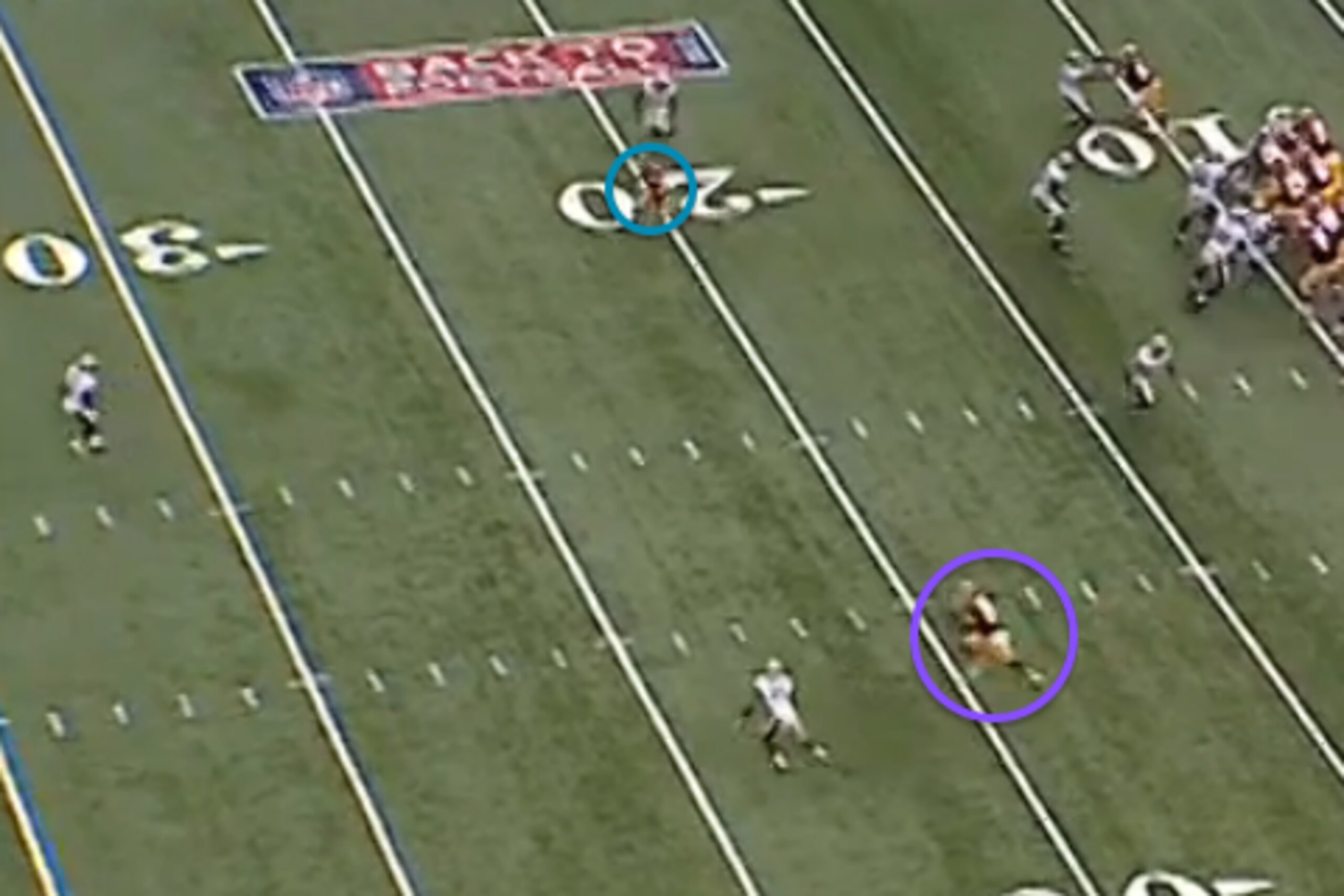
Griffin had an easy throw to make to an in-breaking Pierre Garcon, who promptly turned the catch into an 88-yard score:
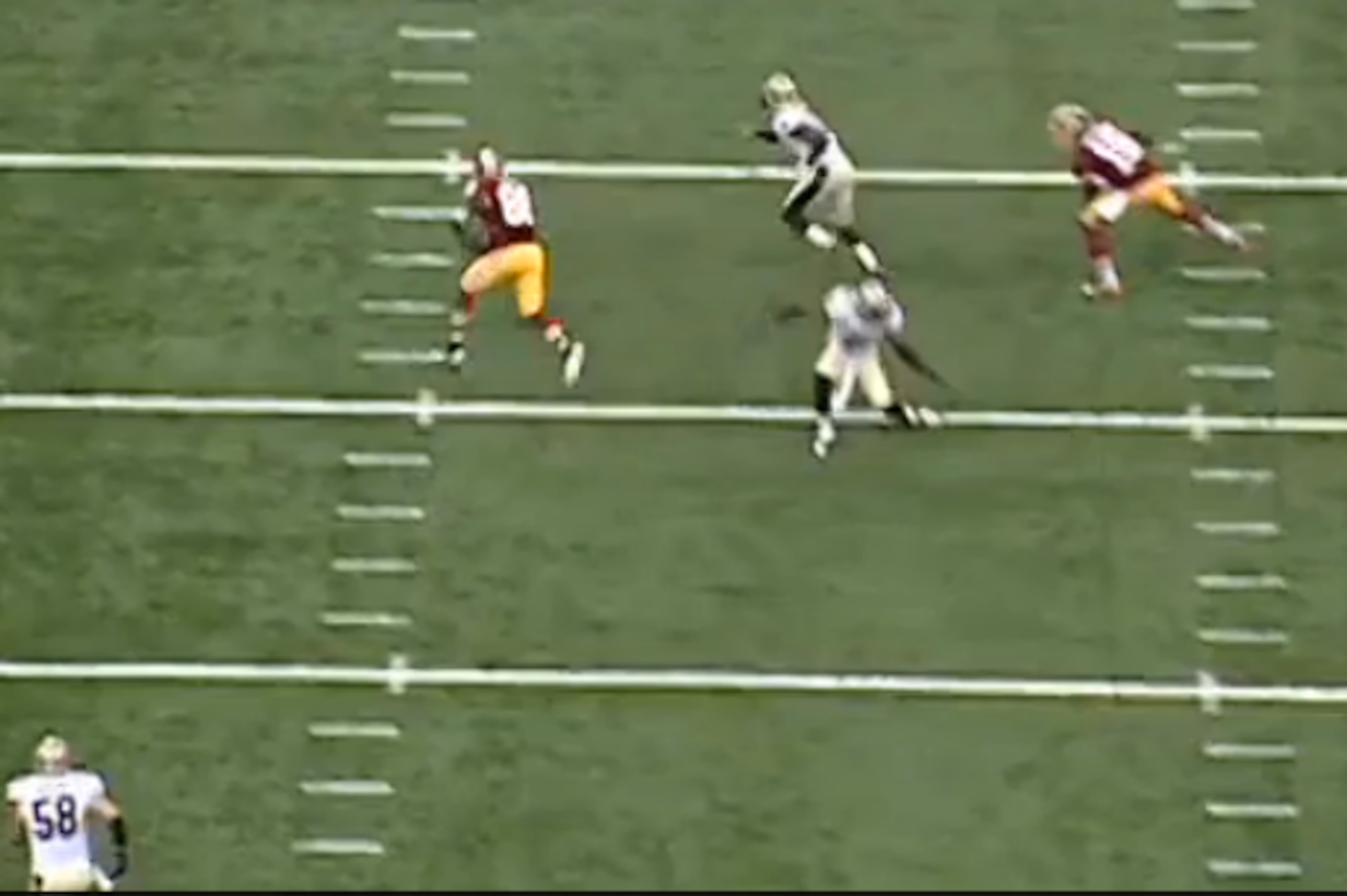
This is the kind of play Washington executed for fun during 2012, exactly the time the running game was leading the way.
Of course, quite a bit has changed since then. Not least, Griffin's health has deteriorated, which naturally poses questions about how much and how well he can still function as a runner.
Naturally, those are tricky questions to answer following surgeries on his knee and ankle since entering the pros. Those issues certainly appear to have limited the speed that once made Griffin so feared.
But Griffin running is not just a physical concern. Choosing the right moments to use his athleticism, and in the process keep defenses honest, has also been a problem.
After the loss in Minnesota, ESPN.com Redskins reporter John Keim detailed this issue:
"With all this consternation surrounding him once again -- how much do teammates love him (not all do); how much do coaches love him (clearly need to see more; 2012 feels like a decade ago) -- Griffin can help himself by elevating his play. And because legs are such an important weapon for him, he needs to improve at knowing when to run, when to unload the ball and when to surrender on a play.
...
One point that needs to be made: Griffin once ran the 40-yard dash in 4.3 seconds. He's used to getting out of impossible situations because of that speed. So, in his mind, his legs can always save him and that's something few can grasp. It powers his mindset. But what those other few do grasp is that the NFL has many fast players and many smart players. They negate that speed by taking good angles or forcing him to cut back to help.
"
Griffin's running should never be purely ad-lib. There have to be some designed plays, such as the planned keeper run against Minnesota, detailed in this article. At full speed or not, Griffin is still an able enough runner that defenses can't ignore the threat.
Yet there's an elephant in the room, and not the one still trying to figure out whether to tackle Griffin or Morris in 2012. In order for the ground-and-pound offense to save this season, Gruden has to let it.
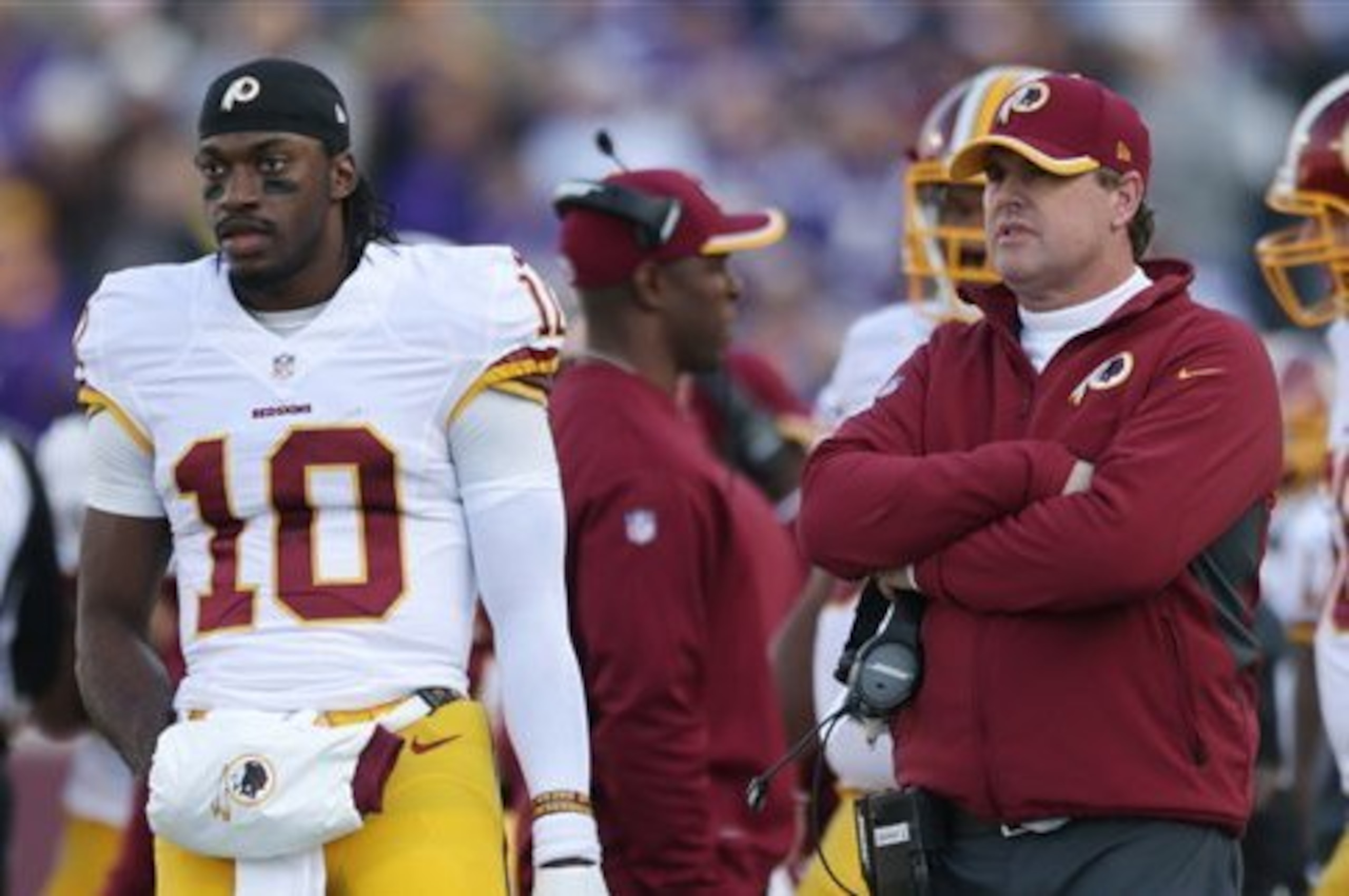
That demands calling a run-first offense. The Redskins are currently 23rd in rushing attempts with just 230 for the season. That breaks down to 25.6 attempts per game, which might be more than many fans would have guessed.
Still, it's not enough. Back in 2012, the Washington offense ranked third with 519 attempts, breaking down to 32.4 rushes per game.
When he looks at both the schedule and his own depth chart, Gruden has little excuse not to call a run-first offense. The Redskins have the Tampa Bay Buccaneers, St. Louis Rams and Giants left on the schedule. That trio rank 18th, 24th and 32nd against the run, respectively.
It's not as if Gruden doesn't have the weapons to exploit those failings. Even putting aside dynamic duo Griffin and Morris, Roy Helu Jr. and fullback Darrel Young are both very capable ball-carriers.
Gruden has to lean at least as heavily as the 2012, Mike Shanahan-led staff did on this running game. The benefits are too wide-reaching not to.
A heavy dose of the run means a more confident Griffin able to make quicker throws against undermanned coverage schemes. It also means more big plays for Morris against defenses forced into playing "Guess Who?" every snap.
Greater efficiency on third down—Washington converted 42 and 46 percent against the Cowboys and Vikings—is more than just a cherry on top of the cake.
If Gruden lets Morris and Griffin do what they do best, a ground-and-pound offense can quickly reverse the trend of losing that has plagued Washington since 2012.
All statistics via NFL.com.
All screen shots courtesy of Fox Sports and NFL.com Game Pass.
.jpg?w=2560 "Seahawks Cardinals Football")
.jpg?w=2560 "Commanders Cowboys Football")