Washington Redskins vs. Dallas Cowboys: Breaking Down Washington's Game Plan
Jay Gruden's Washington Redskins can score an upset road win over the suddenly resurgent Dallas Cowboys by committing to two simple concepts on both sides of the ball.
Defensively, the plan has to revolve around slowing down prolific running back DeMarco Murray. That has to come at the expense of corralling some of the Cowboys' other notable weapons.
On offense, the unit led by Colt McCoy must target the Dallas safeties and linebackers in coverage. In particular, tight ends Jordan Reed and Niles Paul must be primary features of this week's game plan.
TOP NEWS
.jpg?w=2560 "NFL Paris Football")
NFL House in Paris Closes for Protests
.jpg?w=2560 "Seahawks Chiefs Football")
Trevon Diggs Cut by Seahawks
.jpg?w=2560)
B/R's Expert Week 7 NFL Picks 🔮

Let's take a closer look at some of the things the Redskins can do in Texas on Monday night, beginning with the McCoy-led offense:
Exploit Dallas Linebackers and Safeties
Gruden and offensive coordinator Sean McVay must unleash Reed and Paul at the second level of the Dallas defense. This will take advantage of the Cowboys' preference for playing a lot of 2-Man coverage.
Simply put, this involves man coverage on the outside and underneath, seemingly protected by a deep shell of two safeties. With the corners rarely straying from their assignments and the safeties so deep, the Cowboys leave their linebackers on islands in underneath coverage.
That's an obvious matchup advantage for a team with talented "move" tight ends. In Week 7, the New York Giants put this theory into practice and enjoyed plenty of success.
In the first example, Big Blue quarterback Eli Manning targeted Larry Donnell in space in the seam. Notice how the Giants had spread out the Dallas defense with slot receivers:
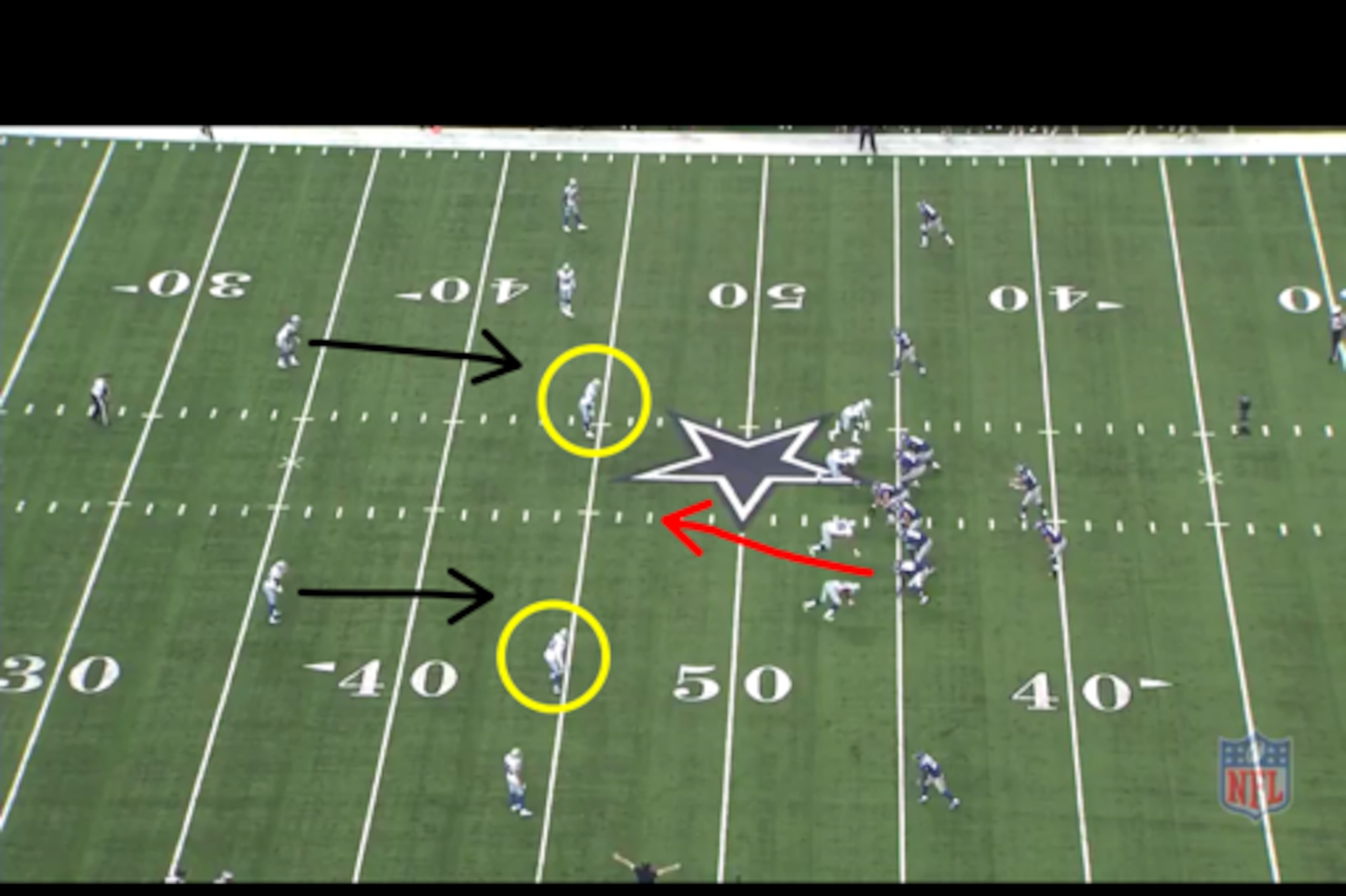
This drew linebacker attention and stretched the middle of the formation. That obviously left an inviting gap in the middle. Notice also how far off the safeties began this play.
The Giants executed a play-action fake between Manning and Peyton Hillis. This encouraged middle linebacker Rolando McClain to peek into the backfield, allowing Donnell a clean release into the exposed middle:
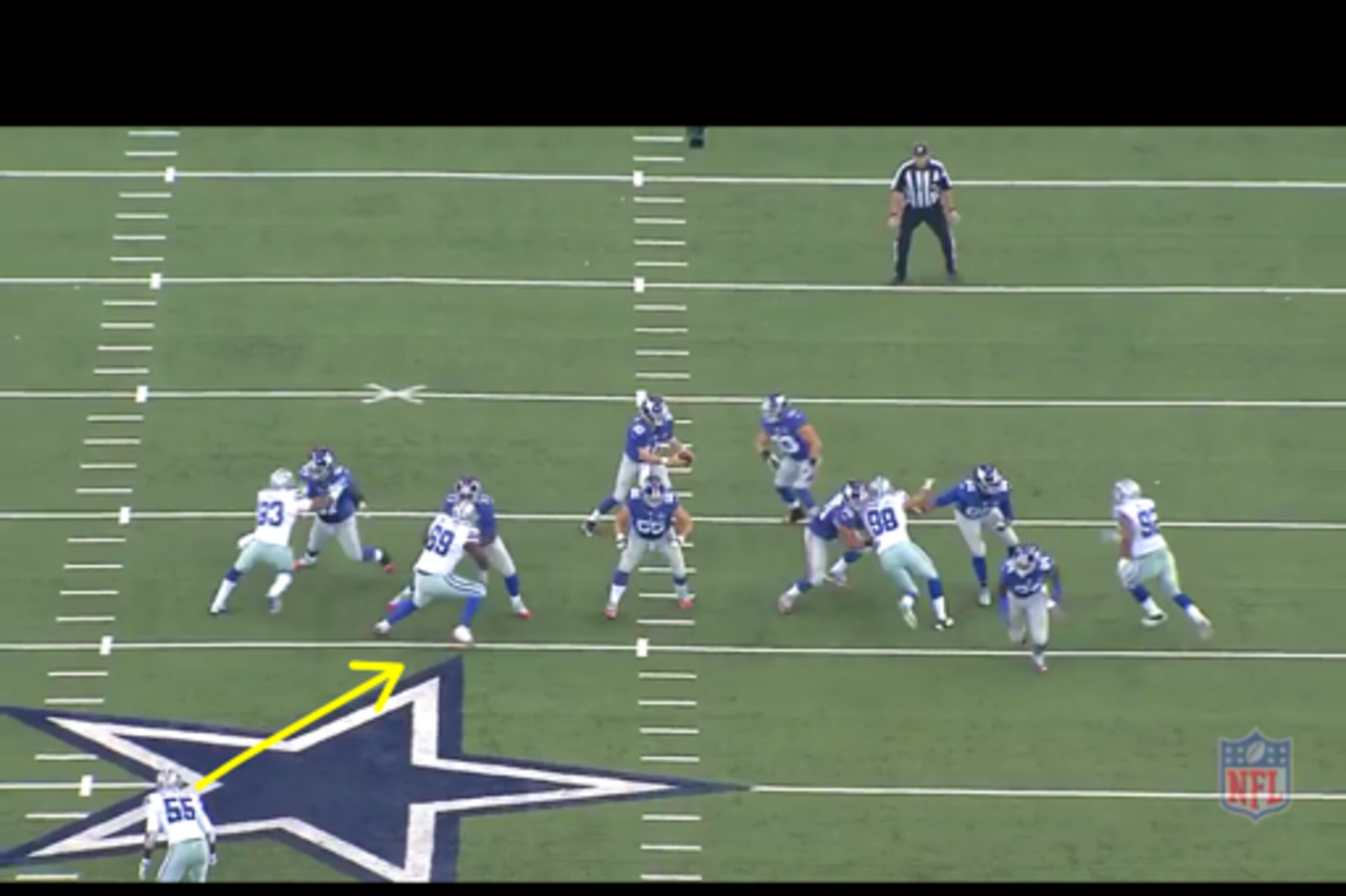
From the overview, it's easy to see just how open Donnell got in the chasm-like space between the Dallas linebackers and safeties:
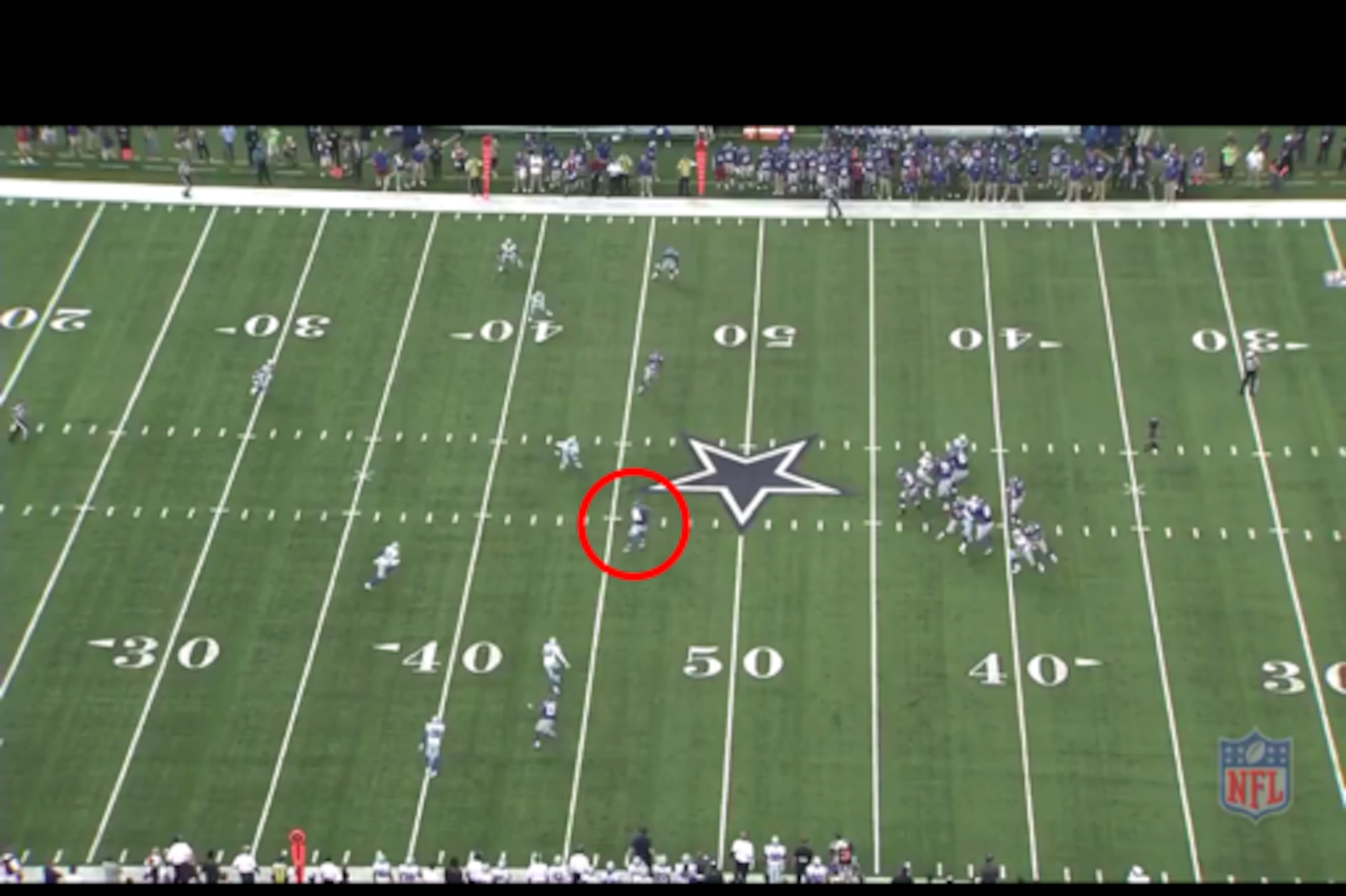
That gave Manning a simple throw to make. McClain and the safeties were too far away to prevent the pass or make a quick stop on the tight end:

Donnell promptly turned upfield and gained 16 simple yards.
This play should appeal to Washington's coaches. Not only can either Reed or Paul thrive in this design, it's also a concept built off a run fake and play-action passing.
Those are core elements of the Washington offense. They are often combined with a bootleg from the quarterback to roll away from pressure.
The Giants later used this exact combination for an even bigger play. On 1st-and-10, the Giants showed "12" personnel, one running back and two tight ends, Donnell and Daniel Fells:

Manning again ran a fake, this time to rookie running back Andre Williams. This drew all three Cowboys 'backers to the line:
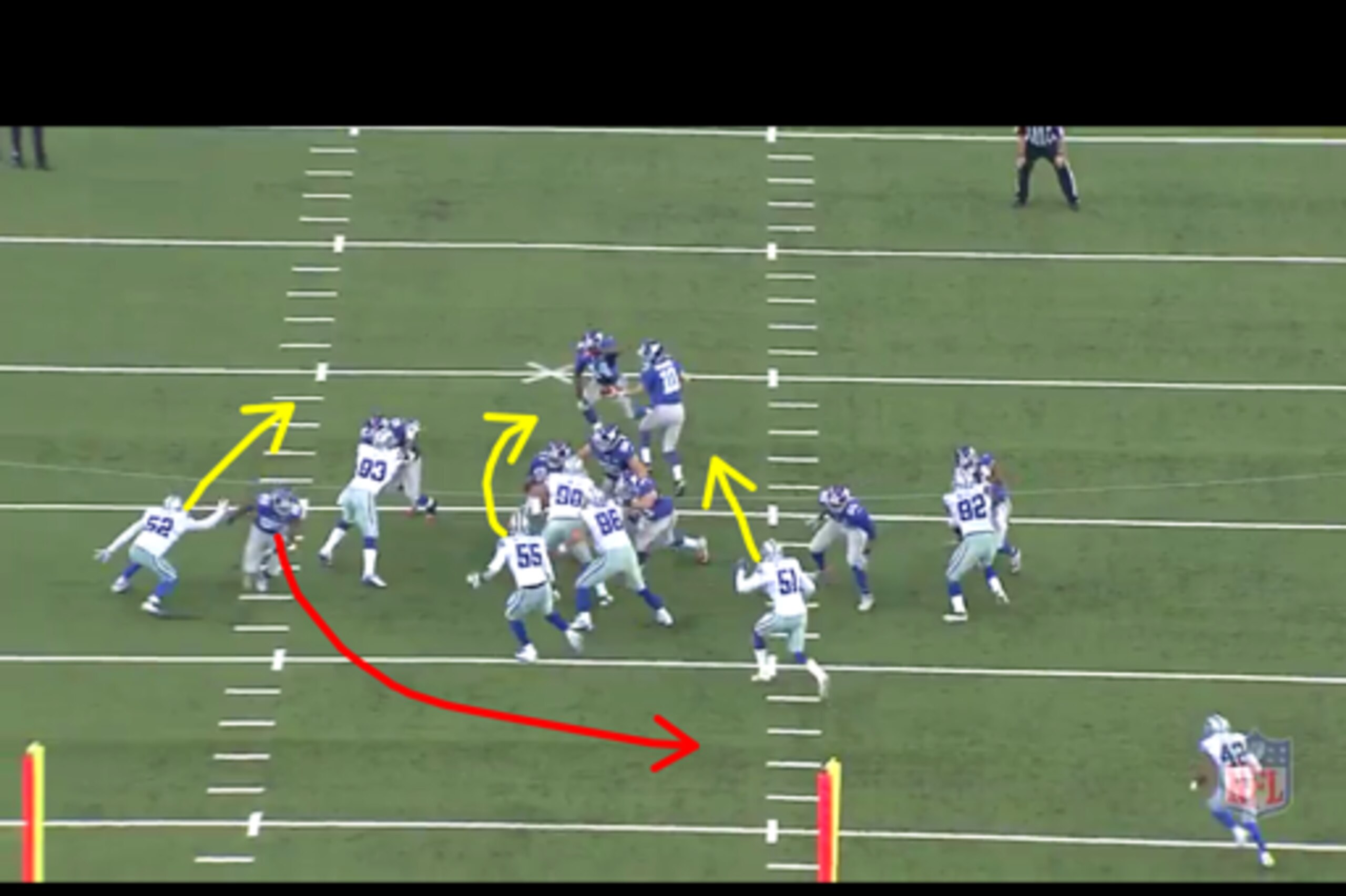
As they overplayed the run, Fells crept off the line and drifted behind the linebacker level and across the field.
The run had even brought safety Barry Church (42) down into the box. As Fells moved behind the run defenders, Manning rolled out, moving the pocket in the process:
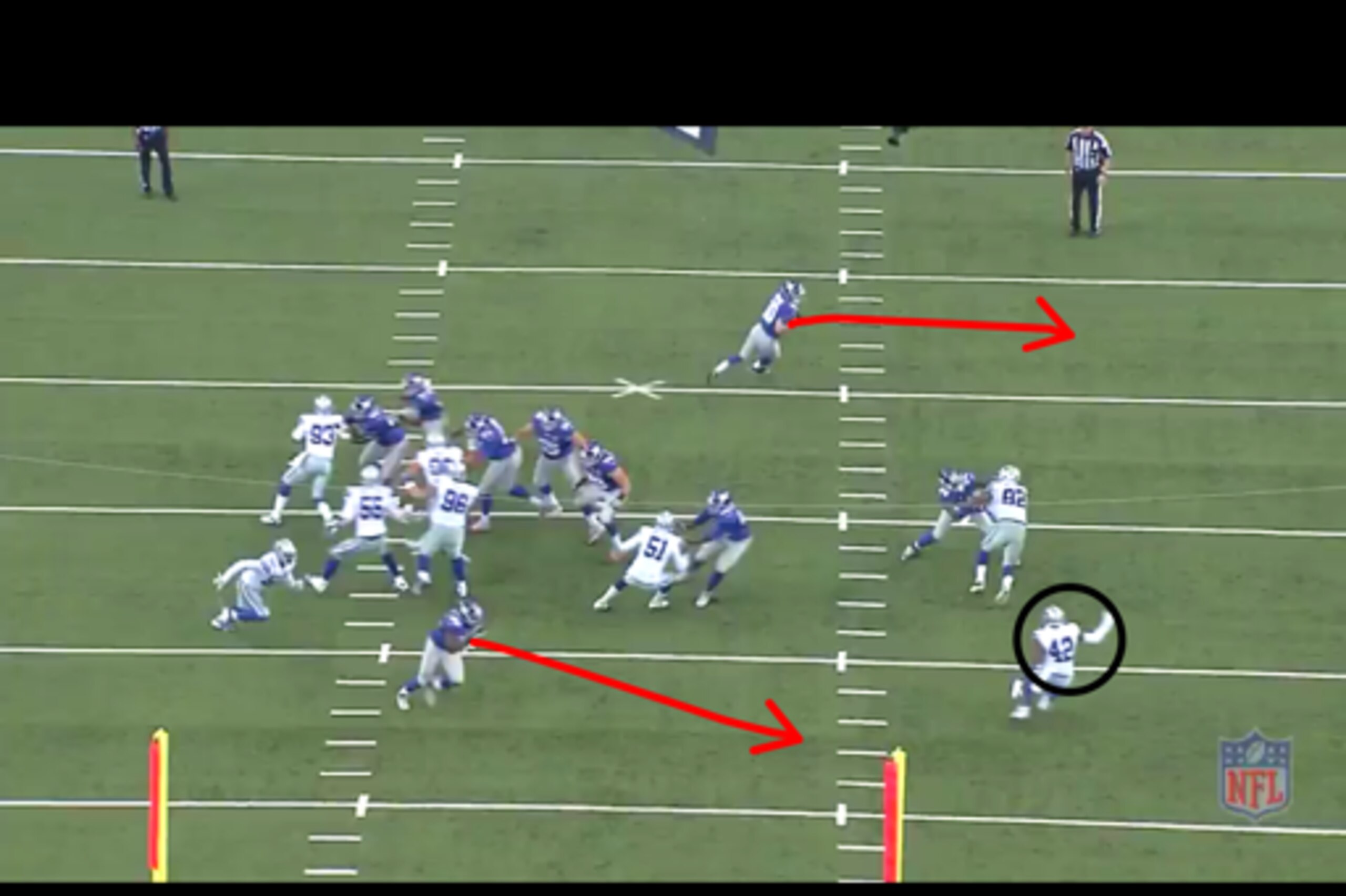
Taking another overview, you can see how Fells was wide-open in the middle. Although they bit on the run fake, the Cowboys still kept one safety deep. But he was too deep to close on Fells:
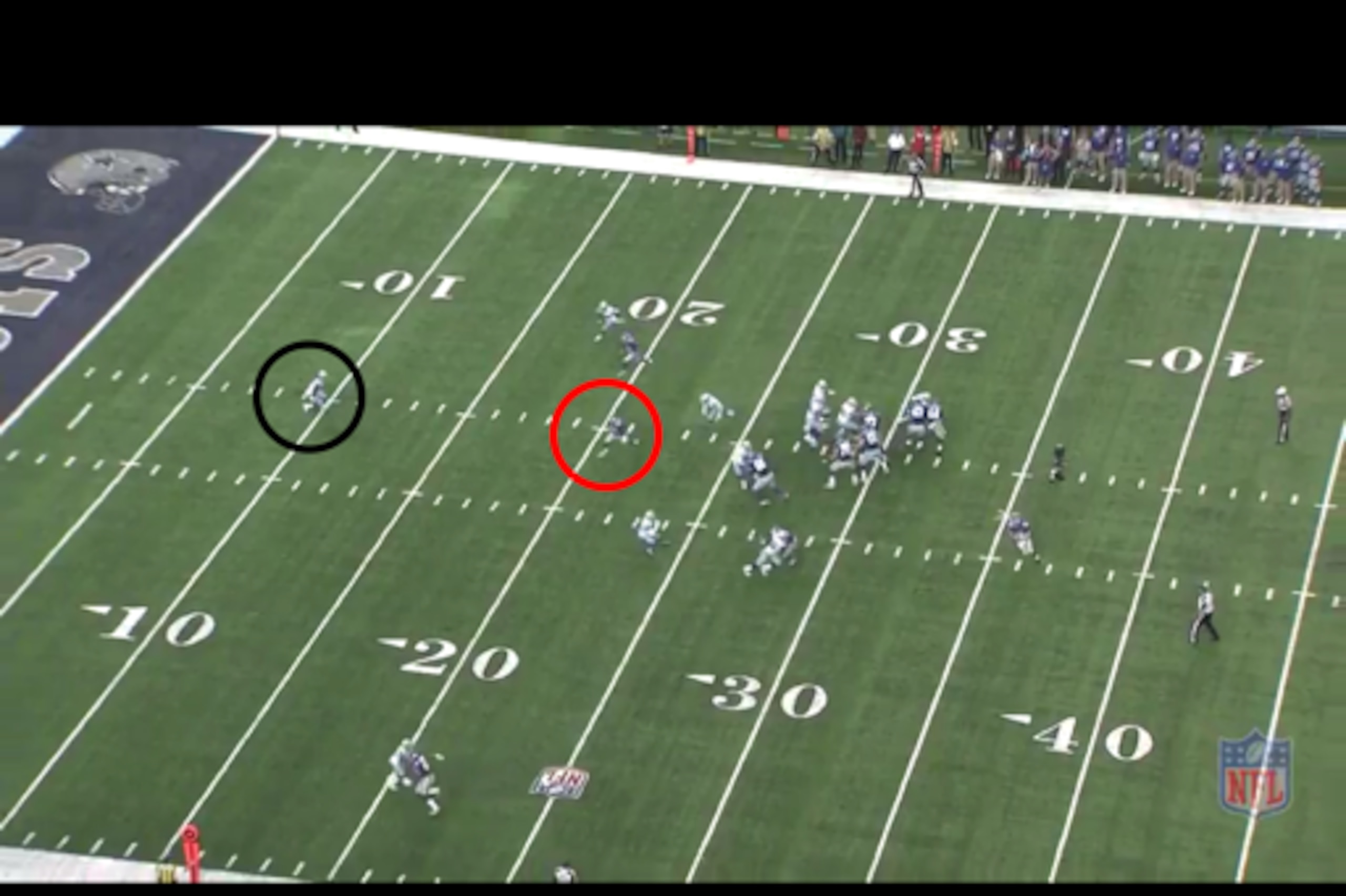
Manning flipped the ball to his tight end who then ran through feeble tackling to complete a 27-yard touchdown connection:
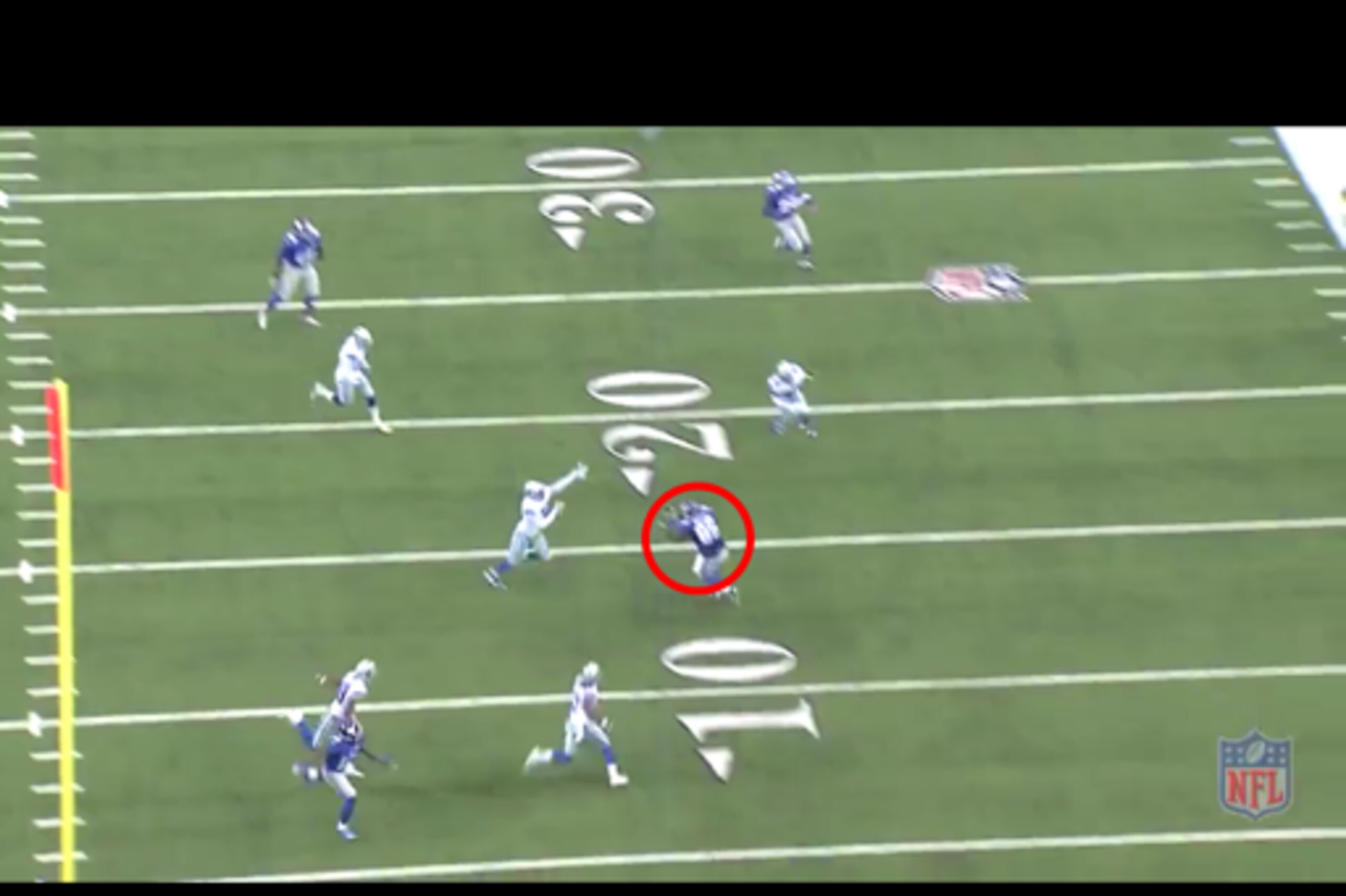
While they were comprehensively fooled on this play, it wasn't the last time the Cowboys were exposed by a run fake and an athletic tight end.
In the third quarter, New York used that same combination, this time from a shotgun look. Donnell began this play lined up in the backfield.
He would attack the Cowboys on a vertical seam pattern. Again, notice how far off the two safeties aligned:
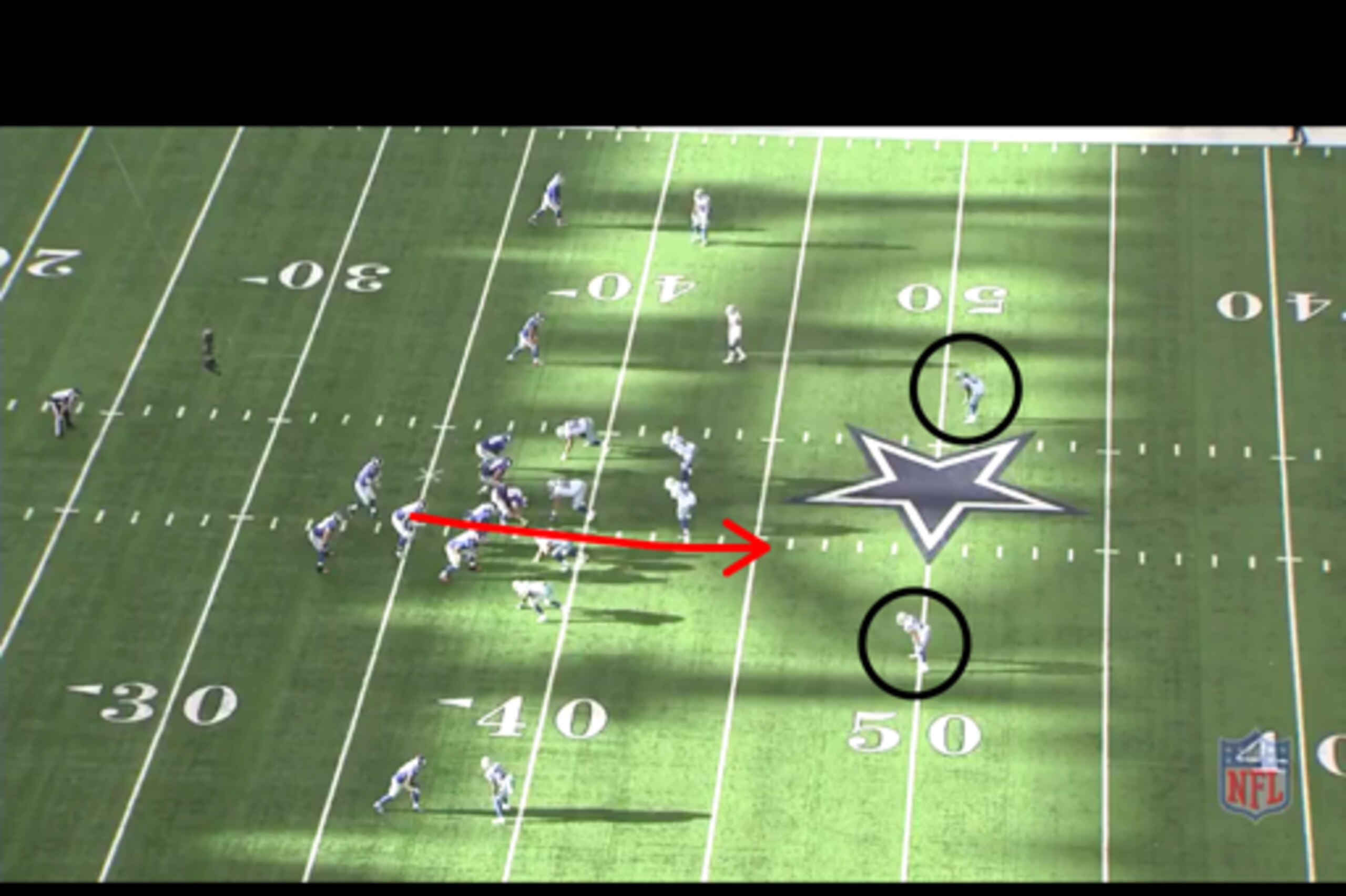
Manning ran another fake and the Cowboys again fell for it. One deep safety joined the linebackers to repel the supposed run:
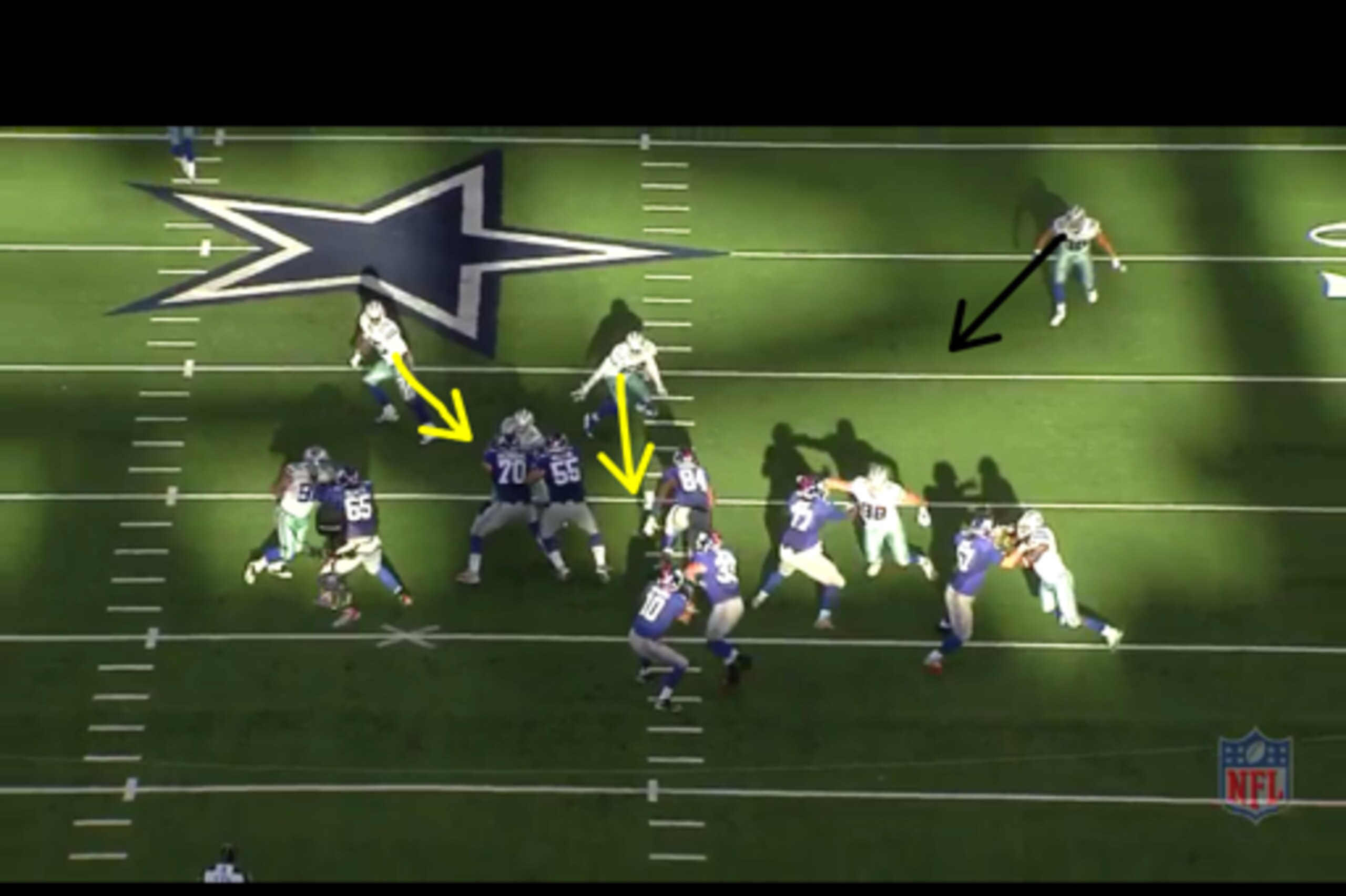
That left Donnell isolated against a linebacker. He quickly won this obvious mismatch:

With the single-high safety too far off to rotate over the top and take away Donnell's route, the tight end made the grab for 21 yards:

Washington has exactly the right players to follow this formula and exploit the Cowboys' overly aggressive pursuit defense.
Because the safeties begin most plays so deep, the middle zones behind the linebacker level are often wide-open. No Cowboys linebacker can stay with either Reed or Paul in coverage.
It also helps that the Cowboys have something of an inferiority complex when it comes to their ability to stop the run. Coordinator Rod Marinelli's unit isn't particularly big up front, so it often needs safety help in the box.
But a problem of relying on safeties rotating from so far away is they have to make snap decisions to cover the distance between themselves and the line of scrimmage. That means they can be fooled by play-action fakes.
The Cowboys try to compensate by regularly cheating linebackers into gaps and are often very eager to read run, trusting quick pursuit to mask a lack of physicality.
The style of the Cowboys defense and its 16th ranking against the run is great news for Gruden. It means Dallas defenders will still be wary about the threat from Alfred Morris, despite the running back's recent struggles.
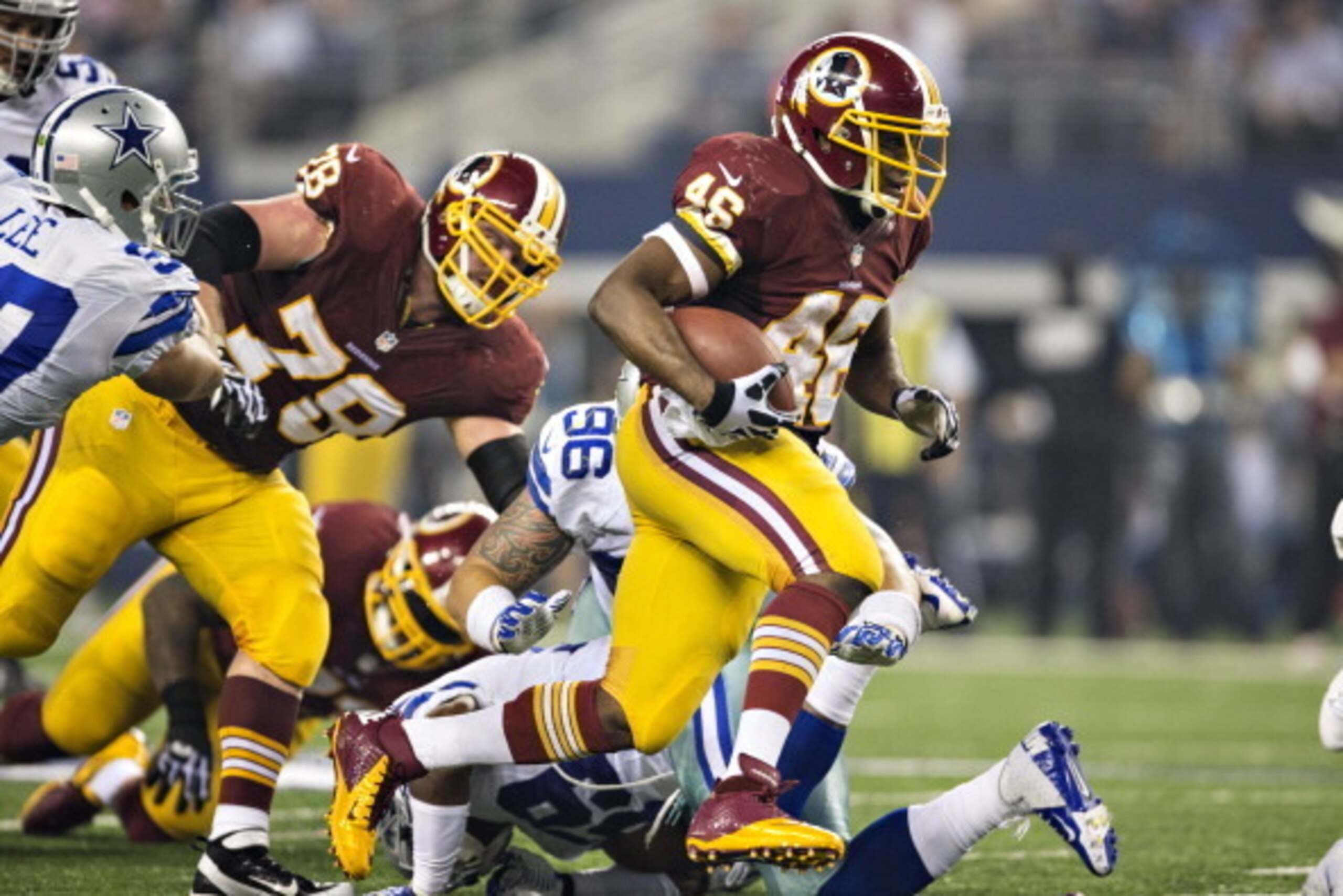
Morris' woes are beginning to irk Gruden, but the coach is not ready for a change, per CSNWashington.com reporter Tarik El-Bashir:
"Morris is definitely struggling. He’s averaging 3.8 yards per carry this season after averaging 4.6 in 2013 and 4.8 in 2012. That’s a problem. Roy Helu on the other hand is averaging a career best 5.4 yards per carry on 25 attempts, which is a fraction of Morris’ 115. But they are different types of runners and they’re deployed in different situations. So it’s not an apples to apples comparison. But I can tell you this: Gruden seems to be losing his patience with the stagnant running game. 'Where do you want me to start?' he said Monday, asked what’s wrong with the ground attack. But after saying Morris has missed some cutback opportunities in addition to numerous other systemic breakdowns, Gruden also gave Morris a vote of confidence, saying, 'We still like Alfred. We still feel like he’s going to carry us to where we need to go.' So it doesn’t sound to me like making a change is even in the discussion.
"
Gruden's rather hollow-sounding vote of confidence in this team's two-time 1,000-yard rusher is timely. ESPN.com Redskins reporter John Keim has detailed exactly why the running game can and must work in Dallas:
"It’s crucial for Washington to do better on its early downs against Dallas. It’s not just about keeping the Cowboys’ offense off the field; they can score in a hurry, though they often dominate time of possession because of their ground game. It’s also about putting the Redskins’ offense in better third-down situations and helping themselves in the red zone. Also, regardless of whether it’s Colt McCoy (likely) or Robert Griffin III at quarterback, a strong run game is needed to lessen the burden.
"
Fortunately for Washington, Dallas allows 5.29 yards per carry on first down (30th in the NFL) and gives up 4.93 per carry overall (29th). However, don’t be fooled: The one game Dallas was truly hurt on the ground was versus Houston, which rushed for 176 yards on 31 carries. The Cowboys have given up long runs, however, with six of more than 20 yards (tied for 26th in the NFL). Those runs have totalled 193 yards (28th in the NFL).
Morris can not only keep the Dallas D honest, he can also create room off play action for Reed and Paul to exploit the middle. If the two roving playmakers don't both enjoy huge games in Dallas, something will be very wrong with this week's game plan.
Of course, Washington's coaches will also pay a lot of attention to the production of the running back on the other side of the field.
Stack the Fronts to contain DeMarco Murray
Apologies if you're looking for anything particularly creative here. The truth is there's no magic formula or reinventing of the wheel needed to stop Murray.
Instead, it will take a commitment of both numbers and sound fundamental football to contain the runner who has started this season with seven straight 100-yard games.
In terms of numbers, it will be vital to stack the defensive fronts by loading the box. The Seattle Seahawks provided a good template for this in Week 6.
On this 1st-and-10 run, the Seahawks stacked a defender on both ends of the line of scrimmage. Safety Kam Chancellor was the eighth man:
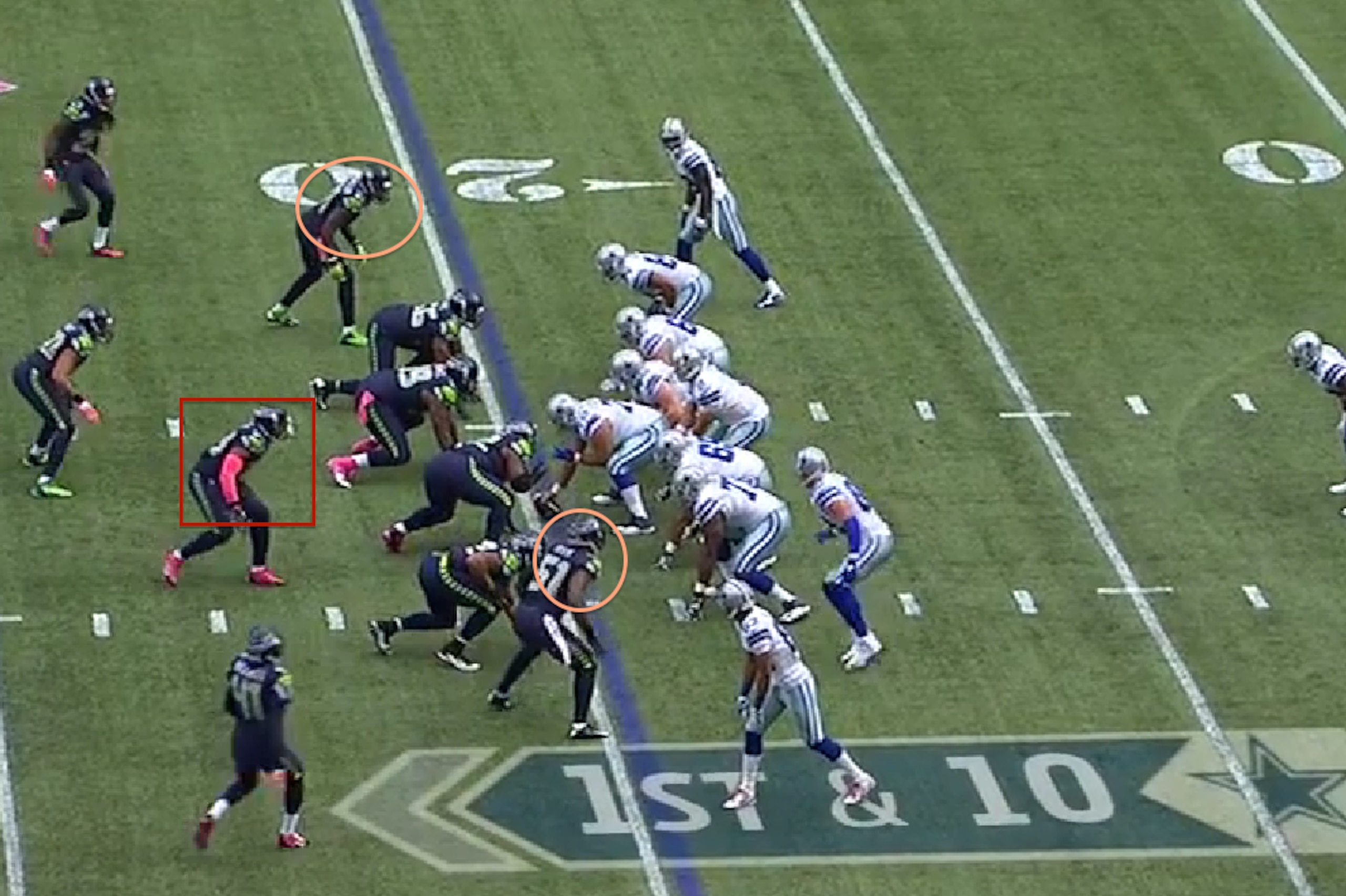
This look matched the Cowboys' balanced, two-tight end set, leaving Murray with no obvious strength to run behind.
In the next look, the Seahawks again used Chancellor (circled) to create an eight-man front:
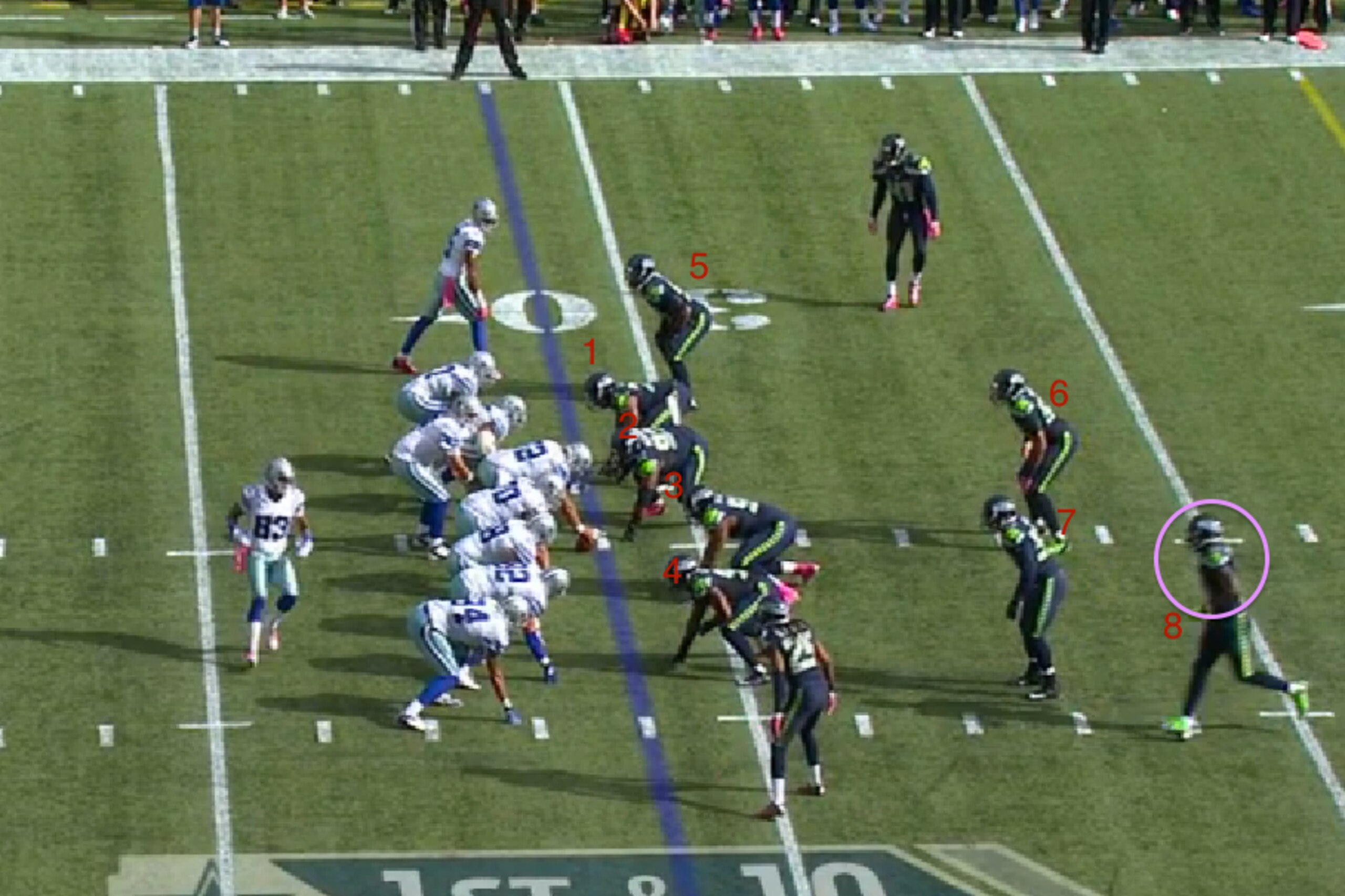
They did the same thing against a standard I-formation look. Chancellor is circled in a de facto linebacker alignment:
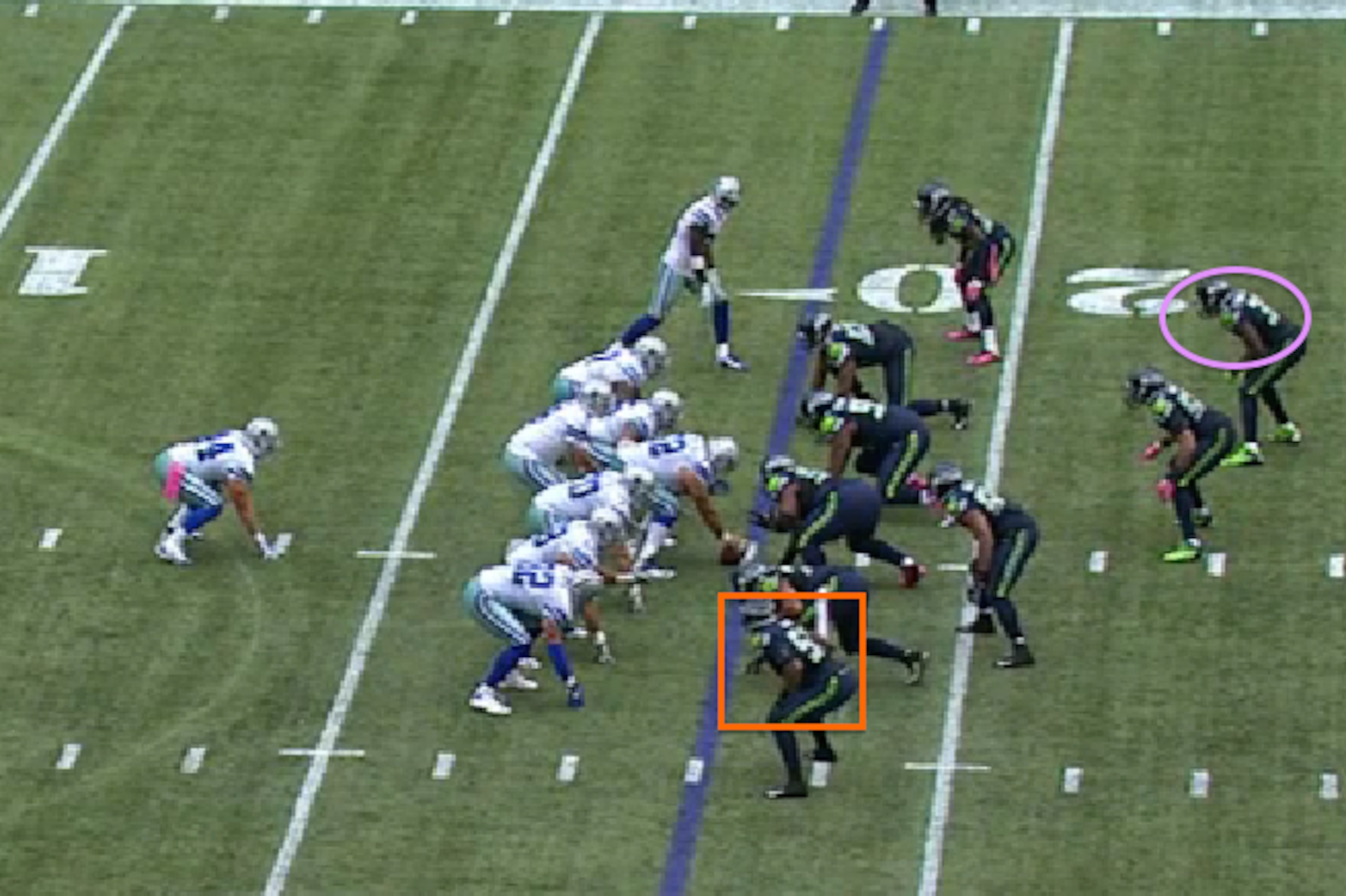
Notice how Seattle stacked a linebacker over tight end Jason Witten. Again, the Seahawks matched the strength of the Dallas formation. The idea is to force Murray toward the eighth man.
Depending on how he aligns his edge defenders, specifically the cornerbacks, Washington defensive boss Jim Haslett can add even more bodies to the front.
Take a look at this alignment from the Seahawks:

Notice how the Seahawks rolled both of their cornerbacks up to line of scrimmage. This essentially gave the defense a 10-man front. As good as Murray is, and he's every bit as good as advertised, few runners in the league can thrive against this heavy a run front.
Rolling the cornerbacks up could serve two purposes for the Redskins. The basis of the Dallas offense this season has been to let Murray soften up a defense before quarterback Tony Romo launches deep strikes to wide receivers Dez Bryant and Terrance Williams.
Haslett should let young cornerbacks David Amerson and Bashaud Breeland use aggressive, press techniques against Bryant and Williams. At 6'1", 205 pounds and 5'11", 197 pounds, respectively, both Amerson and Breeland have the size to make this scheme work.
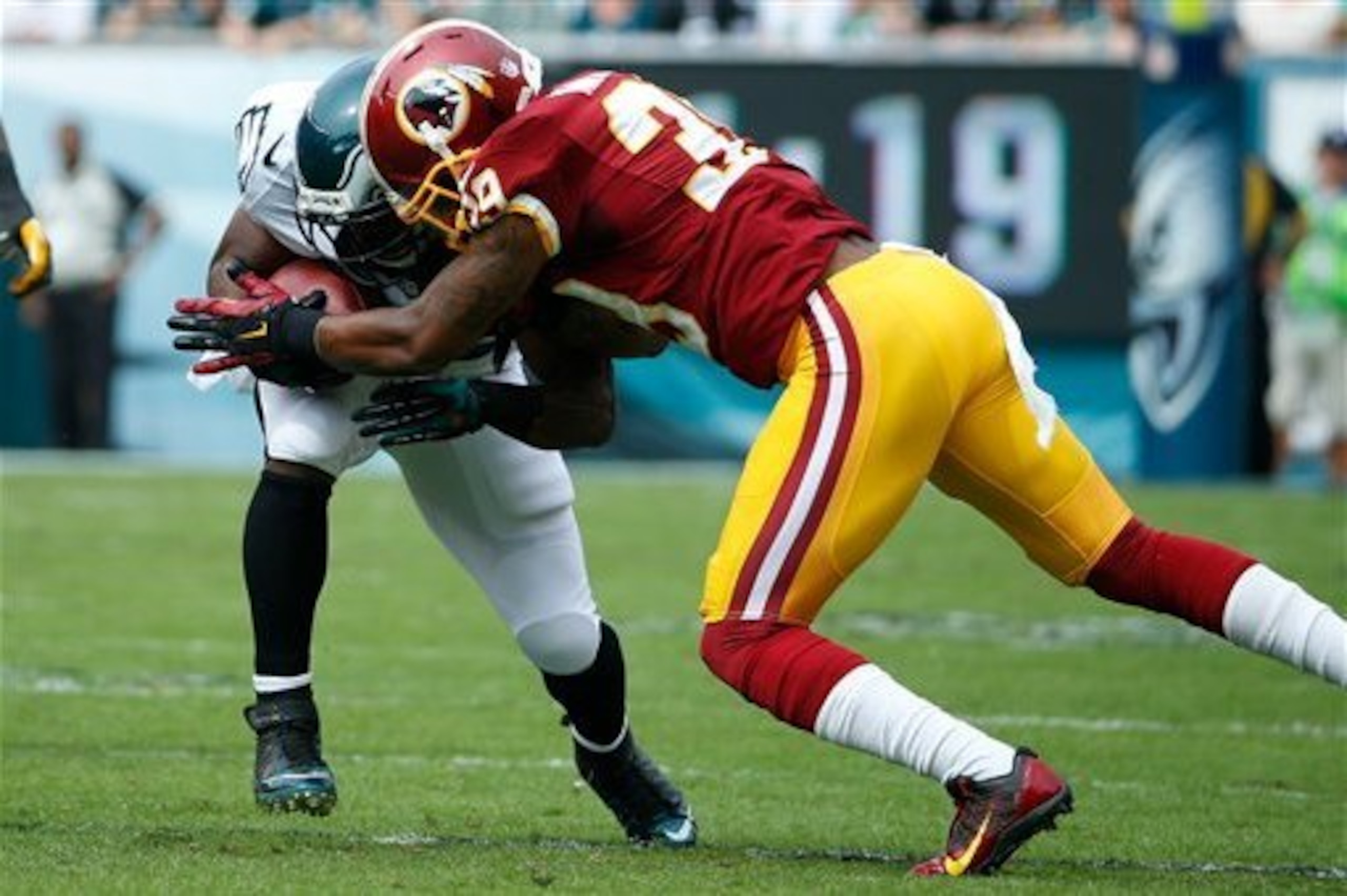
By hitting Bryant and Williams at the line, they can take away the time and space needed to make deep patterns work. Playing press will also regularly position the cornerbacks on the line, making life more difficult for Murray.
On each of the examples displayed here, Murray was held to either no gain or a single yard. The Seahawks had success on these plays because they were willing to commit numbers to the run and risk giving up plays through the air.
It'll be a risky way to travel, but Washington's D must do the same. Of course, the Seahawks were beaten 30-23 by the Cowboys and Murray still rushed for 115 yards.
But it took him 29 carries to do it. The Seahawks held him to four yards per carry, his lowest average of the season.
Haslett should do all he can to cause Murray similar problems. That might involve playing a Cover 4 front on base downs, with both safeties closer to the line and the corners pressing the edges.
It could also mean stacking inside linebackers Keenan Robinson and Will Compton in the A and B-gaps pre-snap to force Murray away from the middle and toward the sideline.
The Cowboys have plenty of weapons other than Murray, most notably Bryant, Williams and Witten. But the Redskins can't cover everything.
Murray is the oil in the engine. Haslett must gear his defense to stopping Murray. If he can, he'll make the Cowboys one dimensional. A one-dimensional offense is fair game against any opponent.
The 2-5 Redskins may seem hopelessly overmatched by the 6-1 Cowboys. But this rivalry has a storied history of upset wins. Form really doesn't matter in this one.
If Washington can corral Murray, the game will remain close. That will be good news for a Redskins offense that can create big plays through the air against an overly aggressive Dallas D.
All statistics via NFL.com.
All screen shots courtesy of NFL.com Game Pass.
.jpg?w=2560 "Titans Colts Football")