The Kansas City Royals began their October run with their share of question marks, but not atop their starting rotation. In James Shields, they had a guy who could match up with anybody.
But that was nine games ago. Suddenly, Shields might now be the biggest question mark on the Royals.
The 32-year-old right-hander started Game 1 of the World Series on Tuesday night against the San Francisco Giants, and it didn't go well. The capacity crowd at Kauffman Stadium was quickly silenced as Shields gave up three runs in the first inning, and he was ultimately tagged with five earned runs after failing to record an out in the fourth.
TOP NEWS

MLB Commissioner Defends Salary Cap
Miz Sets WS Record Already ⛽
Brewers Get 1st WS Win Since 1982 💪
Meanwhile, Giants ace Madison Bumgarner was the anti-Shields with seven innings of one-run ball. Hunter Pence and Pablo Sandoval supported him with two hits and two RBI apiece, and the Giants won handily by a 7-1 final to snap Kansas City's eight-game 2014 postseason winning streak.
That Shields authored yet another excellent regular season—highlighted by a 3.21 ERA across 227 innings—now feels like ancient history. He's made four starts this postseason, and he's allowed 28 hits and 15 runs in 19.0 innings for a 7.11 ERA.

Call it par for the course. Shields has raised an already mediocre 4.98 postseason ERA to 5.76 with his work this October. Rather than finally living up to his "Big Game James" handle like the Royals needed him to, what happened Tuesday night was Shields taking another step in the opposite direction.
Mind you, Game 1 wasn't without bright spots for the Royals.
One was Salvador Perez finally showing signs of life with a solo home run off Bumgarner in the seventh. The other was young southpaw Danny Duffy quieting San Francisco's bats in relief of Shields with three innings of one-hit, two-run ball.
That was a bit of the Duffy the Royals got accustomed to as he broke out with a 2.53 ERA across 31 games (25 starts) in the regular season. As such...well, it was inevitable that the question was going to pop up sooner or later.
ESPN's Buster Olney might have been the first to ask it:
As far as dilemmas go, this is a juicy one. Do the Royals plan on sticking with Shields if the series gets to Game 5, or do they pull the plug and go with the guy who had the 2.53 regular-season ERA and sharp relief performance in Game 1?
Officially, however, understand that this isn't a dilemma.
Royals manager Ned Yost was asked after the game about his plans for a potential Game 5 in San Francisco, and the skipper told Olney:
Still, 'tis the season for second-guessing managers, and no manager invites second-guessing like Yost. Though he's made his decision, we can still talk about whether he made the right one.
I don't know if he did, but only because I'm not sure there is a "right" decision in this case. All Yost could do was make the best decision in his power.
And that's what he did.
Granted, there is merit to the idea of pulling Shields from Kansas City's rotation. It would be one thing if he was pitching well this postseason and getting ugly results, but anybody who's watched him will know that this isn't the case.
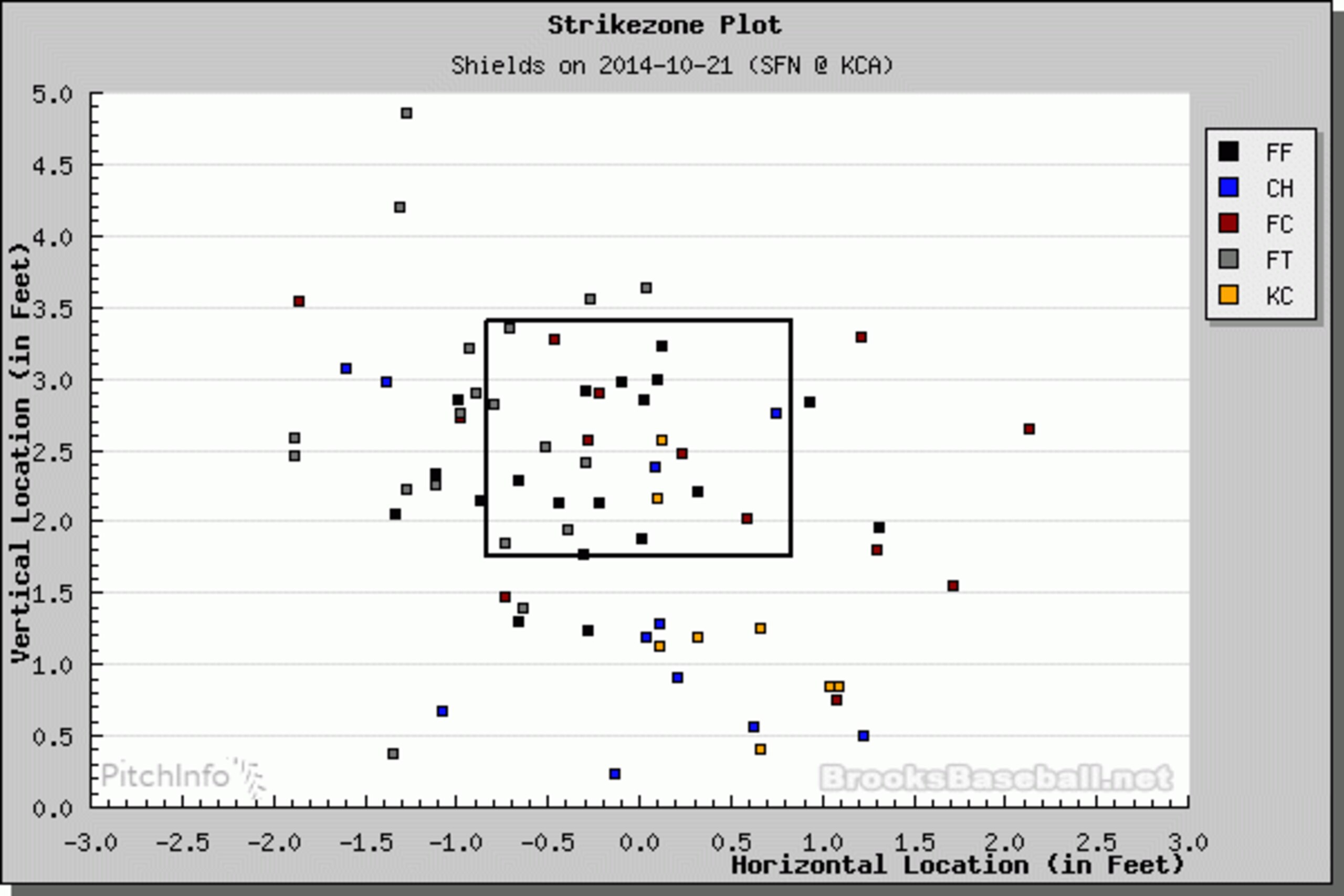
Shields hasn't made it easy on himself, as he's throwing fewer strikes. His strike percentage has gone from close to 65 percent in the regular season to just 62 percent in his four postseason starts. And this isn't misleading, as he really hasn't had good command.
In the regular season, figures at Brooks Baseball say Shields threw 45.1 percent of his hard pitches in the zone. That number has dipped to 40.1 percent in the postseason, and Yost saw a whole 'nother problem Tuesday night.
"Normally when he's really, really good, he's spotting his fastball well and his changeup is dynamite, and he was really struggling to command his changeup tonight," said Yost, via Dick Kaegel, Anthony DiComo and Alden Gonzalez of MLB.com.
Here's a plot from Brooks Baseball that can give you an idea how scattered Shields was in Game 1:
On top of his poor command is the reality that Shields hasn't had an easy time getting swinging strikes.
He drew a solid 16 against the Los Angeles Angels in Game 3 of the American League Division Series. Assuming ESPN.com's figures for Game 1 are accurate, though, he drew just four against the Giants and 17 in his other two starts combined.
It so happens this is where Duffy starts to look good. Though he needed 11 fewer pitches than Shields, he drew five more swinging strikes. Of those, Brooks Baseball says six were on his trademark heat.
After overwhelming the Giants in Game 1, perhaps Duffy can do it again. Certainly, it can't hurt that the Giants finished 25th in OPS against left-handed starters this season. That indicates that one reason Duffy was able to hold them down was because of an inherent matchup advantage.
Either that or, you know, he got lucky.
Duffy got overpowering results, but his fastball itself wasn't as overpowering as it typically was in the regular season. Brooks Baseball had his average four-seamer velocity at 94.2 mph in the regular season. Against the Giants in Game 1, it was 93.4 mph. After experiencing some shoulder issues in September, Duffy may not be all the way back yet.
Despite Olney's hint that Shields is operating with diminished velocity, this is one area where he's actually fine. Here's how his Game 1 velocities compared to his regular-season velocities:
| Reg. Season | 93.6 | 93.0 | 87.6 |
| Game 1 | 94.0 | 92.6 | 88.4 |
A little less on the sinker, but otherwise everything was fine.
While Shields' mediocre command is a red flag, that his stuff is fine makes it hard to wonder if he's worn down. There's little reason to think moving him to the bullpen is for the best, and that's without even mentioning that he's only made one career relief appearance.
Duffy, on the other hand, hasn't thrown over 90 pitches in a game since Sept. 22. He's also not new to relieving, having made six relief appearances in the regular season. And of course, he just showed Tuesday night that he's hardly in over his head coming out of the bullpen.
Again, that Shields' performances this postseason have been about as ugly as his numbers say they've been means there should be concern about how he'll fare in a possible Game 5—especially knowing that he'll more than likely be tasked with matching up with Bumgarner again.
Duffy, however, is not an easy fix. He didn't have his best fastball in his three dominant innings in Game 1, and three good innings doesn't mean he's ready to cut it loose as a starter yet anyway.
Assuming there is a Game 5, the best hope for the Royals is that Shields will somehow snap out of the funk he's in and finally live up to his moniker. But just in case, Yost should have Duffy standing by ready to take over again if Shields shows early signs of another disappointing performance.
The top of Kansas City's rotation may now be a question mark. But rather than reacting with a knee-jerk solution, the Royals are best off handling it with a mix of patience and caution.
Note: Stats courtesy of Baseball-Reference.com unless otherwise noted/linked.
If you want to talk baseball, hit me up on Twitter.
.png?w=2560)

.jpg?w=2560 "NFL House in Paris Closes for Protests")

.jpg?w=2560 "Trevon Diggs Cut by Seahawks")