How Demaryius Thomas Exposed the 49ers' Defensive Weakness
The San Francisco 49ers have one of the NFL’s best defenses. We don’t need to qualify or soften that statement by mentioning injuries, even though core pieces are still missing.
Go ahead and haul out any of the standard statistical measuring sticks typically used to assess a defense. The 49ers are among the top five in four major categories and the top 10 in two others even without getting a single snap this year from middle linebacker NaVorro Bowman and outside linebacker Aldon Smith.
And yet Sunday, one of the best defenses in the NFL was absolutely pummeled by one of the best offenses in the NFL.
TOP NEWS
.jpg?w=2560 "NFL Paris Football")
NFL House in Paris Closes for Protests
.jpg?w=2560 "Seahawks Chiefs Football")
Trevon Diggs Cut by Seahawks
.jpg?w=2560)
B/R's Expert Week 7 NFL Picks 🔮
| Rank | |
| Total yards allowed per game | 2nd (306.0) |
| Rushing yards allowed per game | 5th (84.9) |
| Passing yards allowed per game | 10th (221.1) |
| Yards allowed per pass attempt | T4th (6.6) |
| Opponent completion percentage | 3rd (58.7) |
| Opposing passer rating | 8th (84.0) |
The 49ers were certainly limping defensively against the Denver Broncos during that 42-17 beatdown, tying the most points allowed during the Jim Harbaugh era.
Beyond the deep, dark black hole without Bowman (over 140 tackles in three straight seasons) and Smith (42 sacks in 43 career games), cornerback Chris Culliver sat out, and safety/nickelback Jimmie Ward was sidelined with a quadriceps injury. The hurt kept coming later when cornerback Chris Cook left the game too.
But leaning on injuries after a poor performance becomes a weak crutch. As I wrote immediately following Sunday’s game, go ahead and ask the NFC West division-leading Arizona Cardinals about their far more permanent pain. Or the Seattle Seahawks after they played without middle linebacker Bobby Wagner and cornerback Byron Maxwell in Week 7, both core defenders.
When Tramaine Brock returned from his toe injury the 49ers had three of the four regular starters in their defensive backfield healthy.
Perrish Cox slid into the hole vacated by Culliver, and he’s the early leader for the sweetest offseason bargain after being re-signed and given a league minimum contract (one-year at $695,000). He already has three interceptions and a league-leading 15 passes defensed, making the current version of Perrish Cox an upgrade over Culliver.
So what we saw Sunday was the core 49ers secondary that’s fourth in yards allowed per pass attempt and third in opponent completion percentage.
Then we saw failure: repeated and embarrassing failure and a weakness that was exposed by the highest caliber of competition.
Broncos quarterback Peyton Manning finished the game with only four incompletions. Along with a new all-time career passing touchdowns record, he also walked away with a completion percentage of 84.6, over 25 percent higher than the average per-game percentage allowed by the 49ers defense.
Manning also accumulated his 318 passing yards at a blistering pace of 12.2 yards per attempt. He hasn’t averaged that much or higher in a game since Week 2 of the 2009 season.
He did that while completing two passes for over 40 yards, both to wide receiver Demaryius Thomas on back-to-back throws in the third quarter. Prior to Week 7 the 49ers had allowed only two completions of that distance or more while defending 221 pass attempts.
We all witnessed a defensive collapse even by the high standards set by Manning and his Broncos offense. Both starting San Francisco cornerbacks were routinely victimized, especially Brock.
He was targeted in coverage on six of Manning’s 22 completions, according to Pro Football Focus (subscription required). The result was ugly, with those six catches adding up to 126 yards and a pretty painful clip of 21.0 yards per catch. On the other side Cox entered Week 7 with a passer rating allowed of 65.0 in four of his six games. Against Manning that spiked quickly to 149.3, per PFF.
Quickly we learned the 49ers defense can get thoroughly roasted by speed. Raw, blazing speed.
Thomas highlighted that flaw, one the 49ers share with the division rival Seahawks. He was greeted with a lack of coverage throughout the night while sprinting toward 171 receiving yards and two touchdowns.
One of the worst deep burns came on his 40-yard touchdown catch in the third quarter.
The route was simple, with Thomas running a straight vertical while Manning executed a play fake to running back Ronnie Hillman. The play started on the 49ers’ 40-yard line with Manning in the pistol, Hillman behind and three receivers spread out. Thomas was matched up with Cox wide to the right.
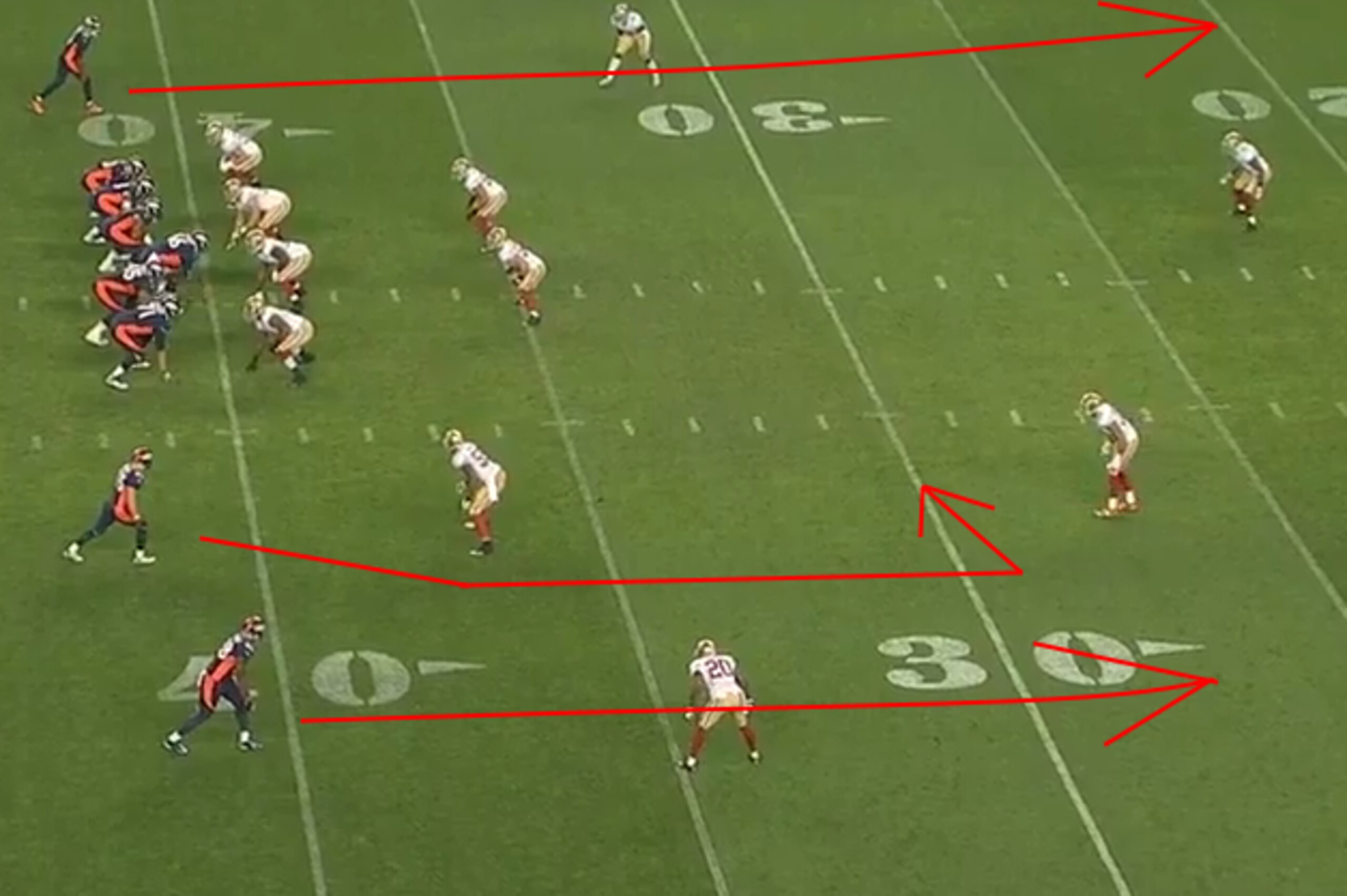
The 49ers gave a single-high safety look, shading Antoine Bethea to the far hash away from Thomas. Manning then had his choice of which vertical to target—either Thomas or wide receiver Emmanuel Sanders on the other side—and it was an easy decision knowing that he had single coverage with Cox, and Bethea would struggle to reach a well-thrown ball.
In theory, the five-yard cushion Cox was giving Thomas before the snap should have bought enough time to stay with the receiver downfield and disrupt the pass. On the other side Brock was respecting Sanders’ speed even more with an eight-yard gap.

But in practice, one-on-one coverage with Thomas on a straight vertical route usually ends in tears. Cox played Thomas to the inside, where he hoped help was coming.
It arrived about two steps too late. And Cox was a half-step behind, which is plenty for Manning.
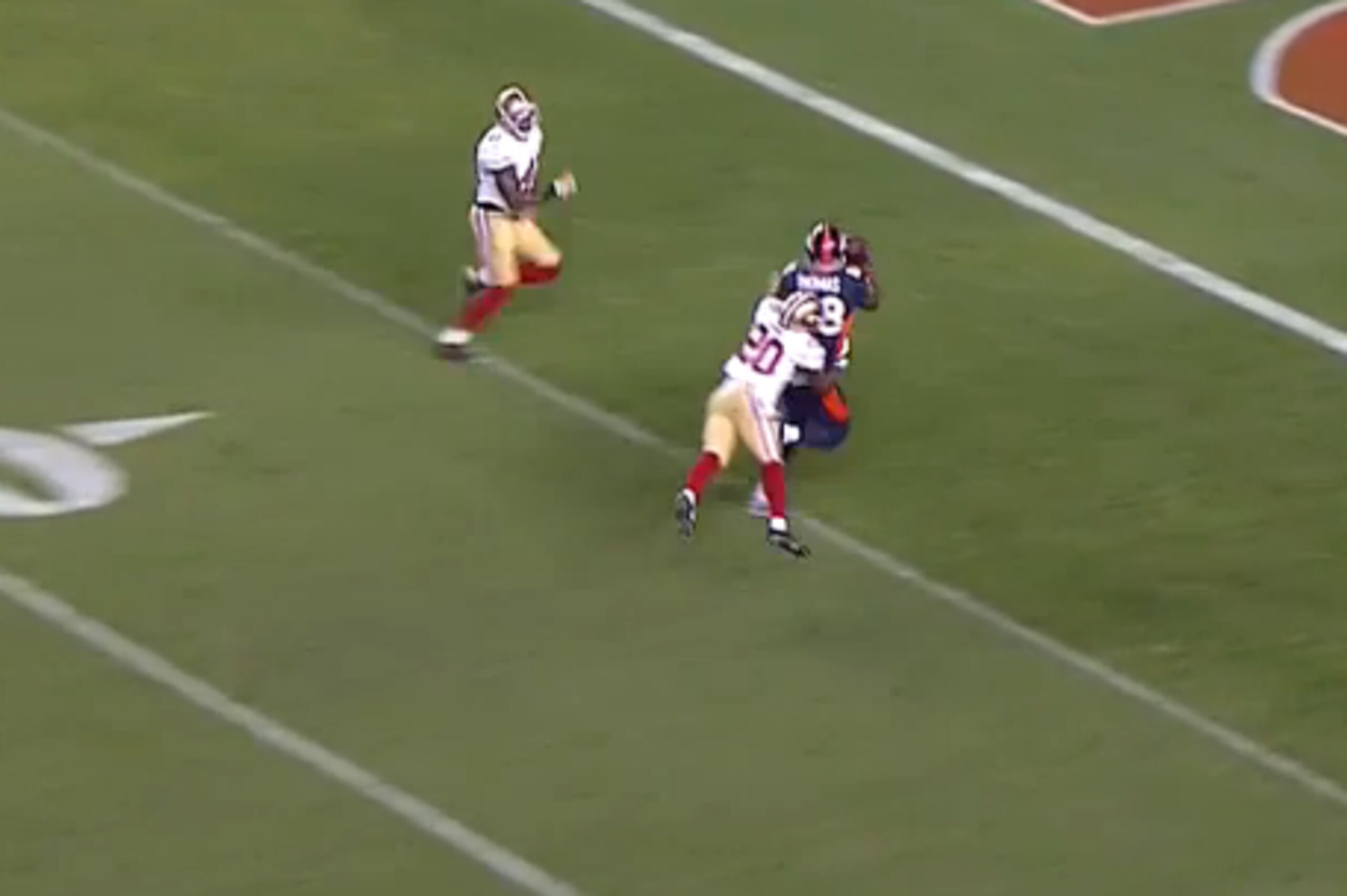
On Manning’s next pass attempt the formation was similar, and so was the result.
At their own 14-yard line the Broncos lined up with three wide receivers again, but this time Manning was under center with Hillman behind. Brock was across from Thomas now, and he gave little cushion. He was playing tight and looking to match the 6’3”, 229-pound receiver’s physicality.
The challenge on this play was managing not only Thomas’ speed, but also his ability to quickly change direction—which became impossible with single coverage.
He ran a double-move. First he sank his shoulders to sell the vertical then Thomas cut abruptly to the sideline 10 yards downfield before quickly shifting again back to the inside.
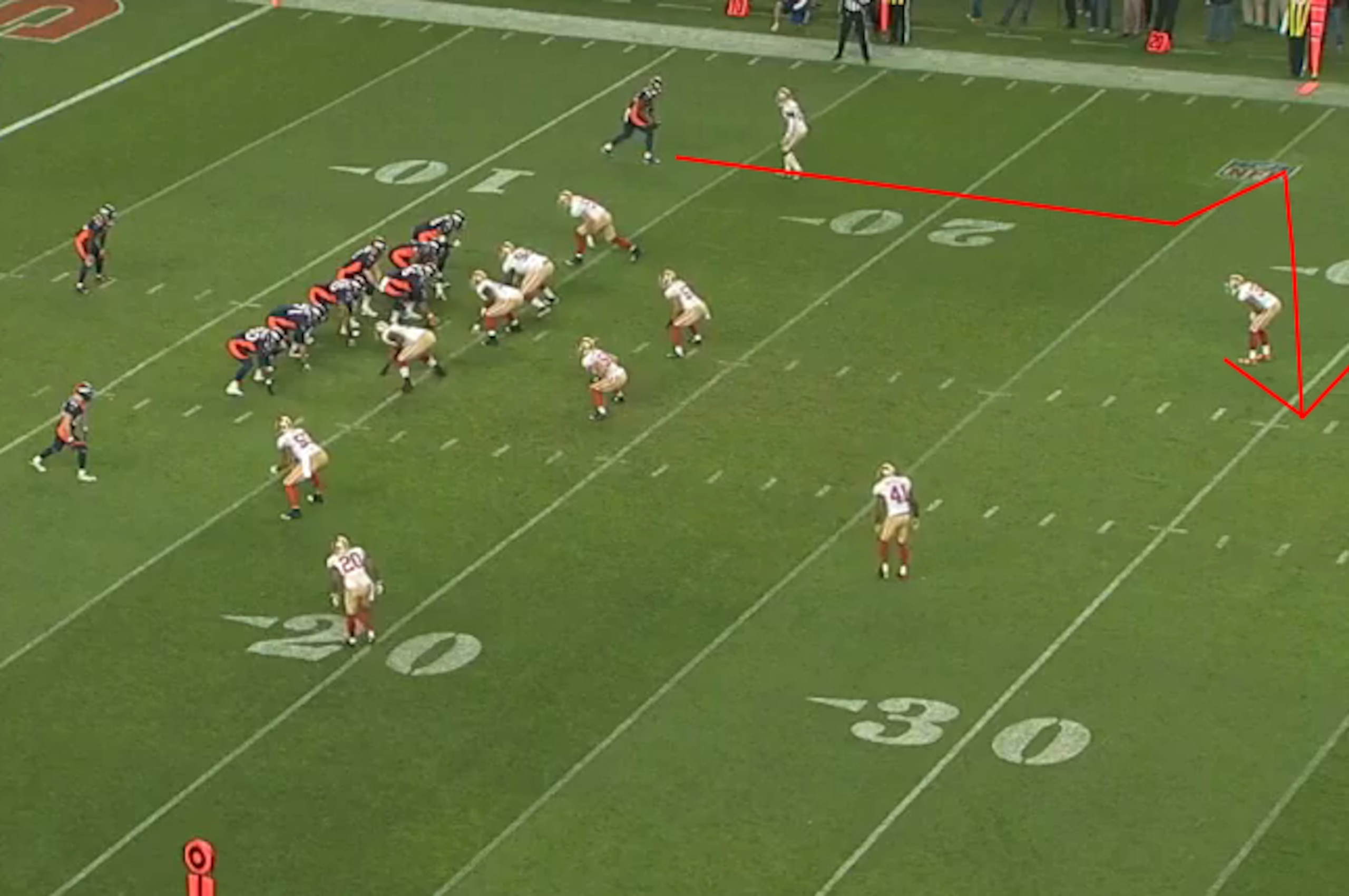
Brock bit hard on the first move, aggressively looking to match Thomas’ speed to the outside and prevent a deep sideline pass. He turned his hips entirely toward the sideline and his back to Thomas, leaving a massive hole up the middle for an easy catch and 49-yard gain.
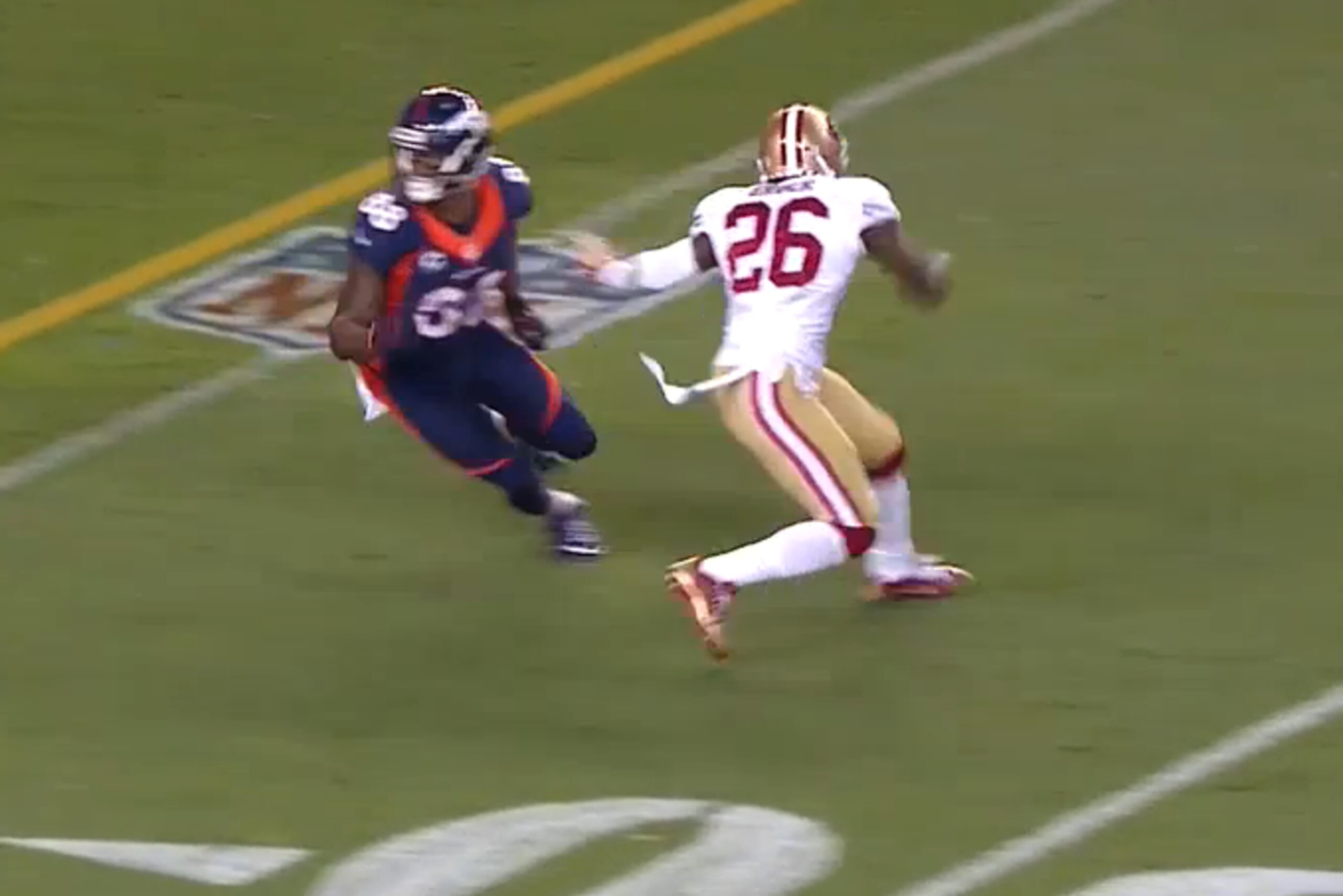
In fairness, defending Thomas hasn’t happened much at all lately. Over just his last three games the fast-moving house has five touchdowns and 521 yards on 26 catches.
But the 49ers also hadn’t been exposed much to a receiver with Thomas’ blend of speed and muscle. Dez Bryant was successfully limited in Week 1 (four catches for 55 yards), but then a gimpy Brandon Marshall used his wingspan to reel in three touchdowns a week later.
Drew Brees and deep-ball specialist Kenny Stills are teed up for Week 10 (15 catches but still two for 40-plus yards), and later when the temperature of the NFC West will be cranked further, DeSean Jackson waits in Week 12 (20.3 yards per catch and three for 60-plus yards).
Then with the division maybe/hopefully on the line in Week 16 the San Diego Chargers come to Levi’s Stadium. Philip Rivers is currently averaging 8.5 yards per pass attempt.
Getting healthy will help to ease some of the concerns after Manning’s aerial assault. The return of Aldon Smith will bring sorely missed pocket pressure, while both Bowman and fellow inside linebacker Patrick Willis will provide quality coverage up the middle.
But deep is where the real worry lies against a top-tier offense after Cox and Brock allowed a combined 171 yards in coverage and when healthy Chris Culliver is giving up a passer rating of 93.1, all per PFF.
Either that needs to change quickly or more pressure up front has to help out fast. Or preferably, both.
.jpg?w=2560 "Titans Colts Football")