Acceptance is the first step to self-correction.
The Los Angeles Lakers have a three-point shooting issue. More specifically, they have a "We're actively going to eschew three-pointers, ignoring endless scores of data and logic that explicitly implore us to do the opposite" issue.
There. The admission portion of Los Angeles' problem-purging process is out of the way. It's time to tackle more pressing matters.

Like how the Lakers can save themselves, from themselves.
Yeah, It's a Problem

First and foremost, operating on the assumption that my words alone aren't your gospel, we as responsible basketball buffs must also acknowledge this is a huge problem.
"Our game plan is really to get to that basket," Lakers coach Byron Scott said after Los Angeles' preseason opener, per the Los Angeles Times' Eric Pincus. "I like the fact that we only shot 10 threes. If we shoot between 10 and 15, I think that's a good mixture of getting to that basket and shooting threes."
True to Scott's spine-spooking declaration, the Lakers have spent the entire preseason not shooting threes. Through five contests, they've attempted 42 treys, or 8.4 a night. They are 2-3 while abiding by Scott's bomb-opposing offense.
Only one team shot fewer than 15 three-pointers last season—the Memphis Grizzlies—and their offense ranked a middling 17th in efficiency. The last squad to hoist 10 or fewer three-pointers per game was the 2006-07 Philadelphia 76ers. They won 35 games. In fact, the last team to disregard the three-ball that much and finish with a winning record is the 2003-04 Utah Jazz. More than 10 years separates them from today's NBA.
Yet Scott still swears by his offensive approach, per ESPN Los Angeles' Baxter Holmes:
Some of what he says is true. Three-point shooting won't win championships on its own. Nor will defense. Or blowing in LeBron James' ear.
Contending and winning championships becomes possible by bringing multiple elements of the game together and dominating through balance.
One such element includes three-point shooting.
Each of the last 10 champions have attempted at least 15 three-pointers per game during the regular season. Nine of them attempted at least 17, the lone exception being the 2011-12 Miami Heat.
Equally concerning as the volume in which the Lakers plan to shoot three-pointers is their conversion rate. They're shooting just 23.8 percent from deep during the preseason. If that percentage carries over into the regular season, well, they're in trouble.
The San Antonio Spurs led the league in three-point percentage last year. They won the championship. The Heat finished second in three-point shooting for 2012-13. They also won a title.
Preseason play isn't always a statistical crystal ball, but it does reveal in-game priorities. Three-point shooting is not among the Lakers' primary offensive concerns. That's the mistake they're tasked with correcting, lest Scott's antiquated way of thinking be the downfall of an offense already facing so many obstacles.
The Fix
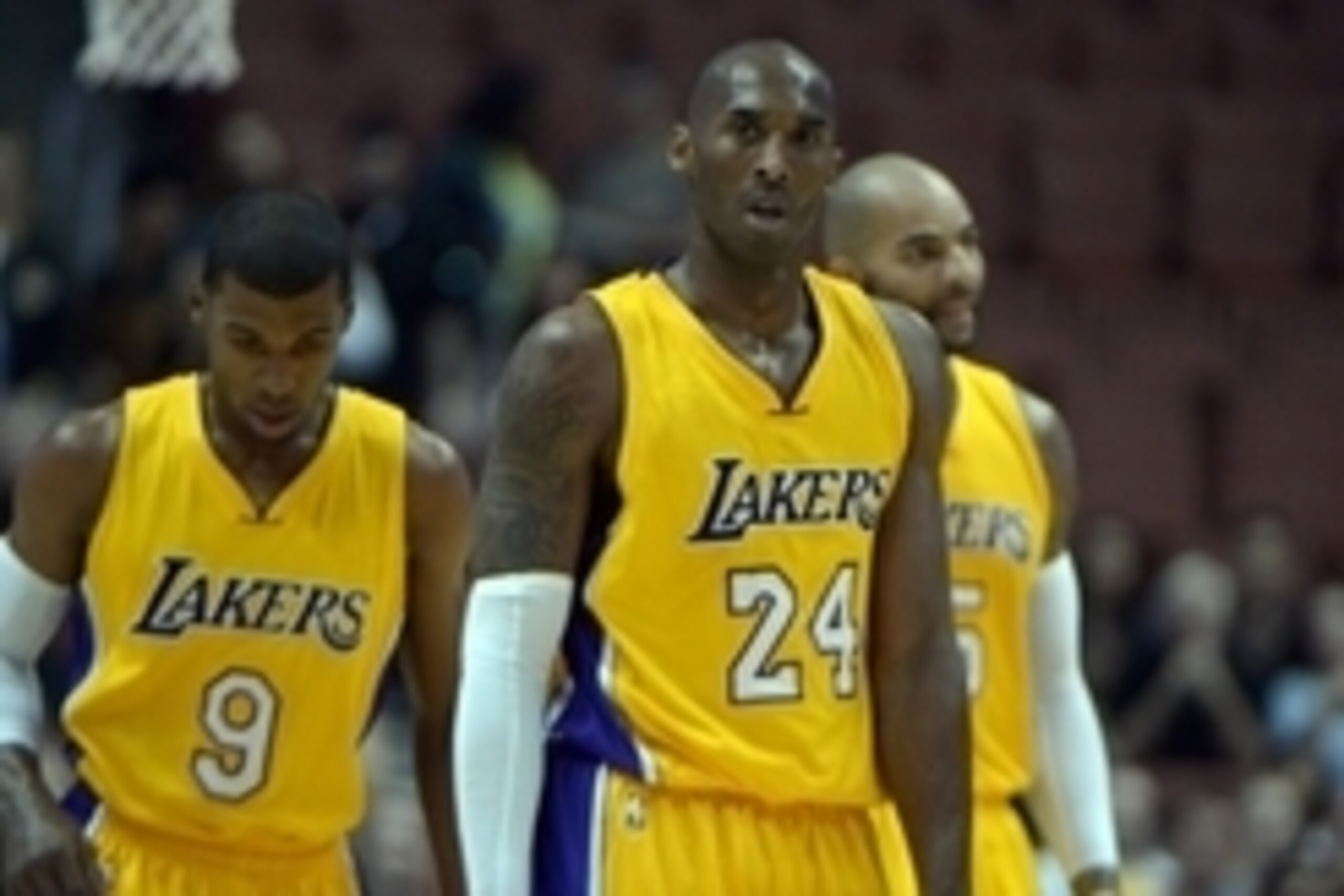
Remedying this starts and ends with, you know, actually shooting threes.
A lack of three-point range isn't a valid excuse for shirking the three-pointer. Even relatively inefficient teams should be attempting more triples. Those deemed erratic shooters should be taking more. Everybody who's anybody needs to shoot!
Bleacher Report's Adam Fromal explains why:
"If a player shoots 50 percent on his mid-range looks and 50 percent on his three-point looks, shouldn't he take far more of the latter? After all, the triples are worth an additional point. In fact, since mid-range shots are worth two points apiece, the player in question is scoring one point per shot on those looks. Meanwhile, he's scoring 1.5 points per shot on his beyond-the-arc attempts. ...
Shooting 48.8 percent from inside the arc means the average two-point attempt yields just 0.976 points. To break even, the necessary three-point percentage is only 32.53 percent.
"
Efficiency isn't unimportant. Let's make that clear. But just because players put in a smaller percentage of three-point attempts, it doesn't make them any less valuable. And the Lakers, as currently constructed, do have enough firepower to make distance shooting a worthwhile avenue of attack.
It's true their four best shooters from 2013-14 (minimum 20 games) are gone. Kendall Marshall, Steve Blake, Jordan Farmar and Jodie Meeks all call different teams home. But the Lakers still have five players who hit at least 34.6 percent of their three-pointers last year: Xavier Henry (34.6), Jeremy Lin (35.8), Wayne Ellington (42.4), Wesley Johnson (36.9) and Nick Young (38.6).
Steve Nash has also only shot under 37.4 percent from deep once in his career (last season). If he's any kind of healthy, he can light it up from downtown.
Kobe Bryant is not to be overlooked either. It's been five years (2008-09) since he buried at least 35 percent of his treys, but he's not afraid to shoot them. His 3 of 7 display from downtown in a preseason victory over the Utah Jazz is encouraging as well.

No, the Lakers aren't built to be the Spurs. Or the Dallas Mavericks. Shooting and making threes at high clips also doesn't promise anything. Mike D'Antoni's run-and-gun-and-tank squad finished third in three-point shooting last year and won 27 games, finishing second-to-last in the Western Conference.
This isn't about turning the Lakers into a juggernaut, though. Relentlessly attacking the basket won't get them anywhere on its own. Three-point shooting has become that vital to the game.
Stretching defenses by showing you're willing to jack threes opens up the lanes Scott values so highly. Avoiding three-pointers like the plague, or gas-station tofu, or spandex in 90-degree heat, makes offenses predictable. It allows defenses to pack the paint and defend solely against dribble penetration, post-ups and mid-range pick-and-pops.
When that happens, your shot chart looks like this, as it did for the Lakers in their Oct. 16 loss to the Jazz:
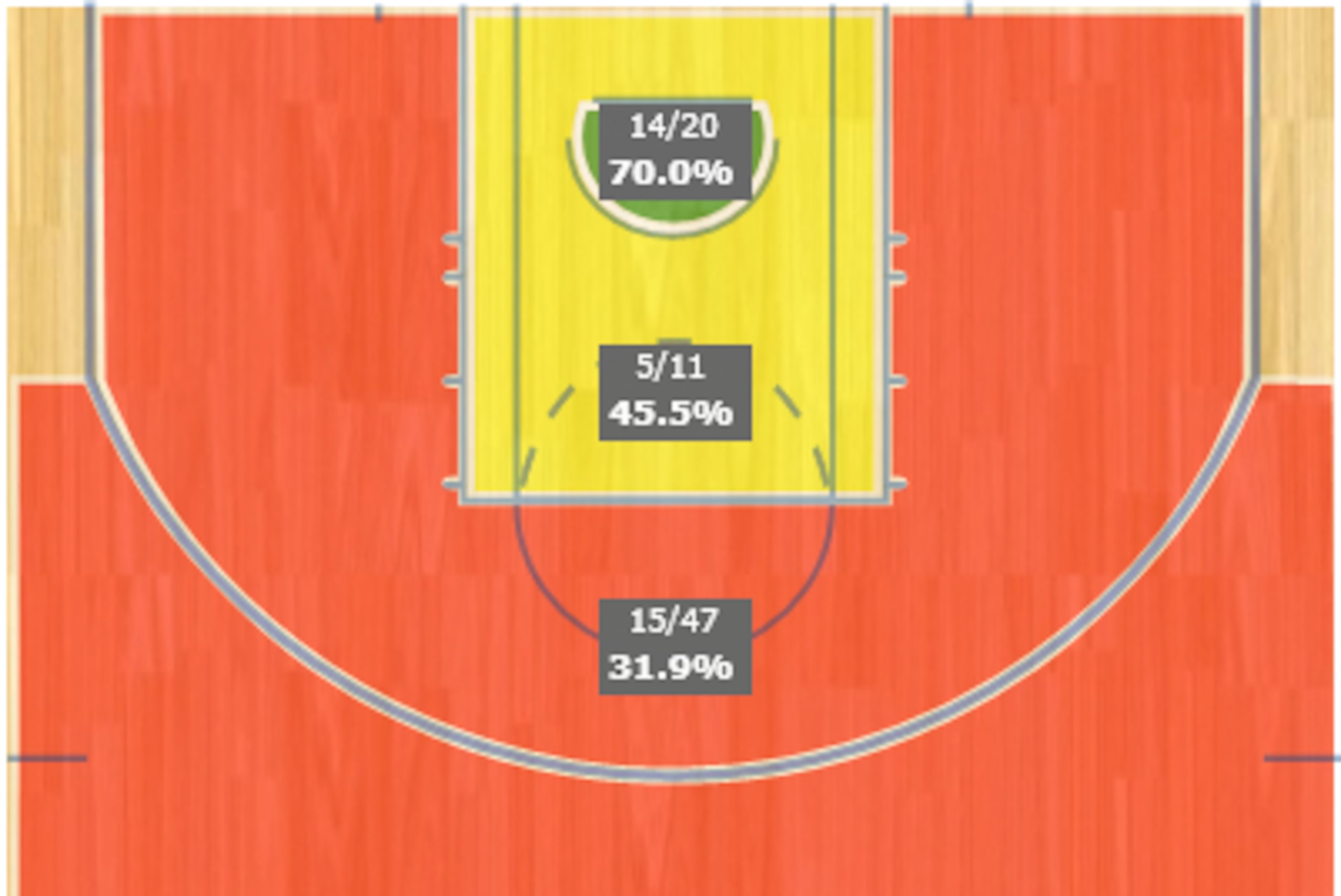
Holy long, ugly, inefficient two-pointers.
Forty-seven of the Lakers' 83 field-goal attempts came from No Man's Land here. That's 56.6 percent of their shots. Meanwhile, less than 25 percent of their shots (20) came near the basket.
Is it pure coincidence that their long-two eruption coincided with five three-point attempts?
Um, no.
Should we expect that to change during the regular season if they keep pretending the game of basketball exists only within the arc?
Like Forum Blue & Gold's Darius Soriano drives home, not at all:
"With zone defenses now legal and the onset of Tom Thibodeau inspired strong side schemes that clog the paint, driving lanes are produced via a spread floor. Players who like to attack the basket, now more than ever before, benefit from shooters spacing out the defense to create those creases to the rim. If the Lakers continue to be a team that eschews the three ball in favor of long two point shots, they will likely find a more crowded lane that limits drives to the rim and promotes…wait for it…more long two point shots.
"
Doubling and tripling their number of three-point attempts won't guarantee the Lakers anything. They may clang them off every which part of the rim with alarming frequency. Their offense could then perish under the weight of those misses.
Barely shooting them at all, though, will make life more difficult than those theoretical misses ever could.
So....
Shoot. The only way for the Lakers to solve what has become an obvious three-point disaster is to shoot.
They don't have to be last year's Lakers. They don't even need to be a good three-point shooting team. They just need to be a three-point shooting team. It will, without question, help other areas of their offense.
Other aspects of what they're doing are quite good, mind you. Scott has always done a solid job utilizing his point guards on the offensive end, and that hasn't changed during his brief time in Los Angeles. Lin, Nash (when he's actually played) and Ronnie Price have been running some interesting, multiscreen movements that have, at times, caught defenses off guard and created open looks.
Just not good ones.
Most of their offensive sets have looked like a mess of different things. Incorporating elements of the triangle and Princeton offenses sounds good, but it's too much—especially when the Lakers are then limiting the kinds of shots they're attempting after doing too much.
That can't happen.
Injuries to Young and Henry, along with Nash's mostly downtrodden health bill, put limits on what they can accomplish offensively. That's understandable. But it doesn't take much to shoot. And right now, that's what the Lakers are most guilty of: not taking the shots that, hit or miss, they need to take.
*Stats courtesy of Basketball-Reference and NBA.com unless otherwise cited.

.jpg?w=2560 "NFL House in Paris Closes for Protests")
.jpg?w=2560 "Trevon Diggs Cut by Seahawks")