Julius Thomas Continues to Emerge as NFL's Ultimate Matchup Weapon
Through five games this season, Denver Broncos tight end Julius Thomas has already caught nine touchdown passes from quarterback Peyton Manning.
That puts Thomas—the matchup weapon in the Broncos offense—in a realistic position to challenge (or break) Rob Gronkowski’s all-time single-season record of 17 touchdown receptions by a tight end.
Today, let’s discuss how the Broncos are using formation and alignment to isolate Thomas in one-on-one situations that cater to the tight end’s skill set as a route-runner.
TOP NEWS
Predicting NFL Roster Cuts ✂️
.jpg?w=2560 "Bills Browns Football")
Shedeur's Reaction to Browns' QB Decision
Biggest Rumors Ahead of Roster Cuts 👀
Creating Matchups at the Tight End Position
We talk about “matchups” all the time when looking at the NFL tape, but it truly applies to Thomas because of his size (6’5”, 246 lbs), lateral quickness and formation flexibility in the Broncos' Ace/12 (2WR-2TE-1RB) and Posse/11 (3WR-1TE-1RB) personnel groupings.
Thomas can align as a traditional “Y” (attached to the core), in the slot, the back side of a 3x1 (called a “Dakota” alignment) or as the No. 1 receiver in a 2x2 Doubles “Orange” formation (2x2 spread).

That creates stress for opposing defensive coordinators because of the matchup issues Thomas brings to the field along with the talent at the wide receiver position in Denver (Demaryius Thomas, Wes Welker, Emmanuel Sanders).
Do you play Thomas with a linebacker, roll down a safety or align a cornerback on the tight end? Plus, do you bring base or sub-package personnel on the field to account for Thomas when the Broncos have two tight ends in the game?
Thomas has the ability to win versus press (footwork on the release), stem hard up the field and create separation at the break point with a quarterback that consistently puts the ball on the proper shoulder to beat the defender’s leverage.
Here’s a quick example versus the Colts with Ace/12 personnel on the field in a Unit Wing Slot formation. That puts Thomas on the line at the Y and forces the Colts to match up with a linebacker as both corners “travel” to their coverage (slot formation).

After the release, Thomas wins versus the linebacker in man coverage and immediately puts the defender in a trail position with the two receivers clearing out/occupying the top of the secondary. That allows Thomas to work away from the linebacker’s leverage on the deep over (crossing route) while displaying his speed after the catch to produce a touchdown.

Back in Week 5, the Broncos aligned Thomas in the slot (Doubles “Orange” formation) with Cardinals safety Tony Jefferson rolled down over the tight end in coverage. This creates a one-on-one matchup inside of the numbers versus a single-high-safety look in the middle of the field for Arizona.

The Broncos clear out the closed (strong) side flat with Sanders releasing up the field on the fade route. That gives Thomas an opportunity to win at the top of the stem (option route) while creating a positive leverage position on an outside breaking cut.
Thomas aligns in a variety of positions to run the core concepts in the Broncos playbook (four verticals, Hi-Lo, Levels, curl-flat, etc.), and that gives Manning the opportunity to target the tight end when he finds a matchup he can exploit.
Isolating Thomas as the Backside 'X' Receiver
The “X-Iso” or “Dakota” alignment is a common look in today’s NFL as it isolates the tight end to the back side of a 3x1 formation. You will see this alignment in San Diego (Antonio Gates), New Orleans (Jimmy Graham), Dallas (Jason Witten) and Chicago (Martellus Bennett).
Last Sunday, the Broncos rolled out the same alignment in the high red zone (15- to 25-yard line) versus the Jets with Gates as the backside X in a matchup versus cornerback Darrin Walls.
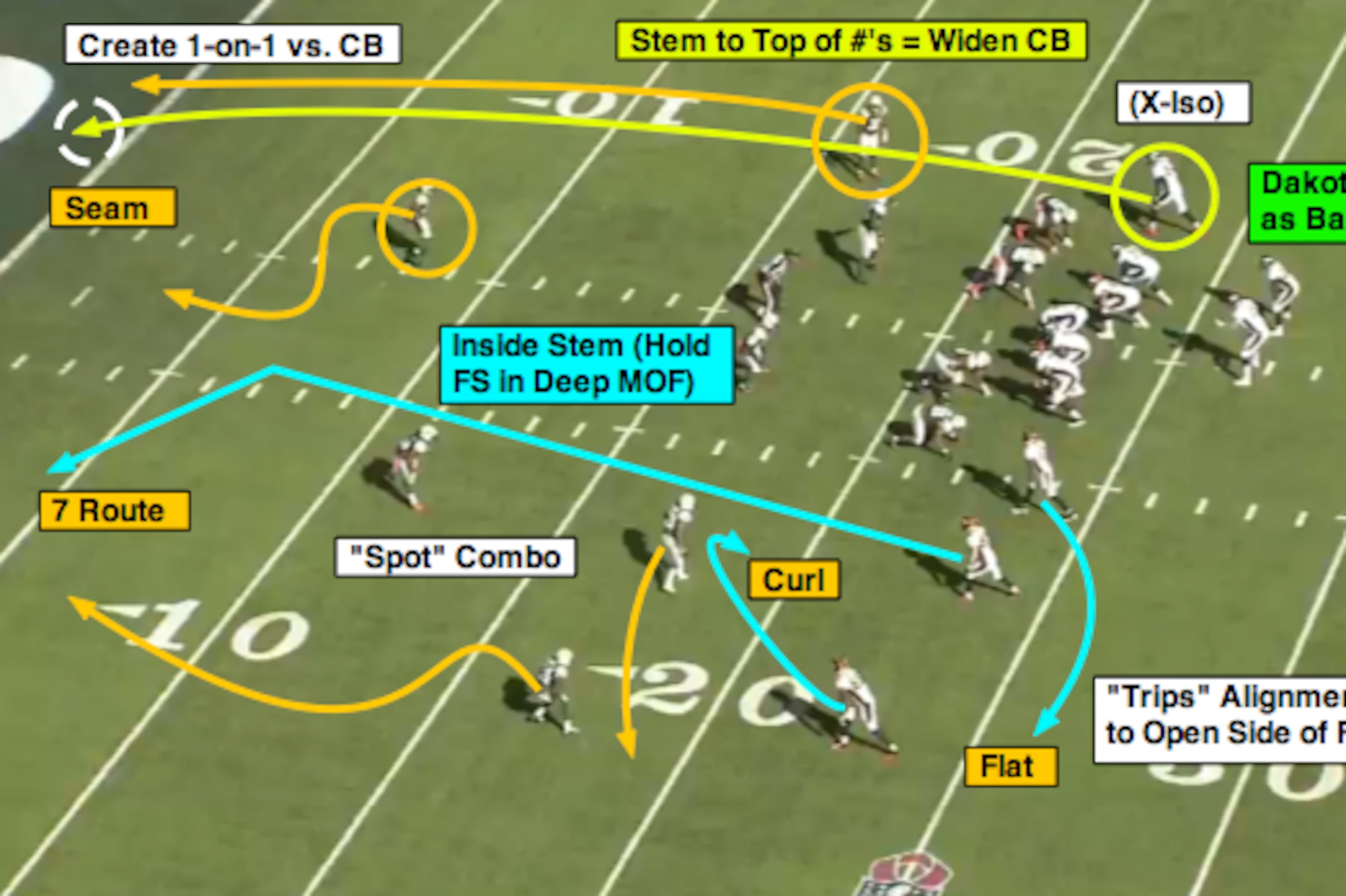
With Posse/11 personnel on the field (trips to the open side), the Broncos run the “spot” combination (7-curl-flat) and send Welker on a hard, inside stem to hold the safety in the deep middle of the field. That creates a true one-on-one for Thomas, with the tight end stemming this route to the top of the numbers (widen defender) and then pushing inside.

With the safety now occupied, Manning can leave the ball to the inside (away from the defender’s leverage) as Thomas secures the catch for another touchdown.
The “Dakota” alignment also shows up on the slant/fade option in the deep red zone when Thomas is again removed from the core versus a defensive back in coverage. Given his lateral movement to win on the release—plus the size to high-point the ball—Thomas can work this matchup based on the initial leverage of the defensive back.
Check out this route against the Cardinals, with Jefferson in a press position and showing an inside shade (take away the slant versus a plus split outside of the numbers).

Thomas takes a straight release off the ball and stems inside (sell the slant) to force Jefferson back on his heels. That slows the transition for the Cardinals safety as he now has to open the hips and work to get back in-phase versus the fade route.
With Jefferson stuck in a trail position, Thomas separates from the safety as Manning drops the ball over the shoulder for a score.
Against the Colts, Thomas drew another one-on-one matchup out of the “Dakota” alignment versus safety LaRon Landry. This time, the Broncos tight end sells the outside stem (fade release) and works back to the slant versus press coverage.

Look at the footwork here from Thomas. That quick, initial stem forces Landry to jump outside and allows Thomas to generates separation/leverage on the slant. That’s nasty stuff on the release, and it creates serious matchup issues for defensive backs in the red zone when Denver isolates the tight end on the back side of the formation.
Will Thomas' Record-Setting Pace Continue?
When the Broncos have the ball out in the field, defenses can lean on core coverages (think Cover 2, 2-Man or Cover 3) versus Thomas and the Denver offense. That allows defenses to get depth from their second-level defenders or use the safety help over the top to play aggressive trail-man technique underneath.

However, inside of the red zone where defenses are showing more Cover 1 (man-free) and zero-pressure (blitz-man with no safety help), finding the proper matchup versus Thomas is a major problem based on what I’ve seen on the tape.
This is where the formation flexibility and the route-running skill set of Thomas comes into play. Whether that is the seam, slant, fade or 7 cut (corner route), Thomas has shown the ability to win on the release while using his size to create leverage at the point of attack.
Catching 17 touchdown passes in one season at the tight end position is really impressive. But given the talent of Thomas (and Manning under center), I wouldn’t be surprised to see the Broncos tight end break Gronkowski’s record this year with 11 games still left on the schedule.
Seven-year NFL veteran Matt Bowen is an NFL National Lead Writer for Bleacher Report.
.png?w=2560 "Bills Browns Football")
.jpg?w=2560 "Grading WWE Raw 🔠")
.jpg?w=2560 "Source: Freedom, White Not Eligible for WNBA Draft (AP)")