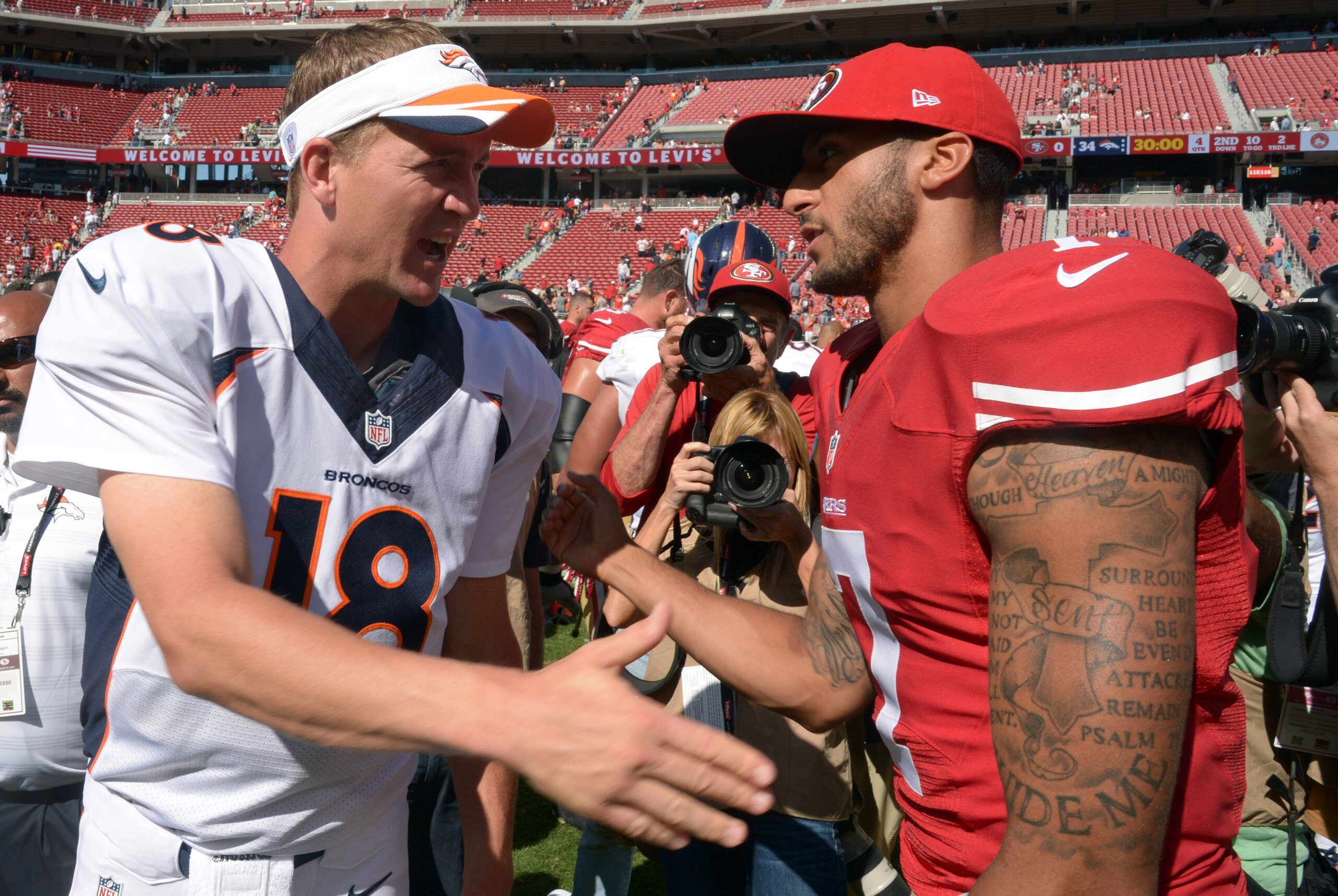

Dissecting Most Crucial Matchups in San Francisco 49ers' Week 7 Game vs. Broncos
If a dissection of the most crucial matchups in the San Francisco 49ers’ Week 7 game with the Denver Broncos were a mathematical equation, what would it look like?
Keep Peyton Manning off the field + pressure him relentlessly while on it + play a physical overall brand of football = 49ers win.
Or something to that effect.
TOP NEWS
.jpg?w=2560 "NFL Paris Football")
NFL House in Paris Closes for Protests
.jpg?w=2560 "Seahawks Chiefs Football")
Trevon Diggs Cut by Seahawks
.jpg?w=2560 "Colts Football")
Jonathan Taylor Landing Spots
The 49ers are 4-2 on the season. The common denominators in their four wins have generally been a swarming, opportunistic defense combined with a balanced and ball-control offense with Frank Gore leading the charge.
In those victories, Gore averages 18.5 touches and the Niners own a plus-eight turnover differential.
Those numbers drop to 9.5 and minus-three, respectively, in their two losses.
San Francisco carries a plus-five turnover margin and 33-minute, 38-second average time of possession overall.
For the Broncos, their one loss on the year came at the hands of the Seattle Seahawks.
The winning formula for Pete Carroll’s club materialized as a plus-one turnover aggregate, holding the ball for an additional 10:22 and a near equal balance on offense with 35 passing attempts and 36 runs.
Seattle also applied effective pressure on 15 of Manning’s 49 dropbacks, or roughly one-third of his pass plays, according to Pro Football Focus (subscription required).
So, how does that recipe translate to a successful game plan for the 49ers? And for the purposes of this analysis, which matchups are fundamental toward achieving that end?
Here’s a hint: underperforming pass-rushers, an undersized linebacker and underachieving offensive linemen sporting the Red and Gold.
And no, this article is not sponsored by “under-” or any of its letter affiliates.
Let’s now break down the 49ers’ most crucial matchups in their Week 7 battle with the Manning-led Broncos at Sports Authority Field.
Outside Linebacker vs. Left Tackle
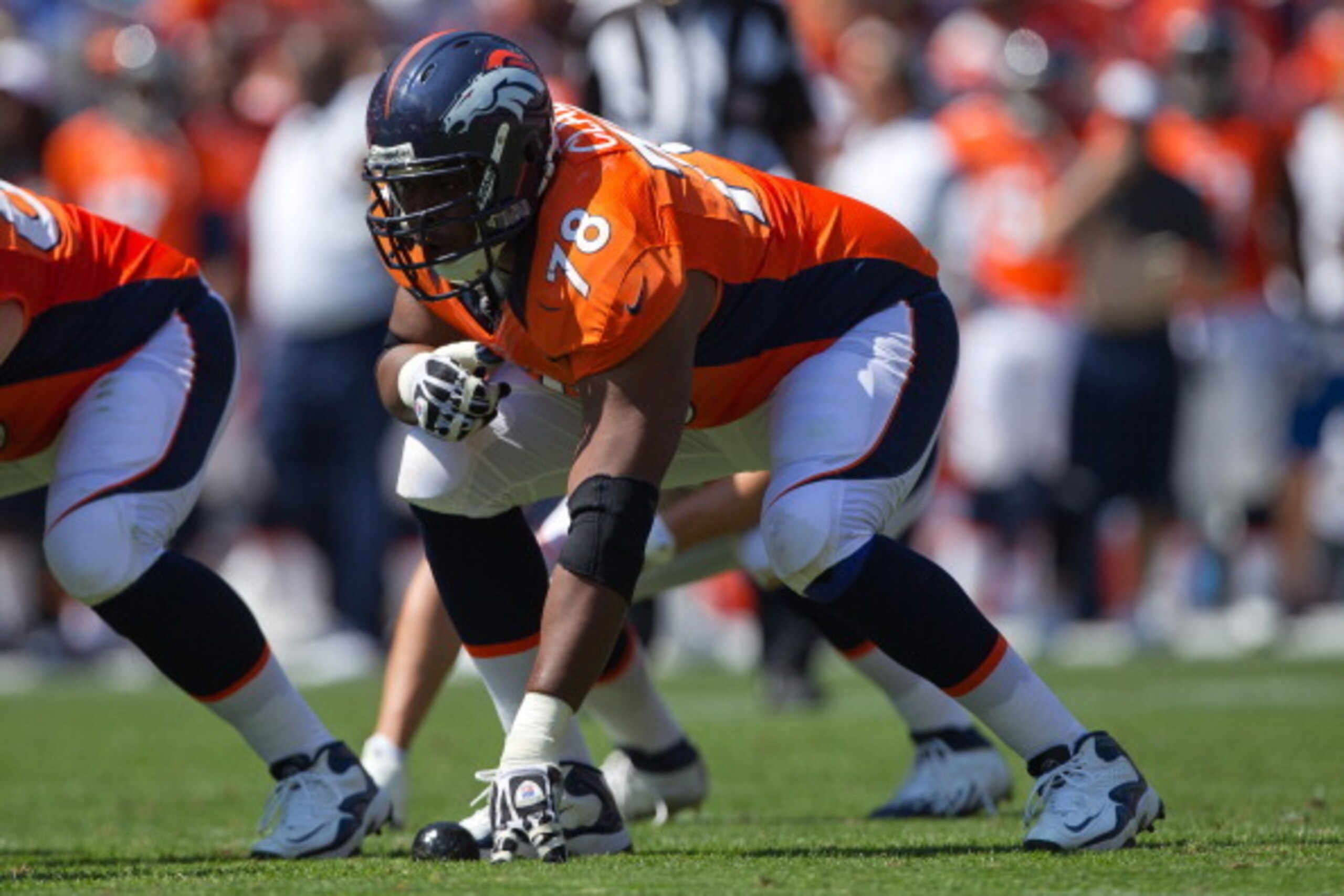
Denver’s offensive line surrendered the fewest sacks in the NFL last year (20).
Its lauded group of pass-blockers earned the No. 2 overall grade from Pro Football Focus.
Left tackle Ryan Clady, who missed all but the first two weeks of 2013, was supposed to make this group even stronger up front. After all, he was a first-team All-Pro in 2012.
Yet, even though the Broncos have allowed the fourth-fewest sacks in 2014, they’ve dropped to No. 9 overall in pass protection.
And Manning’s top blindside protector is a major reason for this legitimate downturn.
Clady has given up a team-high 11 quarterback pressures. Pro Football Focus has tagged him with a minus-1.3 grade, which ranks second worst on the Broncos and 45th among 72 tackles league wide.
He also surrendered four combined pressures and a minus-2.8—and team-low—score in Denver’s loss to Seattle. Manning completed only 40 percent of his throws with an interception and 32.1 passer rating when operating under pressure.
And without Seahawks pass-rushers in his face, the historic all-timer notched a 72.5 completion percentage with two touchdowns, no picks and a 109.1 rating.
Any basic deductive reasoning would deem Clady as one of the weakest links—if not the weakest link—on the Broncos front line.
So, if consistent pressure is the key to neutralizing Manning and his second-leading 2.27 seconds to throw from the pocket, exploiting Clady is a critical priority for the 49ers.
Accomplishing that feat will require the pass-rushing services of Ahmad Brooks and Dan Skuta.
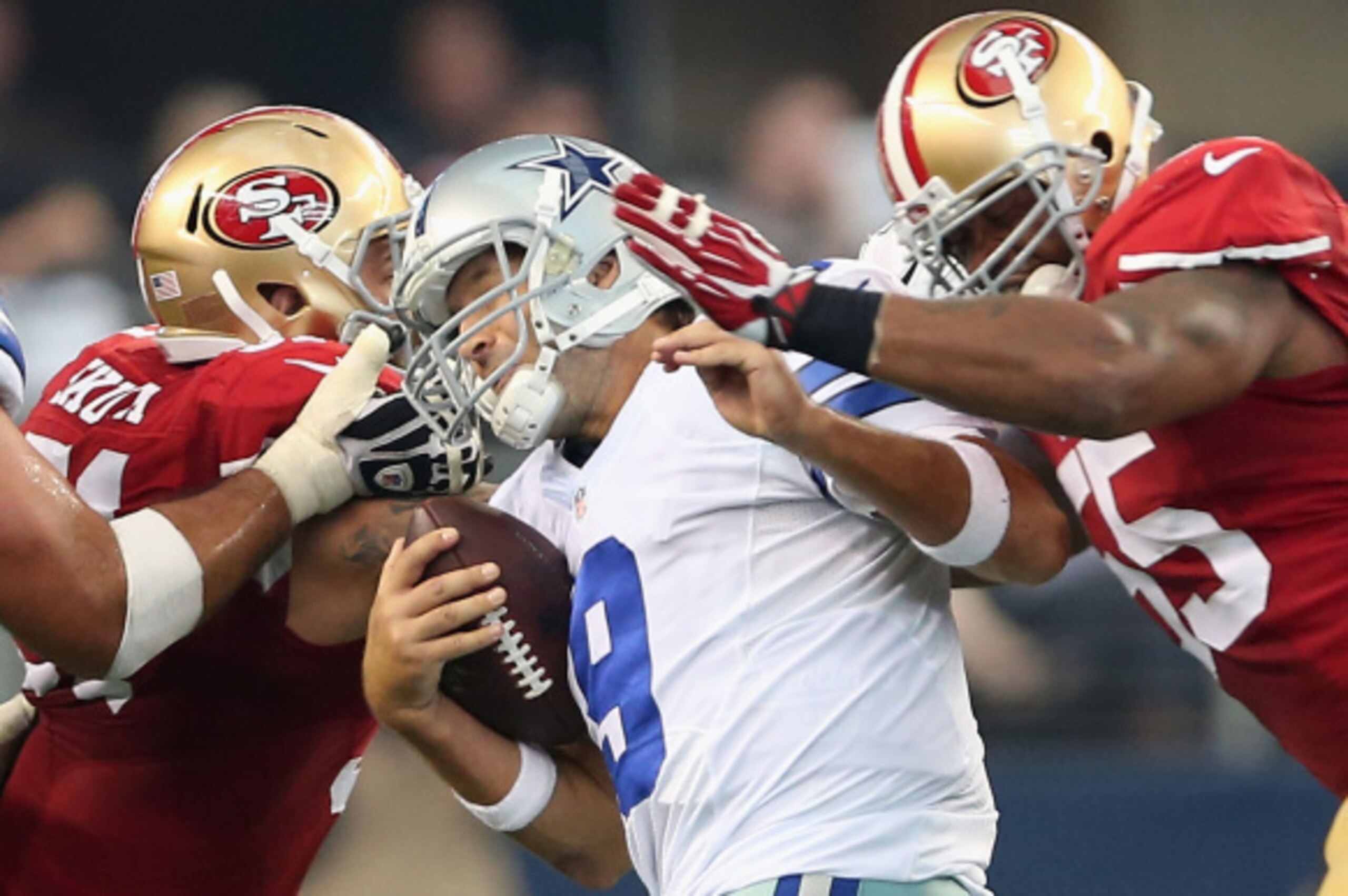
These outside 'backers own half of the 49ers' 10 total sacks. The duo has also been heating up of late, combining for four quarterback takedowns just last week.
Skuta must continue that unheralded effectiveness Sunday in the few times that Denver utilizes its base personnel. Brooks, for his part, must bring his A-game when he’s lined up outside of Clady when the Broncos force San Francisco into its nickel packages.
Sure, Manning has endured a sack on the fifth-lowest percentage of his dropbacks (10.9), not to mention facing pressure the second-lowest percent of the time (23.5).
But in those rare and fleeting occasions, he’s also completed just 43.9 percent of his passes, with a lowly 46.2 accuracy percentage, per Pro Football Focus.
Only two quarterbacks have been less accurate in those situations this season.
Skuta…Brooks—you’re up.
Inside Linebacker vs. Tight End
It’s clear that Manning operates from a clean pocket on an overwhelming majority of his dropbacks.
An absurd percentage of 76.5 should convey said phenomenon for those numerically inclined.
Knowing this salient fact, let’s deduce that Manning will have the requisite time with which to target his array of dynamic pass-catchers, most notably in the red zone.
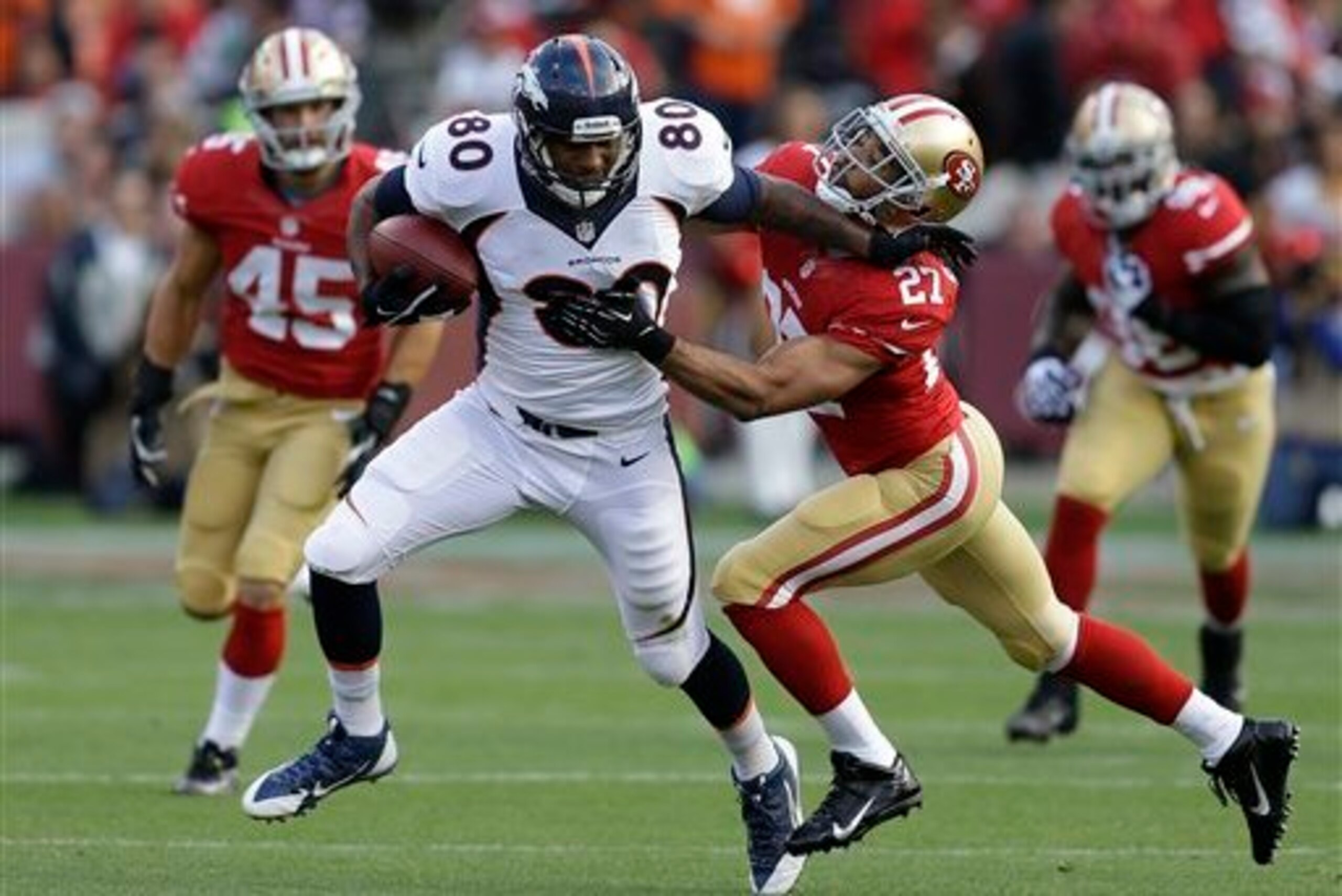
And when using his arsenal inside the 49ers’ 20-yard line, expect a whole lot of No. 80.
Julius Thomas leads the NFL with nine touchdowns. That’s more than any tight end, wide receiver or running back.
Pro Football Focus also notes that Thomas hasn’t dropped a single pass on 24 catchable balls.
The 6’4” reigning Pro Bowler is simply a superior athlete who now understands the nuances of the position, thanks of course to one Peyton Manning.
That should strike fear in the hearts of 49ers defenders—especially two in particular.
With Patrick Willis out with a sprained toe and NaVorro Bowman still recovering, San Francisco is left with two backups at the inside linebacker position.
Meet Chris Borland and Michael Wilhoite.
The 49ers selected Borland in the third round of this year’s draft. He’s a tackling machine who plays with savvy instincts and a nose for the ball.
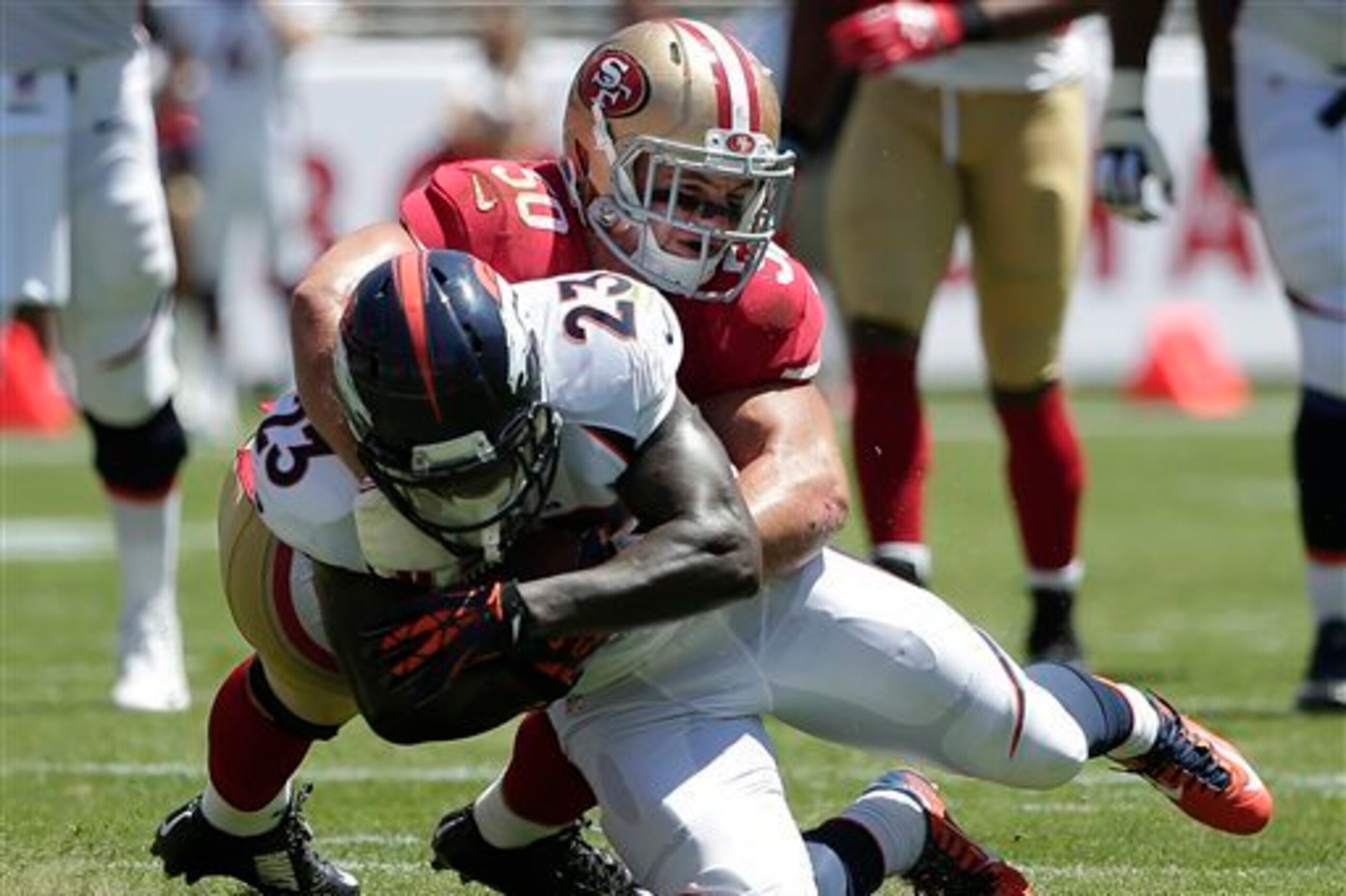
Borland amassed 100-plus tackles in three straight seasons and earned Big Ten Defensive Player of the Year in 2013. He left the NCAA ranks having set the conference record with 15 forced fumbles, per CBS Sports.
The 5’11”, 248-pounder overcame 4.81-second 40 speed, a “short stature,” “maxed-out frame” and “lack of arm strength” to earn a respectable mid-round pick.
As longtime draft guru Mike Mayock put it, via NFL.com, “He’s too short. He’s too slow. I don’t care, he can play.”
But can he cover an upper-echelon tight end at the NFL level? The same goes for the consistently solid—but still backup-quality—Wilhoite.
Well, based off this year’s statistical data, it seems they have a shot.
Borland tallied a high positive grade in pass coverage when subbing for Willis last week.
He allowed just one completion and broke up two passes, including one intended for 6’4” tight end Jared Cook.
Wilhoite, meanwhile, ranks ninth among 65 inside linebackers for his work in pass defense. That includes the sixth-lowest completion percentage allowed (63.5).
That said, Kansas City Chiefs tight end Travis Kelce beat him near the goal line for a two-yard touchdown in Week 5. There wasn’t enough time or space for safety Eric Reid or Antoine Bethea to provide help over top.
Such a scenario will surely present itself when the 49ers travel to Denver. Six of Thomas’ nine touchdowns have come from inside the 7-yard line.
So, whether it’s the third-round pick or former undrafted free agent defending underneath, one of these 49ers inside linebackers must transcend his unheralded status come Sunday at 8:25 p.m. ET.
Borland…Wilhoite—you’ve been notified.
LG vs. DT and LT vs. DE and RB vs. MLB
Please bear with us while we run through a bit of a progression.
Applying pressure to Manning and neutralizing his top red-zone target are two of the more pivotal tasks for the Vic Fangio-coached Niners defense.
Having cornerback Perrish Cox mirror the Broncos' dynamic wideouts—whether outside or in the slot—is a significant need as well.
In addition to the continually injured Tramaine Brock (toe), the 49ers will not have the services of slot man Jimmie Ward (quad). Aside from rookie Dontae Johnson, the entire stable of corners was limited in Thursday’s practice, per Matt Maiocco of CSN Bay Area.
So whether it’s the 6’3” Demaryius Thomas, 4.4-40-running Emmanuel Sanders or all-time slot wideout in Wes Welker, Cox must continue his PFF-awarded top-five level of play.
But all that said, as the old adage dictates, the best defense is a great rushing offense.

We can already visualize the coy yet simultaneously beaming smile on No. 21’s face.
The 49ers’ franchise-leading rusher must have a vintage Frank Gore outing.
Gore, along with rising rookie Carlos Hyde, must utilize their patience, power and high football IQ between the tackles. They must dig deep and maintain extended drives against the surprisingly formidable Broncos run defense, which ranks fourth in the league.
Combining for upward of 35 carries, in addition to a few read-option runs by Colin Kaepernick, can—and must—materialize from the 49ers’ fifth-ranked unit.
However, producing an effective rushing attack, and thus keeping Manning on the sideline, will require dominant work in the trenches by San Francisco’s offensive line.
And it begins with its beastly but soft-spoken leader.
Mike Iupati sports the top grade among 49ers run-blockers. The mauling 6’5”, 331-pound left guard has also earned the No. 2 ranking among 73 guards scored by PFF.
Iupati will have the task of paving running lanes and exploiting the primary weakness against an otherwise stout Denver front line.
Second-year man Sylvester Williams is the only asset in this front seven with a negative grade versus the run. His minus-3.3 places him at No. 61 among the 74 defensive tackles graded.
It’s imperative that Iupati, along with the quietly top-nine center Daniel Kilgore, create openings for Gore and Hyde in the left interior.
Speaking of the left side, Joe Staley—San Francisco’s blindside protector and foremost overall lineman—must win his matchup against a beatable member of the opposition.
DeMarcus Ware has gone throwback as a pass-rusher. Only three other 4-3 defensive ends have compiled more totals sacks, hits and hurries than Ware’s 23.
But even though he rates 13th against the run, he isn’t nearly as impenetrable as the fifth-ranked Derek Wolfe and Malik Jackson and 331-pound Terrance Knighton on the opposite side.
Staley and his top-10 run-blocking grade must seal Ware to the outside. That will allow the Niners’ running back duo to break through the inside behind Iupati and Kilgore.
Most importantly, it will funnel Gore and Hyde away from Von Miller, who is the highest-rated run-stuffer among 4-3 outside ‘backers.
Middle linebacker Nate Irving is no slouch either. His No. 11 rating makes him plenty capable against the run.
That said, his six missed tackles compared with Miller’s one—and zero by weak-side linebacker Brandon Marshall—also make him a much more enticing obstacle.
Quarterback vs. Defensive End/Outside Linebacker

Yet, as much as the 49ers linemen and running backs will drive this Greg Roman-coordinated game plan, it ultimately rests on the shoulders of Colin Kaepernick.
Kaepernick must execute the zone read and overall rushing attack like a seasoned vet.
He must decide when to hand it off, when to keep it himself and when to audible into or out of a run play. He must read the eyes of Miller and the Broncos defensive ends and diagnose—and deliver—accordingly.
Going through his progressions and hitting his possession targets in the passing game will certainly come into play as well.
Connecting with Michael Crabtree, Anquan Boldin and Stevie Johnson underneath, along with Brandon Lloyd and Vernon Davis deep over the top, is a big-time necessity.
But when it comes to conquering Manning and the defending AFC Champions under the bright lights of Sunday Night Football, Kaepernick must shine as a run-oriented leader.
He must out-Manning Peyton Manning with an un-Manning-like approach—at least in the sense of running the ball.
One way or another, the NFL world surely can’t wait until this potential Super Bowl preview goes down.
All team and player statistics courtesy of Pro-Football-Reference, ESPN and NFL.com. Advanced metrics provided by Pro Football Focus (subscription required).
Joe Levitt is a Featured Columnist for Bleacher Report, waxing academic, colloquial and statistical eloquence on the San Francisco 49ers. Follow him on Twitter @jlevitt16
.jpg?w=2560)