Biggest Adjustments Carmelo Anthony Will Have to Make in the Triangle Offense
As in most professional sports, the NBA preseason tends to attract the eyes of only the most fervent and feverish fans—those for whom summer brings the cruelest of hardwood withdrawals.
But there’s something different about this year’s New York Knicks. Marshaled by new president Phil Jackson and first-time head coach Derek Fisher, New York’s foray into the triangle offense has managed to capture even the traditionally distant and skeptical.
Of principal interest is how Carmelo Anthony—long the lone gunner in a scheme built around him and him alone—will take to Jackson’s famously pass-happy system.
Today, we’ll look at the five biggest adjustments the seven-time All-Star will have to make in order for the triangle to thrive.
Can one of the league’s foremost offensive weapons embrace basketball gestalt? Jackson has pulled it off before before. But never with stakes—or on a stage—quite like this.
Working Within the Flow of the Offense
1 of 5
Fair or not, the Knicks under Mike Woodson earned a reputation for being far too predictable on offense. That tends to happen when one player regularly registers usage rates in the 30s.
In fact, according to a Harvard University study, the Knicks ranked dead last in overall player movement a season ago.
Enter the triangle, a system that's very essence lies in putting players in perpetual motion and exploiting the resulting defensive confusion.
In an excellent triangle primer penned shortly after Jackson’s hiring, Bleacher Report’s Dylan Murphy went to work detailing how the system’s emphasis on constant movement will inevitably put Anthony in strategically advantageous—and comfortable—positions:
"All of the movement frees Anthony before he gets the ball. It also muddles up the rest of the defense, with so many choices available for the person with the basketball.
But most of all, it gets Anthony going onto his right hand only 15 feet away from the rim. As opposed to starting in isolation from the baseline or top of the key, as he usually does, he's already moving without the ball in an extremely dangerous position.
Not to mention that he has the 5 at the rim, a dribble attack against an already compromised defender, or a kick to a corner three-pointer if the 2's defender over-helps.
"
That’s not to say Anthony won’t have adjustments to make. As with any top-tier scorer, Melo has his sweet spots on the floor—particularly the right elbow and wing. And while the triangle is bound to find him moving organically toward those sectors, Anthony must resist the temptation to plant himself in his comfort zones and expect the offense to unfurl apace.
There’s little doubt the triangle is well suited to Melo’s offensive strengths. Whether he can let those strengths emerge within the flow of the system, as opposed to forcing them on the system, remains to be seen.
Making Quicker Decisions
2 of 5
Anyone who’s happened upon a Knicks game these past few years has seen it firsthand: a quick entry pass into Anthony (typically at the elbow), followed by seven or eight seconds of jab steps and ball-pounding hesitations before the inevitable jumper or dribble-drive.
It’s that very deliberation that’s helped Anthony become one of the most punishingly lethal scorers in recent memory. Unfortunately, it’s also the kind of thing that can kill a triangle possession where it stands.
Jackson’s offense places a colossal emphasis on reading the defense and making quick decisions—something with which Anthony and the Knicks have long eschewed.
To his credit, Anthony seems to be coming to grips with the triangle’s finer nuances. From a recent interview with ESPN New York’s Ian Begley:
"It's an adjustment. It's an adjustment because I'm used to taking my time and seeing where the defense is coming from. And even now, it's a medium that you've got to play with. Sometimes you can hold it a little, sometimes you don't have it, (you have to) get it out quickly…If you don't have nothing in a second, second and a half, the ball is out. There's no holding, there's a lot of ball movement. So your [teammates] have got to be ready for it.
"
Not that New York’s cornerstone has been a complete black hole. In fact, as of late last January, Knicks shooters were registering a league-high effective field-goal rate of 77.3 percent off of passes resulting from double-teams on Anthony, per the Wall Street Journal’s Chris Herring.
As a passer, Melo is more than capable. Rather, it’s in his willingness to do so—particularly given the arsenal of moves and machinations at his disposal—that critics have found their most fruitful fodder.
Moving Without the Ball
3 of 5
For Anthony, flourishing in the triangle is as much about moving the ball as it is moving without it—making sure he’s in an ideal position to be effective whether or not the Spalding winds up in his hands.
Here’s Dime.com’s Jack Winter expounding on precisely this point:
"Movement in general is key in the Triangle, and the slimmed-down Anthony will have many chances to attack from the post or post-extended with three players stationed on the weak-side to draw attention away from him this season. Likewise, he’ll get more spot-up opportunities when [Amar’e] Stoudemire is occupying the block, and will actually be in position to effectively cut without the ball in that scenario, too.
"
In J.R. Smith, Amar’e Stoudemire and Andrea Bargnani (say what you will about him), the Knicks boast a trio of second options through which the offense can flow, giving Anthony opportunities aplenty to cut baseline for easy dump-downs or let fly on the catch-and-shoot.
During his gold-medal run with Team USA in the 2012 Olympics, Anthony was certifiably devastating working off the ball, tallying 16.8 points per game (second only to Kevin Durant) on a crisp 54 percent shooting (including 50 percent from distance).
Small sample size aside, Anthony has shown he can be as much a force working off the ball as he is with one in his hands. Forging that level of trust with these Knicks, lacking as they are Dream Team-level talent, stands to be one of the biggest bellwether’s for New York’s long-term triangle success.

Becoming a More Well-Rounded Offensive Rebounder
4 of 5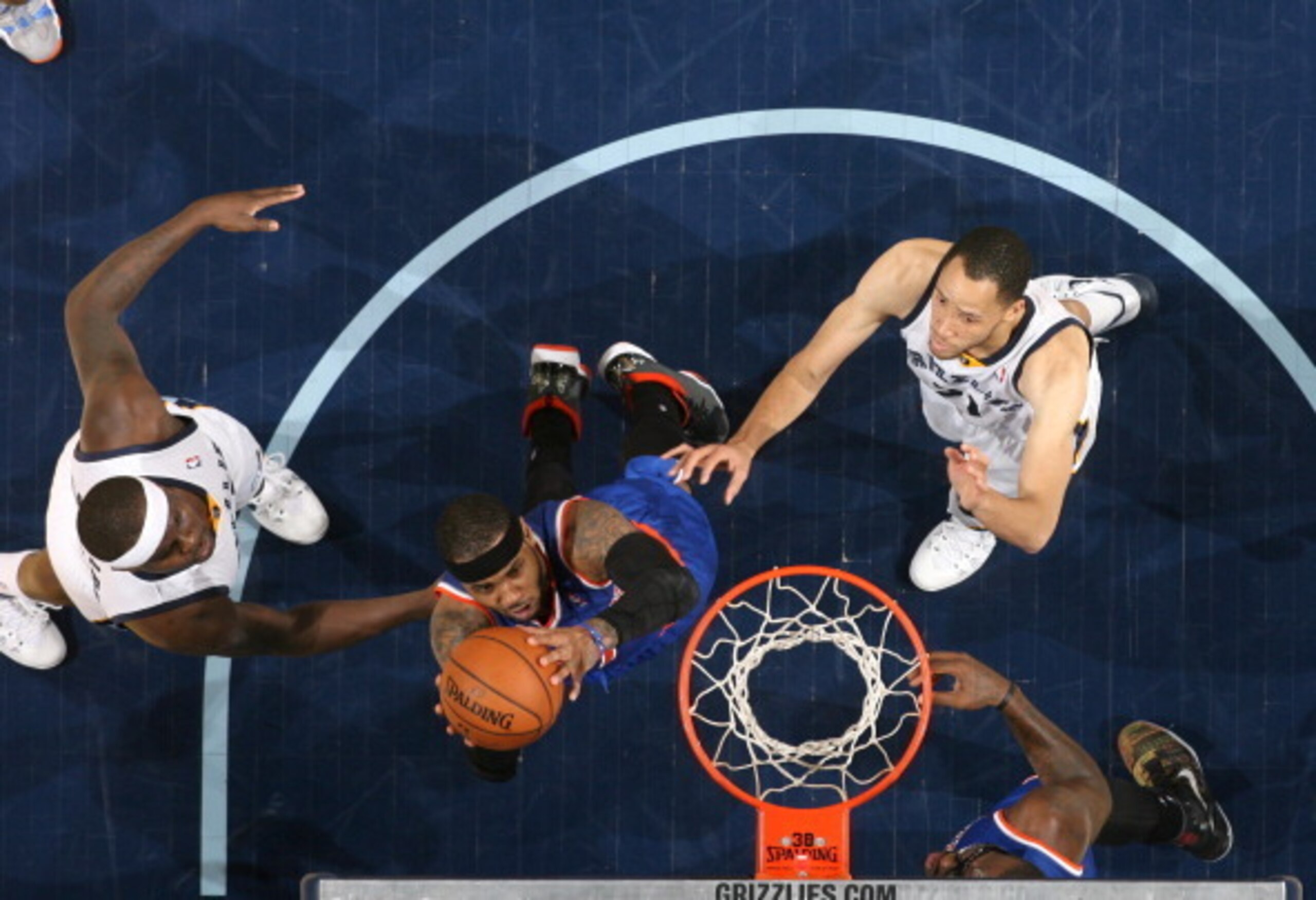
This might sound a bit esoteric, but hear me out.
One of the underrated hallmarks of the triangle is how its unique spacing allows for unencumbered angles to the offensive glass, resulting in a bevy of offensive rebounding opportunities.
And while Anthony has always been solid in this department, the bulk of his OREBs tend to come off his own misses—specifically, on-hard-nosed dribble-drives.
That’s all well and good, of course. But Anthony could stand to become more adept at collecting misses off the weak side, where he can use his bulk and innate sense of positioning to extend possessions and his own stat sheet.
Try as Fisher might to reverse the trend, New York is likely to get steamrolled on defense, making it all the more important that the offense operate efficiently and with as many opportunities as possible.
It might seem like small statistical potatoes, but if Anthony gets his offensive rebounding rate back up into the seven or eight range, that will bode well for the Knicks offense at large.
Being Patient
5 of 5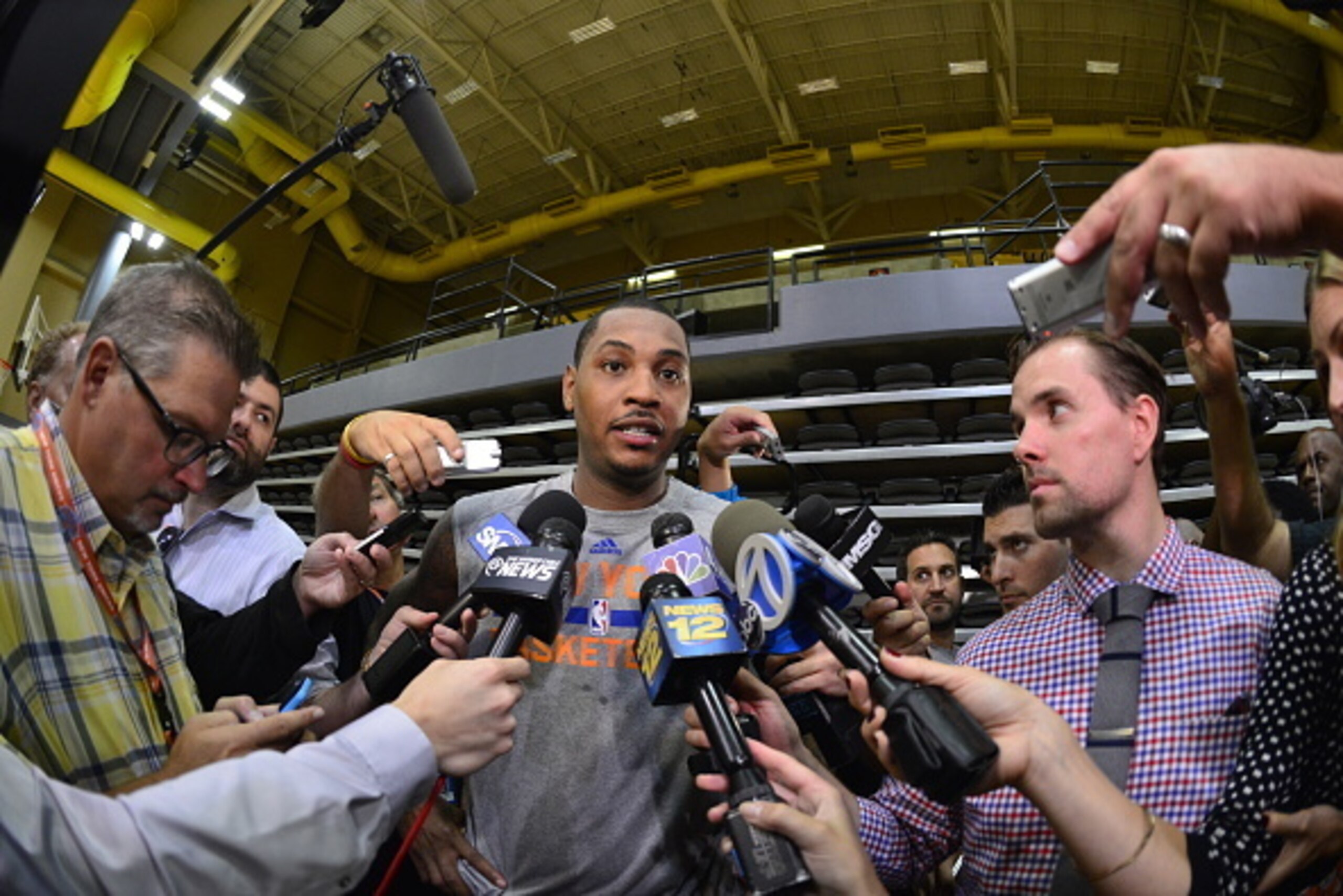
We’ve talked about Anthony needing to make quicker decisions to allow the triangle to operate at full tilt. That is, not making patience too much of a real-time virtue.
Rather, it's important that Melo have patience with the process itself—to not allow one bad slump, or even one bad season, to discourage him from buying in fully to Jackson’s tried-and-true methods.
"We haven't even broke the tip of the iceberg yet in terms of this offense," Anthony remarked following a recent loss to the Boston Celtics (via Begley). "So for me I'm still trying to find my way and trying to see the spots on the court and trying to get the timing down on this offset.”
Clearly Anthony appreciates that finding his triangle niche won't happen overnight. But he also has to engender that same spirit of patience with respect to the overhaul of the team itself—the strategic and psychological cleansing of an organization long mired in mendacious mediocrity.
At 30 years old and with nary a ring to his name, Anthony is at a career crossroads. Buy in lock, stock and barrel, he has a chance to both redefine his NBA legacy and foster the kind of culture capable of attracting more needle-moving talent.
Revert back to bad habits and splintered on-court crutches, not even that $124 million will be enough to flush the bitter taste from the mouths of all involved.
By forcing his way to New York back in 2011, Melo opted for instant fixes over farsighted foundations. The onus is now on him to reverse that narrative, one triangle triumph at a time.

.jpg?w=2560 "NFL House in Paris Closes for Protests")
.jpg?w=2560 "Trevon Diggs Cut by Seahawks")