Teddy Bridgewater Takes Step Back in 'Eye Opening' Performance, Still the Future
After an exciting, promising display in his first career start two weeks ago, Teddy Bridgewater took a step backward in the Vikings’ 17-3 loss to Detroit on Sunday.
Bridgewater completed 23-of-37 passing attempts for only 188 yards through the air. Turnovers and sacks added to the misery. Three of his throws fell into the hands of the Lions defense, and eight of his dropbacks ended in sacks. Those game-changing plays doomed the Vikings offense to only three points on the day.
The high point that was Bridgewater’s brilliant performance against Atlanta has become quickly forgotten. Maybe the rookie wall has already arrived. Maybe this performance was a one-off showing, not one predictive of the future. Either way, the first-round pick will go further under the microscope of the media and fans.
TOP NEWS
.jpg?w=2560 "NFL Paris Football")
NFL House in Paris Closes for Protests
.jpg?w=2560 "Seahawks Chiefs Football")
Trevon Diggs Cut by Seahawks
.jpg?w=2560)
B/R's Expert Week 7 NFL Picks 🔮
Bridgewater gave his account of the struggles after the game, as quoted by Dave Campbell of the Associated Press (h/t Star Tribune):
""You're not just going to go out there and be perfect. There's some throws that you're not going to be able to control and there will be things that happen throughout the course of a game that you won't be able to control," Bridgewater said.
"But at the same time, for me, it was an eye-opener. After my performance against Atlanta, I believe the expectation level is high. But I have a high expectation level for myself also."
"
An eye-opener it was.
That description from Bridgewater should not cause a panic. Rookies of all positions, but especially at quarterback, have aches and pains adjusting to the speed of the NFL game. Detroit was able to vary looks and confuse the rookie at times. The defense combined that with athleticism unmatched by the previous defenses Bridgewater exploited. His trouble adjusting was not entirely unpredictable.
Detroit’s defense being too fast and too overwhelming for the rookie is not why this performance should be looked at as a step back. Most rookie quarterbacks take these lumps. Bridgewater’s struggles represent a step back because he let the Detroit defense affect the way he performed on a majority of his snaps.
The first-quarter interception in the red zone showed that Bridgewater is still rather green as an NFL quarterback. It also pointed to hurried processing and assuming, habits he did not display at Louisville.
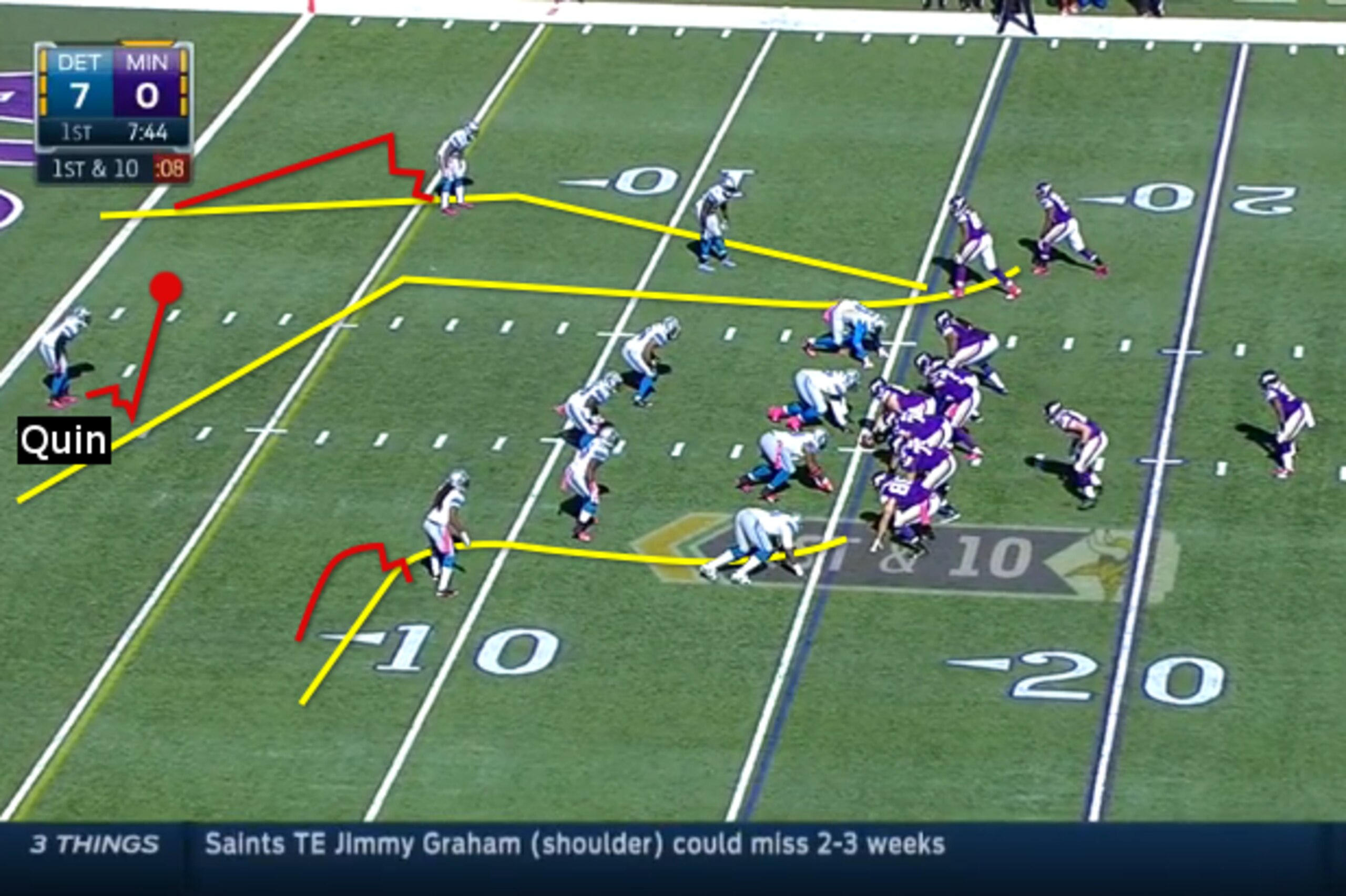
Bridgewater’s progression should be from the outside to the inside on these downfield routes. Locating and reading the safety, Glover Quin, is objective No. 1.
But as Bridgewater hits the back of his drop, the safety is non-committal. Detroit is playing Cover 3 zone, so Quin patrols the deep middle third of the field. When Quin stays between the hashes, Bridgewater should progress to the inside crossing pattern, checking the cornerback’s depth to his left.
If he had done so, he would have located Greg Jennings for a touchdown. Lions cornerback Rashean Mathis didn't deepen his positioning enough to play the deep crosser, staying with the out route instead.
Bridgewater made an assumption that Quin was tracking Jennings, so he threw to the middle of the field, resulting in a simple interception. Justin Rogers of MLive Media Group provide Quin’s side of the story:
"On first interception, Glover Quin baited Bridgewater. Quin told me Carolina beat them with same play, so they changed the coverage.
— Justin Rogers (@Justin_Rogers) October 12, 2014"
This play is one Bridgewater should learn from but also one that he needs to be able to make as a starting quarterback right now. Locating and reading the single-high safety was the first task of the coverage diagnosis, but he got ahead of himself.
He seemed especially aware of the Lions’ pass-rushing potential, which is natural and not always a bad thing. As Detroit began to bring the heat on a consistent basis, though, Bridgewater let it affect his play beyond simply getting sacked when the offensive line let him down.
Accuracy inconsistencies are the biggest concern from Sunday's showing and the lapses were frequently pressure-related.
Inaccuracy in the short to intermediate passing game is not like Bridgewater at all. Through my own extensive work, he charted out as the most accurate passer on throws between 0-10 yards at Louisville. His 90 percent completion rate on such throws stood well above all other 2014 prospects.
Bridgewater left too much work for his receivers on numerous throws, both underneath and to intermediate areas of the field. While some of such incompletions hit the hands of his receivers, he needs to aid them with more precise ball placement.
The final reason why the rookie’s showing against the Lions was a step back comes from his lack of decisive movement in the pocket.
Detroit pressed the pocket from the inside and also won from the edge, often compressing the pocket and forcing the rookie to operate in tight spaces. In comparison to other quarterback prospects, Bridgewater thrived when it came to manipulating tricky pockets in college. He even adjusted to the rush well against New Orleans and Atlanta.
Against Detroit, though, he failed to aid his offensive line on a few plays. The best example of this led to a strip sack in the second quarter.
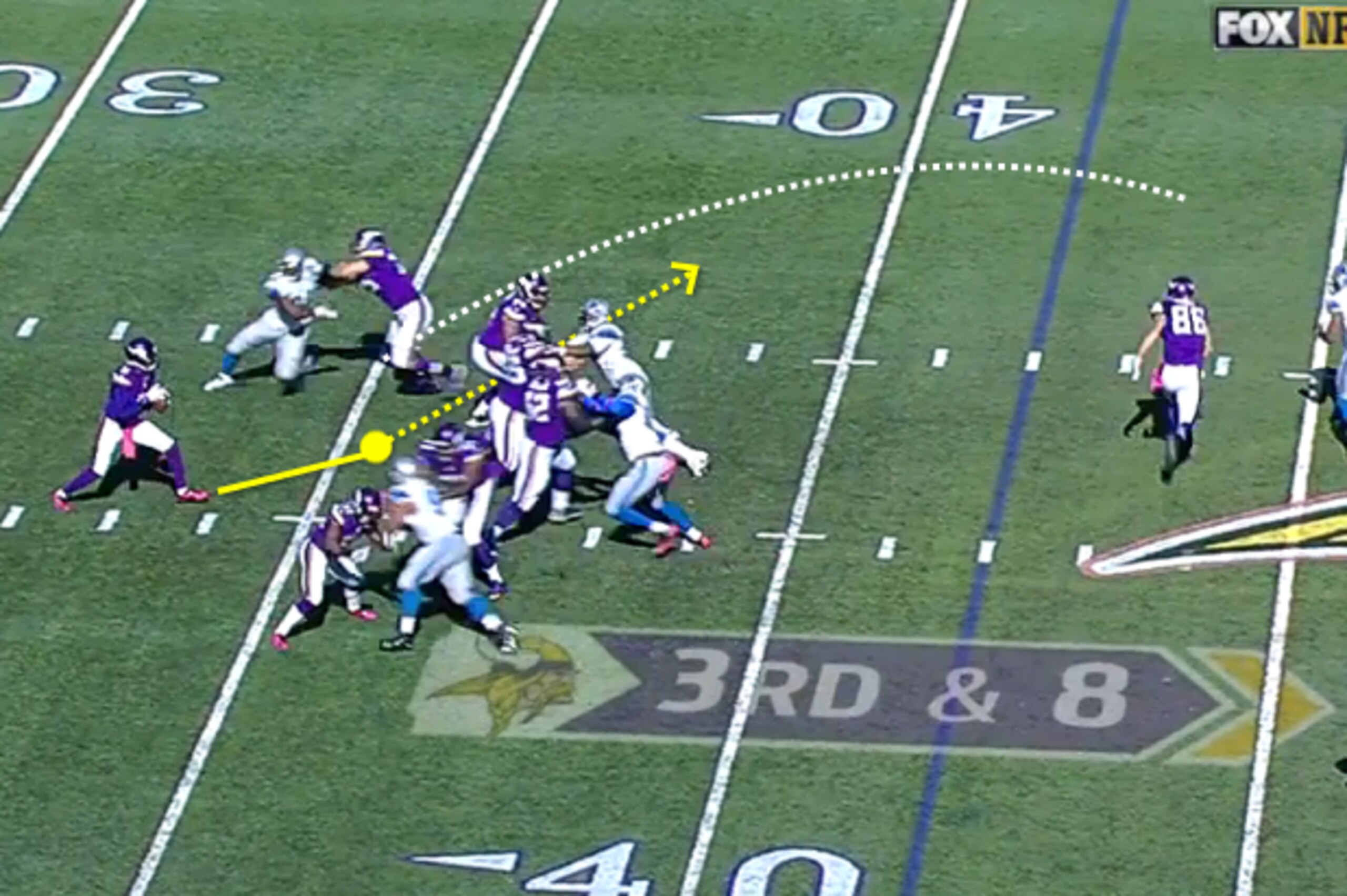
Matt Kalil performs his usual sieve routine at left tackle, losing the quickness battle around the corner. Bridgewater responds appropriately by climbing the pocket to find space. When a quarterback steps up into the heart of the pocket, he is left with only two options. The first is to release the football. The second is to escape the pocket for good. Bridgewater does neither, camping out in no man’s land instead.

Because his decision-making process slowed to a crawl on this play, Ansah is able to reach in and strip the ball. The Vikings recovered, but the Lions earned a third-down stop.
All three of these issues, the failure to properly recognize a simple coverage, the inaccurate underneath passing and the delayed responses to the rush are concerning. Bridgewater showed mastery of these points of quarterback play at Louisville and even in his first two NFL games. For his development to get back on the right track in 2014, these aspects need immediate improvement.
Bridgewater’s stat line tells a much harsher story than that, however. Numerous factors played a part in making the rookie’s poor day look worse than it was. The offense as a whole was overwhelmed by one of the league’s best defenses. Bridgewater was far from the worst performer on Sunday.
Minnesota’s struggles to gain adequate yardage on first and second downs often left Bridgewater tasked with converting from 3rd-and-long situations. Norv Turner called a pass on every third down.
"Distance to go on failed 3rd downs: 9,8,9,3,10,2,13,12,9,9,11 average 8.6. Distance to go on 3rd down conversions: 2,7,3 average 4. #Vikings
— Darren Page (@DarrenPage) October 13, 2014"
When Minnesota was left needing eight or more yards to move the sticks, which was the case in nine of the 11 third-down failures, the Detroit pass rush pinned its ears back. Ndamukong Suh, Nick Fairley, Jason Jones, George Johnson, and Ansah terrorized a porous Vikings offensive line all game long. Having so many 3rd-and-long situations only made the problem worse.
The statistics tweeted by the Star Tribune’s Matt Vensel, via Pro Football Focus premium statistics (subscription required), quantify what the young quarterback was up against.
"Teddy Bridgewater was pressured on 24 of his 47 dropbacks, per @PFF. But the #Lions blitzed the #Vikings on just eight plays.
— Matt Vensel (@mattvensel) October 13, 2014"
Bridgewater erred in his pocket movement a few times as previously mentioned. More often than not, though, he was barraged by a rusher or two as soon as he moved on to his second option in a progression. He was even sacked by rushers from multiple directions on more than one play.
Having to come off his first option and then often his second option as well occurred because the receiving corps did little to separate from coverage.
Cordarrelle Patterson was hobbled by a hip injury. Per Pro Football Focus premium statistics, Patterson still ran 39 routes against Detroit. Only Jennings and Chase Ford ran more routes. Most of Patterson’s routes were clearly affected by the injury, so he had trouble making himself open for Bridgewater.
Even Jennings, a wily veteran who’s experienced in beating man coverage, frequently failed.
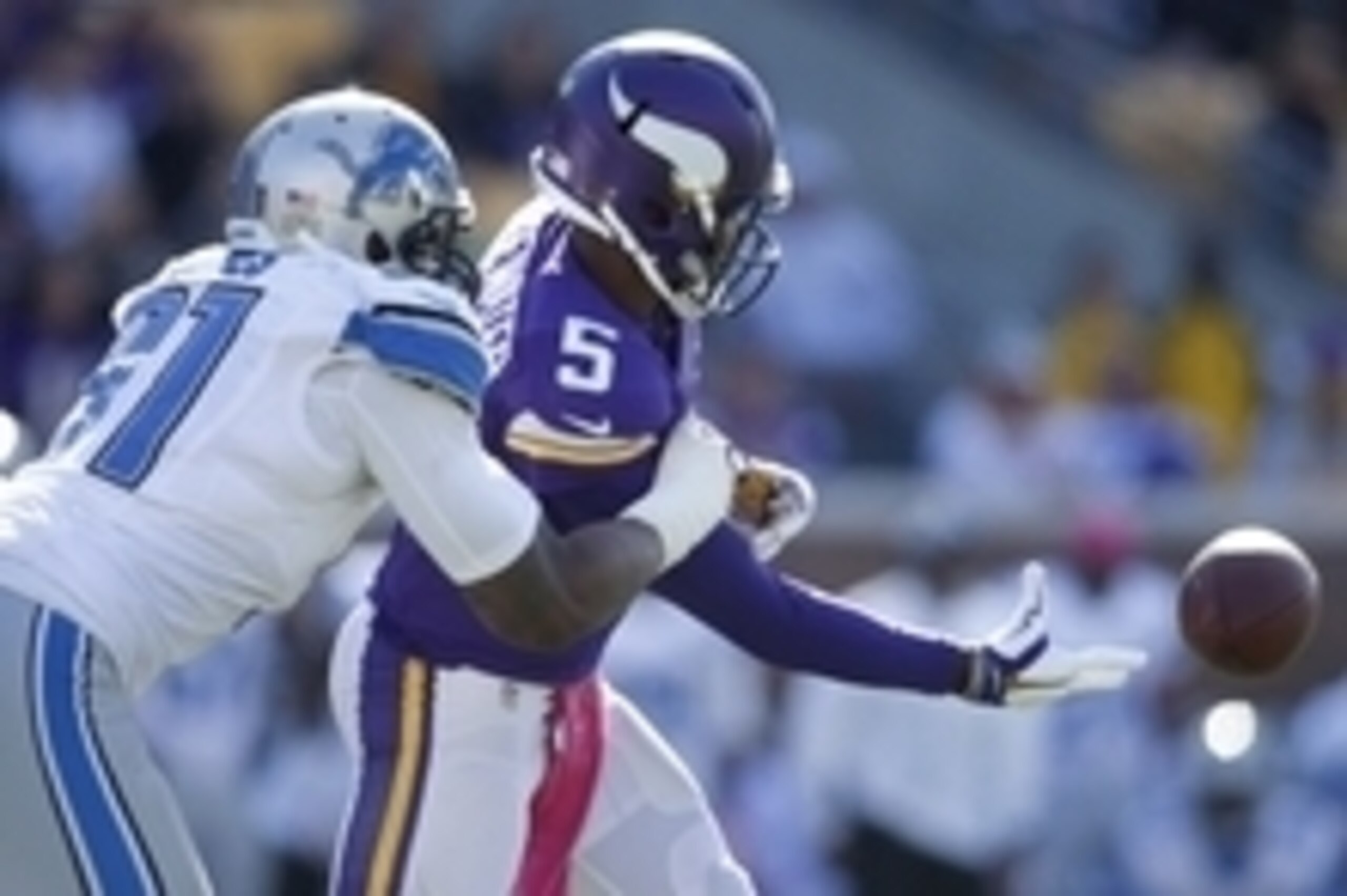
Bridgewater was left to his own improvisational devices too often, because his receivers were shut down by Detroit’s effective man coverage. With how quickly the Lions pass rush was able to swarm the rookie quarterback, the results became predictable.
The interception total paints an unfair picture as well. There is no doubting Bridgewater’s fault on the first, as previously detailed. The second bounced off the hands of running back Matt Asiata and into the waiting arms of a defender.
The third was the result of a deflected pass at the line of scrimmage. While quarterbacks can avoid getting passes tipped by defensive linemen, an interception was hardly an accurate assessment of Bridgewater on this particular play.
Distributing blame to multiple facets of the offense is not the convenient way to analyze Bridgewater’s performance, but it is the correct way. He had a hand in numerous failings, some of them causes for concern. His supporting cast also let him down.
Head coach Mike Zimmer was quick to quick to stand by his quarterback’s side, per ESPN.com’s Ben Goessling:
"Zimmer said he believes "with all my heart that Teddy Bridgewater is going to be the franchise QB for a long, long time."
— Ben Goessling (@GoesslingESPN) October 13, 2014"
Bridgewater is a long-term investment that the Vikings have made. While immediate returns would make things easy for fans, coaches and the team, quarterback development is a process that takes time. Few young quarterbacks have ever entered the league with guns blazing on a weekly basis. Hiccups are the norm.
The quarterback’s growth over time is truly important. Look for the ways Bridgewater learns from his mistakes and adapts to the speed of NFL defenses. He showed measureable improvements over the course of his collegiate career and the same should be expected from him in the NFL, both during his rookie season and over the course of his first contract with the Vikings.
Early errors are healthy. Bridgewater must now respond with the appropriate corrections.
Stats accumulated from ESPN.com unless noted otherwise.
.jpg?w=2560 "Colts Football")