

Did Klay Thompson Prove He's a Max Player This Offseason?
It isn't easy for NBA players to greatly improve their profiles over the offseason, but Golden State Warriors sharpshooter Klay Thompson managed to do just that.
From his featured role in the ill-fated Kevin-Love-to-the-Warriors trade talks to his prominent position with Team USA's gold medalists at the 2014 FIBA Basketball World Cup, Thompson's status grew to heights previously unseen by the 24-year-old.
But did they rise high enough to warrant the max-contract demands that USA Today's Sam Amick reported were made by Thompson's agent, Bill Duffy? That's a question the Warriors front office needs to figure out by October 31, the deadline to ink Thompson to an extension and prevent his potential path to restricted free agency next summer.
TOP NEWS

Buzz: Bron Chopper Part of Deal 🚁

MJ Makes Record-Setting Donation 🙌
Buzz: Knicks' KAT Offer Revealed
The Warriors, unsurprisingly, haven't yet tipped their hands on the matter. They have, however, publicly proclaimed how much they cherish their two-way 2-guard and stressed that they want him to stick around as long as possible.
"We value him in the highest way," Warriors general manager Bob Myers said, per Bay Area News Group's Diamond Leung, "and we want to keep him on this team for a long time."
Of course, the team's stance would have been equally clear had Myers said nothing at all. The Warriors' pursuit of Love stalled because of an "organizational split" on whether to include Thompson in the deal, sources told ESPN.com's Marc Stein and Ramona Shelburne.
If the Dubs had hesitations about dealing Thompson for Love, who has appeared in three of the last four NBA All-Star games, that speaks volumes on how much the franchise values the sniper.
It also signals the fact that a max deal sits in Thompson's near future. The Warriors will surely try to talk their way out of paying that premium—and could conceivably force Duffy to find that money elsewhere next summer—but some team is going to foot the bill.
And considering both what the Warriors have invested in Thompson and how well he fits alongside franchise face Stephen Curry, they'll probably be the ones signing the check.
"That backcourt is special," Klay's father Mychal Thompson told Amick. "You don't break that up. He and Steph, they are a great combination, like Laurel and Hardy, Abbott and Costello, Sanford and Son. They're perfect together. ... I expect them to be together another 10 years. I'd be shocked if they're not."

Debating how much Thompson will make on his next deal has been an exercise in futility since the ink dried on the new contracts of Gordon Hayward (four years, $63 million) and Chandler Parsons (three years, $46 million).
Per Tim Kawakami of the San Jose Mercury News, those negotiations cemented a max-money payday for Thompson:
"If Thompson and his agent were contemplating a $12 million average (still pricey!) before the Parsons and Hayward deals, that's outdated now.
Post-Parsons/Hayward, Thompson's next deal has to start at his maximum level, which is estimated to be slightly more than $15 million next year for a player of Thompson's experience level.
Has to start there, and has to average about $16-17 million overall, unless Thompson's career collapses, which it probably won't.
"
The far more interesting conversation to be had is whether Thompson actually deserves such an investment.
The stat sheet paints him as a specialist, firing off three-point bombs at one end and stifling perimeter attacks at the other. He does both exceptionally well.
His 545 threes over the past three seasons are second only to Curry's 588. Thompson's 41.0 three-point percentage ranks fourth among the 20 most prolific perimeter shooters over that stretch.
Defensively, Thompson shines brightest for his versatility. He has the speed to stay in front of track-star point guards and the size and strength to bother bigger scorers out on the wings. Those traits help him tackle Golden State's toughest backcourt assignment, allowing Curry to conserve his energy for the opposite side.
The numbers stop short of labeling Thompson as an elite defender. The 0.82 points per possession he allowed to opposing scorers last season ranked 69th in defensive efficiency, per Synergy Sports (subscription required). Considering the caliber of player he squared up with on a nightly basis, though, that standing is far more impressive than it sounds.
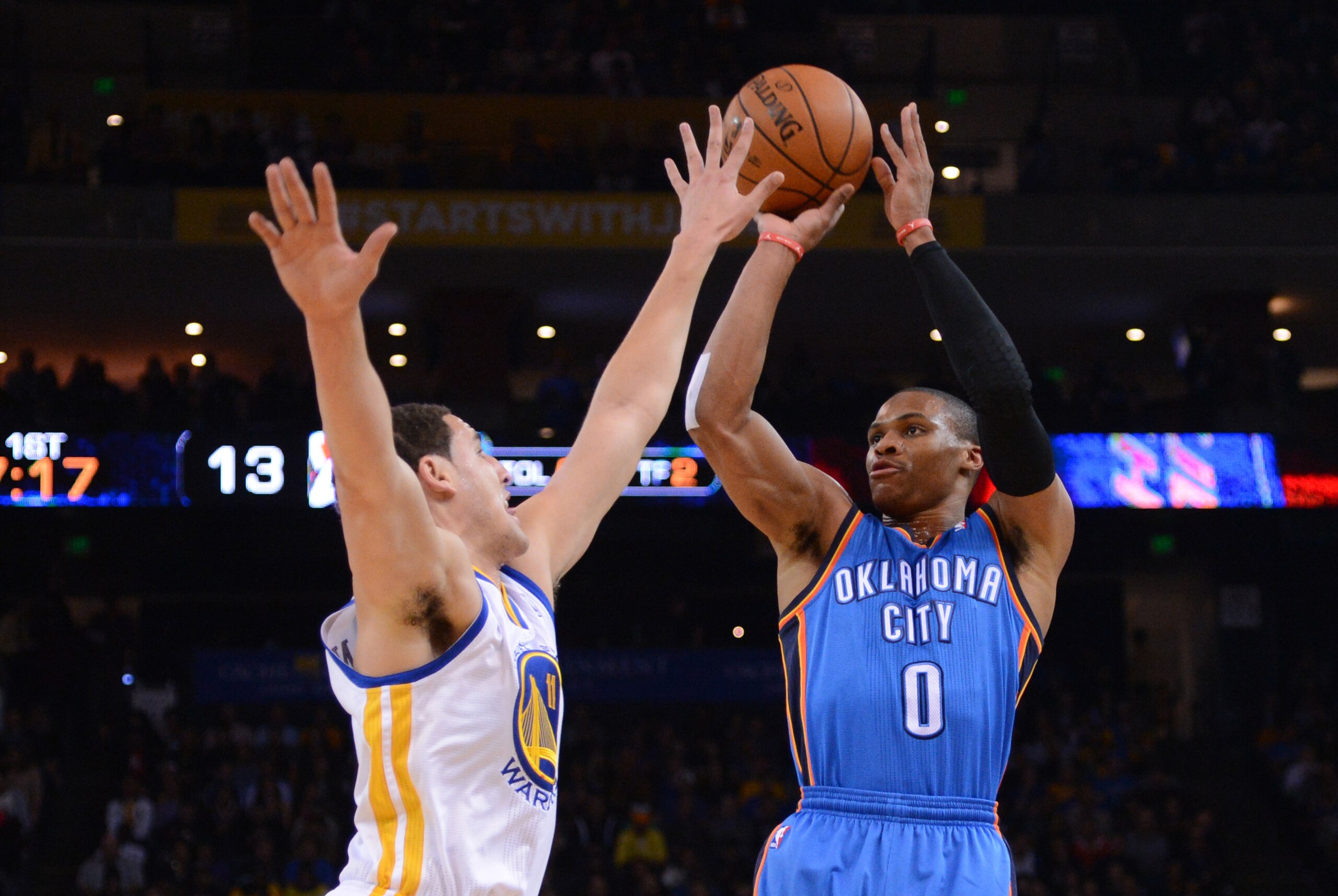
Along with All-Defensive first-teamer Andre Iguodala and rim protector Andrew Bogut, Thompson helped power the Warriors to the NBA's third-best defensive efficiency (99.9 points allowed per 100 possessions). Truth be told, Thompson may have had the heaviest hand in that ranking.
"Klay is a much better defender [than Iguodala]," a former Warriors assistant told Bleacher Report's Ric Bucher. "It's not even close."
Combine those two elements, and the result is a two-way force.
Appropriately, the Warriors outscored opponents by 9.5 points per 100 possessions with Thompson on the floor and were outscored by 5.2 points per 100 possessions when he sat. That 14.7-point net differential was second only to Iguodala's (17.0) on the team.
In other words, there is some substance at the source of Thompson's max-contract request.
However, there are some holes in his game—and, by extension, that request.
He offers little in the form of offensive creativity. He has averaged just 2.2 assists over his three-year career. His 10.2 assist percentage ranked 43rd out of the 46 guards who averaged at least 30 minutes per game last season (minimum 41 games played).
The problem with his inability to set up his teammates is compounded by the fact that he rarely found himself shots.
Over 62 percent of his two-point field goals came off assists last season. Of the 27 guards and forwards who averaged at least 18 points last season, only power forwards David Lee (68.2) and Blake Griffin (64.9) were assisted on a higher percentage of their baskets.
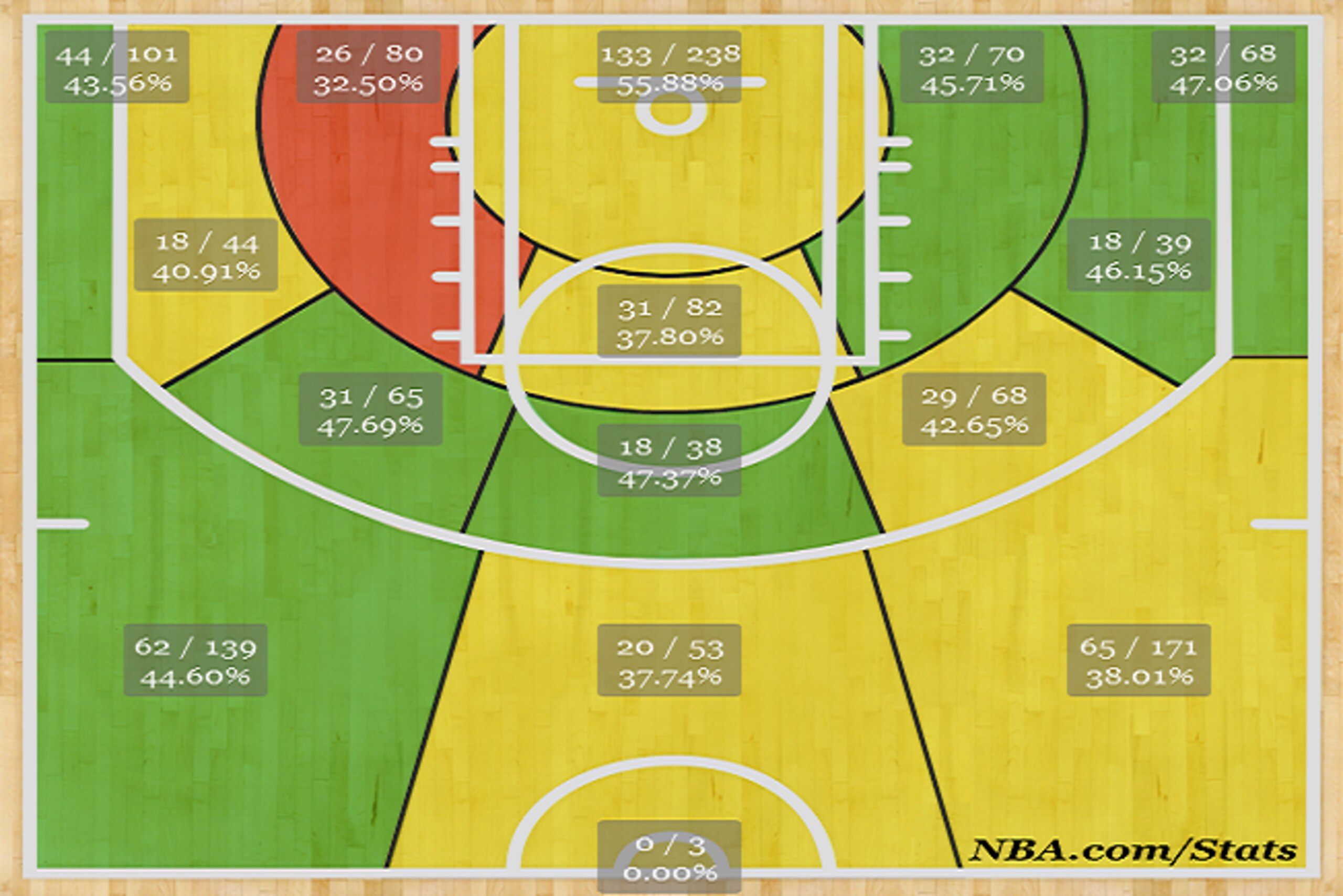
Thompson also struggles to force his way to the free-throw line, where he's averaged just 1.9 trips a night over his career. His shot chart, captured via NBA.com, also pegs him as a pedestrian finisher around the basket.
As a rebounder, Thompson checks in well below average. Of the 56 players 6'7" or taller to see at least 30 minutes of action a night in 2013-14 (min. 41 games), only Corey Brewer's 4.3 rebound percentage checked in behind Thompson's 4.7.
Yet while he certainly needs to grow in a number of different areas, some of those numbers are negatively impacted by his role on the team.
The Warriors don't ask Thompson to initiate offense for a couple of reasons.
For starters, he spent nearly 83 percent of his floor time alongside Curry, who finished fifth in overall assists (8.5) and seventh in assist opportunities (15.4), via SportVU player tracking data provided to NBA.com. Golden State simply didn't have much incentive to take the ball out of Curry's hands.
Doing so would have also weakened one of Thompson's greatest strengths: spot-up shooting. His 9.2 catch-and-shoot points per game led the entire league, as he hit 44.7 percent of his field goals and 44.2 percent of his threes on that type of play.
As for his rebounding troubles, those can partly be explained by his defensive positioning. Not only did he spend a majority of his time chasing scorers around the perimeter, he also leaked out when he could to spark an offense that far too often grew stagnant in the half-court under former coach Mark Jackson.
Thompson has his faults, but none so severe that they push him out of max-contract range.
As ESPN Insider Bradford Doolittle explained (subscription required), Thompson's max market is easy to identify by the way he has been propped up around the league:
"Decision-makers in the NBA are very smart. The Warriors might have been able to obtain Love...but chose not to because they wanted to keep Thompson. That also means that the Timberwolves, if all this is true, would have been willing to send Love to the Warriors, but only if they could get their hands on Thompson, likely even with the knowledge that he wanted a max extension. And as mentioned, it's commonly believed that if the Warriors don't give Thompson the max now, some team will leap to do so next July.
"
Whether he expands his game or simply continues shoring up his strengths, it seems obvious that—barring injury—his best days are ahead of him. It's easy to forget after his summer in the spotlight that he has all of three NBA seasons under his belt.
He has so many avenues of improvement available to him, yet he has already played his way into a substantial raise. That's why when it comes to his future finances, he has no worries regarding how this situation will progress.
"I just let (agent Bill Duffy) and the front office sort it out," he said, per Leung. "I know if I just keep my mind on hoops and staying healthy, I know everything else will take care of itself."
Those are the words of a comfortable, confident player. Judging by his offseason, he has every right to feel that way.
His jackpot payday is coming sooner than later.
Unless otherwise noted, statistics used courtesy of Basketball-Reference.com and NBA.com.


.jpg?w=2560 "2 NFL Officials Suspended")
.jpg?w=2560 "Mahomes' Wife Trolls Kubiak 💀")

.jpg?w=2560 "Love's Body Already 'Tired'")