Riley Cooper's Slow Start to 2014 Season a Big Disappointment for Eagles
Riley Cooper’s short time as a starting wide receiver for the Philadelphia Eagles has been filled with incredible highs and unimaginable lows. Over the past 13 months, he’s gone from a relative unknown thrust into a starting role—and then the center of a national scandal—to his arrival as a viable option in the passing attack, even a legitimate deep threat, earning a new five-year contract during the offseason.
Lately, however, Cooper is closer to being back at the beginning of his story than where he left off, at least in terms of on the field. The fifth-year veteran has been slow to produce in 2014, which beyond being detrimental to an up-and-down offense desperately in need of some consistency, has a lot of folks wondering whether last season was a fluke.
TOP NEWS
.jpg?w=2560 "Chiefs Giants Football")
Mahomes Told Teammate to Leave Meeting

Geno Explains Wilson Exchange

McCarthy Wins 1st Giants Start
Cooper wound up with 47 receptions, 835 yards and eight touchdowns in ’13—not bad at all for a guy people didn’t want starting in the first place. He finished the year third in the NFL with 17.8 yards per catch and tied for sixth with six catches of 40 yards or more. Cooper followed his breakout campaign with six receptions for 68 yards and a score in a playoff game.
| Wk 1 vs. JAC | 4 | 8 | 29 | 7.3 | 0 |
| Wk 2 @ IND | 1 | 3 | 8 | 8.0 | 0 |
| Wk 3 vs. WAS | 4 | 7 | 34 | 8.5 | 0 |
| Wk 4 @ SF | 6 | 8 | 54 | 9.0 | 0 |
But it was the ball the wideout couldn’t come up with in that postseason loss to the New Orleans Saints that seems to be haunting him this year. Cooper came wide open on a shallow crossing pattern over the middle, and quarterback Nick Foles hit his man in stride, but the ball clanked off the receiver’s hands and fell harmlessly incomplete. Philadelphia eventually lost the game by two points.
If Cooper catches that pass, he’s still running.
After hauling in seemingly everything thrown his way up to that point, it appears as though Cooper has developed a case of the dropsies he can’t shake.
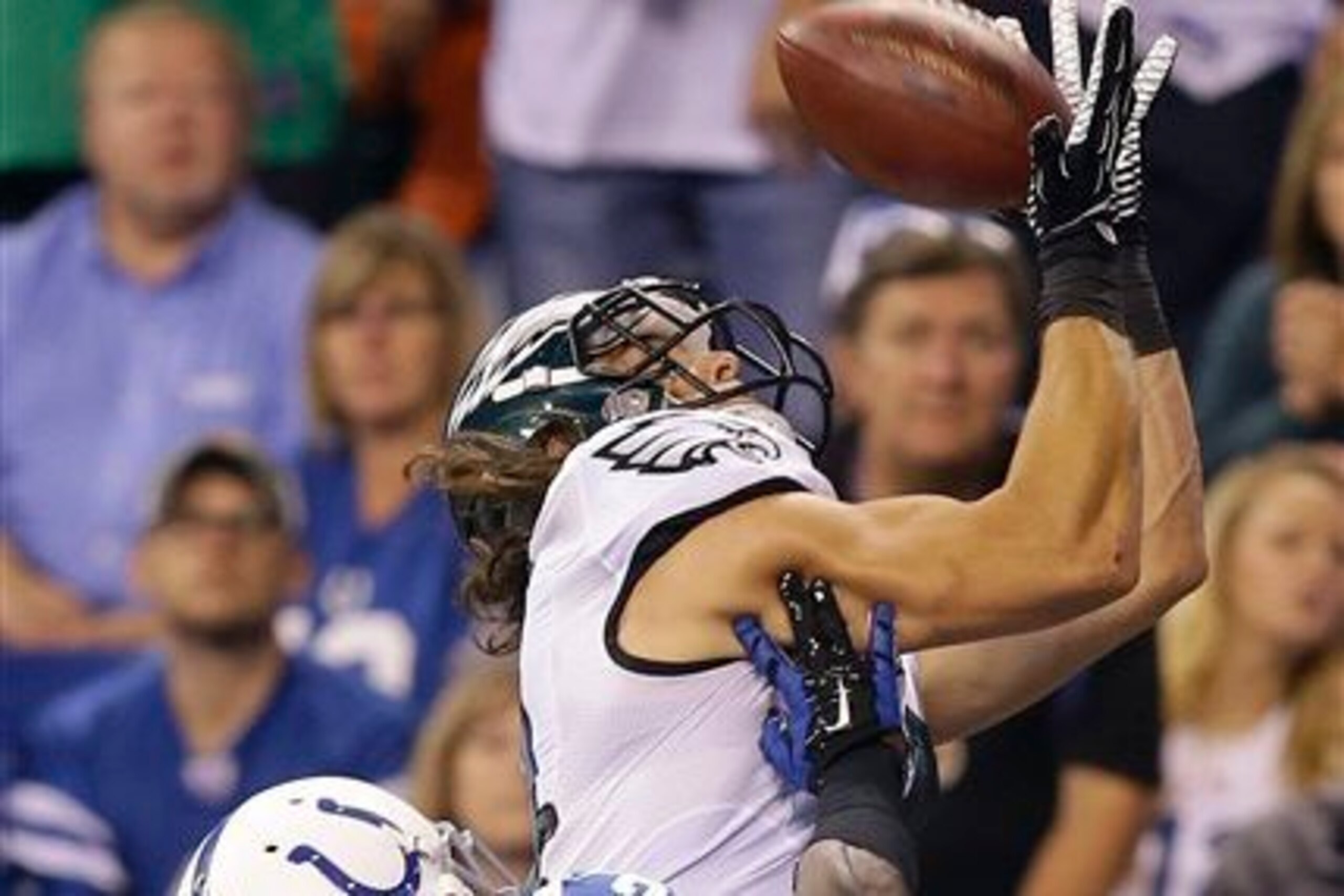
Against the Indianapolis Colts in Week 2, Cooper flat dropped a 20-yard touchdown pass in the end zone—a tough over-the-shoulder grab with the defender on his hip, but a perfectly placed ball the likes of which he was coming up with last year.
And again in Sunday’s loss to the San Francisco 49ers, Foles threaded the needle on a 17-yard slant, but with the cornerback draped all over him, Cooper’s hands failed him once more.
Both drives, by the way, ended up falling short of the goal line.
It’s led to a rather disappointing four weeks to open the ’14 slate. Cooper has 15 receptions, which puts him ahead of his pace from a season ago, but for only 125 yards and zero touchdowns. That’s nowhere near the impact he was having in ’13, nor is it living up to the reported five-year, $25 million contract he signed back in February.
Some regression was inevitable. Listed at 6’4”, 230 pounds, Cooper has great size for an NFL receiver, but there’s a reason he spent the first three years of his professional career on the bench. His limited college production at the University of Florida and below-average 4.53 speed, according to NFLCombineResults.com, resulted in a fifth-round selection in the 2010 draft.
Cooper only ever got a chance because of the torn ACL that erased Jeremy Maclin’s campaign; otherwise he reaches free agency to little fanfare during the offseason.
There were signs of Cooper’s decline already last year. Following his initial breakout performances—a five-week stretch that included three 100-yard efforts and six touchdowns—Cooper was merely serviceable the rest of the way.
| 1-5 | 8 | 93 | 11.6 | 1 |
| 6-10 | 20 | 462 | 23.1 | 6 |
| 11-17 | 25 | 348 | 13.9 | 2 |
Over the Eagles’ final seven games, including playoffs, he averaged 3.6 receptions and 49.7 yards. There were no more 100-yard days, and he found the end zone just two more times.
That being said, few people suspected he would be as unreliable as he has been so far in ’14.
Cooper started slow last season, too, so there is some reason to hold out hope he improves. Then again, nobody was expecting a lot at the time, and much of those early struggles could be traced back to his inability to connect with Michael Vick, the Eagles signal-caller for the first four-and-a-half games.
Through five weeks, Cooper had just eight catches for 93 yards and a touchdown.
There’s no change on the horizon under center this time, as if that would matter. Cooper isn’t taking the league by surprise anymore, not to mention he’s been his own worst enemy.
The question is how long can the Eagles continue getting so little production out of their No. 2 receiver?
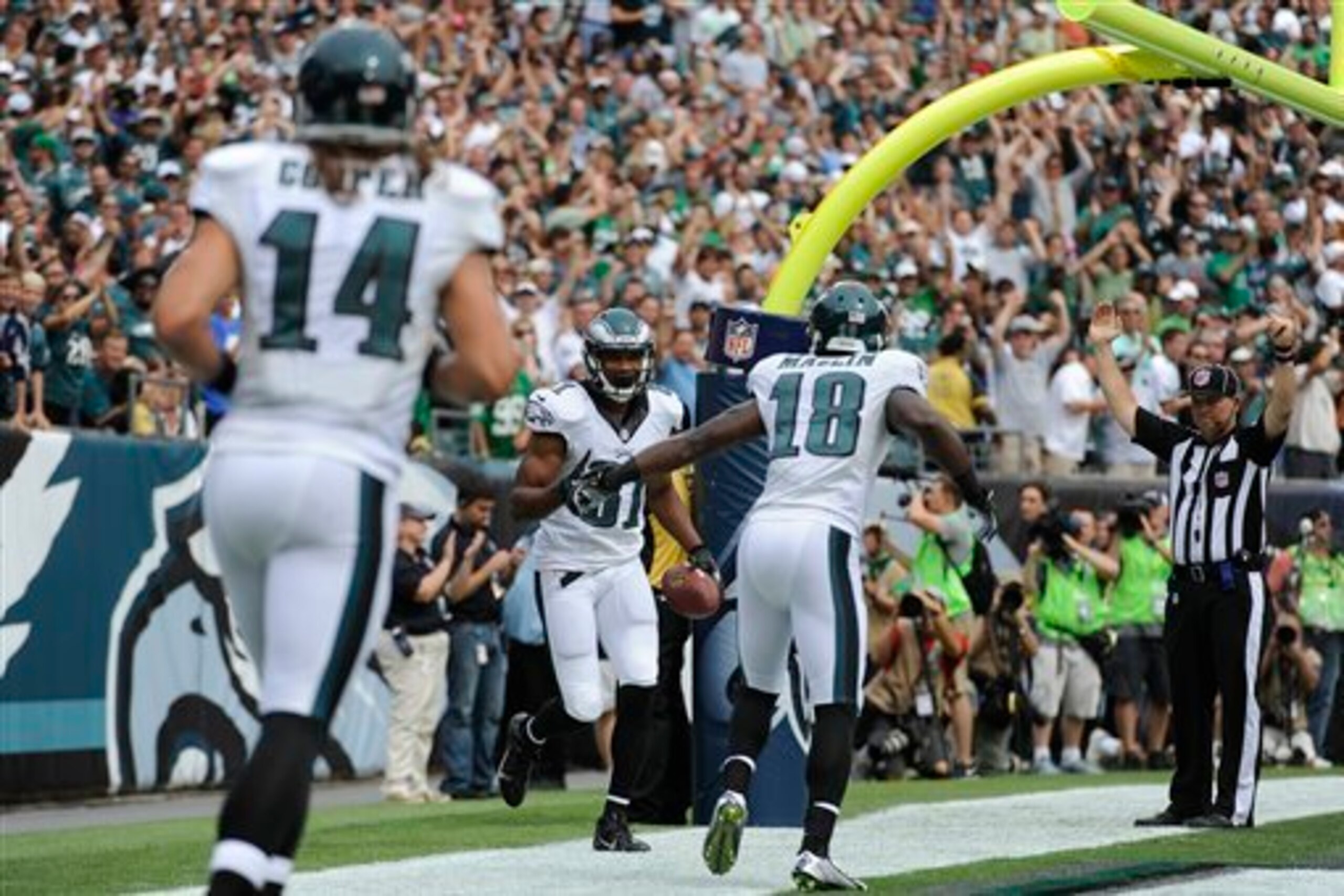
Don’t expect to see a change there, either. One of the reasons the team awarded Cooper a new contract in the first place was depth issues, which were only exacerbated by the release of three-time Pro Bowler DeSean Jackson. Even if the Eagles were inclined to go in a different direction, there’s no easy solution to replace Cooper.
While people are rightfully excited by second-round pick Jordan Matthews out of Vanderbilt, head coach Chip Kelly prefers the rookie in the slot. Plus, while Matthews has flashed potential, there’s no evidence he’s ready for a bigger role in the offense. The 22-year-old has 15 catches for 141 yards and two touchdowns.
The Eagles also used a third-round pick on Josh Huff out of Oregon, but he has yet to so much as suit up for a game after suffering a shoulder injury during the preseason. Behind Matthews and Huff, veterans Brad Smith and Jeff Maehl are underwhelming options as well.
Philadelphia is likely stuck with Cooper for now. Down the road might be a different story.
Should Cooper’s struggles run deeper than a few weeks or months even, the Eagles do have outs in his new five-year contract. According to Spotrac, dumping Cooper in 2015 would trigger $6.2 million in dead money, which would be bigger than his cap hit if he stayed, making a move unlikely. However, in ’16, the dead money drops to $2.4 million, which is a lot more reasonable.
| 2014 | 4 | 15 | 125 | 8.3 | 0 |
| 2013 | 16 | 47 | 835 | 17.8 | 8 |
| 2012 | 11 | 23 | 248 | 10.8 | 3 |
| 2011 | 16 | 16 | 315 | 19.7 | 1 |
| 2010 | 13 | 7 | 116 | 8.9 | 1 |
We’re obviously getting way ahead of ourselves, though. Right now, the focus should be on getting Cooper going, because frankly, the offense needs him.
Then again, depending on your view of Cooper as an NFL receiver entering this season, you may need to adjust your expectations. He’s not a Pro Bowl-caliber player, or even one of the game’s premier deep threats. He’s strictly a No. 2 receiver, and replacement-level at that.
Regardless, he’s had opportunities and will continue to have opportunities to make plays. Defenses are going to put a man on Cooper and forget about him. He has to be able to make them pay when the ball does come his way.
Once Cooper’s hands come around, he’s going to be fine, and that should provide some form of boost for Philadelphia’s offense as a whole. Cooper isn’t going to work miracles, either, but the Eagles aren’t so good that they can afford to have him leaving plays on the field.
.jpg?w=2560 "🚨 Week 8 AP Top 25 Poll")
.jpg?w=2560 "Updates from EVERY NFL Game 🏈")