

Kirk Cousins Can't Mask All of Washington Redskins' Problems
Kirk Cousins or Robert Griffin III can line up under center, but it won't make any difference to the Washington Redskins. Not while the team is still plagued by so many other, familiar problems.
All the evidence you need that the change at quarterback won't mask all of the problems was provided by watching the New York Giants thumping Washington 45-14 to begin Week 4.
It was a game that highlighted just how many things are still wrong with the rebuilding Redskins. Let's perform an ominous roll call of the different problems.

.jpg?w=2560 "Steelers Saints Football")
.jpg?w=2560 "Rams Raiders Football")
A dreadful defense, blighted by both schematic and talent deficiencies? Check. A shambles of an offensive line whose members seem offended by the very idea of pass protection? Check.
Let's see, what else is present? A diabolical special teams that still gives away big plays as though they are prizes in a raffle? Check. Consistent penalties that destroy momentum and erase good plays on both sides of the ball? Check.
It's easy to see how any quarterback would struggle to lead a winner with this many things stacked against his team. So it proved for Cousins, who was competent for large portions of this game before heavy pressure and an escalating scoreline deficit made him don his Keystone Cops uniform with the rest of the team.
Cousins threw four picks, although he was really only at fault for those gratefully snatched by Quintin Demps and Trumaine McBride late in the third quarter. The real culprits for the dire showing on offense were the five linemen in front of Cousins.
The Giants unleashed their stable of quality pass-rushers from wherever they wanted and still got to Cousins. He was only sacked twice but put under duress on almost every snap.
Both sacks came against right tackle Tyler Polumbus, who's every team's welcome post to Washington quarterbacks. Polumbus is extremely limited, but he's been that way since joining the team in 2011.
The real issue is why he's still starting. The same goes for right guard Chris Chester. At the end of last season, a compelling argument could have been made to recruit four new starters next to left tackle Trent Williams.
Instead, the team returned four of last season's five starters. How was this formula possibly supposed to produce an improvement? Against both the Giants and the Houston Texans in Week 1, this still highly suspect line has been pushed around. Is anyone really surprised?
Griffin couldn't have changed last night's scoreline. In fact, he's likely already telling Cousins some of his own horror stories about what life behind this O-line is like.
After the game, Jay Gruden was quick to deflect the blame from Cousins, per Mike Jones of The Washington Post:
It doesn't help that Gruden is so inconsistent when it comes to leaning on the running game. When Alfred Morris is only given 12 carries, something is very wrong. That's especially true when he averages 5.2 yards on those carries.
The disparity in the score is a misleading excuse for the imbalance in the play-calling. The Redskins trailed 24-14 early in the third, after coincidentally, Morris had gotten them back into the game.
But he should have been used more in the first half when it was obvious the defense wasn't going to stop Big Blue quarterback Eli Manning all night.
Speaking of that defense, it showed once again that being front-loaded with big names counts for nothing when you can't execute the basics. Coordinator Jim Haslett was thoroughly out-coached by Giants play-caller Ben McAdoo and Manning's improvisation.
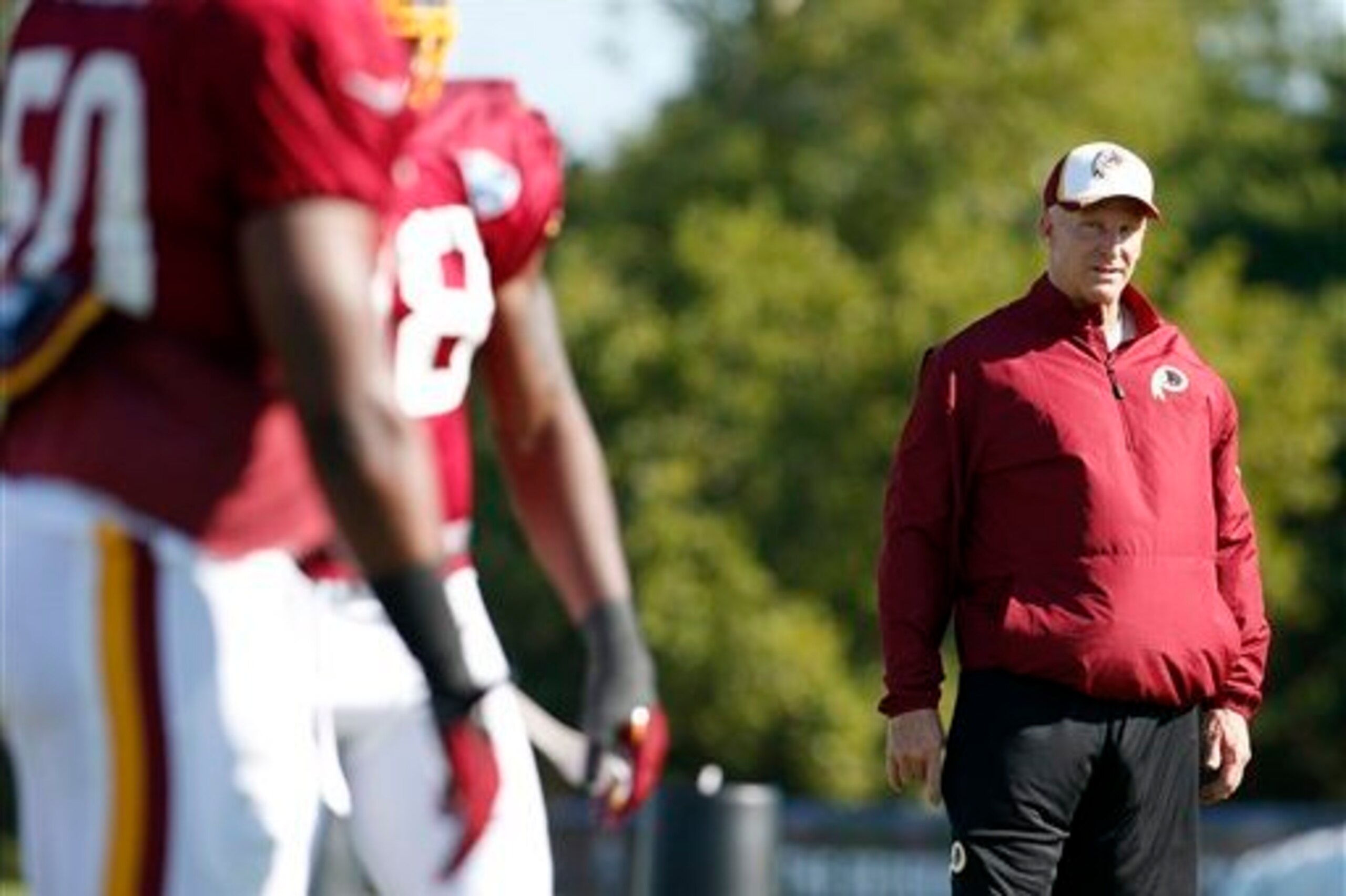
Haslett is often fond of creating designer blitz pressures, featuring multiple rushers and complex coverage exchanges. It's pretty radical stuff and always sounds great in theory, but Haslett desperately needs to pay more attention to the dull things every defense has to get right.
That means proper, form tackling. You know the kind. It's the tackling that stops a ball-carrier for a minimal gain and prevents big plays.
It's not the kind of highlight-reel, teeth-shattering shots that send mouthpieces flying. But it's the type of tackling that good defenses consistently execute.
Speaking of execution, wouldn't it be nice to see proper angles taken in coverage for a change? Taking bad ones seems to be a prerequisite for starting in this secondary.
Of course, getting those basics right isn't as exciting as working on ways to disguise coverage behind multiple pressure. But again, it's what effective defenses do.
While we're on the subject of effective defense, Haslett could help his technique-deficient unit by calling a better game. For instance, he hardly needs to make a contribution to defensive innovation by instructing his covering defenders to jam receivers.
It was alarming how often Big Blue pass-catchers were allowed a clean release. Tight end Larry Donnell owes his breakout, three-touchdown game to this fact.
He first score came when he was allowed a clean run at inside linebacker Perry Riley. What could possibly be the thinking of allowing a receiver space at the goal line, where he doesn't need much to make an impact?
That's especially true when that receiver is a big-bodied matchup tight end. Here's a clue: hit him at the line!
The one and only allowance that could be made for the most recent defensive carnival of horrors is the lengthy casualty list on that side of the ball. Haslett was already missing D-linemen Barry Cofield, Stephen Bowen and Kedric Golston.
The former pair's failing health has coincided with a decline in the performance of the front the last two years. It didn't help that D-tackle Jason Hatcher and outside linebacker Brian Orakpo both played at less than full capacity. It certainly would have helped to have top cover man DeAngelo Hall available.
Ultimately, though, injuries are inevitable, at least in some degree. The smart coordinators are the ones who make subtle tweaks to help their schemes function after the loss of key players.
You only need to look at the last two scorelines Washington has been part of to know Haslett isn't doing that.
The one sobering thought from the drubbing at the hands of the Giants is that any quarterback would struggle to win with a team afflicted with this many holes.
Those holes exist in part because of systemic failings in recruitment. This offseason's free-agency and draft hauls were long on glitz and glamour and short on players who addressed obvious needs.
How could Gruden, general manager Bruce Allen and owner Dan Snyder enter a new season with largely the same offensive line and familiar problems at safety?
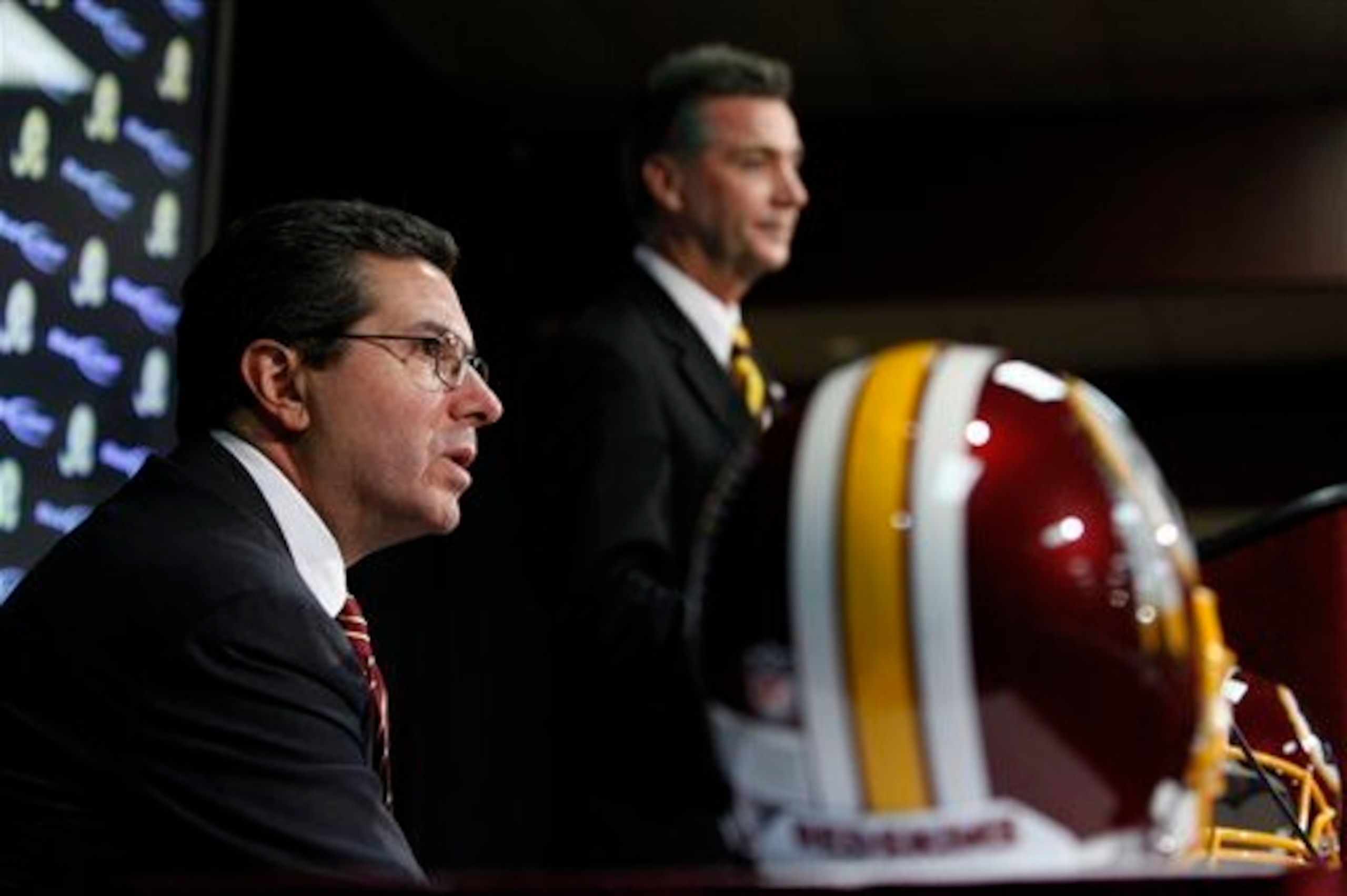
Why was only 34-year-old Ryan Clark added at the latter position? Why is Brandon Meriweather still a starter?
What reasonable expectation suggested that sticking with largely the same personnel at annually weak positions would produce different results?
Most of the answer lies in the fact that instead of signing O-linemen, Allen and Gruden loaded up on receivers. Instead of doing all they could to add a pair of safeties, the team stockpiled pass-rushers.
Was DeSean Jackson a need on a team that boasts Pierre Garcon and had already signed Andre Roberts? Of course he wasn't.
As talented as he is, Jackson is a luxury purchase. His arrival has simply created a logjam for catches, one that already seems not to suit Garcon.
Considering the investment the franchise made in Griffin, the priority should be protecting him. It shouldn't be forgoing that protection to give him more weapons than he knows what to do with, then hoping he'll figure it out as he goes.
But that's been the nature of things this offseason. Marquee signings have arrived, presumably in the hope nobody would notice this team is still fatally flawed.
I've been as guilty as anyone at falling for the hype. Signing Hatcher and drafting pressure specialist Trent Murphy appealed to my feeling that a strong pass rush can mask a lack of talent in coverage.
However, that's not how it's playing out. Neglecting fixing the secondary and hoping the problem will just correct itself was never going to work, as ESPN Redskins reporter John Keim noted:
Hatcher and Murphy will make an impact this season. But on a team already featuring Orakpo and Ryan Kerrigan, they were useful signings, yet far from top priorities.
That's been the way with this team for most of the years Snyder has owned it. It's a policy skewed toward headlines, rather than quietly building a winner.
Winning teams are constructed via the acquisition of solid citizens, not ill-fitting star names. Targeting the latter types has done nothing but laid bare Washington's biggest weaknesses.
The Giants exposed that vulnerability in ruthless fashion. It was noted in the breakdown of Washington's possible game plan for the Giants that head coach Tom Coughlin's team was beginning to look strong again. That proved ominously prophetic.
Without particularly wanting to embrace a new role as this season's harbinger of doom, here's one more worrying thought. This team already looks and acts like a losing one.
That's just how it will stay as long as it remains crippled by problems that have nothing to do with who's playing quarterback.
All statistics via NFL.com.
.jpg?w=2560 "Chiefs Giants Football")

.jpg?w=2560 "🚨 Week 8 AP Top 25 Poll")

.jpg?w=2560 "Lamar Being Out Shocked Ravens")
.jpg?w=2560 "Packers Safety Slams Refs 🤬")