Geno Smith Must Perform Better to Keep Jets Starting Job
There were plenty of reasons as to why the New York Jets find themselves at a disappointing 1-2 start. The team's top receiver, Eric Decker, has missed roughly half of the season to date. Left guard Brian Winters has been a turnstile at left guard, and Chris Johnson has yet to produce more than 4.0 yards per carry since Week 1.
Antonio Allen, who was playing a different position just over a month ago, is the team's top cornerback.
In reality, the Jets situation could be much worse than the one they find themselves in—but in the business of NFL quarterbacking, avoiding disaster simply is not good enough.


.jpg?w=2560 "Commanders Eagles Football")
Geno Smith will be the starting quarterback of the Jets for the foreseeable future. The New York Jets may have paid for a premium insurance policy in Michael Vick, but the last thing they want to do is to admit defeat on John Idzik's handpicked quarterback in just his second season at the helm.

Instead, what Smith should be much more worried about is convincing the Jets brass that they don't need to make such heavy investments in the position for quite some time—not whether Rex Ryan has considered giving Vick a few more first-team reps in practice.
For Smith, this season is not just about making the playoffs and enjoying team success. Even if Vick enters the game in relief of a struggling Smith, such instances are only temporary. For Smith, this season is about the long-term prognosis for him as the face of a franchise that has been starving for a quarterback it can hang its hat on for decades.
This year may be his only chance to prove his worth as a franchise quarterback, a chance that is slowly passing him by with each pedestrian outing.
On Monday night, Smith was far from the Jets' biggest problem. After all, he did throw for 316 yards while completing 60 percent of his passes, all without his top receiver.
However, for as much promise as he showed, Smith reminded the Jets why they have been careful to not anoint Smith as their franchise player before they need to (taking a lesson from how Mark Sanchez was mishandled).
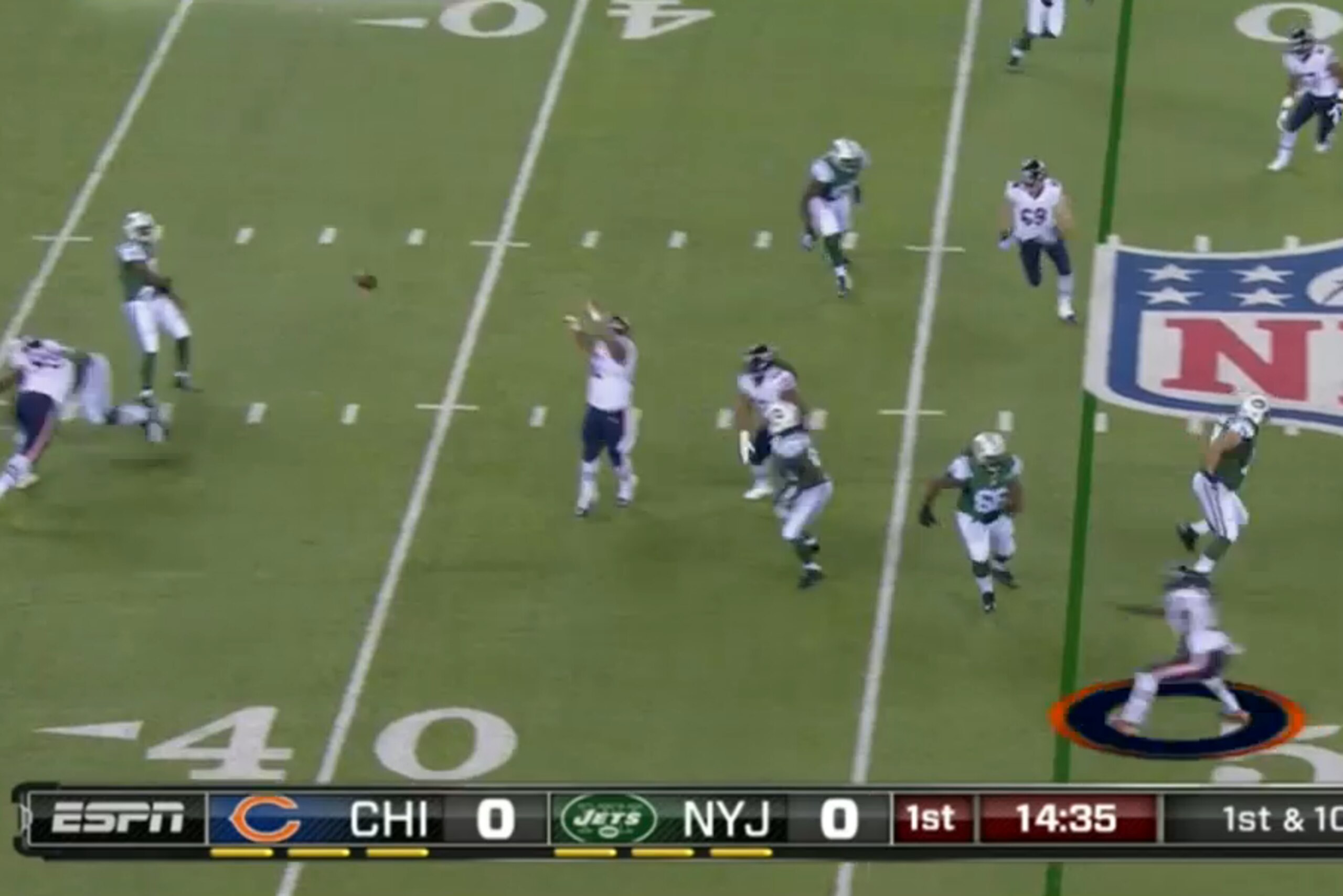
Two brutal interceptions, starting with a pick-six on the first play of the game and continuing on a crucial red-zone play, pulled Smith right back down to earth just as he was starting to get comfortable with his job title.
The Jets may not be losing because of Smith—but they certainly are not winning because of him either.
When it comes to identifying franchise-caliber quarterbacks, past production only accounts for so much of the evaluation process. What is more relevant is the trend a quarterback has shown and whether the player is making continuous improvement in areas of weakness.
Smith has shown improvement, especially when it comes to his accuracy and decision-making. Even after two straight losses (against difficult playoff-caliber opponents), Smith's numbers have improved across the board.
| 2013 | 55.8 | 6.9 | 12 | 21 |
| 2014 | 63.1 | 6.9 | 3 | 4 |
Sure, Smith's numbers have improved—but they have not improved to a level where his job should never be in question for the rest of the season.
Every quarterback throws interceptions, but Smith's misfires continually occur on forced passes on remedial decisions. These are the types of throws overwhelmed rookies make, not quarterbacks on the verge of morphing into franchise players make:
Smith's issues go beyond his interception totals and win-loss record. He struggles to grasp the concept of "giving up" on plays that have broken down, turning bad plays into game-changing, disastrous dumpster fires, even in his otherwise-strong performances.
Late in the win against the Oakland Raiders in Week 1, Smith and the Jets were set up to knock in the game-clinching field goal—until Smith took an inexcusable 19-yard sack trying to extend a play that was dead from the start, taking them out of field-goal range and giving the Raiders a logistical chance to win the game.
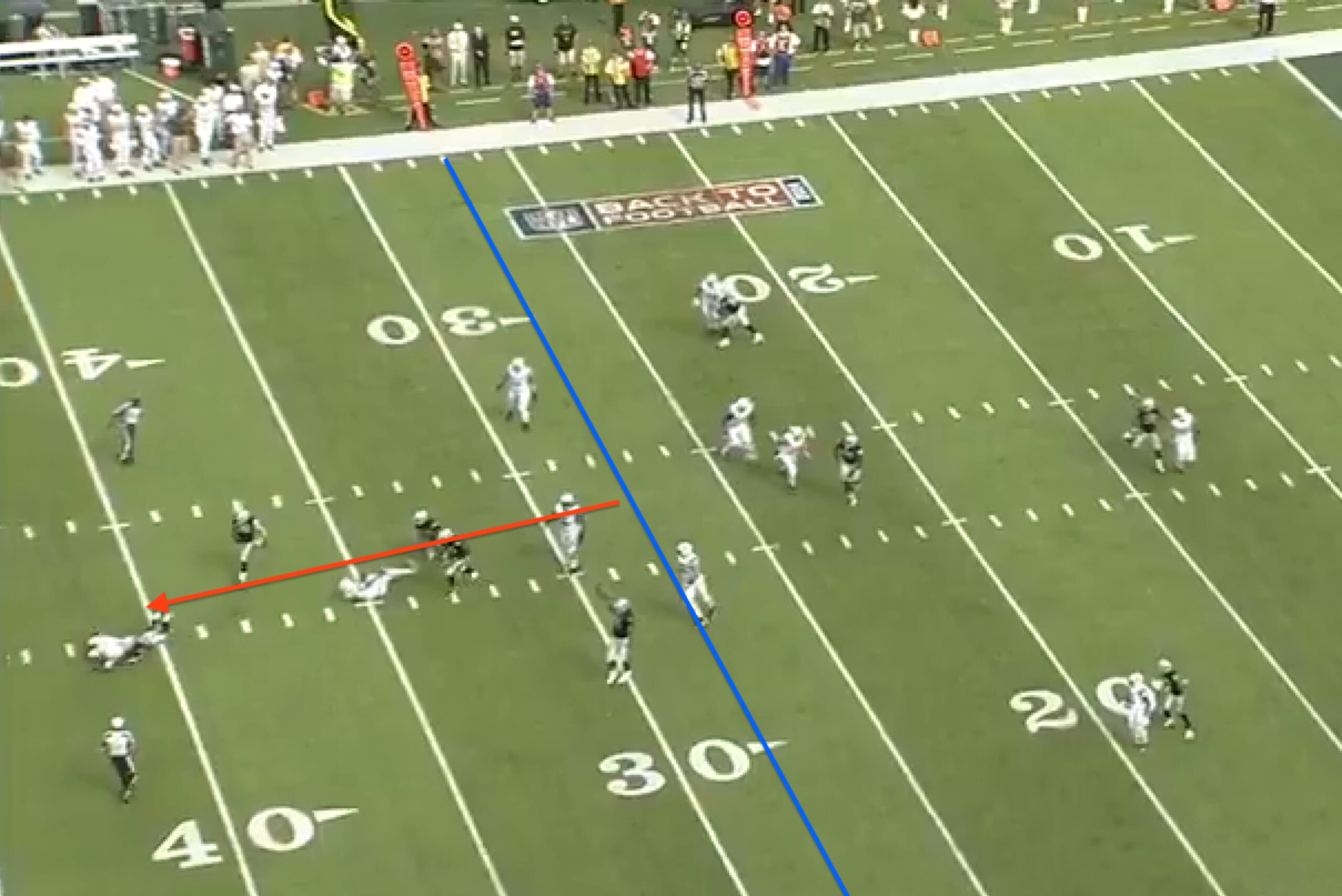
These types of mistakes don't show up in the stat sheet and are especially overlooked in a win. However, for Jets front office personnel who are trying to determine if they should invest their careers in a player, these types of mistakes draw red flags.
The Jets are not going to base their evaluation on Smith just on a few bad sacks and ill-timed interceptions. However, if these "instances" become "trends" before turning into "facts," the Jets cannot invest their future in a player who will continue to make such mistakes.
Smith does not need to completely overhaul his game by any means, as there has been tangible improvement since last season in just three games. However, if he wants to have the word "era" attached to his name, making tiny, incremental improvements is not going to be enough—especially when his coach's job security is on the line.
Franchise quarterbacks do not just perform at a certain level; they increase the output of the teammates around them—something Smith has yet to do. In terms of talent, the Jets are staffed as well as any ol' average team, and their 1-2 record reflects that. Smart teams do not invest in players who maintain a level of averageness, especially when it comes to quarterbacks.
This is not to say that Smith can not become the face of the Jets' franchise for the next decade. With his physical tools, mental acumen and work ethic, the ingredients are all there for Smith to become everything that Mark Sanchez could not become.
Smith does not have to become the next Peyton Manning or Aaron Rodgers. Frankly, the Jets would be satisfied with him landing somewhere in the Matthew Stafford/Joe Flacco/Matt Ryan realm of being in the top half of quarterbacks in the league. Simply put, Smith needs to prove he can be a catalyst to a potential Super Bowl run, not a detriment to the effort.
Smith's rookie season was not unlike many other successful NFL quarterbacks. His stats are very similar to several quarterbacks who have already signed big-time extensions with the teams that drafted them.
| Andy Dalton | 3398 | 20 | 13 | 58.1 |
| Matthew Stafford | 2267 | 13 | 20 | 53.3 |
| Joe Flacco | 2971 | 14 | 12 | 60.0 |
| Matt Ryan | 3440 | 16 | 11 | 61.1 |
| Geno Smith | 3046 | 12 | 21 | 55.8 |
However if Smith wants to reach the next level of becoming an unquestioned starter, he must make a dramatic—not incremental—improvement in his game, just as some of the listed players did.
Smith has made improvement to his completion percentage, but his interception rate is still far too high for a player in his second season. Significant strides must be made in his game even if he wants to reach Andy Dalton's level of efficiency,
| Andy Dalton | 3669 | 27 | 16 | 62.3 |
| Matthew Stafford (3 games) | 535 | 6 | 1 | 59.4 |
| Joe Flacco | 3613 | 21 | 12 | 63.1 |
| Matt Ryan (14 games) | 2916 | 22 | 14 | 58.3 |
| Geno Smith (3 games) | 713 | 3 | 4 | 63.1 |
There is still plenty of time for Smith to erase the doubt surrounding his ability to be a permanent solution to the most important position on the team. He has more than enough ability to get the job done. Now, it is just a matter of executing and excelling when the lights are on and the mistakes can no longer be written off as rookie errors.
The Jets know that, especially with injuries mounting up at the skill positions, Smith does not have the caliber of supporting cast most other quarterbacks are offered. Many may view this situation as a problem—for Smith, this "problem" is just an opportunity in disguise. If Smith can succeed in these conditions, he will prove himself as a player the Jets can invest in.
Advanced statistics provided by ProFootballFocus.com (subscription required).
.jpg?w=2560 "Chiefs Dolphins Football")



.jpg?w=2560 "Love's Body Already 'Tired'")