Collapses, Mismanagement of Braves Roster Core Cost Frank Wren His Job
Frank Wren’s demise was brewing for years, and in the end, it was the months of September and October that hurt him most.
In an organization known for stability and winning, those two important months cannot be failures as they were for the Atlanta Braves for the last seven years.
The Braves were eliminated from the postseason Sunday, and the brass did not wait a full day before firing Wren, its general manager since October 2007. Sources believed this decision was well in the making this season, with Wren’s bosses having planned to pull the plug if the Braves did not make the playoffs.


"The #Braves knew a month ago Frank Wren would be fired if they didn't make the playoffs, and pulled the trigger. http://t.co/k56DePKJEX
— Bob Nightengale (@BNightengale) September 22, 2014"
The Braves have not won a playoff series since 2001, and they are 2-7 in the postseason during Wren’s tenure. They've also missed the playoffs four times since he was in charge. Those are the October failings.
The September ones have been much uglier. In 2011 the Braves lost 18 of their final 26 games and squandered an 8.5-game lead in the National League wild-card standings with less than a month to play in the regular season. Their final game of the season, a 13-inning loss to the Philadelphia Phillies, was the thousandth cut that finally eliminated them from the playoffs after the team blew a ninth-inning lead.
The Boston Red Sox had a similar collapse in 2011, finishing the season 6-18 and blowing a nine-game wild-card lead with less than a month to play. The Red Sox started cleaning house after that, but despite the meltdowns being virtual mirror images, Wren survived.
There was another collapse this September, although not as brutally horrid as in 2011. The team is 4-14 this month and had nipped at the heels of the second wild-card spot before losing 11 of its last 13 games through Sunday.
When the team you built goes through this kind of total breakdown twice in recent memory and hasn’t won a playoff series in your time in charge, job security is a fleeting luxury.
"Not funny, Google. pic.twitter.com/SZDnIi1KpW
— Craig Calcaterra (@craigcalcaterra) September 18, 2014"
Then, there were the contracts. While Wren has been rightfully credited with pulling off minor moves that have worked out and for jumping on the dangling Justin Upton, snagging him from the Arizona Diamondbacks for utility man Martin Prado—a trade that ironically helped end Arizona GM Kevin Towers’ tenure earlier this month—it was Wren’s other high-profile moves that hurt him.
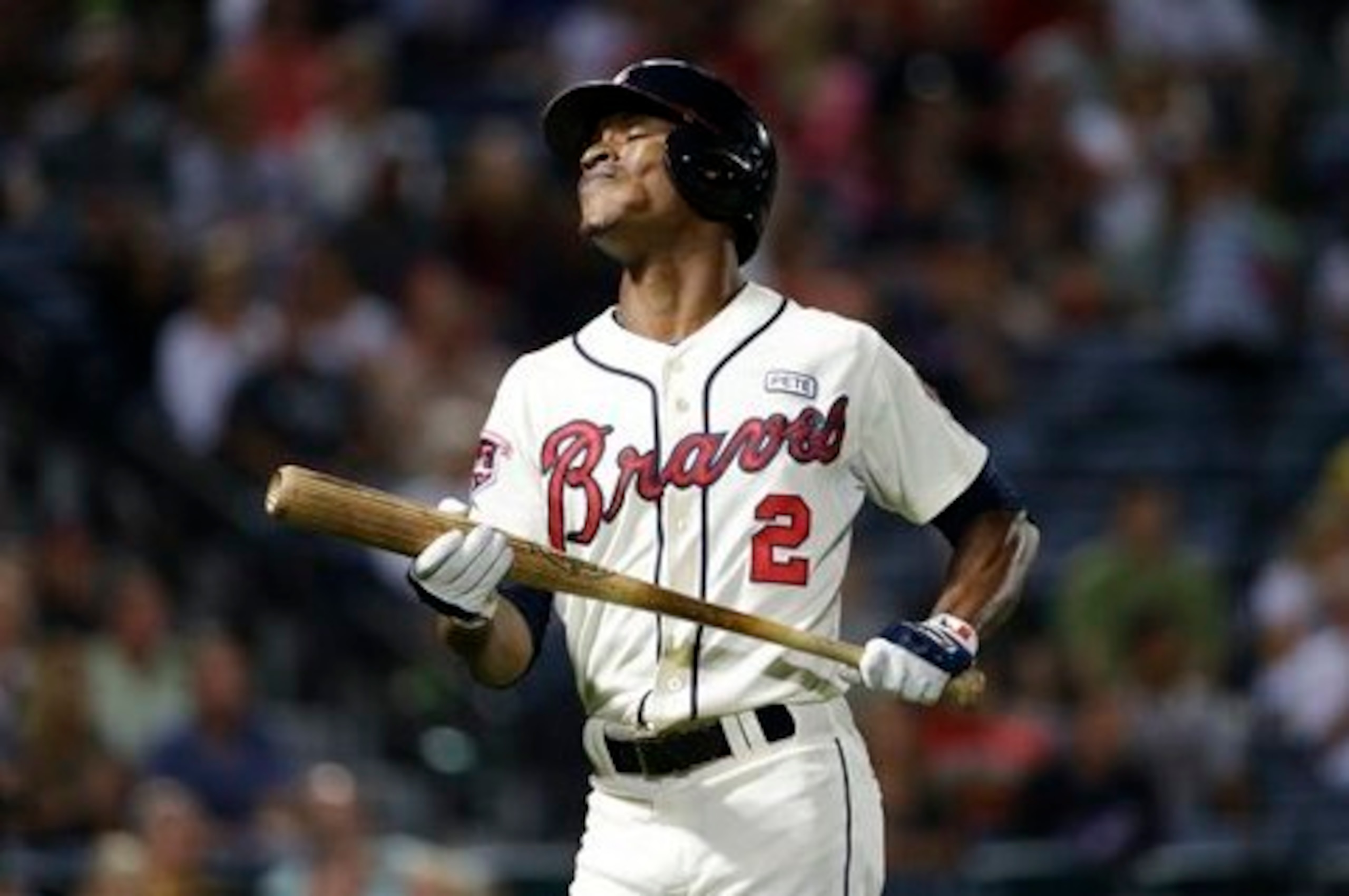
B.J. Upton—Justin’s brother in another ironic twist—is Wren’s signature free-agent failure. Wren inked Upton to a five-year, $75.25 million contract in November of 2012. It was the largest free-agent contract the Braves had ever given out, and since then Upton has hit .197/.276/.311 with 20 home runs and 60 RBIs in his first two seasons to this point.
That deal happened about a year after Wren’s other terrible signing—Dan Uggla. Uggla was going to be 31 years old going into the first season of the five-year, $62 million deal he signed before playing an inning for the Braves. In the first season he hit .233/.311/.453 with 156 strikeouts, and only his 36 home runs made him a slightly above-average player.
In the two full seasons following that, Uggla hit .201/.330/.374 with a .704 OPS and 339 strikeouts, and he lasted just 48 games with the team before it released him in July. He had a 34 OPS+ at the time—a 100 OPS+ is considered average.
Needless to say, the return on the money spent on these two players is a big part of the reason Atlanta’s top bosses started to zero in on Wren’s job earlier in the summer.
"It's no stretch to say the Uggla and B.J. Upton acquisitions cost Wren his job. A lot to hang on two bad deals. #braves
— Jerry Crasnick (@jcrasnick) September 22, 2014"
To throw more kerosene on this fire, Wren gave Derek Lowe a four-year, $60 million deal after other free-agent pitchers like A.J. Burnett spurned the Braves. Lowe had a 4.57 ERA, 3.89 Fielding Independent Pitching mark and 1.463 WHIP in three seasons with the Braves before they traded him.
The Braves also plummeted in the farm system rankings during Wren’s reign. The team had the fourth-best system in 2009, according to Baseball Prospectus, but the same website ranked the Braves 24th entering this season because they don’t have much help coming to the majors anytime soon.
A three-man panel has been formed to select the organization’s next GM, and that person’s work will have their work cut out for him or her. The Braves raised their payroll to nearly $110 million—the original plan was a $100 million ceiling—leaving them without much financial flexibility and virtually no chance to trade B.J. Upton’s contract. And to reiterate, there is no immediate help coming through the farm system.
The Braves pride themselves on their stability—Wren’s firing is the first firing of a GM or manager for the organization since 1990—so the next hire will be given a good amount of rope to turn around what has become a team teetering on the ridge between contender and mediocrity.
Even with those bad contracts and fluttering farm system, had Wren’s teams won more in September and October, he could have survived the other missteps. Instead, they failed when games mean the most, and as their architect, he had to shoulder the blame.
Anthony Witrado covers Major League Baseball for Bleacher Report. He spent the previous three seasons as the national baseball columnist at Sporting News, and four years before that as the Brewers beat writer for the Milwaukee Journal Sentinel. Follow Anthony on Twitter @awitrado and talk baseball here.


.jpg?w=2560 "Rodgers Iced Out on Plane 💎")
.jpg?w=2560 "Mahomes Told Teammate to Leave Meeting")
.jpg?w=2560 "🚨 Week 8 AP Top 25 Poll")


.jpg?w=2560 "Raiders Could Start Mendoza")
.jpg?w=2560 "Lamar Being Out Shocked Ravens")