How Michigan and Florida Lost Elite Status in the College Football World
In 2006, there was a debate over whether Michigan or Florida should play Ohio State in the BCS championship game, even though the Wolverines were just coming off a loss to the Buckeyes to end the season.
At the time, it sparked initial comments from then-Florida coach Urban Meyer and then-Michigan coach Lloyd Carr about potentially starting a playoff to solve the conundrum:
"As Florida padded its resume, second-year coach Meyer became very vocal about getting a chance to play Ohio State, especially when it appeared the Gators would be left out.
He called for a playoff and suggested the BCS should be imploded if the SEC champ again was left out of the championship game—the way undefeated Auburn was in 2004.
...
"It's an imperfect system," Meyer said Sunday. "If you want a true national championship, the only way to do it is on the field.
Carr agreed: "I hope one day we have a system where all the issues are decided on the field."
"
.jpg?w=2560 "AP Poll Top Five Week 9")
How things have changed in eight years.
Now officially in the College Football Playoff era, neither Michigan nor Florida look ready to compete for a spot in the four-team field any time soon.
The Wolverines are coming off a 26-10 loss at home to Utah and have yet to score a touchdown against a Power Five opponent this season (h/t Nicole Auerbach, USA Today). Florida was no match for Alabama in a 42-21 loss.
So how did two perennial powers fall from the top of the college football mountain?
Michigan
Nearly nine months after Florida surpassed Michigan for the chance to play the Buckeyes, the Wolverines again were surpassed on the field in the greatest college football stunner to date: a 34-32 season-opening loss to Appalachian State.
In addition to igniting the wackiest season in recent college football memory—check out this top 25 from midseason—it marked the final months of the Carr era in Ann Arbor.
An 8-4 regular season with yet another loss to Ohio State was the end, and Carr's final game came against Florida, of all teams, in a Capital One Bowl win.
As Michigan tried to fix its problems, however, it only prolonged them. The university hired Rich Rodriguez from West Virginia, an offensive mastermind with a history in the zone-read. Rodriguez didn't have ties to the program and never got off to a smooth start, as Mark Snyder of the Detroit Free Press chronicled.
From the coach's perspective, Michigan suffered from an entitlement problem. Here's what Rodriguez said in a 2013 interview with Matt Hayes of the Sporting News:
"We had some guys committed at Michigan, but we had others that weren’t. Some guys felt a sense of entitlement. The name on the chest, and 'I’ve already arrived.' The Chad Hennes and the Jake Longs put the work in and succeeded before us, and guys behind them thought they were entitled to the same status but hadn’t proved anything.
"
Regardless, poor on-field results and an NCAA inquiry into practice violations put the heat on Rodriguez. He was never able to have a defense that matched his offense and was let go after a Gator Bowl loss to Mississippi State in 2011 with a 15-22 overall record in three seasons.
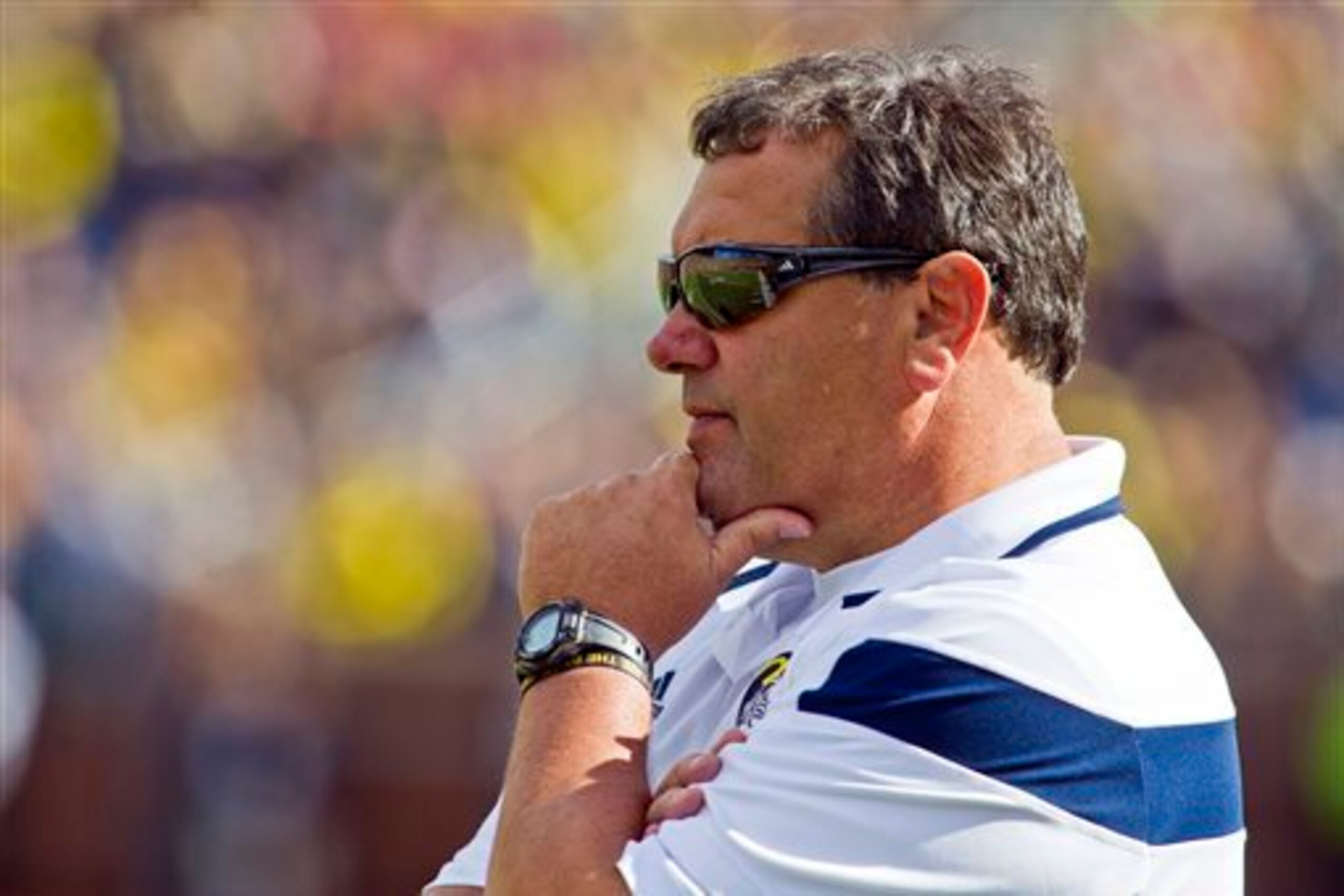
Michigan then hired San Diego State coach Brady Hoke, a former Wolverines assistant. Things appeared to be headed in the right direction when Michigan went 11-2, topped off with a Sugar Bowl victory over Virginia Tech, in Hoke's first year in 2011.
Things have gone downhill ever since.
With Hoke at the helm, Michigan hasn't won more than eight games in a season since then, and the school fired offensive coordinator Al Borges in January.
In addition to coaching turnover, Michigan's inability to develop talent has been its biggest problem. The Wolverines haven't had more than three players in an NFL draft class since 2008.
Amazingly, Michigan had two offensive linemen taken in the '14 draft—Taylor Lewan and Michael Schofield—but were tied for 103rd nationally in rushing offense rankings, per cfbstats.com.
The offense hasn't looked any better under first-year OC Doug Nussmeier. Now 2-2, Hoke is nearing rock bottom, according to Nick Baumgardner of mlive.com.
How long it takes Hoke to get Michigan out of its hole, if he can at all, remains to be seen.
As Matt Hinton of Grantland writes, "When Hoke says 'This is Michigan' in 2014, the distance between the Michigan in his mind and the Michigan he’s selling to teenagers who were newborns when the Wolverines last wore the crown has never been greater."
Florida
Florida had success after the 2006 season. In fact, two years later, it won a national championship with Meyer. But two years after that, the Gators went 8-5 and Meyer stepped down to spend more time with his family.
That decision came one year after Meyer briefly retired, citing health concerns, before changing his mind.
Florida hired Texas defensive coordinator Will Muschamp, considered to be a rising star in the business. But things have been troublesome for Muschamp since he became the head coach.
Mainly, the Gators, an offensive juggernaut under Meyer, haven't finished in the top 70 in scoring offense since Muschamp's arrival, per cfbstats.com. Things hit a low point in 2013 during a disastrous 4-8 campaign in which Florida ranked 113th in points scored.
Whereas Michigan had no problem scoring but couldn't stop anyone under Rodriguez, Florida has had the opposite problem with Muschamp.
Of course, there's been massive turnover at the offensive coordinator position. Former Notre Dame and current Kansas head coach Charlie Weis was the Gators' play caller for one year. Former Boise State offensive coordinator Brent Pease never got things going in his two years (2012-13), either.
This past offseason, Muschamp hired Duke offensive coordinator Kurt Roper to repair the damage. However, following a 42-21 loss to Alabama, it's clear Roper still has a lot of work to do, specifically with quarterback Jeff Driskel.
As B/R's Barrett Sallee writes, "At this point, it's clear Florida quarterback Jeff Driskel isn't going to live up to the 5-star hype that followed him to Gainesville."
But unlike at Michigan as of late, getting NFL-caliber players through the program hasn't been as big of a problem for the Gators.
NFL teams drafted eight Florida players in 2013. However, Muschamp has hinted that perhaps Meyer left behind a program in need of a rebuild from a bad situation. As Mike Bianchi of the Orlando Sentinel reported:
"To Muschamp's credit, he never blamed Meyer for a roster that was bereft of experience, depth and discipline in Year 1, although he did hint that there were some issues. Meyer's disciplinary and player-arrest record at UF were abysmal, and Muschamp had to clean out some of the character problems. That left him a roster of only 71 scholarship players last season—14 below the NCAA limit.
"
If Muschamp inherited a problem, he certainly hasn't found a solution yet. Muschamp's defense, normally solid, has allowed 818 pass yards over the last two games.
Is Muschamp on the hot seat? He's definitely going to have to get Florida back to a bowl game to even have a chance of eliminating that conversation.
For blue bloods like Michigan and Florida, the fall from the top rung to mediocrity has been surprising. Each took their separate routes, but share common problems: underdeveloped talent, poor coaching hires and/or turnover and the rise of surrounding programs.
Florida, for example, is now competing head-to-head with programs like South Carolina. Michigan, meanwhile, has lost five of its last six meetings with Michigan State. Not surprisingly, Steve Spurrier (South Carolina) and Mark Dantonio (Michigan State) are considered some of the best coaches in the business.
Michigan and Florida are getting out-coached and out-played. The instability surrounding each program plays a role, but in theory, both should be able to rebound quickly given their resources.
That's proving to be more difficult than it originally seemed.
Ben Kercheval is a lead writer for college football. All quotes cited unless obtained firsthand.
.jpg?w=2560 "Colts Texans Football")
.jpg?w=2560)

.jpg?w=2560 "Rodgers Iced Out on Plane 💎")
.jpg?w=2560 "Mahomes Told Teammate to Leave Meeting")


.jpg?w=2560 "Raiders Could Start Mendoza")
.jpg?w=2560 "Lamar Being Out Shocked Ravens")