Packers Defense Must Resolve Issues Against the Run Before Showdown with Jets
The Green Bay Packers' floundering run defense has some serious issues to resolve before welcoming the New York Jets—and the NFL's No. 1 rushing offense—to Lambeau Field in Week 2.
Good luck.
Considering an eight-month offseason wasn't long enough for Dom Capers and his staff to alleviate the problem, it's probably unlikely to assume Green Bay's run defense will flick on the switch during the 10 days between last Thursday's 36-16 loss in Seattle and Sunday's home opener with the Jets.
TOP NEWS

New NFL Power Rankings 📊
.jpg?w=2560 "Texans-Mixon Released Football")
Injury-stricken Seahawks signing veteran RB
.jpg?w=2560 "Commanders Eagles Football")
2 NFL Officials Suspended
Many of the Packers' problems have roots in the fundamentals of fitting the run. Others, like at inside linebacker and nose tackle, are simply personnel-related. And maybe the most simple but important hurdle—the lost art of tackling—is one the Packers defense has been trying (and generally failing) to jump over for several years.
"You are what you are," Packers head coach Mike McCarthy said last Friday. "And after one game, we've put out there our performance and our next opponent will stress us in those areas that we did not perform very well in."
In Week 1, the Packers were particularly bad in the area of run defense. Led by the bruising between-the-tackles running of Marshawn Lynch and the gadgetry and raw athleticism of Percy Harvin, the Seattle Seahawks manhandled the Green Bay defense to the tune of 207 rushing yards and two touchdowns. Only the Oakland Raiders gave up more yards on the ground during the NFL's opening weekend.
| Rushing Yards | 207 |
| Yards per Carry | 5.6 |
| Rushing TDs | 2 |
| Rushing First Downs | 13 |
| Yards per Carry, First Down* | 7.2 |
| Rushing Yards, First Half | 100 |
| Rushing Yards, Second Half | 107 |
Last season, Green Bay allowed 125 rushing yards (25th in the NFL) per game and 4.6 yards per rush (29th).
In Week 2, the Jets will bring to Green Bay a rushing offense that totaled 212 yards and averaged 6.2 yards per rush in a 19-14 win over the Raiders. The Packers should expect a heavy dose of the hard-to-tackle Chris Ivory (102 rushing yards, touchdown vs. Oakland) and speedster Chris Johnson (93 total yards, receiving touchdown) Sunday.
The two could be considered a poor man's version of Lynch and Harvin.
The Packers generally fit the run well during the preseason, save for one long touchdown run from Raiders running back Maurice Jones-Drew. But that run—which featured poor gap discipline and a bevy of missed tackles—was really a premonition to the problems the Packers would face in Seattle.
While Lynch hurt the Packers in a number of ways, counters and misdirection plays routinely opened up wide chasms in the Green Bay front seven.
Here is one example:

The Seahawks blocked this play well, but the Packers made it easy on the Seattle front. Both inside linebackers—Brad Jones (59) and A.J. Hawk (50)—reacted wrongly to the misdirection and read the play to the left. From there, it was just one-on-one football. Seattle made all the necessary blocks. Jones took himself completely out of the play, Hawk is easily walled off, Letroy Guion (98) is blown off the ball and Mike Daniels (76) is helpless to fill the gap.
Get mauled up front and lose gap discipline against Lynch, and the Packers are probably lucky this was only a 10-yard run.
"There were some plays that our gap fits weren't exactly right, and that contributed to some of the runs," Capers said this week. "Where we lost our gap control, maybe didn't leverage the ball from outside-in."
Jones, a three-starter at inside linebacker, had a cover-your-eyes, burn-the-tape kind of game. Roll back a big play from the Seahawks, and No. 59 was probably associated with the play's outcome.
Here is another instance when the Packers got beat up front and at the second level:
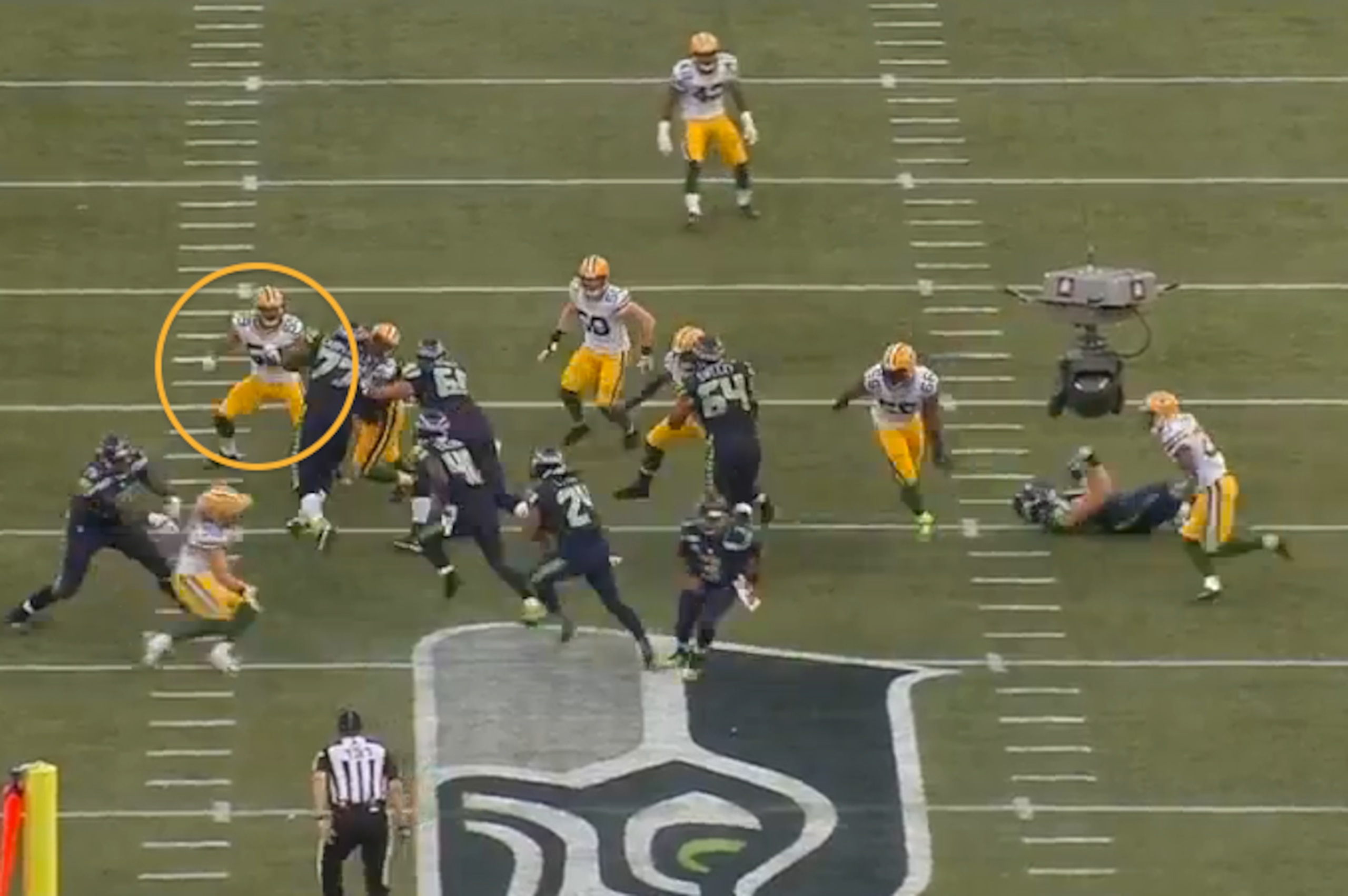
Capers blitzed rookie safety Ha Ha Clinton-Dix off the right side, but the Seahawks simply ran a power play to the left. Look out. Clay Matthews was caught upfield and Daniels got bullied off the ball. A dominant interior defender might have squeezed the gap and altered Lynch's path, but Datone Jones (blocked by No. 64) was instead handled fairly easily to the right of center.
The Packers were already in obvious trouble. However, a pair of competent inside linebackers could have limited the damage. Instead, Green Bay's duo compounded the problem.
Jones was hesitant to take on the lead fullback and set the edge (a play like this has to be turned inside to where the help is), and Hawk found himself lost in a mess of bodies. Neither factored into the stop. Run this same play against the 49ers inside linebackers, and Patrick Willis probably drops Lynch after four or five yards. Against Jones and Hawk, the result is 21.
While the Packers struggled to handle Lynch inside, Harvin made life particularly difficult on the edges.
Although the Seahawks gave jet-sweep looks in the Super Bowl, Green Bay's defense looked like it had never seen the play before. The result was similar to Colin Kaepernick running the read-option back in January of 2013.
This screenshot tells the story:

Harvin already has the football and is preparing to turn upfield. Yet Jones and Julius Peppers are still focused in on the dummy read-option happening in front of them. The Erik Walden impression is a bad look for both players. Hesitation against the jet sweep effectively took away two of Green Bay's defenders and gave Harvin acres of space to maneuver on the outside.
In-game adjustments? There appeared to be none.
In the second half, another jet sweep to Harvin had the exact same result:

Nick Perry is caught watching the dummy read-option. Jones is again flat-footed and reading the option. Meanwhile, Harvin is already ready to turn the corner with a giant hole in front of him.
"We didn't get good inside-out support," Capers said. "Harvin, all you need to do is give him a crease. So they hit us on it a couple of times."
Harvin ran the jet sweep twice for 29 yards. He finished the game with 41 rushing yards on just four carries. If the Jets have any good sense, they'll run Johnson on the jet sweep until Green Bay stops it Sunday.
The Packers also had basic communication issues in Seattle. Capers spent all offseason installing a hybrid front, with heavy 4-3 looks and a number of personnel groupings. But after months of prep, the Packers were still caught unprepared in the opener. Calls were late and it cost the Packers.
On Lynch's touchdown run in the first half, the Green Bay defense had just 10 men on the field. It was an easy score.
In response, Capers ditched many of his hybrid looks in the second half, opting to reduce the substitution clutter and play one primary grouping. However, that decision meant keeping five defensive backs on the field for most of the final 30 minutes. Predictably, Seattle ran all over the softer front. The Seahawks rushed for 107 yards and seven first downs in the second half.
Yet scheme and matchups are essentially thrown out the window when a defense can't consistently tackle, the most fundamental of football assignments.
According to Pro Football Focus (subscription required), the Packers missed 18 tackles in Seattle. Only the New Orleans Saints (23) missed more in Week 1. Six Green Bay defenders missed more than one tackle, led by Jones and Casey Hayward (three).
"We had way too many missed tackles," McCarthy said. "The fundamentals of the footwork and the things that go into that, that's practiced every day, did not carry onto the field."
Back in 2009, the Packers missed just 65 tackles, or roughly four a game. In the four years since, Green Bay has averaged almost 92 a season, including 116 in 2013. The defense is on pace for 288 in 2014.
Ivory and Johnson, New York's thunder and lightning pair, combined to break 10 tackles in Week 1.
The Packers may be significant favorites to rebound and beat the Jets, but there's no doubting who will be the underdog when New York attempts to run the football Sunday. Expect another struggling Packers run defense to be heavily stressed by the Jets in Week 2.
Zach Kruse covers the NFC North for Bleacher Report.
.jpg?w=2560 "Rams Eagles Football")



.jpg?w=2560 "Mahomes' Wife Trolls Kubiak 💀")