

Bill Lazor's Offense Can Elevate Miami Dolphins to One of the Best in the NFL
For the first time in 13 years, the Miami Dolphins completed back-to-back victories over the New England Patriots.
Much of the acclaim for that victory went to the team's defensive line. The Dolphins sacked Patriots quarterback Tom Brady four times, forcing two fumbles, while consistently disrupting the pocket. While the defense deserved a huge amount of credit for the victory, it was the Dolphins offense that allowed for a comfortable victory.
The Dolphins offense compiled 191 rushing yards, 178 passing yards, four field goals and three touchdowns. Scoring 33 points against a Bill Belichick-coached defense is always impressive, but doing so while not playing particularly well is almost inconceivable.
TOP NEWS
.jpg?w=2560 "Chiefs Giants Football")
Mahomes Told Teammate to Leave Meeting

Geno Explains Wilson Exchange

McCarthy Wins 1st Giants Start
That is the impact of Bill Lazor...and Chip Kelly.
Kelly, the head coach of the Philadelphia Eagles, has changed NFL offenses by moving away from the concepts that the traditional "pro-style" systems are built on. Instead, he has incorporated more aspects of football that are prevalent in the college game.
In his first season with the Eagles, Kelly's scheme created nightmare situations for opposing defenses and, crucially, took the pressure off of his quarterback, Nick Foles. Foles enjoyed a breakout season in that scheme. He was benefiting from Kelly's play design and play-calling, while Lazor, the team's quarterbacks coach, focused on his individual performance.
Largely because of Foles' displays, Lazor was hired to be the offensive coordinator of the Miami Dolphins during the offseason. Lazor would take the inept Mike Sherman's place as the Dolphins once again revamped their offensive personnel and scheme to fit around quarterback Ryan Tannehill.
As was evidenced in the preseason and Week 1, Lazor is attempting to mirror Kelly's scheme. While that scheme allowed the Eagles to lead the league in big plays last season, its success is built on the running game.
The running game is all about numbers and space. The best running games in the NFL understand how to create space and win the numbers advantage with how they set up and run their offense. In the past, most running games focused on winning the numbers battle by bringing more blockers tight to the quarterback and running back.
Kelly and Lazor understand that bringing more blockers close to the ball also brings more potential tacklers close to the ball, which leads to more potential blown blocks.
It's very rare that every single block on a play is executed effectively. Often, productive plays come from running backs being deceptive with their movement before the line of scrimmage or with their ability to break tackles after the line of scrimmage.
Instead of asking for more blocks to execute, the Dolphins running game is now based on the principle of moving players away from the ball to drag defenders with them.
This was evident on their very first running play of the game.

In the red zone, the Dolphins come out with three receivers, one tight end and a running back in the backfield next to Tannehill. Importantly, the two receivers to the right of the screen are spread wide on the wider side of the field. This stretches the defense out to eliminate two defenders from any potential running play.
After initially lining up tight to the formation on the left side, the Dolphins' other receiver motions behind the line of scrimmage so that the ball is snapped when he is in the opposite slot. That receiver never stops moving; instead he runs behind the other two receivers in a position to catch a potential screen pass.
When that receiver moves, the defensive back who initially lined up over him follows him. This means that there are now three defenders eliminated from the Patriots run defense. Three defenders who don't need to be blocked.
If that defender didn't following the motioning receiver, Tannehill would have had the option to throw the screen pass to his receiver who would have had two blockers to account for two defenders. Likely an easy touchdown in this situation.
Because that defender followed the receiver, Tannehill is instead going to run the read option with Lamar Miller.
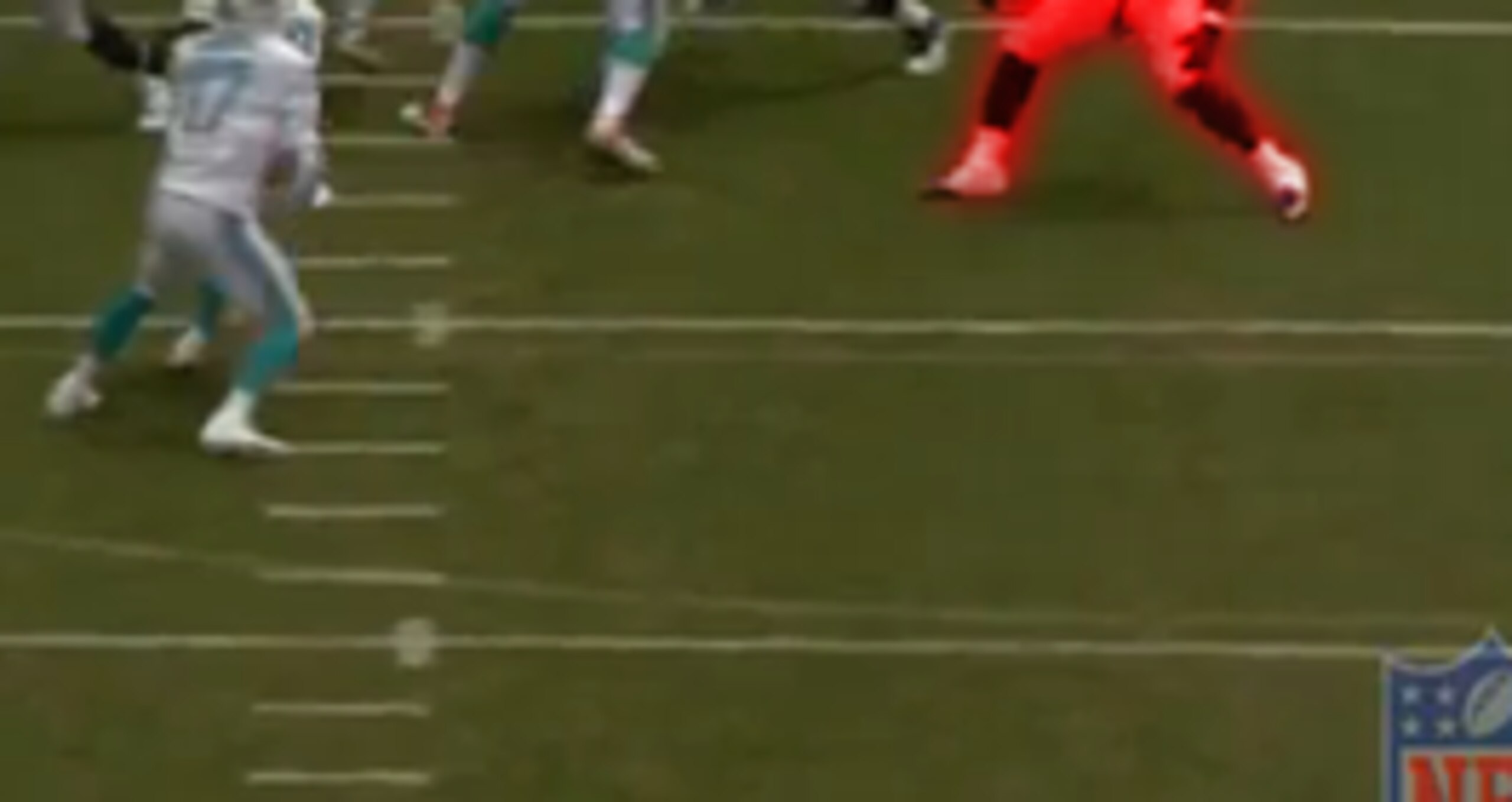
Importantly, Tannehill is reading the linebacker to the same side of the field as the other receivers. When that defender freezes to read the play, Tannehill knows that he should give the ball to Miller running the other way.
Because of the design of this play, Miller now has six blockers for seven active defenders. In the NFL, that is as good of a situation as you can expect in the red zone.
Miller's blocking up the middle of the defense is outstanding. Samson Satele is making the key block on defensive tackle Vince Wilfork. Wilfork has been pushed to Satele's outside shoulder, clearing a route for Miller to run into the secondary.
No matter the design of the play, it can always be ruined by the running back. Miller shows very poor vision here as he runs directly into Wilfork and the outside linebacker who Tannehill had initially frozen with his read.
Even though this play was unsuccessful, it highlighted the situations the Dolphins were going to be able to put the Patriots defense in.
To start the ensuing drive, the Dolphins come out with five players in receiving positions. Tannehill is alone in the shotgun formation, so the Patriots spread their defense out understanding that the run threat is minimal. Linebackers Dont'a Hightower and Jerod Mayo are lined up outside of the right tackle.
Before the snap, Knowshon Moreno, a running back who was initially lined up in the slot, motions into the backfield next to Tannehill.

The Dolphins don't wait long before snapping the ball after Moreno gets in position. With this haste, they catch Mayo and Hightower as they are still settling into their new spots on the defense. Most significantly, Mayo has only just brought his eyes back to the quarterback after communicating with his teammates.
This creates hesitation in the front seven at the snap.
Mayo becomes the key defender on this play. It's not a read-option for Tannehill, because he would definitely have kept the ball if he had the option in this situation. Tannehill had a lead blocker out in front of him with a huge amount of space to run into.
For two reasons, Jamie Collins (No. 91) can't be aggressive at the point of contact on this play.
Firstly, Collins hadn't had a chance to survey the offense from his established spot before the snap. Secondly, he was put in a vast amount of space because of how the Dolphins initially lined up. His safety support is deep, and his closest outside linebacker is covering a slot receiver.
This play was always designed to cut back to Collins' side of the field.
Collins' play contains staying on the outside shoulder of his blocker to force Moreno to run infield. Moreno does that and is unable to get outside for a potentially huge play, but he still gets a free five yards because of the space within the defensive front seven.

This play wasn't perfectly executed by the Dolphins. Left guard Daryn Colledge (No. 67) failed to get to the second level to block Collins, the linebacker who eventually tackles Moreno, and Charles Clay, the pulling tight end, never blocked anyone instead of sealing off Mayo on the edge.
If Clay had sealed off Mayo in the double-team, Moreno would have had a big-play opportunity outside. If the left guard had blocked Collins on the second level, Moreno might have had a first down.
Failed blocks in this offense are less significant because they typically come in space down the field. If the defense tries to bring more bodies into the formation to force more failed blocks at the line of scrimmage and in the backfield, then the alignment of the offense will give the quarterback easy, quick throws outside.

Just like how the Philadelphia Eagles had DeSean Jackson last season, having Mike Wallace outside is going to force teams to always keep safety help back also.
When you combine that speed with Lazor's misdirection and personnel packages, the Dolphins running game is under less pressure to execute effectively to still be productive.



This is how Moreno and Miller combined for 193 yards rushing behind an offensive line that featured underwhelming individual talent on the interior. Both Moreno and Miller were effective, but both also left yards on the field, which is truly a testament to the quality of this scheme's design.
An obvious answer to this rushing attack would be to overplay the run and force the Dolphins to beat you throwing the ball.
Tannehill's numbers were modest in this game, but again, much like the running game, the execution of both he and his receivers caused the Dolphins to miss plenty of opportunities for more big plays. That is a startling statement to make considering the opposition, but that is what happened in Week 1.
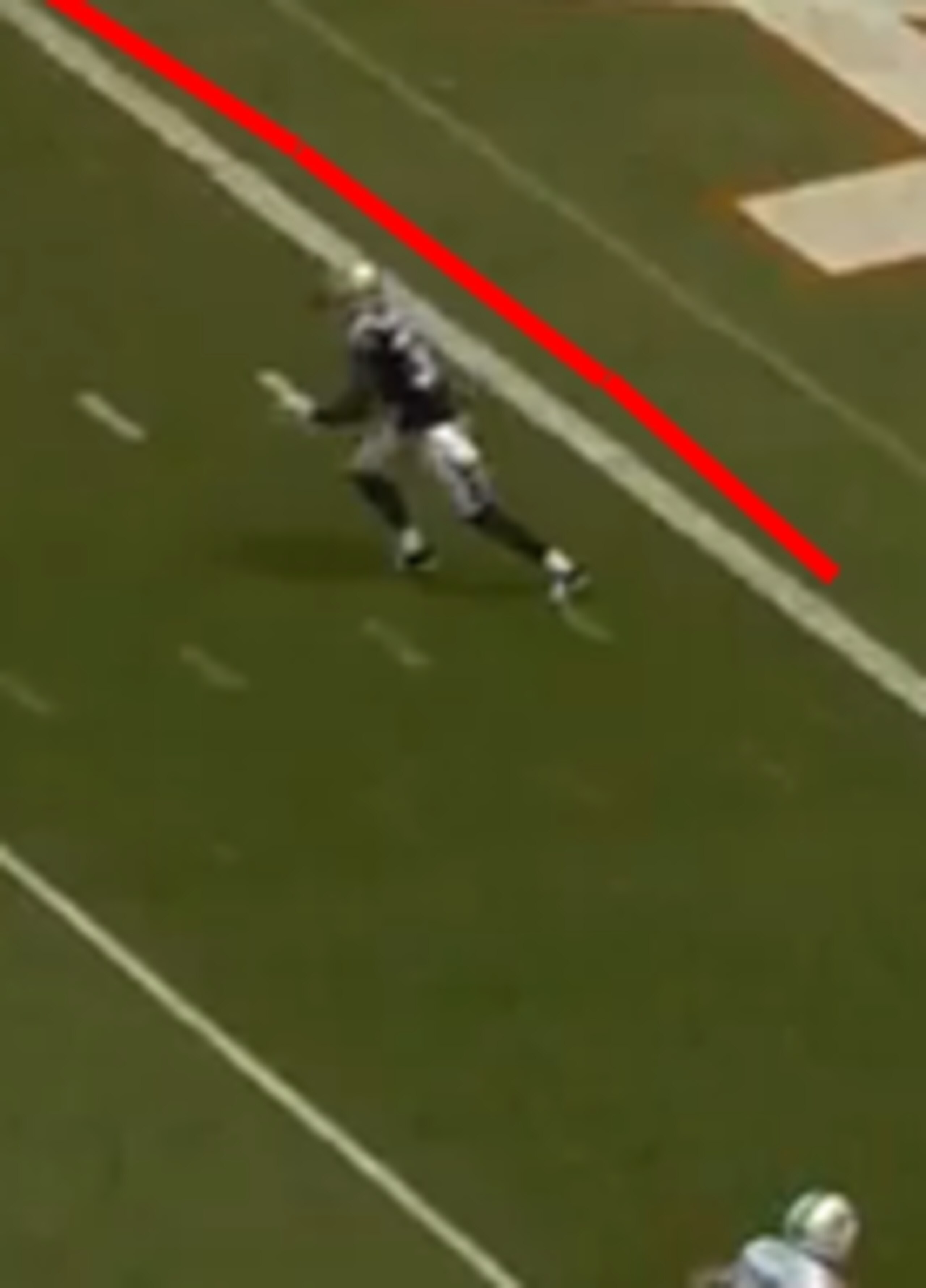
On this play in the red zone, Tannehill is running a triple-option play where he technically makes the right decision. Tannehill reads the unblocked outside linebacker to the top of the screen and gives Miller the ball because that linebacker stays outside.
However, with greater awareness, Tannehill would have realized that Wallace was wide open for an easy touchdown in the flat after running behind the quarterback on an end-around.
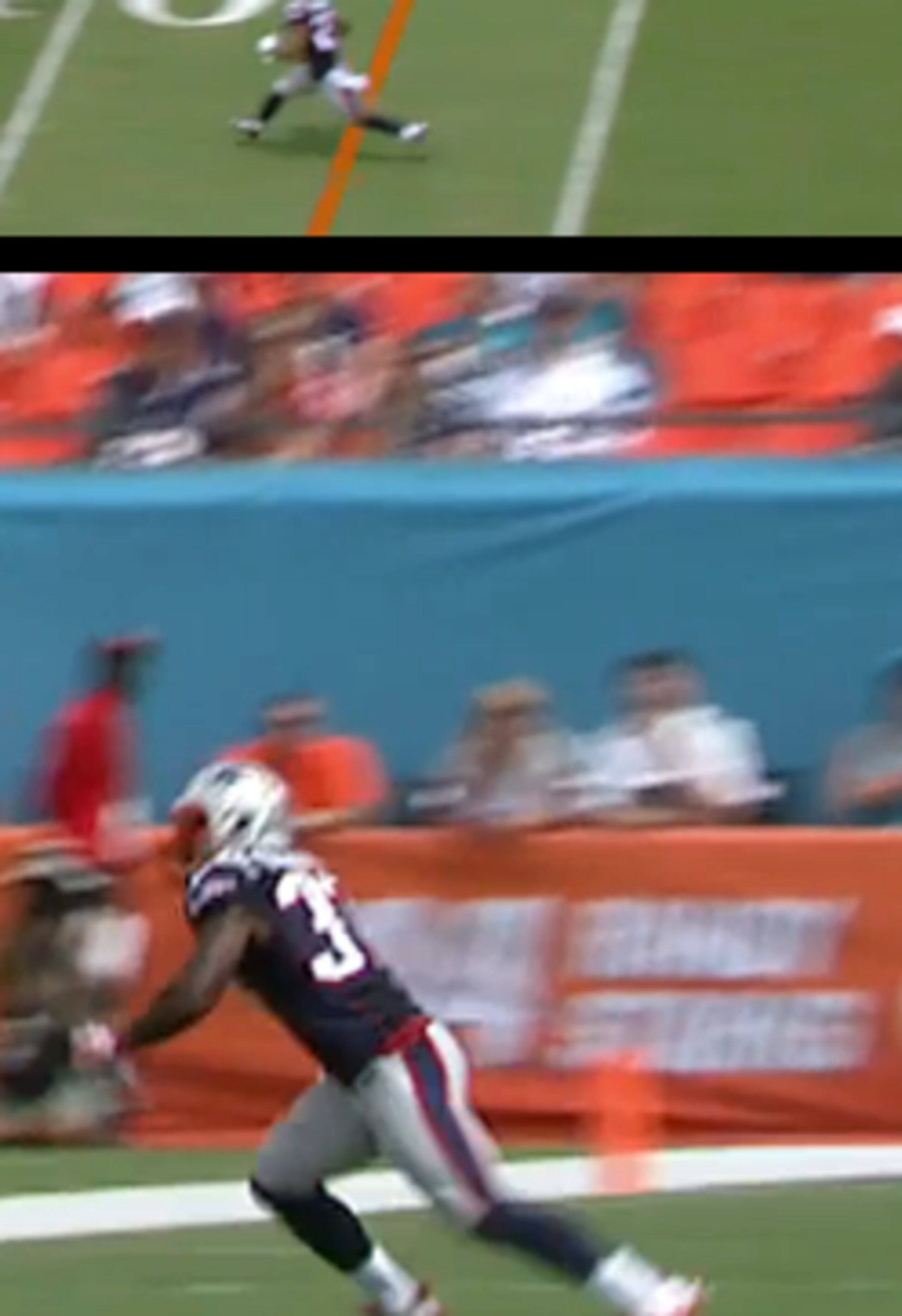
Both Jarvis Landry and Wallace dropped passes when they were wide open down the field on deep crossing routes. Both plays would have been first downs and significant yardage even without yards after the catch. Wallace's was somewhat offset by a roughing-the-passer penalty on the defense.
More importantly, Wallace and tight end Dion Sims also dropped touchdown passes in the end zone.

Wallace beat Darrelle Revis with an impressive double-move route, but he showed off his unnatural receiving ability in the end zone. Instead of comfortably catching an accurate pass from Tannehill with his hands, he let the ball drop into his chest, which caused him to step and fall out of bounds.
Sims' drop came on a play when he ran down the seam after play action. It was a beautifully designed play from Lazor that sent Sims down the left seam after lining up on the right side of the offense. Sims simply dropped a perfect pass with his hands extended as a defender jumped on him.
Those plays don't even consider the three drives that ended prematurely because of two fumbles and an interception or Miller's touchdown run that was called back for a penalty.
As history proves, the NFL is a cyclical entity. It will eventually evolve to catch up with Kelly and Lazor's approaches through scheme or personnel at some point. That point doesn't appear to be 2014, though, as each coach is putting their players in the best positions to succeed on a regular basis.
If the Dolphins can score 33 points without impressive execution against a highly regarded defensive unit, then it's clear that this offense could potentially become one of the best units in the NFL.
Lazor is taking the pressure off of his players, something that is the polar opposite of what his predecessor, Mike Sherman, did. For the first time in his career, the sentence "Ryan Tannehill didn't play well but the offense around him masked some of his struggles" can be uttered with actual sincerity.
.jpg?w=2560 "🚨 Week 8 AP Top 25 Poll")


.jpg?w=2560 "Rodgers Iced Out on Plane 💎")
.jpg?w=2560 "Updates from EVERY NFL Game 🏈")