Jay Gruden Must Adapt Play-Calling to Suit Robert Griffin III
Jay Gruden's first regular-season game calling plays for Robert Griffin III produced a tepid and stunted offensive display in Week 1. The Washington Redskins head coach must adapt his play-calling to suit what his young quarterback can and can't do.
Since taking over from Mike Shanahan, Gruden has been on a campaign pledge to make Griffin a pocket-based passer. It's a necessary part of his development, but one that should be handled with a little more subtlety.
Gruden wants quick throws and smart decisions to suit his version of the West Coast offense. The problem is that he seems to have left out the things Griffin does best.
.jpg?w=2560 "Raiders Football")
The one thing, perhaps the only thing, Griffin does well as a passer is push the ball down the field. He has a rocket of an arm that demands a vertical passing scheme.
Yet in the season-opening 17-6 loss to the Houston Texans, Griffin was limited to cautious, conservative throws that netted only minimal yardage. ESPN announcer Skip Bayless rightly condemned this tame approach:
Those were Griffin's first-half numbers. He would finish with 29 completions from 37 attempts, on the face of it, respectable figures.
Yet those 29 completions accounted for only 267 yards. That's an average of just 7.2 yards a reception.
This offense is never going to win moving the ball in increments. That simply doesn't suit what Griffin is at quarterback.
He's a big-play, quick-strike passer. Of course, no offense is proficient enough to hit the deep ball every time its quarterback drops back, or even on every drive.
The opposition certainly has something to say about that. ESPN 980 reporter Chris Russell noted how the Texans made taking away the deep ball a priority:
This is a type of coverage plan the Redskins should expect to see most of this season. That's going to be the natural reaction to a stable of receivers featuring DeSean Jackson, Andre Roberts and Pierre Garcon.
But just because they'll see it often, Gruden and his coaches shouldn't abandon the deep game so easily. Griffin attempted only two obvious vertical strikes against the Texans.
One, coming on a broken play, was intended for Andre Roberts. He couldn't haul the ball in after Griffin's bad throw pushed him to the sideline instead of leading him more infield.
The second was a planned heave toward Garcon during the fourth quarter that was double-covered and knocked away. Yet the fact that Washington even tried it was encouraging.
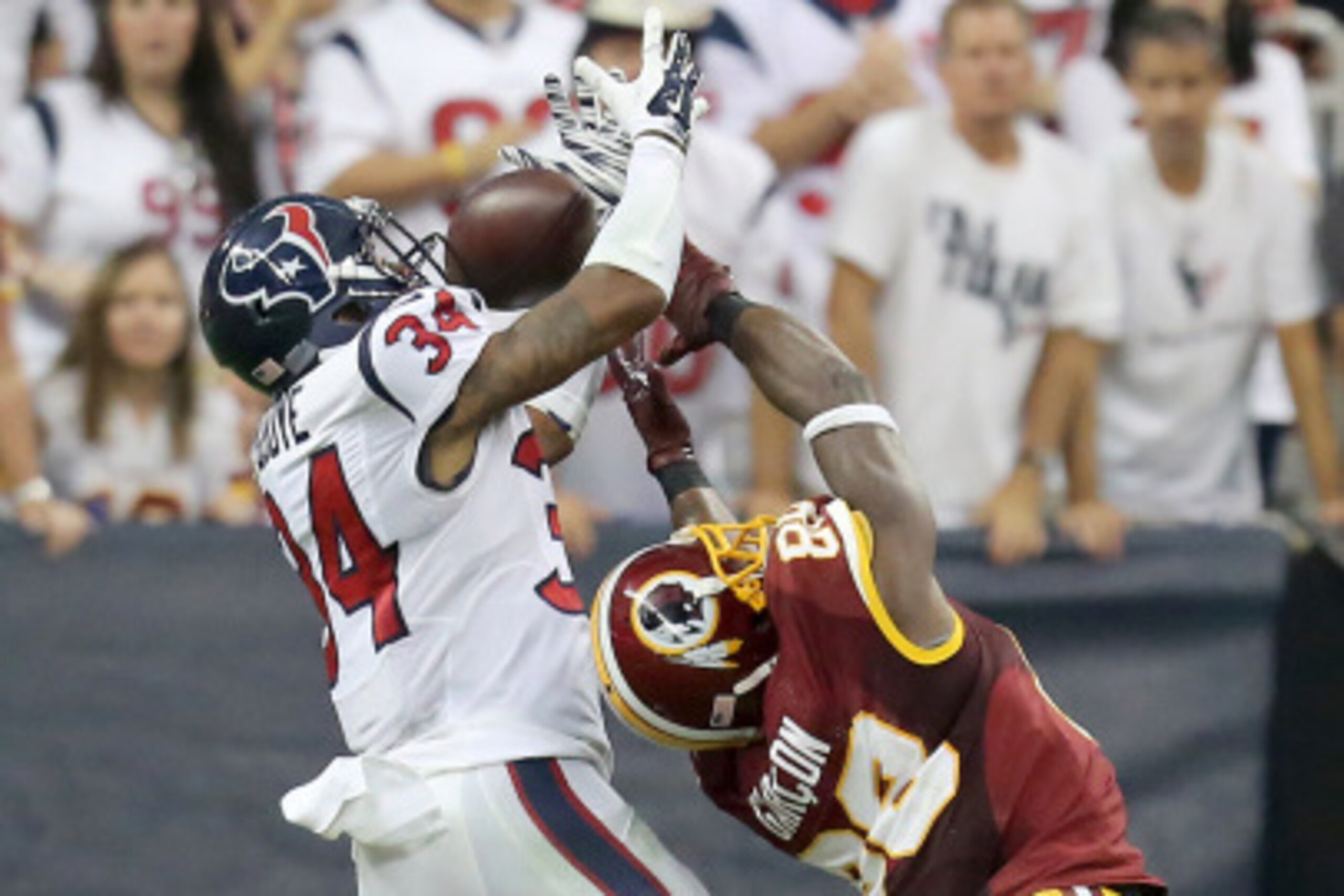
Gruden can't allow the strength of his team's passing game to be diffused so easily, simply by being greeted with a soft zone shell. Launching the ball 40 yards or more doesn't have to be his only counter.
But a few more passes of the 20-25-yard variety would have been welcome. One of Griffin's best passes of the day came on 2nd-and-10 late in the third quarter.
It was a hi-lo concept, with Jackson and Garcon running vertical routes on the outside while Roberts ran a deep slant across the middle. Underneath, tight end Logan Paulsen ran a shallow crossing pattern.
With the deep coverage pushed back and Paulsen taking away short-range defenders, the middle was wide open. Griffin flicked a beautiful pass to Roberts who made a nice catch for a 22-yard gain.
This was a big play without having to heave the ball into the clouds. Sadly, this was merely an isolated example. Most of Washington's routes were tentatively run underneath break-offs that played right into Houston's game plan.
Of course, setting up any big play through the air requires the credible threat of a successful running game. Gruden had that advantage against the Texans, but he declined to make full use of it.
Washington's dominance on the ground was explicitly spelled out on the team's official Twitter feed:
Those impressive numbers came despite the play-calling being skewed toward the pass. The Redskins ran the ball 23 times, compared with 37 passes.
That's in direct contradiction to Gruden's preseason boasts about the run being the strength of this team, per CSNWashington.com writer Rich Tandler:
"We need to be pretty good at everything but obviously the strength of our football team would be, I would say, our running game. We have to continue working on that, work on handing the ball off and being good at something, really good at something and I think we are pretty good in the running game.
"
It's the timing of the runs that really didn't help. Gruden went away from the run after the break. He had Griffin hand the ball off only seven times in the second half. Washington ran the ball just twice on planned runs after Griffin and Morris botched an exchange in the red zone early in the second quarter.
The unwillingness to stick with the run is worryingly reminiscent of last season. Head coach Mike Shanahan and offensive coordinator Kyle Shanahan were guilty of the same misstep.
It's also a criticism that has dogged Gruden before:
With Alfred Morris and Roy Helu Jr. available, Gruden can't afford to bring any bad habits he might have picked up as offensive coordinator of the Cincinnati Bengals to one of the NFL's most dominant ground games.
More than just how often he called a run, which can be an easy criticism of any coach post-defeat, it was when Gruden chose to run, or not to, that caused problems. The most mystifying example came just before Texans rookie running back Alfred Blue blocked a punt and returned the deflected ball for a touchdown.
The drive that preceded the punt came prior to the two-minute warning in the second quarter. At that point, Washington trailed 6-7.
It would have made sense to start off with a few runs, not only to get the drive going, but also to keep the clock moving. This sounds like a steady approach, but while a coach has to guard against being too conservative, he also has to know when to be smart.
Instead, Gruden had Griffin put the ball in the air twice. One was a tame little out-route to Garcon executed at snail's pace. Prior to the passes, Gruden actually worked in a run.

But rather than give the ball to Morris or Helu, both of whom were running well, he opted for a bizarre call. Mike Jones of The Washington Post aptly described the damaging play:
"The one play call that seemed like a head-scratcher was the reverse to DeSean Jackson. The conventional rushing attack with quick passes sprinkled in was working well. Then, deep in their own territory, Gruden tried the trickery only to have Jadeveon Clowney sniff it out and drop Jackson for a nine-yard loss and backing Washington up to the 12. Two plays later, the Texans had the blocked punt.
"
This poorly conceived drive and subsequent special teams blunder swung momentum permanently in the favor of the Texans. It showed play-calling that put too much onus on Griffin.
At times it felt as though the desire to show off what Griffin can do on quick throws from the pocket got in the way of what was working. For his part, Gruden was quick to admit he should've leaned on the team's strength more:
Of course talk is cheap, never more so than after a defeat. But Gruden has to know that this team, especially Griffin, needs the running game to be a feature of the offense.
Aside from launching the long ball, one of Griffin's best mechanical assets is his skill on play-action. His fakes can make fools of defenders and cameramen up and down the country.
His strong arm and faking skills were the perfect complement to the running game during his electric rookie season in 2012. The team earned countless big plays courtesy of this dynamic.
Let's take a look at a brilliant example from Griffin's debut year. It came in Week 12 against the Dallas Cowboys on Thanksgiving.
The Cowboys showed a soft, two-deep look to Griffin, similar to how the Texans played him. He was in the pistol in a run-heavy look that saw Morris flanked by fullback Darrel Young and Paulsen.
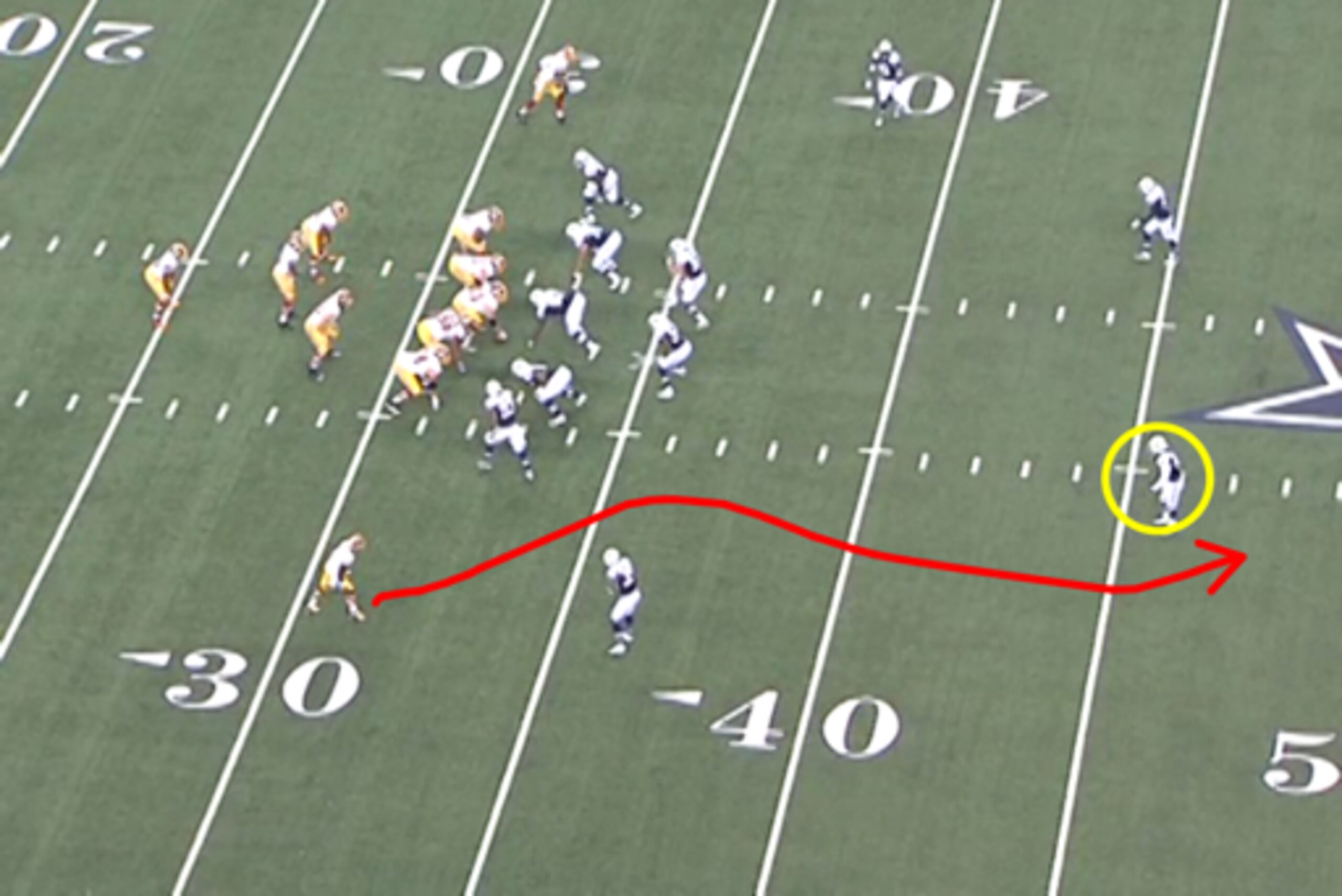
The plan was to draw at least one of the deep safeties up into the box and release burner Aldrick Robinson behind the coverage on a post pattern.
The way to bring the safety down was to fake a run by Morris. He had been running well, as he so often does, so the Cowboys had to respect the threat.
Griffin's convincing, option-style play fake, jamming the ball into Morris' gut, really sold the idea of run. That deception turned the attention of both safeties to the backfield.

It also froze both inside linebackers, preventing them from spot-dropping underneath to take away crossing routes and obscure Griffin's view of the passing lanes.
As the play developed, the safety on Robinson's side was still looking into the backfield and even taking a step down. That gave Robinson a void to attack with his tremendous speed.

From behind the line, you can see how the safety's angle and body shape were all wrong for coverage. He was leaning forward for the run, anticipating having to rotate down in force.
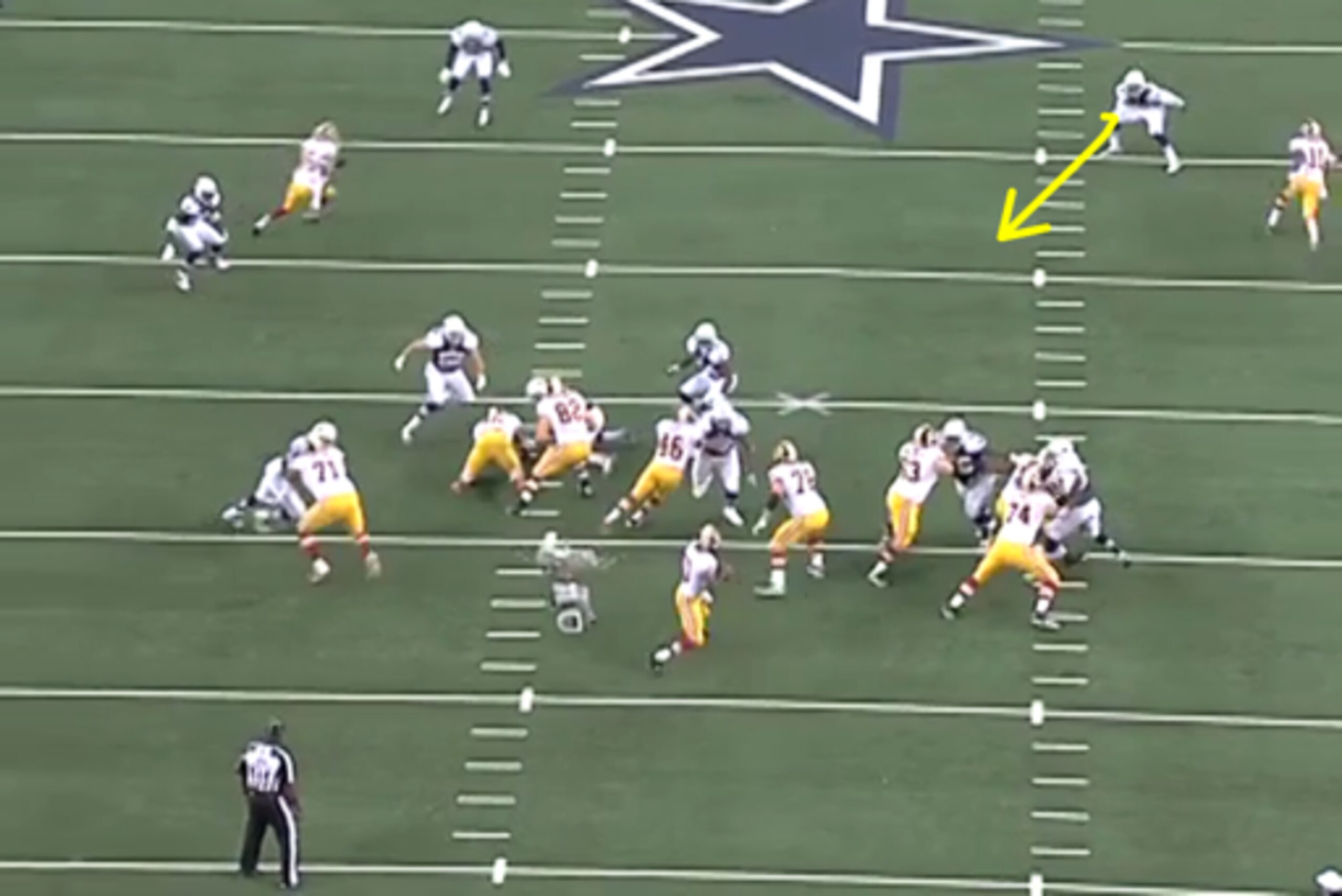
By being out of position even for a split-second, the safety gave a speedster like Robinson all the time he needed to get deep and work across the field.
Notice how wide open Robinson was on this simple, yet superbly executed 68-yard touchdown strike.
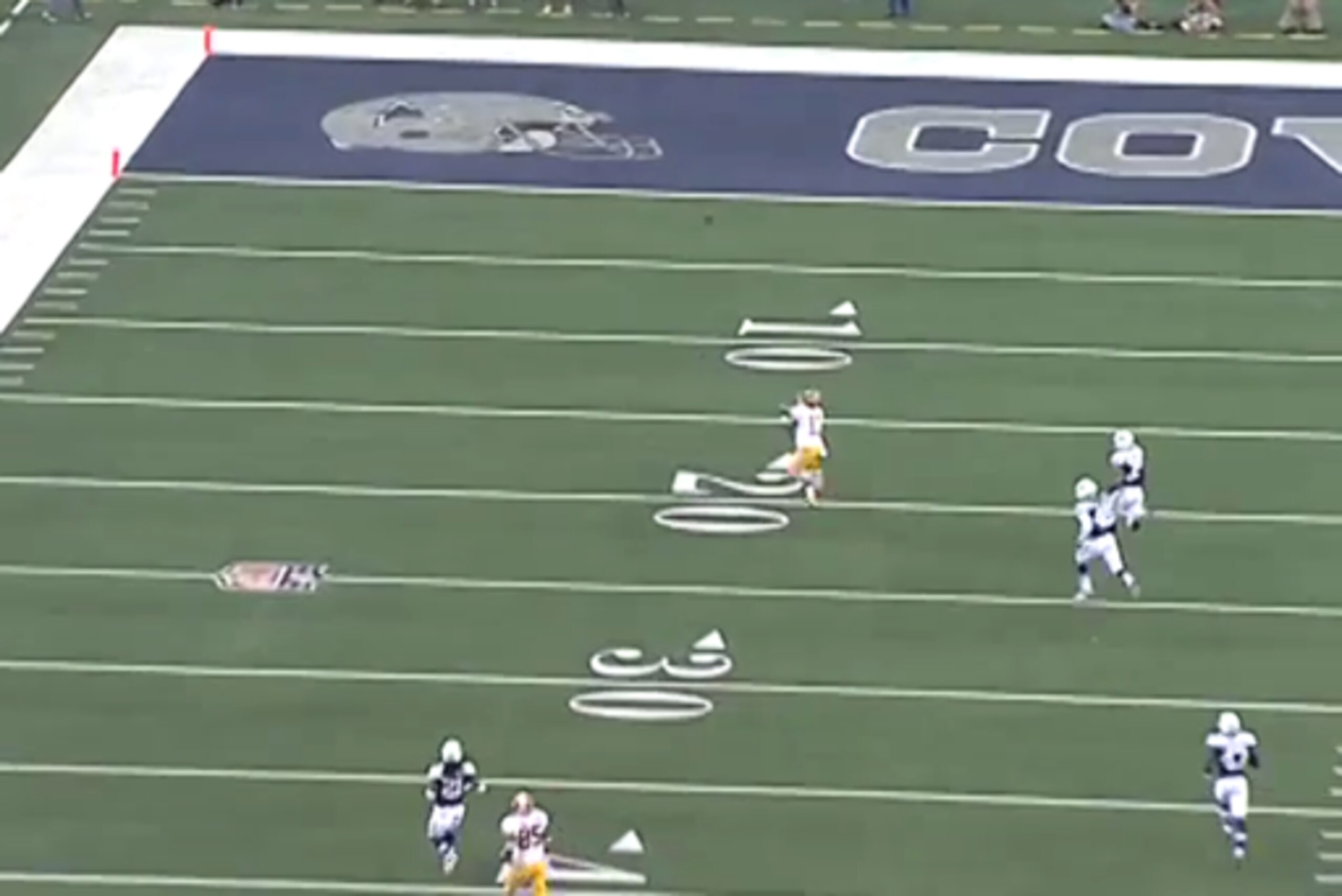
That was a play entirely indebted to the success and threat of the run. But as much as Morris created it, Griffin was able to carry it out because it played to his core strengths, the play-action fake and the deep ball.
Gruden must know the value of this ground game, particularly against soft zone coverage of the variety the Texans deployed in Week 1. Consistent running will always draw the attention of a deep safety eventually.
Any two-deep look is vulnerable to the run because of the depth of the safety pairing. So Cover 2 safeties often overcompensate by gambling on a run and taking early steps toward the line post-snap.
That leaves the scheme wide open to the kind of vertical strikes that have to be a staple of this season's passing game. Of course, a wily coordinator like Houston's Romeo Crennel might be willing to surrender the run if it means never giving away the deep pass.
But not every opponent will be so willing to make that compromise. Sooner or later, a play-caller will break up a deep safety shell. That will leave at least one of Garcon, Jackson and Roberts in single coverage.
Griffin needs his new head coach to trust his arm and expand the route concepts accordingly. He needs fewer short passes designed not to lose games, rather than win them.
Instead, healthier doses of the running game and the play-action pass will help dictate what coverages Griffin sees. That's the best way to make the game easier for the young quarterback.

Once that happens, Griffin can work on making better reads underneath, where there should be more room to work if the deep game is also utilized.
Griffin is at a delicate crossroads in his career, and that's something that makes things tough on Gruden as a play-caller. Griffin needs to refine his overall mechanics. But he doesn't need to be reinvented from the ground up.
Wedging this option-style, big-play quarterback into the pocket could be a very uncomfortable process. It might end up looking a lot like Gruden forcing a schematic preference on a player, rather than tailoring a system to suit individual talent.
The first glimpse of Griffin in Gruden's offense proved a tough watch.
It didn't look as though Gruden wasn't gently guiding Griffin through the door to pro-style, pocket passing as much as he was dragging him through it kicking and screaming.
All statistics via NFL.com, unless otherwise stated.
All screen shots courtesy of Fox Sports and NFL.com Game Pass.
.jpg?w=2560 "Rams Camp Football")